60,000 words, Rediscover Hong Kong
Hong Kong now has its own five-year plan.
On September 16, the *First Five-Year Plan for Economic and Social Development of the Hong Kong Special Administrative Region (2026–2030)* (abbreviated as the "Five-Year Plan") and the 2026 Policy Address (abbreviated as the "Policy Address") were jointly released. The full text of the Five-Year Plan is about 60,000 words, and the total length of the two documents exceeds 100,000 words, which respectively lay out the blueprint for Hong Kong's economic and social development in the next five years, and the annual governance priorities to support the implementation of the plan.
"Hong Kong's first Five-Year Plan is of great significance. It is not only an action arrangement for Hong Kong to better seize the dual overlapping advantages of national and international opportunities, but also a continuous path to improve public well-being." John Lee Ka-chiu, Chief Executive of the Hong Kong Special Administrative Region, stated that through the Five-Year Plan, Hong Kong will become a more attractive, vibrant and opportunity-filled international metropolis in the world.
(Source: Official website of the Hong Kong Special Administrative Region)
What exactly does this long document cover? What changes will Hong Kong see in the next five years, and how will these changes affect ordinary people? We have sorted out five notable highlights from the plan with the help of AI.
01
No explicit "five-year GDP target"
In the "key objectives" section at the beginning of the Five-Year Plan, Hong Kong puts "consolidating and elevating the 'four centers and one hub'" in the first place.
This is the strategic positioning granted to Hong Kong by the outline of the national "15th Five-Year Plan", that is, to consolidate Hong Kong's status as an international financial, shipping and trade center and international aviation hub, accelerate the development of an international innovation and technology center, and build an international hub for gathering high-end talents.
However, this Five-Year Plan of Hong Kong does not give a specific number for "what the GDP will reach in 2030".
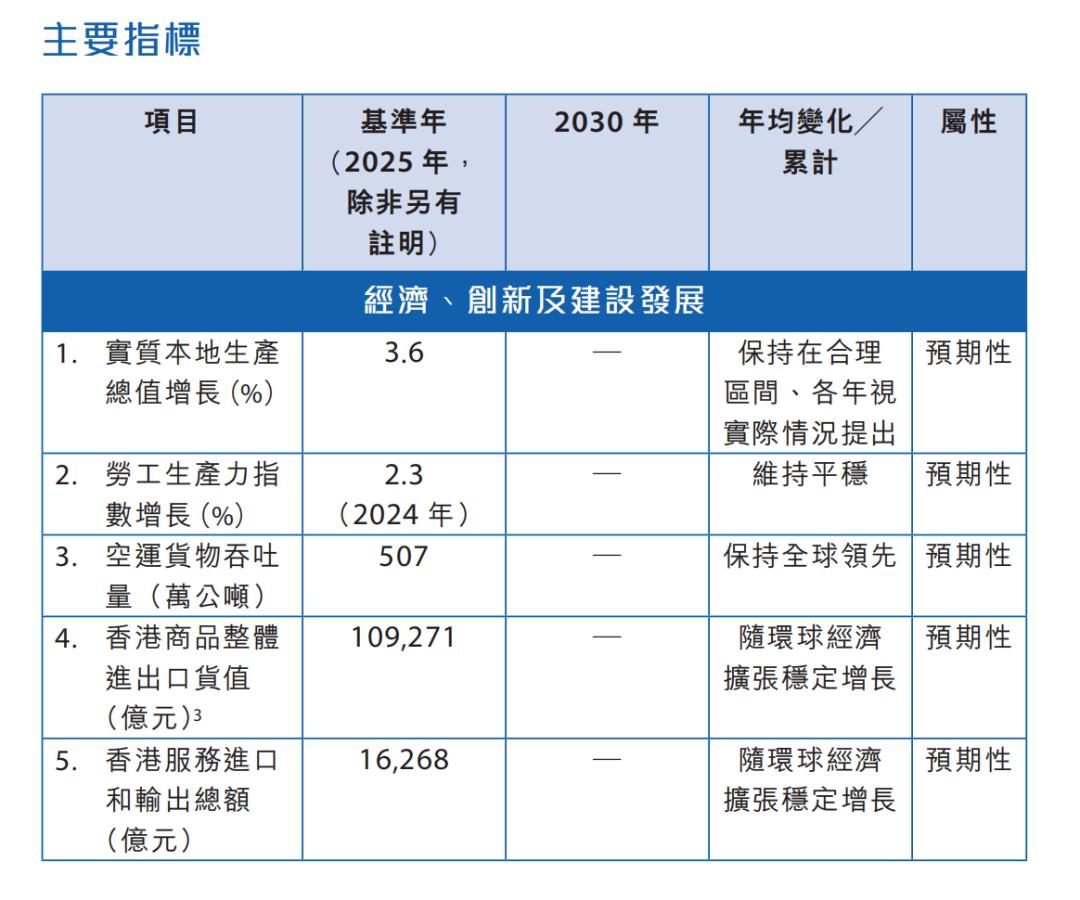
Key indicators of Hong Kong's Five-Year Plan (Source: Official document)
But a careful look at the document shows that this does not mean Hong Kong does not care about economic growth.
The first economic indicator listed in the plan is still the growth of real Gross Domestic Product (GDP). The benchmark value in 2025 is 3.6%, and the expression for future development goals is "maintaining in a reasonable range, and proposing specific targets according to the actual situation of each year".
The Policy Address notes: "In the previous four years, Hong Kong's economy reversed from a negative growth of 3.7% to a positive growth of 3.6% last year, and recorded a year-on-year growth of 5.1% in the first half of this year, marking the strongest half-year performance in nearly five years." Although the Five-Year Plan does not set a fixed cumulative GDP growth rate, it puts more indicators that can directly reflect the changes of economic structure in the foreground.
For example, Hong Kong aims to raise the proportion of total expenditure on local innovation activities in GDP from 1.63% in 2024 to 3% after 2030;
The proportion of value-added of manufacturing and new-type industries in GDP will rise from 3.8% in 2024 to 5.5% after 2030, with an average annual growth of related value-added of about 10%.
Putting these figures together, they better illustrate what Hong Kong wants to change than a vague GDP growth target: it does not simply pursue the growth of total economic volume, but hopes to change the source of economic growth.
There are also corresponding indicators in the livelihood sector.
According to the plan, the median monthly employment income of employed people in Hong Kong in 2025 is HK$22,200. No specific figure is given for the next five years, but the goal of "keeping pace with the trend of economic growth" is put forward; medical services will also be improved, with the plan to increase the number of doctors per thousand population from 2.25 to 2.43.
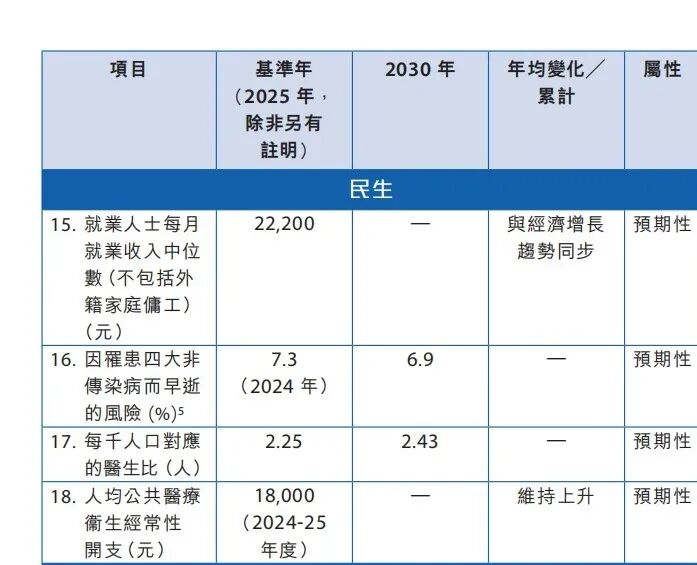
Key indicators of Hong Kong's Five-Year Plan (Source: Official document)
This may be an entry point to understand Hong Kong's first Five-Year Plan.
The plan acknowledges at the very beginning that "as a highly outward-oriented economy, Hong Kong is extremely vulnerable to changes in the international environment. There is also room for optimization in Hong Kong's own economic structure, and the task of transforming old and new development drivers is arduous." At the same time, the new round of technological revolution represented by AI is spawning new industries and business models.
Therefore, what this plan really tries to answer is what Hong Kong relies on to generate new GDP in the next five years.
The answer points to innovation technology, new-type industries, talents, and new businesses of the financial industry itself.
02
Solving the problem of low-quality "subdivided units"
Hong Kong's housing problem has long attracted widespread attention. The Five-Year Plan has a clearer elaboration on "where ordinary people live".
The plan proposes that the housing supply plan for the next ten years will be based on the proportion of 40% public rental housing, 30% subsidized sale flats and 30% private residential properties, so as to form a multi-level housing supply system.
Public rental housing is similar to public housing in the Chinese mainland, with rent significantly lower than the market level, which mainly meets the basic housing needs of low- and middle-income families; subsidized sale flats are between public housing and commercial housing, with selling prices lower than the market level, but this type of housing usually has institutional arrangements such as resale restrictions and qualification restrictions; private residential properties refer to ordinary commercial housing.
According to official data, the current stock of housing in Hong Kong accounts for 28% public housing, 15% subsidized sale flats and 57% private residential properties. In other words, in the housing supply plan for the next ten years, the proportion of public housing and subsidized sale flats will be greatly increased.
The plan proposes that in the next five years, including Light Public Housing, the total number of public housing units to be built in Hong Kong will reach about 196,000; with the increase in supply, the average waiting time for public housing is expected to drop to 4.5 years in the 2026/27 fiscal year, and further fall below 4 years in the 2030/31 fiscal year.
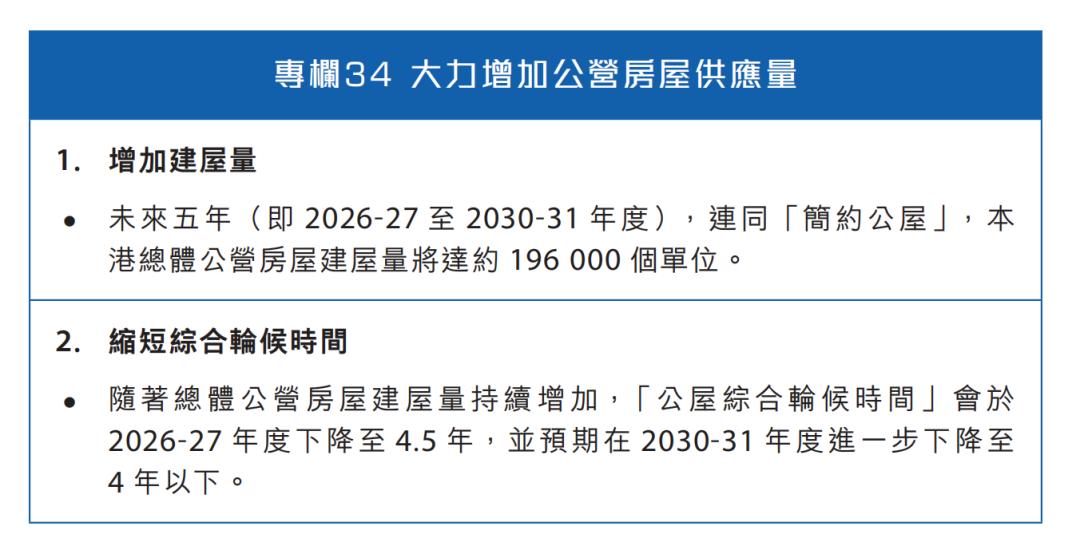
Public housing supply targets for the next five years (Source: Official document)
In the past, Hong Kong's housing problems were largely concentrated in insufficient supply, long waiting time and poor living conditions of some grassroots families.
In order to solve these problems, the Five-Year Plan proposes to basically solve the problem of low-quality "subdivided units" (housing units formed by dividing ordinary residential flats into multiple small units for rent) in residential buildings by 2030, and continue to promote the construction of Light Public Housing, with the goal of completing 30,000 Light Public Housing units by 2027.
Another change is the beginning of emphasis on housing quality.
The plan proposes that the indoor floor area of public housing completed in the next ten years will be gradually increased, the proportion of larger units in new subsidized sale flats will also be raised, and the design of subsidized sale flats will be reviewed to adapt to the lifestyle of the younger generation.
It is worth noting that in a city like Hong Kong with scarce land and high population concentration, how to tap more living resources in the next five years?
In this regard, the plan mentions that it is expected that the output of "developable land" (plots that can be directly leased and started construction) will be about 2,500 hectares in the next ten years, of which about 1,400 hectares will be produced in the next five years.
03
Attracting 100,000 non-local college students
Compared with the general expression of "attracting talents", the Five-Year Plan gives another specific figure: 100,000 non-local college students.
In the last academic year, there were 79,800 non-local students studying in locally accredited full-time post-secondary programs in Hong Kong. By the 2029/30 academic year, the plan proposes that this number will reach 100,000, representing a 25% increase in five years.
This is not just an education indicator, but is actually closely related to Hong Kong's future industrial structure.
The Five-Year Plan proposes that Hong Kong should build an international innovation and technology center, and build an international hub for gathering high-end talents, and attract more non-local students to study in Hong Kong, as well as top global talents and innovation teams to settle in Hong Kong by expanding high-quality higher education.
This means that the function of universities in Hong Kong's future development is becoming more and more complex. Higher education is increasingly becoming an entry point connecting talents, scientific research and industries.
As the Northern Metropolis that will carry a large number of educational resources in the future, the changes will be particularly obvious.
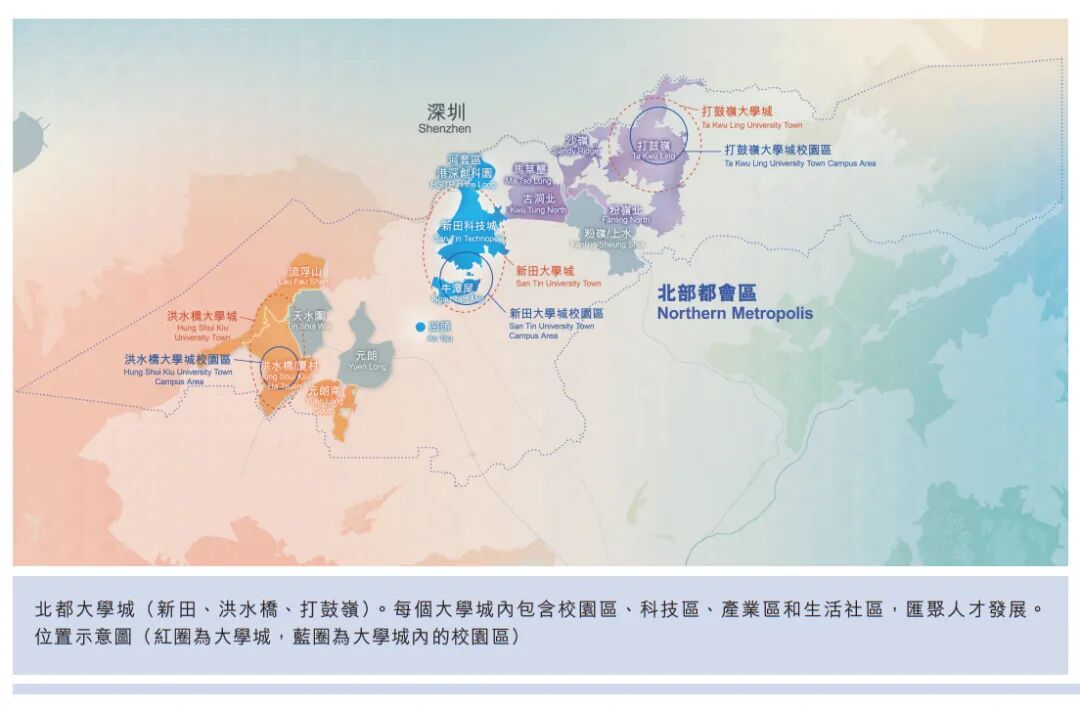
Planning of the Northern University Town (Source: Official document)
The plan proposes to promote the infrastructure construction of the San Tin University Town in the next five years, start the construction of the School of Medicine of the Hong Kong University of Science and Technology and the comprehensive medical research and teaching hospital, and at the same time link with the San Tin Technopark and the Hong Kong Park of the Hetao Shenzhen-Hong Kong Science and Technology Innovation Cooperation Zone, support Hong Kong's universities to cooperate with well-known universities and scientific research institutions at home and abroad to build scientific research facilities such as joint laboratories.
The Hung Shui Kiu University Town is given a clearer industrial positioning: focusing on application-oriented post-secondary education for intelligent manufacturing and cultivation of international talents, and at the same time deploying intelligent manufacturing industrial parks, enterprise and science parks, digital technology hubs, microelectronics R&D facilities and advanced construction industry industrial parks.
From this perspective, attracting 100,000 non-local college students is Hong Kong's attempt to retain both talents and industries through universities. It can be said that this is a link in the "talent - technology - industry" chain of the entire Five-Year Plan.
04
Increasing investment in manufacturing and new-type industries
If you look for one of the most noteworthy changes in this plan, "manufacturing" may be one of them.
For a long time, the most well-known industries in Hong Kong are finance, trade, shipping and professional services, and manufacturing has rarely become the core keyword for the outside world to understand Hong Kong's economy. But in this Five-Year Plan, "manufacturing and new-type industries" are directly included in the main economic indicators.
In 2024, the value-added of Hong Kong's manufacturing and new-type industries accounted for 3.8% of GDP. The plan proposes to strive to reach 5.5% after 2030, with an average annual growth of value-added of about 10% in the future.
It is not limited to traditional manufacturing. The plan focuses on key core technologies such as life health, artificial intelligence and robotics, microelectronics, new energy, as well as advanced manufacturing and new materials; at the same time, it deploys national and regional major scientific research platforms, strengthens the research on key core technologies, and introduces and supports related enterprises to develop in Hong Kong.
The Five-Year Plan also proposes to build a "Global Advanced Manufacturing Excellence Center" to promote the development of artificial intelligence in manufacturing, robotics, new energy, industrial design and other fields.
Therefore, for Hong Kong, it does not intend to follow the path of traditional manufacturing cities again, but hopes to use its existing scientific research, finance, professional services and international capabilities to enter the links behind manufacturing such as R&D, design, technology transformation, financing and access to the international market.
05
The new growth point may be in the Northern Metropolis adjacent to Shenzhen
The previous sections have mentioned that Hong Kong needs new housing and more talents; universities need to expand and scientific research needs to develop; manufacturing and new-type industries need new industrial space.
So, where will all these people, industries, universities and scientific research institutions be placed in the future?
The answer is clear: the Northern Metropolis.
The Northern Metropolis is positioned as a new engine for Hong Kong to develop new quality productive forces, and also a main platform for Hong Kong to deeply participate in the construction of the Guangdong-Hong Kong-Macao Greater Bay Area and actively integrate into and serve the overall national development.
The development of the Northern Metropolis will take the Northern Metropolis University Town, innovation and technology, industries and livable, business-friendly and tourist-friendly environment as the goals. The SAR government adopts the development concept of "one city with five elements", namely education, technology, industry, talent and urban construction, to build three university towns in San Tin, Hung Shui Kiu and Ta Kwu Ling, each of which includes campus area, technology area, industrial area and living community.
The leading industries of the three university towns are slightly different:
The San Tin University Town will be positioned to develop medicine, life health technology, artificial intelligence, robotics, microelectronics and emerging industries, and become the core area for the development of Hong Kong's innovation and technology industry in the future;
The Hung Shui Kiu University Town will be positioned as an application-oriented post-secondary education center for intelligent manufacturing and an international talent cultivation center to develop diverse industries;
The Ta Kwu Ling University Town will integrate art and blue-green development elements, and reserve strategic development space to support the development needs of different industries in the future.