Morgan Stanley has substantially raised the valuation of Tesla Semi, and the Robotruck software subscription service has opened up a hundred-billion-dollar market space.
On the software subscription model of Robotruck, Chinese enterprises including DeepWay have already started relevant practices.
According to information from IPO Early Knowledge, Tesla officially launched the European version of the Semi electric heavy truck a few days ago, and confirmed that it will start delivering to customers in 2027. According to official introduction, the Semi has a maximum range of 550 kilometers at full load, energy consumption of about 1 kWh per kilometer, a maximum total train weight of 40 tons, and a curb weight of 9100 kilograms.
It is worth noting that after the release of the Semi electric heavy truck, Morgan Stanley immediately released a research report on Tesla.
Morgan Stanley pointed out in the research report that the debut of Tesla Semi is changing the profit landscape of freight carriers — the competitiveness of Semi lies not only in the fuel cost advantage brought by electrification, but also in the transport capacity reconstruction empowered by autonomous driving technology. Tesla's competitive advantage is not only that it manufactures electric vehicles, but also its status as a leader in "Physical AI", which enables it to obtain considerable recurring revenue through the software subscription model, instead of relying solely on hardware sales.
At the same time, Morgan Stanley regards Tesla as a "credible emerging competitor" in the autonomous truck sector, and raised its bull case valuation for network services. Looking at the Semi truck opportunity alone, Morgan Stanley analysts estimate that its value can reach $20 per share, equivalent to a market value of about $80 billion.
The essence of Semi's business model is "vehicle + continuous software services", and the growth potential of autonomous truck software revenue is higher than that of passenger car FSD
Compared with the mass production and delivery scale, Morgan Stanley pays more attention to the autonomous driving and software charging capability of Semi — which is the key to truly determining its commercial value.
On the one hand, compared with human-driven electric trucks, the cost per mile of autonomous electric trucks has dropped by 20% from $2.67 to $2.13. Among them, labor costs ($1.21 per mile) are completely eliminated in the autonomous driving mode. In terms of utilization rate, human-driven trucks travel about 92,400 effective miles per year, while autonomous trucks can reach 215,210 miles, with the utilization rate increased by 2.33 times, mainly because autonomous driving can achieve 22 hours of operation per day, while human driving is limited by regulations to only 11 hours. Under the caliber including sales, general and administrative expenses, the annual profit of each autonomous truck jumps from $31,000 to $189,000, with a profit margin of 29%, a significant expansion compared to the 11% of human-driven trucks.
In short, autonomous driving can significantly improve the operational efficiency and per-vehicle profit of electric trucks.
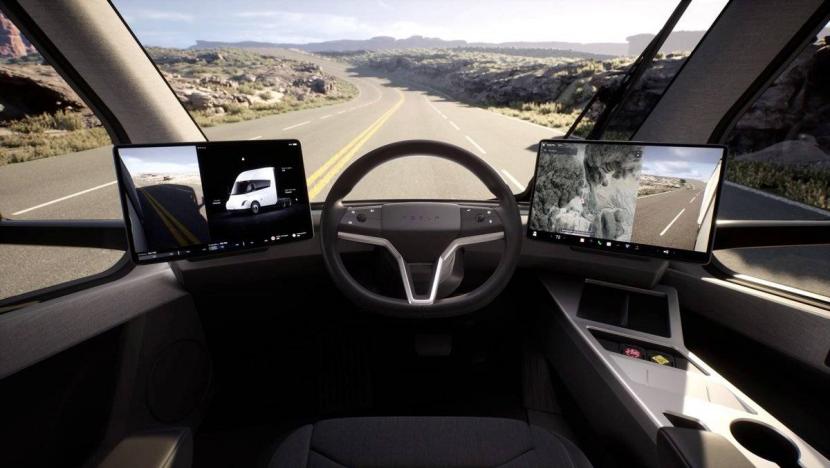
On the other hand, what is more noteworthy is that autonomous driving transforms the Semi electric heavy truck from a low-margin transport equipment into a high-utilization, high-margin software charging platform. In other words, Semi's business model will be upgraded from "selling vehicles" to "vehicles + continuous software services".
Morgan Stanley expects that Tesla is expected to charge an autonomous driving software subscription fee of $0.85 to $1.00 per mile for Semi. Calculated based on 18,000 miles traveled per month, each Semi can generate about $12,000 to $18,000 in software revenue per month.
Here we can make a comparison: the FSD subscription fee for passenger cars is about $100 per month. This shows that the monthly software revenue of one autonomous Semi is equivalent to the FSD revenue of about 120-180 passenger cars. The reason behind this is that heavy trucks travel about 18,000 miles per month on average, which is much higher than private vehicles, and charging by mile can fully convert this usage difference.
In the base case scenario, Morgan Stanley assumes that by 2040, about 82,000 Tesla Semis will be put into operation, accounting for about 13.5% of the addressable market share of autonomous trucks in the United States. Semi's software revenue will be about $17 billion to $17.3 billion (note: all are estimates of software and service revenue, excluding Semi's total vehicle sales revenue, Tesla's charging infrastructure revenue, and potential energy or fleet service revenue), corresponding to incremental EBIT of about $7.5 billion to $8 billion, with an implied EBIT margin of about 44% for the software business.
Based on the above logics, Morgan Stanley is highly optimistic about Tesla's long-term investment value after the launch of Semi.
82,000 Semis are a "conservative assumption" with considerable revenue expectations, the long-term growth space of the Robotruck track is seriously underestimated
It should be pointed out here that 82,000 units are only Morgan Stanley's "conservative forecast", and Morgan Stanley analysts clearly wrote in the report: "Tesla's initial manufacturing target is 50,000 Semi trucks per year, so we believe that assuming a total deployment of 80,000 units in the next 15 years is a conservative starting point."
Even measured only by the relatively conservative deployment scale of 82,000 units, Semi is expected to contribute about $17 billion in software subscription revenue. Morgan Stanley predicts that in the bull case scenario, Semi's software subscription revenue will reach about $34.4 billion in 2040, doubling that of the base case scenario.
More importantly, this is only the caliber of Tesla's single model and only counting software subscription revenue; if all revenues from more global players, more models, as well as hardware sales, technology licensing and unmanned transport services are included, the real growth space of the Robotruck track may be far broader than institutions currently predict.
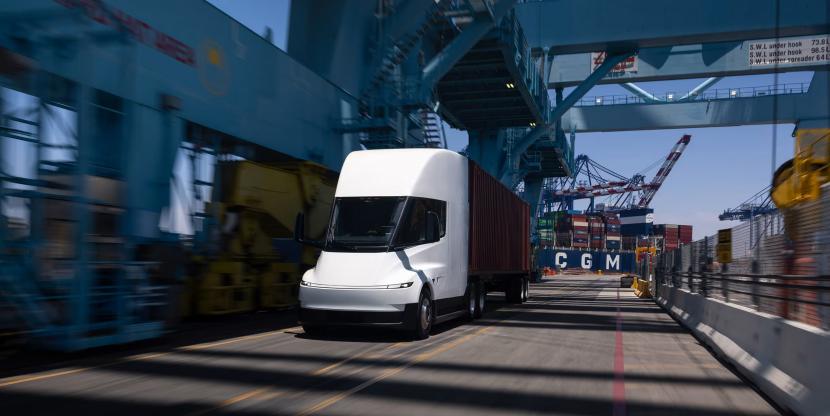
Multiple structural forces are simultaneously driving the accelerated explosion of the global Robotruck market. In terms of fuel costs, international geopolitical conflicts have led to tight diesel supply, and diesel prices have generally risen in many regions. At present, the average price of diesel in the United States has exceeded the $6 per gallon mark, rising by more than 63% compared with the same period in 2025. High oil prices have increased the operating costs of traditional fuel heavy trucks, pushing the freight industry to transform to lower-cost clean energy.
In terms of labor costs, the freight industry has long faced a labor shortage problem. A report released by the International Road Transport Union (IRU) shows that there are about 2.9 million truck driver vacancies in 18 major freight markets around the world, accounting for 11% of the industry's labor force. China is also facing a structural shortage: among the 38 million truck drivers, drivers aged 36 to 55 account for 84.38%, the proportion of drivers under 35 has dropped significantly, and the truck driver gap is as high as 10 million.
Multiple cost pressures are transforming autonomous trucks from a "technical option" to an "economic necessity". Goldman Sachs predicts that the global autonomous truck market size will reach about $5600 billion in 2035, with corresponding gross profit exceeding $1350 billion. Policies are also being relaxed at an accelerated pace: China has included L3 and L4 level cargo vehicles in the unified management system, and California in the United States has officially lifted the ban on autonomous operation of heavy vehicles.
Obviously, in the wave of global freight transformation and upgrading, Tesla Semi is transforming heavy trucks from low-margin transport equipment into high-margin, recurring revenue software charging platforms.
The only Robotruck enterprise that can directly benchmark Tesla Semi, DeepWay has made more leading progress in multiple dimensions
It is worth mentioning that the subscription model of Robotruck is not actually pioneered by Tesla. DeepWay, which is sprinting for the "first Robotruck stock", has already taken the lead in running through the L2 intelligent driving subscription model.
As of April 2026, DeepWay has delivered 13,707 new energy heavy trucks, with a cumulative delivery of over 9,000 L2 intelligent heavy trucks, and the subscription rate has exceeded 30%. As of September 2026, the cumulative operating mileage of L2 has approached 500 million kilometers.
Public information shows that DeepWay's L4 fleet has completed the unmanned test with the rear vehicle's main driver being unmanned in Inner Mongolia, and it is expected to realize the commercial operation of rear vehicle unmanned driving by the end of the year; in addition, DeepWay's L4 single vehicle is undergoing continuous tests on the Beijing-Tianjin-Tanggu Expressway and Hefei urban roads, and recently completed the industry's first L4 level new energy heavy truck road test in cooperation with STO Express.
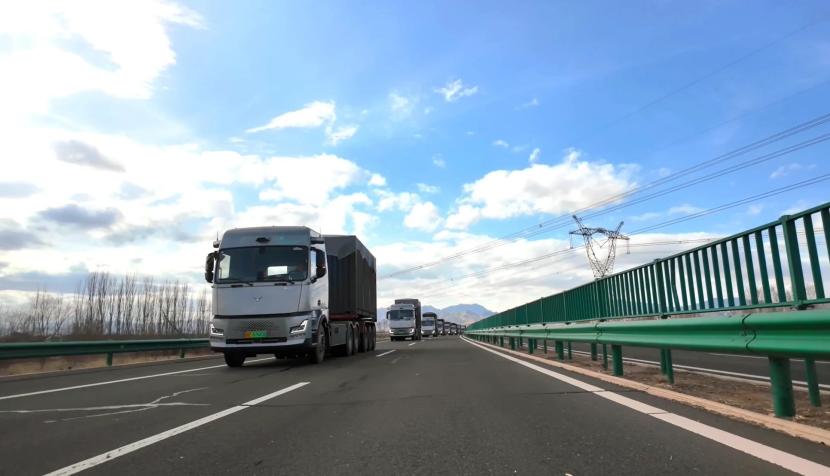
In DeepWay's vision, its Robotruck commercialization path is divided into three stages:
The first stage is to build a native intelligent heavy truck platform through forward definition, realize large-scale mass production and delivery, and complete the layout of hardware entrances.
The second stage is to promote the large-scale release of L2 subscriptions on the basis of large-scale delivery, simultaneously advance the commercial pilot of L4 fleets, drive the rapid growth of software subscription revenue, and form continuous, high-margin recurring revenue.
The third stage is to establish a Robotruck transport service network, enter the $3.9 trillion global road freight market, further extend from "vehicle sales + subscription" to transport capacity service revenue, and open up a larger value space.
To a certain extent, DeepWay is currently the only Robotruck enterprise that can directly benchmark Tesla Semi, and even has more leading progress in mass production delivery and business model exploration.
In the longer term, just like Tesla Semi, "vehicle sales" is one of the fundamentals of DeepWay, but "vehicle sales" is only one-time revenue. What is more important is the continuous revenue brought by software subscriptions and transport capacity services, and vehicles can be regarded as the foundation for continuously obtaining revenue from intelligent driving technology.
The global freight market is ushering in structural transformation, and the Robotruck track has also moved from conceptual assumption to the period of commercial realization. Morgan Stanley's calculation of up to $34.4 billion in software revenue for Tesla Semi further confirms the potential of this track: whoever takes the lead in running through the closed loop of "hardware delivery + software subscription" can convert one-time vehicle sales revenue into continuous, high-margin recurring cash flow, and then seize the market dividend of hundreds of billions of dollars.
This article is from the WeChat official account "IPO Early Knowledge" (ID: ipozaozhidao), author: Stone Jin, published with authorization from 36Kr.