Why did Publicis secure Pepsi's $1.7 billion business without a competitive pitch?
In early September 2026, Coca-Cola originally planned to bring the senior executives of two shortlisted agencies together in Mexico City to enter the next round of its global media pitch.
The conference room was booked, but not all attendees showed up. Only WPP, one of the two scheduled agencies, arrived, while the other did not appear. It went elsewhere to sign a contract, securing a $1.7 billion account from its rival.
On September 2, PepsiCo announced that it had entrusted Publicis Groupe with its global media, data and technology business, covering more than 200 markets, with brands including Pepsi, Gatorade and Lay's, under an operation model called One PepsiCo.
According to most industry media estimates, this contract is worth about 1.7 billion US dollars. The key point is that Publicis Groupe obtained such a huge order without going through a pitching process.
Moreover, this is far from the first time that Publicis Groupe has won large clients in a similar way.
In April this year, Microsoft entrusted its global media business to Publicis Groupe without the traditional pitching process. In September, it was reported that LVMH also transferred its Asia-Pacific media business to Publicis Groupe without a formal pitch.
Earlier, similar situations occurred with some of Paramount's media business and B&Q's creative business.
Pitching used to be almost a rite of passage in the PR and advertising industry: conference rooms, proposal books, and plans revised all night to the final version, which is exactly the scenario depicted in the American TV series *Mad Men*.
Nowadays, Publicis Groupe has won multiple large orders without going through pitching.
A single case can be attributed to special circumstances, but when this happens one after another, it is worth asking: what exactly did Publicis Groupe do right?

01 Before the Pitching Stage, Clients Have Already Recognized Publicis Groupe's Capabilities
For unfamiliar agencies, proposals help clients quickly understand them: what projects they have done, how they understand the business, and what team they plan to assign, all of which need to be presented in a concentrated manner.
But if the two parties have already cooperated, the client has another set of reference materials.
PepsiCo was already a client of Publicis Groupe, which had been serving its businesses in China, India, South Korea, Indonesia, the Philippines, Thailand, Vietnam, Malaysia and some Eastern European markets.
When Publicis Groupe won the PepsiCo China account in 2022, it still went through a competitive pitch. For that, Publicis Groupe built a dedicated team called PLUS+ by Publicis. Four years later, the same set of capabilities was directly applied to the global business scope, with the process replaced by capability review.
The premise that a capability review can work is that the capabilities being audited have been proven to be effective. This means that who will eventually get the $1.7 billion account may have been determined very early.
The situation of LVMH is similar. Publicis Groupe was previously responsible for most of LVMH's North American media business, and this appointment expands the cooperation to the Asia-Pacific region. Microsoft and Publicis Groupe also have a long-term technical cooperation foundation.
These backgrounds provide a reasonable explanation: large clients have the opportunity to judge whether an agency can take on greater responsibilities through existing projects.
Especially for multinational enterprises, cooperation in one region can be a reference for selecting suppliers in other regions. Teams that have already delivered projects, systems that have been put into use, and familiar management methods can all reduce the cost of getting to know a company from scratch.
Of course, this cannot explain everything. Omnicom has also cooperated with PepsiCo for many years, but the long-term relationship did not prevent the client from transferring its business, and Publicis Groupe took the business away from Omnicom.
What clients are really comparing is which party is more suitable for the work in the next stage.
Therefore, to figure out Publicis Groupe's advantages, we need to further explore what PepsiCo wants to do next, and why these demands give Publicis Groupe more room for cooperation?

02 Publicis Groupe Has Expanded the Value of What Clients Need to Purchase
According to Marketing Dive, PepsiCo hopes to connect media strategy, planning, execution, data, identity recognition and technology across all markets to build a unified One PepsiCo media operation model.
A multinational brand may face media teams in different regions, delivery systems for different channels, and data provided by different suppliers at the same time.
All parties can submit a report, but the enterprise still needs to spend time figuring out whether these reports can be integrated, how to adjust the budget, and who to hold responsible when problems arise.
We can imagine the situation faced by a marketing leader: the creative team explains why the content is attractive, the media team explains why the reach is effective, and the e-commerce team explains why the sales do not keep up.
Each link has its own indicators, but the work of coordinating all links is left to the client.
When managing these interfaces itself becomes a cost, suppliers that can deliver integrated and unified services will gain opportunities.
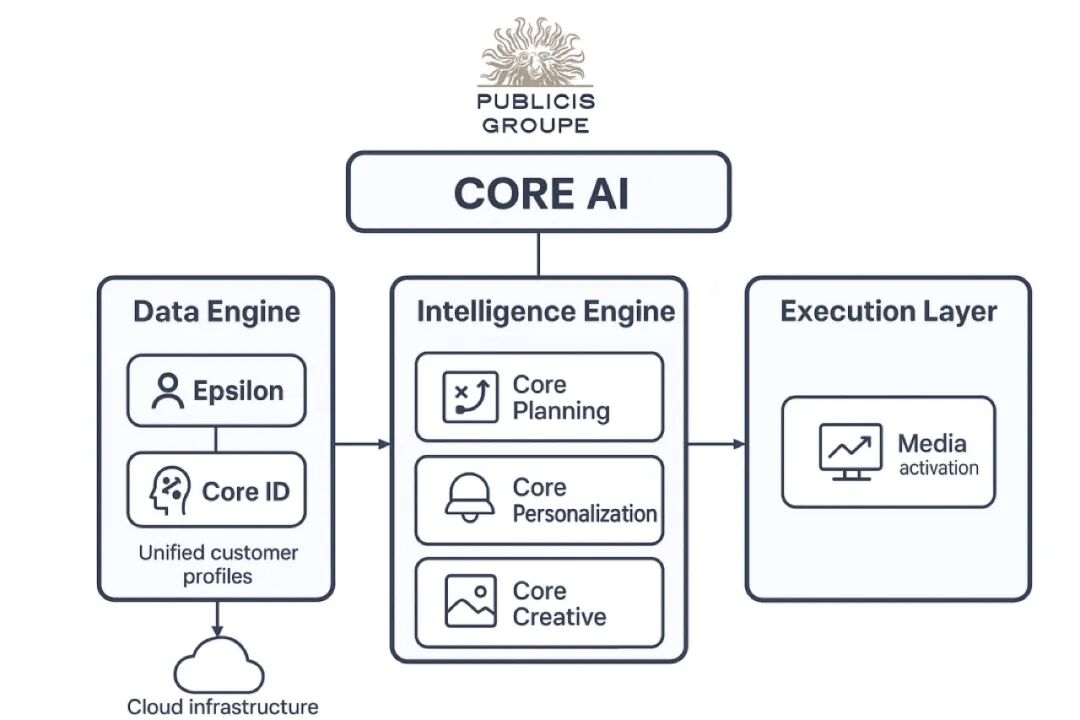
Earlier, in my article Publicis Groupe Surpasses WPP with AI to Become the World's Largest Advertising Group, I introduced Publicis Groupe's capabilities in this field.
In 2015, Publicis Groupe completed the acquisition of Sapient, bringing consulting and technical services into the group. In 2019, it announced the acquisition of data marketing company Epsilon.
By integrating data platforms, Publicis Groupe has built an end-to-end intelligent marketing system from data insight to commercial return.
With its self-owned data platform and middle-end capabilities, Publicis Groupe has mastered the right to train and iterate core algorithms, thus building a deeper moat and stronger customer stickiness in the AI-driven marketing era.
These capabilities are important weapons for Publicis Groupe to win the PepsiCo account.
There is another necessary factor to mention here — price. MediaPost cited the judgment of analysis agency Madison And Wall that price may be an important factor for PepsiCo to transfer its business. But obviously, relying on price alone is not enough to win an order without going through pitching.
03 The Competition Has Already Started Before the Pitching Stage
The industry still needs to select suppliers, but it is beginning to re-examine the selection methods.
Pitching was originally designed to reduce the risk of choosing the wrong partner. If both parties have sufficient cooperation experience, sometimes there is no need to hold a large-scale competition.
The efficiency benefit of no-pitch cooperation is built on sufficient mutual understanding.
This also has a deeper impact on agencies. In the past, receiving a pitch invitation meant getting a relatively concentrated opportunity to show capabilities: the client puts forward the demand, and several companies compete for the same task.
Now, part of the competition may happen much earlier.
Who has participated in the client's regional projects, who can solve a specific difficult problem, and whose tools have been put into daily work, all of which may affect the next appointment.
When other companies are ready to present their proposals, the client may have formed a clear judgment on one of the parties through actual cooperation.
For groups that are deeply involved in the client's business, this is conducive to expanding cooperation. For external agencies, the difficulty is more obvious, and they may not even get the opportunity to make a formal presentation.
In the past, agencies sold comparable services that had market prices, so pitching was required. Now some agencies are beginning to sell non-comparable infrastructures, and non-comparable things can only be settled through negotiation.
Whoever finally grasps the consumers' identity data will not need to go through pitching.
An increasingly important part of competition takes place before the client decides who to invite to the pitch, and also takes place in the daily delivery of services.
This article is from the WeChat official account "Xunkong's Marketing Revelation", author: Xunkong 2009, published with authorization from 36Kr.