Where did Polly English come from two years after Lingostar was delisted?
In September 2026, a teacher recruitment page labeled Lingostar was still recruiting remote English teachers. However, after clicking to apply, candidates were directly redirected to Polly English's teacher recruitment domain: teach.pollyenglish.cn.
Two years ago, Lingostar once came into the public spotlight due to a classroom incident. On September 20, 2024, the China Association for Non-Government Education issued a notice stating that after verification with the competent authorities, the involved entity was an "unqualified and non-compliant institution", and the relevant APP had been removed from shelves.
Two years on, a business chain that has not been completely broken remains between the two brands.
Two names, one integrated recruitment chain
If only the teaching materials, teacher sources and class schedules are similar, it is not sufficient to prove that there is a connection between the two brands. It is not uncommon in the online English industry to use the same teaching materials and recruit teachers from the Philippines or North America.
What is truly noteworthy is the recruitment entry itself.
A recent teacher recruitment page labeled Lingostar shows that the platform is recruiting remote ESL teachers, requiring a bachelor's degree or above, a teaching qualification or ESL certificate, and teaching experience. Teachers are required to provide at least 10 hours of classes during peak hours such as 17:00 to 21:00 Singapore time every week, and use Classpod to complete online teaching.
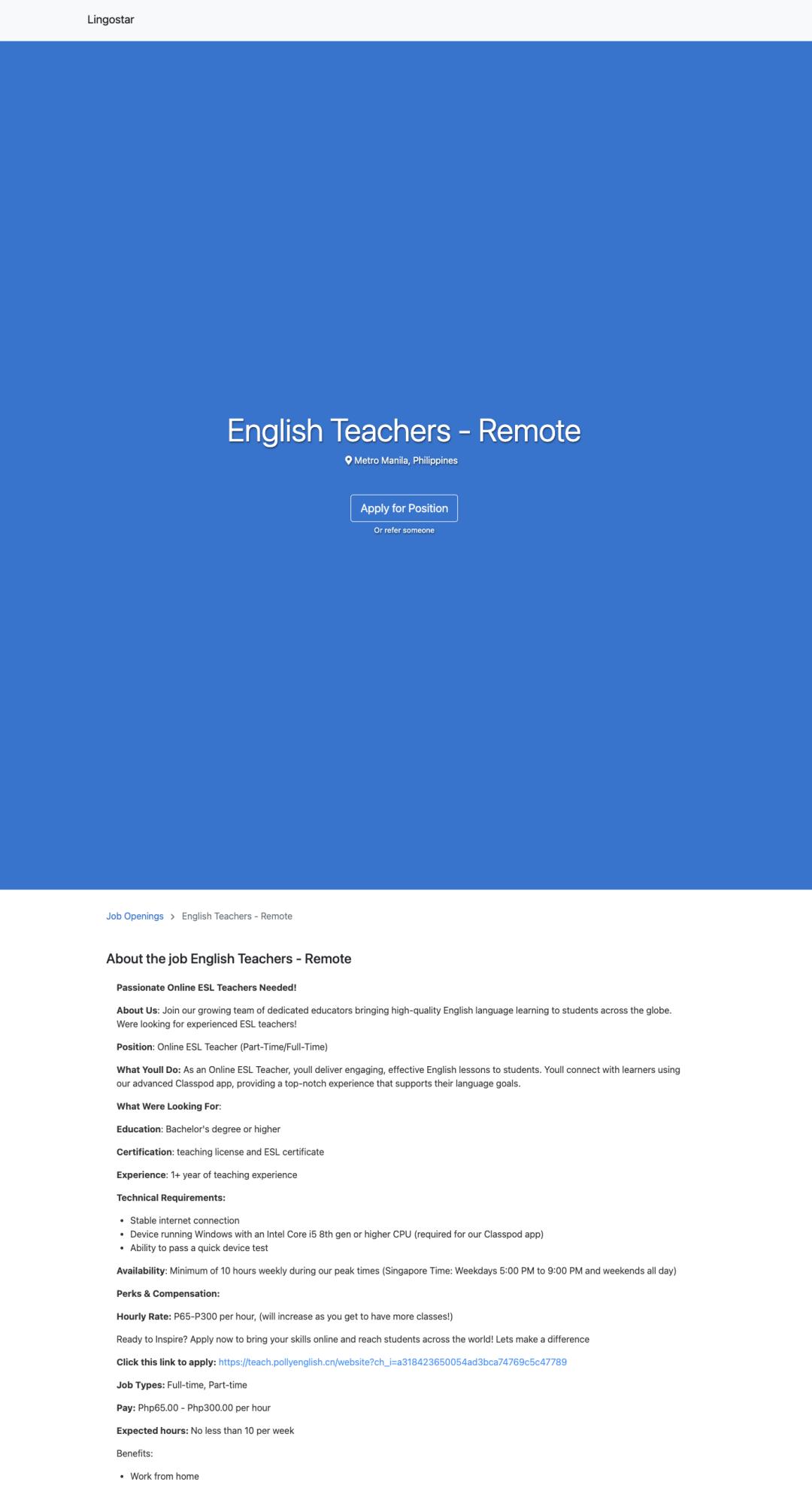
However, the application link on the page eventually points to Polly English's teacher recruitment domain.
At the same time, LITTLE MOON PTE. LTD., the Singaporean company behind Polly English, is still recruiting remote teachers in the Philippines. The job requirements for academic qualifications, teacher qualifications, teaching experience, minimum working hours and peak teaching hours are highly similar to those of Lingostar, and the teaching tools used also include Classpod.
Earlier, teacher positions labeled "Polly" also appeared directly in Lingostar's public recruitment system. One page still displays Lingostar at the top, but the main text of the position reads "Polly English is currently hiring".
Compared with "the same teaching materials", this direct connection between recruitment systems is closer to the intersection at the real business level.
This intersection can still be explained in many possible ways. The two brands may share recruitment service providers, have teacher resource cooperation, or share some technical or operation systems. But at least it can be confirmed that the two are not operating completely independently.
The reason why this connection is important is related to the timeline of 2024.
In September 2024, a foreign teacher of Lingostar made inappropriate remarks while teaching Chinese children, and subsequently clashed with the parents. Lingostar later stated that the involved teacher was in the probation period, had been dismissed and would never be rehired.
On September 20, the China Association for Non-Government Education issued a notice stating that after verification with the competent authorities, the involved entity was an "unqualified and non-compliant institution", and the relevant APP had been removed from shelves.
Less than two months later, on November 8, 2024, LITTLE MOON PTE. LTD. was established in Singapore. The developer currently shown on the App Store for PollyEnglish is exactly this company, and its early version records can be traced back to December 2024.
Since then, Polly English has entered the Chinese market as another online children's English brand.
Public recruitment information once introduced that Polly English officially entered the Chinese market in 2024, providing real-person live courses for English learners aged 6 to 12. At present, its Chinese official website is still selling one-on-one real-person foreign teacher courses, and the product side is also continuously updated.
Based solely on this chronological order, it cannot be proved that Polly English is the continuation of Lingostar. From the perspective of legal entities, LINGO STAR PTE. LTD. and LITTLE MOON PTE. LTD. are not the same company.
However, the two brands with different legal entities continue to have intersections in recruitment entries, teacher systems and teaching tools, which has gone beyond the scope of simply "similar business models".
If the two parties are only in business cooperation, then such cooperation at least involves recruitment or teacher resources; if they share some technical and operation infrastructure, it also means that there is a deeper business connection between the two brands than what is shown at the public brand level.
As for whether the original teacher, technology and operation resources have been migrated after the Lingostar-related APPs were removed from shelves in 2024, the public information is not sufficient to draw a conclusion at present.
But "two platforms that look very similar" is obviously not enough to summarize the relationship between them.
The foreign teacher incident only exposed the platform
The 2024 Lingostar incident is most easily interpreted as a teacher management accident.
A foreign teacher made inappropriate remarks in class, parents filed complaints, and the platform subsequently dismissed the teacher. From the perspective of enterprise crisis management, this is a very common logic: confirm the individual violation, and then cut off the cooperative relationship.
But the final regulatory information did not stop at the individual teacher. The statement in the notice of the China Association for Non-Government Education was "unqualified and non-compliant institution".
This means that what the incident really touched is not just "what the teacher said", but what identity the platform itself uses to provide services.
This is also the most difficult part to handle in the online foreign teacher business.
A company can standardize all teaching materials, class scheduling and classroom systems, but it is difficult to fully standardize real teachers distributed in different countries. Especially for one-on-one courses for young children, a large number of communications take place in real time between teachers and students.
Whether a teacher has a certificate is only the first layer. Teacher screening, background review, daily training, classroom sampling inspection and abnormal situation handling are what really determine whether a platform can manage a large number of teachers distributed overseas.
Lingostar's current public teacher recruitment process includes document review, equipment testing, Demo, training, as well as identity and background verification. Polly English has also established a similar teacher access process, and set up compliance requirements related to classroom content.
These mechanisms can reduce classroom risks, but cannot solve a more fundamental layer: whether the platform itself has the compliance foundation to provide such courses to specific users.
The unavoidable overseas foreign teachers
The "Double Reduction" opinions issued in 2021 have very clear regulations on overseas foreign teachers.
The Opinions on Further Reducing the Burden of Homework and After-school Training for Students in Compulsory Education issued by the General Office of the Central Committee of the Communist Party of China and the General Office of the State Council proposes that the employment of foreign personnel in China shall comply with relevant national regulations, and clearly states: "It is strictly prohibited to employ foreign personnel outside China to carry out training activities."
This regulation was later also included in the model text of the after-school training service contract for primary and secondary school students.
Five years later, this rule has not disappeared.
And one of Polly English's most important selling points at present is still real overseas teachers. Its Chinese official website publicly promotes one-on-one live courses taught by teachers from the United States and Canada, while the overseas recruitment system continues to recruit remote English teachers for locations such as the Philippines.
On the other hand, Polly English is not an overseas product completely isolated from the Chinese market.
Public recruitment information once clearly stated "officially entered the Chinese market in 2024"; the Chinese official website sells trial courses to Chinese users; domestic companies have also recruited children's English positions related to Polly English's business.
This has formed a more complex cross-border business structure after the "Double Reduction" policy: the brand and APP belong to an overseas company, the teachers are overseas, the domestic team is responsible for sales, operation or user services, and the contract, payment, teaching and after-sales may fall on different entities respectively.
When each link is taken apart, it can have a reasonable commercial explanation.
But the regulatory judgment ultimately does not depend on how many pieces the enterprise splits the organizational structure into, but on what services are actually provided to whom.
If the service targets include students in the compulsory education stage within the territory of China, and the courses have the attributes of subject training, then whether it falls within the current regulatory scope needs to be comprehensively judged in combination with the location of the students, the nature of the courses, the location of the teachers, the contract entity, the charging entity and the actual performance relationship.
This is where the issue of the connection between Polly English and Lingostar is truly important.
Public information has shown that the two brands once had intersections in the recruitment system, teacher entry and teaching tools. When Chinese parents purchase Polly English courses, which entities the signing, payment, teaching and after-sales services fall on respectively is also directly related to the actual operation structure of this business.
These facts are more important than a simple sentence like "is it a shell change".
Because brands can change, APPs can be removed from shelves, and corporate entities can also be re-established.
What really deserves to be confirmed is where the set of teacher, course, technology and operation system went after Lingostar was notified and its related APPs were removed from shelves in 2024.