Apart from Sam's Club, there are other underlying profound intentions behind Walmart's vigorous promotion of Wojixian.
In the shopping carts of young consumers, private labels of supermarkets and hypermarkets are quietly gaining ground.
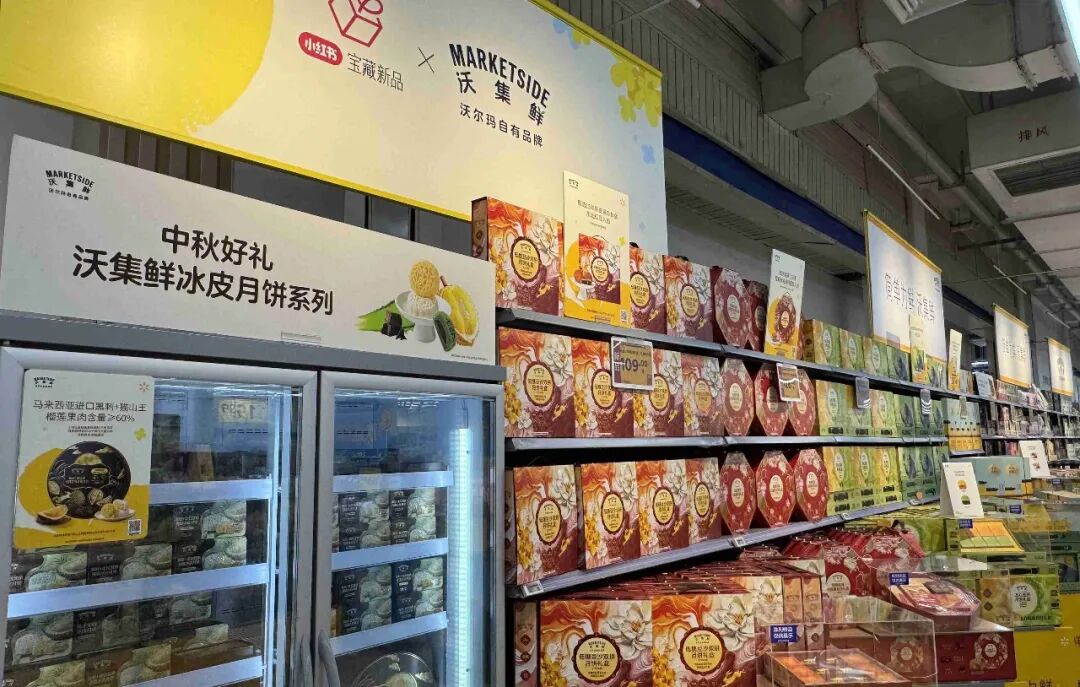
This trend is particularly evident amid the approaching 2026 Mid-Autumn Festival holiday season. Walmart's Marketside health-focused mooncakes with edible and medicinal ingredients, Hema's low-sugar Cantonese-style mooncakes, Yonghui's custom low-sugar low-GI mooncakes and other similar products have all occupied core display positions. What these products have in common is that they are not traditional mooncake brands such as Maxim's, but private labels of supermarket channels.
This is not an accidental phenomenon during the Mid-Autumn Festival period. From dairy products to baked goods, from pre-made dishes to snacks, supermarket private labels are breaking away from the stereotyped positioning of "affordable alternatives to big brands" and penetrating into all scenarios of daily consumption.
According to the definition of the Private Label Manufacturers Association (PLMA), private labels refer to goods sold under the retailer's brand, which can be either the retailer's own trade name or an independent brand exclusively created by the retailer.
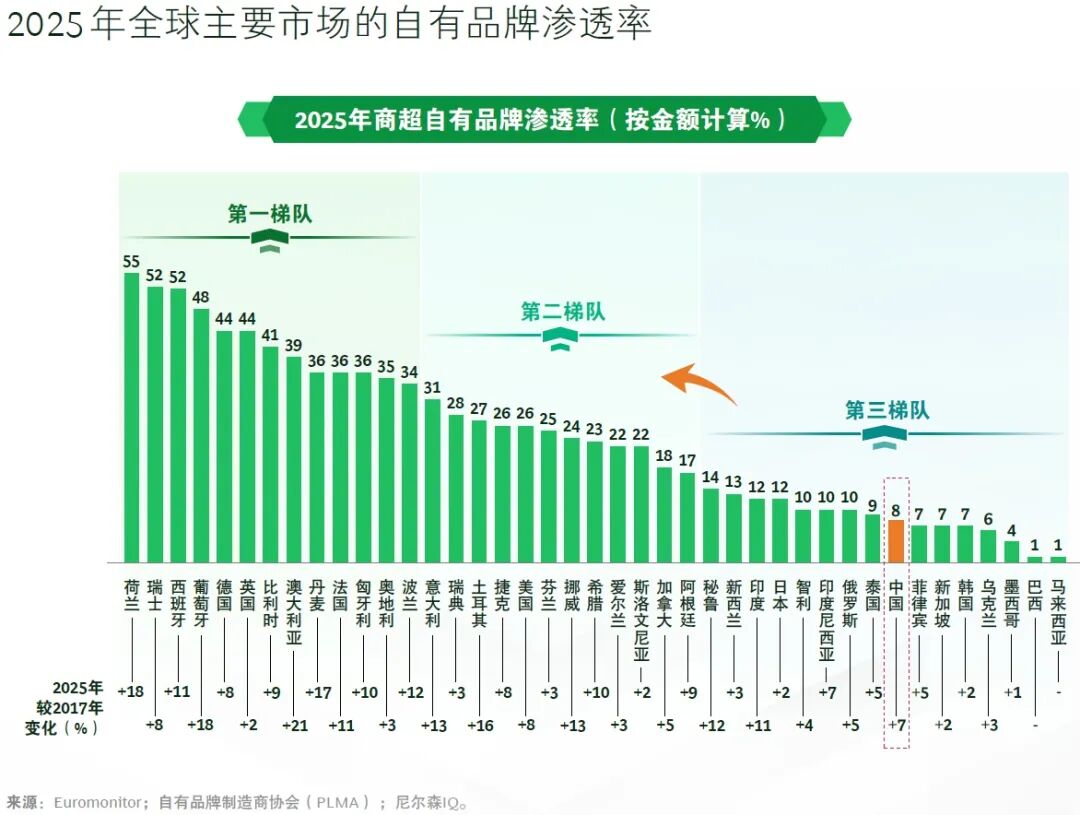
The *Inflection Point Has Arrived: 2026 China Private Label Development Report* jointly released by the China Chain Store & Franchise Association (CCFA) and Boston Consulting Group (BCG) in August 2026 shows that the proportion of people in China who are willing to buy private label products has reached 40%; however, the sales penetration rate of private labels in Chinese supermarkets and hypermarkets is only about 8% (the statistical caliber covers standardized product categories, excluding fresh food), which is still in the third echelon when referring to the global market benchmark; it is expected that by 2030, the penetration rate of private labels in China's supermarket channels is expected to rise to 20%-30%.
At this industry inflection point, the moves of global retail giant Walmart are worth examining. Walmart's financial report shows that in the quarter ended July 31, 2026, Walmart China's net sales reached 7 billion US dollars, a year-on-year increase of 20.7%; Sam's Club continued its strong growth momentum, adding 11 new stores in the past 12 months; thanks to the optimization of product category structure and the increase of private label penetration, the gross profit margin achieved growth in this quarter.
The financial report does not separately disclose the sales data of "Marketside", but this Walmart private label has already gained considerable popularity on social media. In particular, a 9.9-yuan small green bottle 4.0 pure milk often runs out of stock after going viral. Currently, it is limited to 10 bottles per purchase on the Walmart App, and its price has even been driven up to more than 20 yuan by daigou shoppers. As some of its products are similar to Sam's bestsellers, Marketside has also been labeled as the "affordable alternative to Sam's Club".
The rise of Marketside is undoubtedly driven by Walmart's strong marketing efforts. The question is, since Sam's Club has already proved the success of the warehouse membership system, why doesn't Walmart concentrate its resources on expanding Sam's Club, but instead goes back to developing private labels for the mass market? The answer is probably far more than just saving the hypermarket business. Sam's Club's growth will eventually hit a ceiling, and the continuous public opinion disputes and regulatory pressures since 2025 have also exposed the concentration risk of relying on a single business format. It is always better to take precautions before problems arise than to remedy the situation after the damage is done.
The Misunderstood Affordable Alternative
Walking into a Walmart hypermarket today, it is hard to ignore the presence of the "Marketside" brand.
As one of Walmart's global private labels, Marketside first appeared in the brand list of Walmart's financial report in 2010, focusing on cooked food and baked goods. When it entered the Chinese market in 2016, it continued the product categories and positioning in the United States. In March 2019, the Chinese name of Marketside was officially released, and its product categories were expanded to fresh commodities such as vegetables and fresh meat. In November 2025, the Marketside brand was refreshed and upgraded, with the concept of "Simplicity for Freshness", and its SKUs expanded to nearly 1,000, covering multiple core categories such as fresh food, food and beverages, which made its positioning different from its American parent brand.
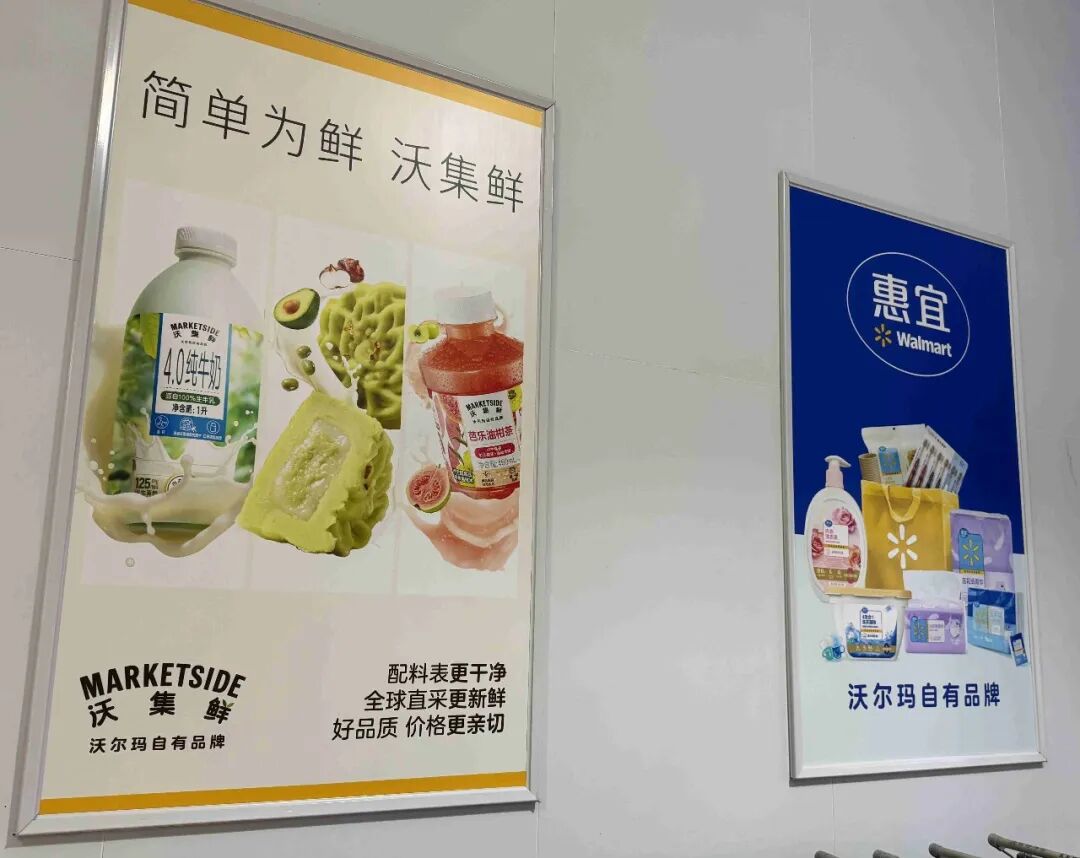
According to Heke Finance's observation, in the early stage of the brand refresh, Marketside's product development path was mostly to adjust the large-packaged bestsellers that had been verified by the market in the Sam's Club system into small packages suitable for daily consumption. Sam's Club's private label Member's Mark Swiss roll has 12 slices per box, while Marketside changed it to 6 slices per box; for lime juice, Sam's Club has two specifications of 2 bottles of 1L and 300ml×8 bottles, while Marketside offers specifications of 1L and 300ml×4 bottles.
Leveraging the popularity of Sam's Club, Marketside opened up its brand awareness, and the label of "affordable alternative to Sam's Club" on social media came into being. Some of Marketside's self-operated products share top-tier suppliers with Sam's Club, for example, Zhiweixuan manufactures nuts for both, Haitian produces soy sauce for both, and Yoplait Dairy manufactures Greek yogurt for both. These OEM manufacturers appear in the supply chains of the two brands at the same time.
However, the same supply chain origin does not mean that product standards and market positioning are identical. Take a Greek yogurt as an example: both the Member's Mark and Marketside products are produced by Yoplait Dairy, both focus on zero fat and high protein, and have a shelf life of 30 days. The Member's Mark product is skimmed yogurt, a set of 3 boxes (3*410g) totaling 1.23kg, priced at 53.9 yuan; the Marketside product is flavored fermented milk, with acacia honey given as a gift, a set of 2 boxes (2*100g) totaling 0.2kg, priced at 11.99 yuan. When converted to unit price, the unit price of Marketside is actually higher than that of Member's Mark.
The two also differ in SKU strategies. Sam's Club adheres to the "broad categories with narrow selections" principle, selecting only a single-digit number of products for each major category; Marketside provides more choices in each category, for example, there are as many as 10 SKUs of low-temperature fresh milk, the same product has different packaging specifications, and its price range is also significantly wider.
The positioning and target customer groups of the two are thus clearly distinguished. Sam's Club has an annual regular membership fee of 260 yuan as the access threshold (the premium membership fee is 680 yuan per year), and its large packages target middle-class families, suitable for stocking up a large amount of goods at one time; Marketside is more targeted at small urban families and single people, matching the immediate needs of multiple meals a day with high frequency and small quantity. It can be said that Walmart's hypermarket features of zero access threshold, small packaging, multiple specifications and low unit customer price undertake the mass quality demand overflowing from Sam's Club, and can cover a wider range of daily consumption scenarios.
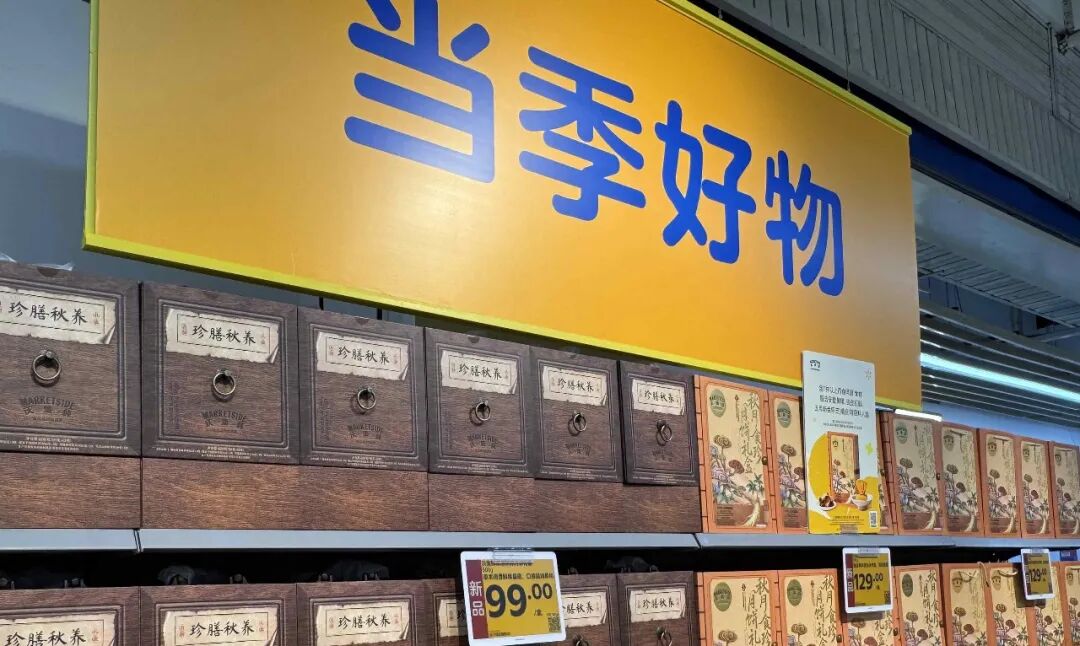
After the brand refresh, the pace of new product launches of Marketside has accelerated significantly. Launching new products according to seasonal trends and consumer trends has become the norm for Marketside. For example, it launches a series of osmanthus-flavored products in autumn, and launches a series of health mooncakes with edible and medicinal ingredients during the Mid-Autumn Festival. The frequency of new product launches and the richness of categories are far higher than Sam's Club's Member's Mark, which adopts a more prudent product selection strategy.
Its marketing methods are also keeping pace with the times. In January 2026, Walmart reached a cooperation with Xiaohongshu, and the two sides opened the first co-branded innovative retail experience space "Marks Potato Store" at Walmart Shenzhen Shekou, showcasing nearly 20 co-branded products. In June 2026, Marketside cooperated with Disney China to launch nearly 100 "Toy Story" themed Marketside Disney co-branded products and Walmart exclusive products, and created a Disney-themed experience zone at Walmart Shenzhen Xiangmihu store.
The reason why Marketside can achieve all this lies in its operational autonomy. Although Marketside is part of Walmart's global private label matrix, after completing the brand refresh in 2025, its product system and operation strategy are both led by the Walmart China team. Essentially, this is the fierce competition and business format iteration speed of China's retail market that forces the regional team to make localized innovations.
More Than Just Saving Hypermarkets
Walmart's motivation for developing Marketside comes from at least three aspects: the survival crisis of hypermarkets, the concentration risk and ceiling of Sam's Club's growth, and the accelerated encirclement by hard-discount competitors.
First, look at the situation of hypermarkets. In recent years, the traditional hypermarket format as a whole has faced the pressure of declining passenger flow and decreasing sales per square meter. Store closure adjustment and business format upgrading have become common practices in the industry, and Walmart China's hypermarkets are also in dynamic adjustment. According to official Walmart data, as of July 31, 2026, Walmart operated 278 Walmart supermarkets in China, while this figure was 412 in 2020, a decrease of 134 stores in 6 years, with a decline rate of about one third.
Private labels have become a self-rescue measure to cope with the decline of the business format. According to Heke Finance's observation, in the new generation of Walmart stores after renovation, Marketside, as the core brand, is displayed on golden shelf positions such as the entrance and main aisles. At the same time, it has greatly increased high-frequency and rigid-demand categories such as short-shelf-life fresh food and fresh produce, and compressed non-food areas. According to Walmart's official plan, more than 100 stores will complete renovation and upgrading in 2026.
This is the common transformation direction of traditional supermarkets. Yonghui, which is carrying out "Pangdonglai-style transformation" by learning from the Pangdonglai model, also focuses on increasing the proportion of private labels to restructure its product structure. According to Yonghui's financial report, in the first half of 2026, the total sales of Yonghui's comprehensive private label matrix (covering Yonghui Custom, Quality Yonghui, YH Bakery, Yonghui Farm, etc.) reached 2.533 billion yuan, accounting for 10.07% of the company's total sales. However, Walmart can reuse Sam's Club's supply chain, so compared with its peers, its starting cost is lower and its momentum is faster.
Business concentration risk may be Walmart's deeper consideration for laying out the Marketside brand. Sam's Club has become the absolute growth engine of Walmart China. Once Sam's Club is impacted by the consumption environment, public opinion or competition, the overall performance may be greatly affected. In fact, the impact signals have already emerged. Since the summer of 2025, Sam's Club has been exposed to multiple successive food safety disputes. On June 15, 2026, the State Administration for Market Regulation interviewed the person in charge of Walmart (China) Investment Co., Ltd. (Sam's Club headquarters) in accordance with the law regarding the frequent food safety problems in Sam's physical stores and online stores; on the same day, the company completed the industrial and commercial change, the former legal representative and chairman MUK SOOK YEE stepped down, and Liu Peng, Sam's Club China President with Alibaba background, took over the position; two days later, Zhang Qing, Chief Merchandising Officer of Sam's Club China, submitted his resignation. The timing of Marketside's brand refresh is also quite delicate — November 2025, right after the concentrated outbreak of Sam's Club's food safety disputes.
Sam's Club's own growth also has a ceiling. As of the opening of the Shijiazhuang store on August 21, 2026, Sam's Club has 68 stores in China, and plans to open 13 new stores in 2026 to reach 76 stores by the end of the year. The expansion of Sam's Club stores is restricted by site selection and regional consumption power. At present, first- and second-tier cities are almost saturated, and Sam's Club is gradually sinking to economically strong counties such as Kunshan, Jinjiang and Zhangjiagang, but the number of county-level markets that can support the warehouse membership model in the future is limited after all.
The accelerated encirclement by external competitors constitutes the third driving force. In the past two years, the hard-discount format has risen rapidly, and the core barrier of this format is private labels. On the one hand, ALDI, the global originator of hard discount from Germany, has more than 120 stores in China as of September 2026, plans to add more than 50 new stores throughout the year, and its private label proportion is about 90%; on the other hand, Super Hema NB under Hema, the leading local representative, has nearly 700 stores nationwide as of the end of August 2026, with a private label proportion of nearly 60%.
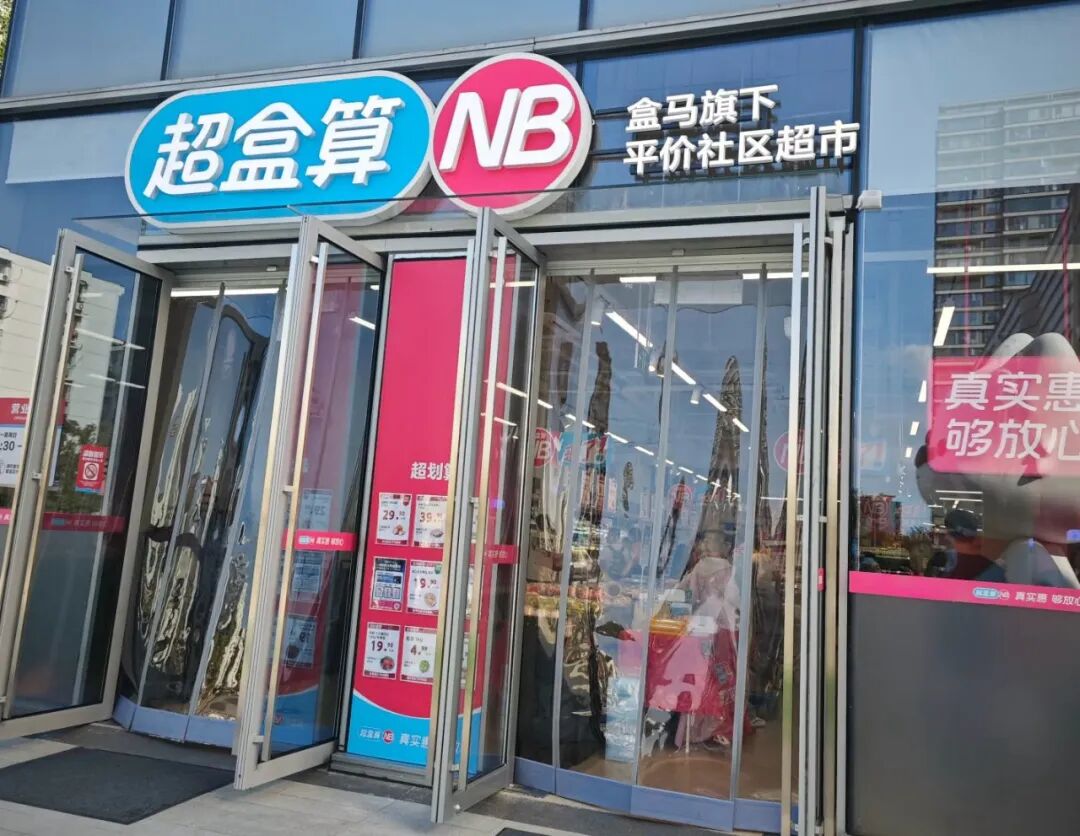
The target customer groups of these competitors highly overlap with Walmart's neighborhood stores, but the number of stores and expansion pace are far faster than Walmart's. Walmart opened its first neighborhood store in Shenzhen in January 2025, and opened 20 stores in Shenzhen by August 2026, and will accelerate its expansion to cities such as Suzhou and Guangzhou in the second half of the year. Under such a competitive situation, Walmart's neighborhood stores need the Marketside private label to strengthen their differentiated barriers.
Where Does the Future Lead
The rise of Marketside is obvious to all, but risks are growing simultaneously with its scale.
Food safety issues are one example. On August 21, 2026, the food sampling inspection bulletin of the State Administration for Market Regulation revealed that one batch of Marketside salmon slices was detected with excessive coliform bacteria. Walmart China responded that the abnormality came from a single batch of products in Guangzhou in May. After a comprehensive investigation in conjunction with the supplier, no abnormality was found; the re-inspection result in July was qualified, and all salmon products on the market meet the national food safety standards.
Apart from individual cases, for Marketside, which has been developing rapidly in the past year and has nearly 1,000 SKUs, whether its quality control system can keep up with the expansion speed is a very realistic test.
A deeper concern lies in its relationship with Sam's Club. On the one hand, Marketside's brand mindshare is not yet independent. The label of "affordable alternative to Sam's Club" is not only traffic dividend, but also will limit the establishment of the brand's own trust. On the other hand, in the public opinion storms that broke out around Sam's Club, some members questioned that Sam's Club has become "Walmart-ized" because some of its private labels have been replaced.