The Federal Reserve deleted four characters.
The Federal Reserve raised interest rates last night.
In this rate-setting meeting, the most widely discussed topic is interest rates, but the most crucial move is hidden in a single deletion.
Its statement is not long, with only three short paragraphs and very few lines in total. There must be many onlookers, right? There are three key moves, namely: one sentence removed, one sentence added, and a "unanimous vote".
Let's start with the removed sentence:
In the July statement, it was written that "Inflation remains elevated, partly reflecting supply shocks that have pushed up prices in sectors such as energy". The September statement only retains the first half: "Inflation remains elevated". The latter half of the sentence is gone.
Supply shock, in plain terms, means finding an external excuse for inflation. Oil prices go up, freight rates go up, none of these are our fault, inflation is pushed up by external factors.
It's a bit like fever and weather: the weather does exist, but the fever is your own problem. The weather forecast can tell you what's coming, but you still have to hold your own umbrella.
Indeed, every word in the Federal Reserve's statement is carefully weighed. Deleting that half-sentence means admitting that those external excuses no longer work.
Keeping that sentence originally reserved a fallback: if inflation fails to come down, you can blame external factors; if you want to wait a little longer, you have a reasonable excuse. Deleting it means the fallback is removed. The fallback, which seems unnoticeable in normal times, reveals its true weight only when it is taken away.
Oil prices, tariffs, wars, one after another, excuses change every year, and the direction is always pointing outward. This time, the outward-facing excuse is also deleted, even the four words "Middle East conflict" are replaced with the more general term "geopolitics".
Now let's talk about the added sentence:
"Today's policy action will help achieve the Committee's 2% target in a more timely manner".
The three most important words in this sentence are "more timely". Previously, the official stance was that inflation would gradually fall back. Now the stance is that we need to make it fall back faster. The subject has also changed accordingly: the decline is no longer something that happens to inflation on its own, but a task that the Federal Reserve must fulfill.
The core difference lies in one choice: to wait or not to wait?
If you choose to wait, you can hold your ground and watch the external wind die down on its own. If you choose not to wait, you have to take action yourself, keep pressing down until the data falls into place, and treat every subsequent inflation data as its own exam, with no make-up exam allowed if you fail.
There is another point that needs to be made clear: "The Committee will achieve price stability", which was already written in the July statement and remains unchanged this time; only the two adjustments mentioned above are made, small in quantity but huge in weight.
People who often read official documents know that what is deleted is more valuable than what is added.
Oh right, there is also the unanimous vote. Voting results are more honest than verbal statements. The last vote was 9 to 3. The three dissenting voters had different reasons from the chair, they thought the action was too slow and voted for a rate hike.
This time, the vote was 12 to 0, with no dissenting votes at all. From 9 to 3 to 12 to 0, only seven weeks passed, and those who were urging for faster action last time now stand in line with everyone else.
The unanimous vote also means there is no backdoor: if inflation fails to come down in the future, no one can claim that they disagreed with the move at that time.
One sentence removed, one sentence added, unanimous vote: these three things are essentially one single action, taking the accountability for inflation back from external factors to its own side. Taking this accountability is rarer than raising interest rates, and no one else can be blamed for any problems that arise later.
Fed Chair Wash also spoke very directly at the press conference:
"Inflation is a choice".
He said this before, and it should not be an impromptu remark. By defining inflation as a "choice" rather than "fate", the responsibility is shifted from the weather back to the conference room.
The meaning of the word "choice" is that the accountability is in our own hands, and the reason we dare to take this accountability is that we have kept a detailed account of it, which has grown thicker and thicker over time.
Inflation has stayed at a high level for more than five years. The categories of rising prices are still expanding. It is no longer just a few items that are getting more expensive. According to Wash's own statement, too many categories of goods have seen a price increase of more than 3% whether measured over half a year or a full year.
Demand is also not weak. The statement explicitly writes that domestic spending is resilient.
Investment in the AI sector is pushing up the prices of chips and electricity. The Federal Reserve has even set up a working group, which will submit a report by the end of the year.
On the oil price side, someone asked him at the press conference:
Can you control oil prices? His answer was straightforward: we cannot control oil prices. What we can control is to prevent its further transmission, to avoid the second-round effect where today's energy prices become tomorrow's freight rates and the day after tomorrow's wages.
Hmm. Three of the four concerns are internal issues.
The set of external excuses has been deleted, and what remains is the accountability on our own side. How this accountability will be settled depends on two things: will anyone oppose it? Will the market accept it?
.......
On the same day (that is, early morning Beijing time), dissenting voices emerged; in the White House's response, the spokesperson who put forward the most complete stance is Kush Desai.
He is the former White House Deputy Press Secretary in the Trump administration. In an interview with Fox News, he first threw out a phrase: "quite regrettable".
This phrase is not mild. The White House usually leaves some leeway when speaking. Then he added that the rate hike has no convincing economic basis, which means the data does not support this move.
The heaviest remark comes at the end:
Inflation is entirely caused by energy supply shocks and has nothing to do with interest rates; this sentence says it all. Since interest rates are irrelevant, raising interest rates is a useless effort.
He also added another comment: It is not the Biden era now. This administration has not spent trillions on stimulus, so there is no out-of-control demand that needs to be suppressed. Then he pointed out the mortgage issue: if interest rates go up a little more, the first to suffer will be monthly mortgage payments, followed by corporate investment.
The three statements can be summed up in one sentence: the accountability is pushed to oil.
The president's post is also very direct: U.S. interest rates should be cut to 1% or lower, and he gave the reason that the United States is the country with the best credit in the world, so its interest rates should be the lowest.
There is also a sentence attached at the end: "CUT RATES, AND DO IT FAST", this last sentence is all in uppercase in the original text, and you can almost hear the loud volume through the screen. Yes, you are not mistaken, in a country that just raised interest rates, the president is publicly calling for a rate cut, and he is completely justified in doing so.
After the press conference ended, he spoke even more unceremoniously to reporters. He said he had talked to Wash, and the original words were:
You might as well vote with the committee, it's useless anyway; the committee is very hostile, very politicized, and is doing the wrong thing.
Interestingly, when asked about his conversation with the president, Wash never gave an answer. This time, the president essentially answered it for him across the air. Hostile, politicized, doing the wrong thing: three phrases, each more severe than the last.
Despite the criticism, he did not attack Wash personally. When the reporter followed up and asked if he still had confidence in Wash, he said yes.
Besides, these remarks were not made up on the spot. There are more than one person holding this view, and it has been going on for more than just one day.
Back in August, Treasury Secretary Bessent already said that short-term interest rates do not need to be raised, inflation is caused by supply shocks, and the Federal Reserve should not tighten policy for that reason.
In other words: inflation is an external impact, and a rate hike cannot stop something that comes from outside. He also added that even if interest rates are raised, there will be no obvious impact within a year.
Vice President Vance also shouted the same tune: cutting interest rates is the correct and responsible choice, and we hope to get help from the Federal Reserve.
Before the meeting and after the meeting, this set of stances is passed like a relay baton. The person changes, but the meaning remains the same. There is a reason for the urgency: there are only seven weeks left before the midterm elections, and both oil prices and interest rates are closely related to the ballot boxes.
Onlookers outside the market can also see it clearly:
Before the rate hike, JPMorgan Chase's chief global strategist once said that Wash is pushing himself into a corner. If he does not take action this time, he will lose credibility first.
The response from the other side was very short. The press conference lasted for 30 minutes, and in response to all these remarks, Wash only said three sentences.
"Independence is a two-way street. Those who make trade policy and fiscal policy should also stay in their own lanes". "I am not a press release from Wall Street". "I have nothing to say about my conversation with the president".
He did not pick up the argument, but drew a line: I am responsible for my own territory, and you are responsible for yours. This line is drawn for two things: one is tariffs, and the other is government spending.
You cannot afford to start a quarrel. Once you pick up the argument, the issue of accountability will turn into an issue of personal temper.
One side is continuously posting on social media, giving interviews, and attending hearings non-stop, while the other side only responded with three sentences. The scale of the two sides' actions is not at the same level at all.
Pushing accountability has its own use. If the accountability is attributed to oil, you can stay free from trouble, and the blame for inflation can be placed elsewhere.
After all the arguing, there is only one thing at stake: who should be held accountable for inflation?
If it is attributed to external factors, no one is guilty; if it is attributed to our own side, we have to take action. For the same inflation, there are two sets of accounts. Which path to take depends entirely on whose hands the account book falls into.
.......
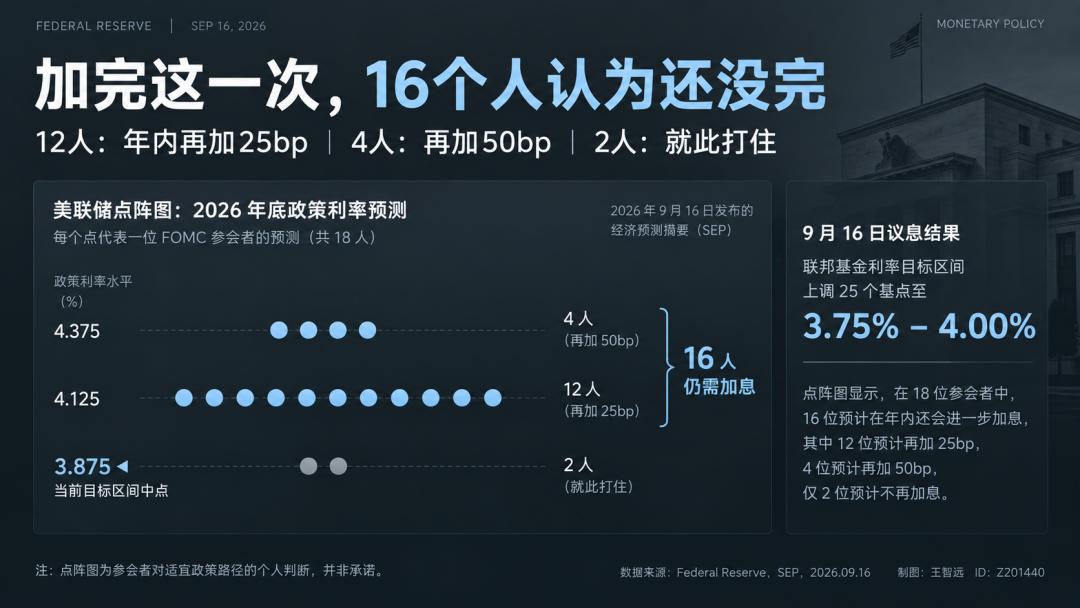
First look at the timeline. When the dot plot is unfolded, the anonymous forecasts from 18 officials are all on it. 16 of them think there will be another rate hike within the year, and only 2 think we can stop here.
To compromise, 2027 will see interest rates stay at the current level; the shadow of rate cuts is pushed to 2028.
The dot plot reflects the collective attitude. No one takes it as a prophecy, but the attitude itself is information.
Someone asked at the press conference: When will you stop? Wash did not give a single answer. Not providing forward guidance is a rule he stated long ago.
For the market, what is more tormenting than this rate hike is that the end point is invisible. Bad news can be priced in, but uncertainty cannot.
The market can only guess on its own, and the result of the guess is that the chance of a rate hike at the next meeting is 50-50. It is normal that no one can guess accurately. Looking through all the records, the only time that the Fed stopped after just one rate hike was in 1997.
People want to hear "it's over", but what they get is "it's not over".
Moreover, according to the official's own forecast, the 2% inflation target will not be achieved until 2029. This date is tougher than any harsh remarks.
Then look at the long end of the yield curve:
The 10-year U.S. Treasury yield is hovering around 5%, a position that has not been seen for nearly 20 years. The short end follows the Federal Reserve, but the long end does not fully follow. It includes the term premium, fiscal policy, and those groups that are competing with AI for capital. The government is issuing new debts, and large tech companies are borrowing long-term funds, targeting the same group of buyers.
After the rate hike landed, the long-end yield did not fall back at all. Wash himself pointed out three reasons: strong economy, geopolitics, and capital competition. Each of them is more like an external issue than the last.
Hmm. The fact that the long-end yield does not fall back is itself an answer.
Finally look at the market price tags:
The U.S. dollar index stood above 100 for the first time in nearly five weeks; gold prices went on a roller coaster, rising first and then plummeting; the RMB exchange rate barely moved; on the other side of the ocean, the U.S. stock market saw the Dow Jones Industrial Average fall 1.2%, closing at the lowest level in more than three months.
There is no cheer, no protest, everyone is settling their own accounts.
The European Central Bank already raised interest rates last week, the Bank of Japan's decision is coming tomorrow, and several Gulf countries followed the Federal Reserve to take action. Global interest rates are all moving upward, the wind is blowing in one direction, this time, everyone has to take their share of the responsibility.
Let's talk more about gold. According to past experience, after a rate hike is confirmed, gold prices should fall. This time it did fall for a while, but the drop is special: before the resolution was released, gold prices were still rising, once the news came out, it plummeted to a new low in more than a month, then climbed back at the end of the trading day, with the closing loss narrowed to 0.7%.
There is a change worth noting: since 2022, the decades-long correlation between gold prices and real interest rates has loosened.
Because the anchor that prices gold is changing. In the short term it still depends on interest rates, but in the medium term, there is another participant standing next to the anchor: central banks of all countries.
In one quarter, global central banks purchased 289 tons of gold, 60% more than the same period last year; the Chinese central bank has increased its gold holdings for 22 consecutive months; in August alone, the inflow of gold ETFs hit the second highest level in history.
Among the gold buyers, there are a group of large buyers who do not look at the Federal Reserve's face. They buy gold as reserve assets for peace of mind. The calculations of these large buyers are made on an annual basis. They don't care much about whether the price falls this month. No matter how loud the rate hike calls are, they will keep buying as planned.
This year, more than 20 banks have adjusted or stopped their personal precious metal businesses. The channels for ordinary people to buy gold are increasingly replaced by funds. The reason why the gold fund you hold does not follow the old script is right here.
Looking further back, the last person who did this was Alan Greenspan in 1994. The economy was strong, inflation was stubborn, and he dared to tighten policy aggressively.
Within one year, he raised interest rates from 3% to 6% in seven steps, including several 50-basis-point hikes, without any hesitation. As a result, the economy did not collapse, and inflation did not get out of control.