Ctrip, which was once surging ahead at a breakneck pace, has slowed down.
Ctrip, which has been expanding at a breakneck pace since the post-pandemic era, slowed down in the second quarter of this year.
The latest financial report shows that Ctrip's revenue reached 15.7 billion yuan, with its growth rate dropping to single digits. It recorded a net loss of 2.46 billion yuan, swinging sharply from profit to loss year on year.
Excluding the 5.2 billion yuan anti-monopoly fine, Ctrip's net profit stood at 2.7 billion yuan, far lower than the 4.8 billion yuan in the same period last year.
Since the beginning of this year, Ctrip's share price in the US stock market has nearly halved.
This OTA giant is bringing an end to its cycle of blind rapid expansion.
Stalling on Both Core Engines
Ctrip's growth has always been driven by two core segments: domestic accommodation reservation and transportation ticketing. These two sectors have long contributed more than 70% of the company's segmental revenue.
In the second quarter, both segments underperformed at the same time.
The ticketing business was the first to take a hit. Its revenue in the second quarter reached 5.35 billion yuan, down 0.9% year on year, marking the first negative year-on-year growth in ten quarters. The company attributed the performance to "the direct and indirect impacts of macro adverse factors such as high energy prices and geopolitical fluctuations". This explanation is reasonable, but geopolitical tensions have erupted since the first quarter, and the segment still posted 11.7% year-on-year growth in that period.
Obviously, the ticketing business itself has run into growth bottlenecks. The core of this problem lies in that OTA platforms can hardly obtain excess returns relying on their monopoly position.
On the one hand, the prices of aviation, railway and passenger transport services are relatively transparent, making it increasingly impossible for Ctrip to increase revenue through tactics such as price gouging of loyal users. On the other hand, there is less and less room for "innovation". For example, the "speed pass" products of Ctrip and Qunar were pushed to the forefront of public criticism last year. The Beijing Municipal Market Regulation Administration interviewed platforms including Ctrip, requiring them to rectify misleading promotions such as "speed pass", "dual channel" and "remaining ticket monitoring" after tickets are sold out in a timely manner.
In this widely watched market, there is less and less room for Ctrip to engage in under-the-table operations, and its business model is increasingly leaning towards traffic diversion.
The accommodation reservation segment rarely recorded single-digit growth this quarter. Excluding the caliber of revenue offset by the fine, the growth rate was 8.0%. It is worth noting that in the past several quarters, this segment has maintained double-digit growth, with most growth rates exceeding 20%.
The holiday travel business and corporate travel management business are relatively value-added services. The growth rates of these two segments have always remained stable, leaving little room for explosive growth. Among them, the growth rate of the holiday travel business is only 8%. The corporate travel management business has a low base, with a growth rate of 11%, which is slower than that in the first quarter.
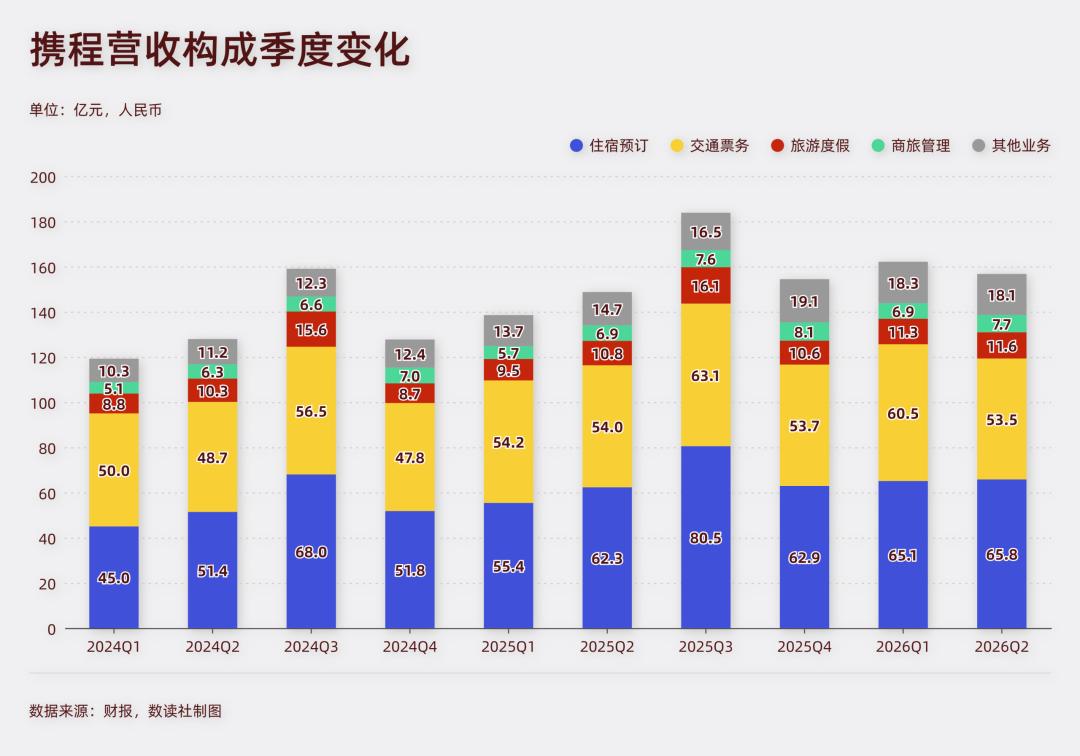
The only "X factor" is the international business. The revenue of its international platform increased by more than 50% year on year, and the revenue of inbound tourism posted a high double-digit year-on-year growth. The Asia-Pacific region is the main source of growth, while Europe and the Americas achieved faster growth on a relatively small base.
However, the financial report does not specify how much revenue the international business has generated. It remains uncertain how much opportunity Ctrip can seize in this market.
The current tourism market is entering a phased contraction stage after the previous explosive growth. Coupled with the interference of abnormal climate and geopolitical issues, tourism demand has fluctuated, and Ctrip has been affected amid this context.
In a booming cycle, merchants can make profits, and Ctrip can naturally expand rapidly without careful planning. But at the current stage of consumption pressure, merchants are generally struggling to survive. Given the close interdependence between the two sides, the platform needs to make more efforts to support the ecosystem. Only by helping more small and medium-sized merchants get through the difficulties can it continue to reap rich profits in the next booming cycle.
However, judging from the performance of the second quarter, Ctrip has not given much priority to its ecosystem.
Unwilling to Let Go of High Gross Margins
As the founder of Ctrip, Liang Jianzhang is obviously more interested in the label of "demographic economist". He often expresses his concerns about demographic issues and puts forward suggestions such as "free childbirth support" and "increasing cash subsidies for childbearing".
From his point of view, to encourage fertility, it is necessary to reduce the pressure on young people of appropriate childbearing age and provide them with childbearing conditions.
This is essentially an ecosystem issue. Liang Jianzhang is well aware that the key to the healthy operation of an ecosystem is to give enough space to all participants in the system.
But obviously, there is a huge gap between saying and doing. In the commercial field, facing huge commercial benefits, Ctrip itself finds it very difficult to transfer profits to merchants.
At the current stage, Ctrip's priorities are artificial intelligence and globalization.
In the second-quarter earnings report, Liang Jianzhang's comments always centered on these two propositions: "We are continuously advancing our self-developed capabilities... We are building a global platform with more differentiated value, creating greater value for travelers and partners, and laying a foundation for sustainable growth in the next stage." Sun Jie, on the other hand, placed more emphasis on the globalization strategy.
In the second quarter, both Ctrip's sales and marketing expenses and R&D expenses reached 3.8 billion yuan, up 15% and 8% year on year respectively. In recent quarters, Ctrip has continued to increase its investment, with both expenses growing simultaneously.
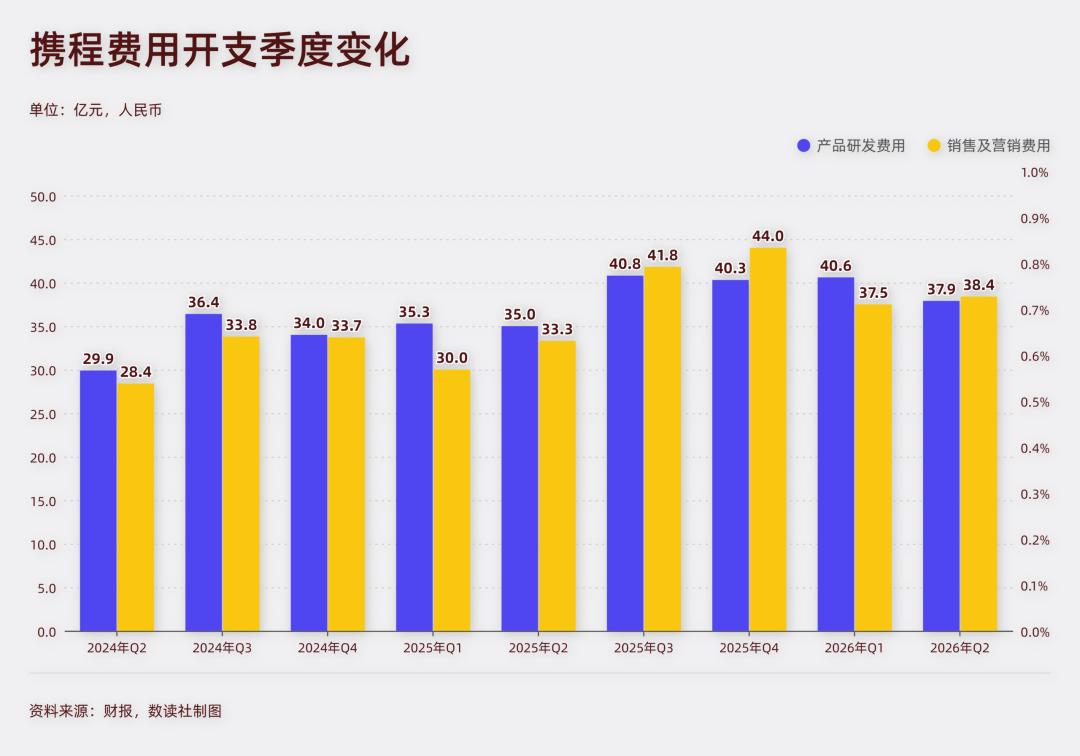
The fundamental reason for attaching such great importance to AI and globalization is that the former caters to the preference of the capital market, while the latter is the key for Ctrip to raise its growth ceiling and create incremental revenue.
In the domestic market, Ctrip's reputation has plummeted, and it needs a new growth narrative.
In the second quarter, Ctrip's net loss attributable to shareholders was 2.46 billion yuan, the first time since the first quarter of 2022. Ctrip's profitability is indeed declining, with its net profit recording negative growth for two consecutive quarters. Its operating profit margin dropped from 31.5% in Q3 2024 to 23.7%, contracting by 7.8 percentage points.
But the reason for the profit decline is not that Ctrip distributed money to merchants, but that it was fined.
The announcement shows that the shift from profit to loss is mainly due to "the 5.2 billion yuan anti-monopoly penalty imposed by the State Administration for Market Regulation". Excluding the fine, its actual profit reached 2.7 billion yuan.
In the context of being fined, Ctrip should have reorganized its merchant ecosystem and provided greater support to them. But judging from the relevant data, this is not the priority of Ctrip at the current stage.
Ctrip's gross margin level remains very stable. Since 2023, although Ctrip's gross margin has fluctuated, it has stayed within a narrow range of 79.0% to 82.4%, and recorded a quarter-on-quarter increase in the second quarter.
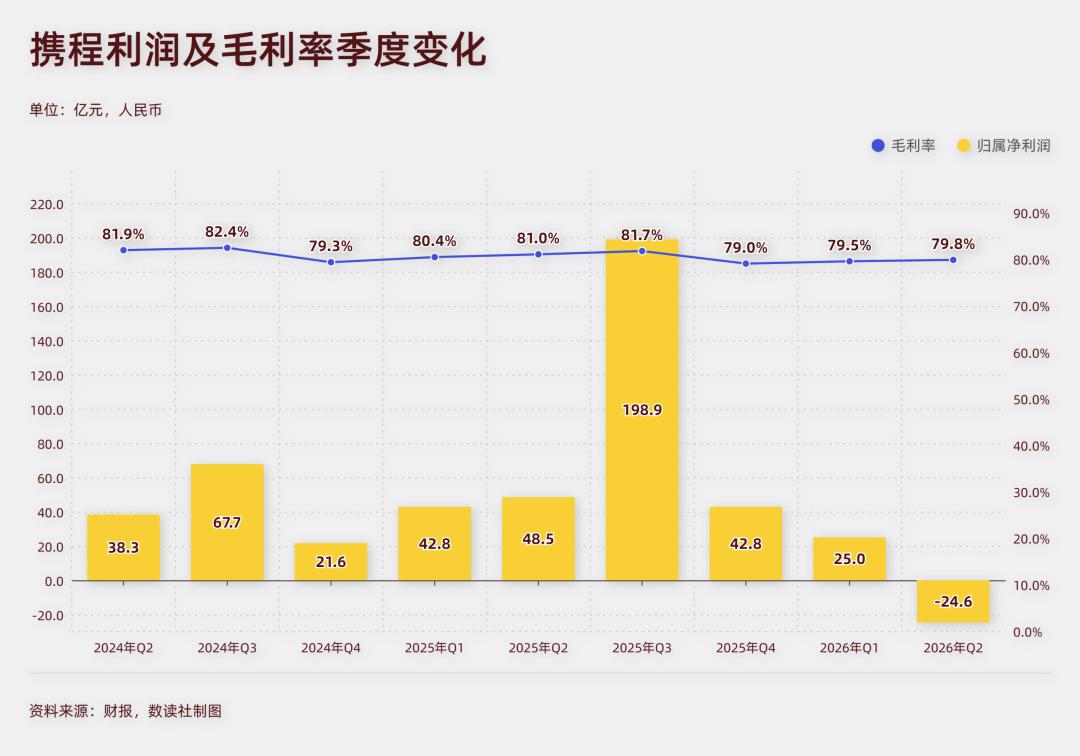
This means that the survival status of hotel operators is still not the focus of Ctrip at present. But this is the fundamental reason why Ctrip is caught in the current predicament.
The Post-Fine Era
Ctrip's anti-monopoly penalty is largely due to the fact that its platform ecosystem has brought operational difficulties to merchants.
In the previous penalty decision issued by the State Administration for Market Regulation on Ctrip, two main violations were mentioned.
The first one is the "special tag" policy: taking traffic tilt as an incentive, Ctrip induced high-quality hotels to sign exclusive agreements, requiring all their online rooms to be sold on Ctrip and not to cooperate with competing platforms.
The second one: Ctrip forced the price of "gold tag" hotels to be 20 yuan or 5% lower than that on other platforms, and the price of "no tag" hotels to be no higher than that on other platforms. It also used the technical tool "price adjustment assistant" to automatically compare and adjust prices, supplemented by measures such as traffic restriction, tag removal and deduction of order reserve fund.
Under this competitive state, the ecosystem for hotel operators is getting worse and worse. According to reports, some operators said that in the process of cooperating with Ctrip, hotels have to follow all the requirements of Ctrip, with no room for price negotiation. Another hotel person in charge said that Ctrip explicitly requires the price at the hotel front desk to be higher than the price on the platform. The first violation will lead to a warning and traffic restriction, and the second violation will directly put the hotel in the "blacklist", making it almost impossible for users to find the hotel on the App.
After the fine, Ctrip made adjustments. According to CEO Sun Jie, Ctrip's updated hotel recommendation and evaluation mechanism covers multiple dimensions: customer feedback, service quality, product competitiveness, historical transaction conversion rate, etc., aiming to improve the matching between supply and demand and provide more flexible and market-oriented services for hotels.
No matter how the rules change, Ctrip needs to face two problems directly: whether it requires the lowest price, and whether it implements strong binding constraints.
If these two problems cannot be solved, Ctrip is still using its dominant position to carry out unfair competition. If these two barriers are broken, Ctrip's moat will soon collapse.
In the past, the "lowest price across the network" meant that as long as a hotel was listed on Ctrip, its price could not be lower on any other platform. Ctrip became a "must-list" channel for hotels, and it did not need to engage in price wars, so its commission ratio and market share would not be impacted.
When these barriers are removed, hotels can openly set lower prices on Meituan and Fliggy. Ctrip has to shift its focus from "exclusive clauses" to "service quality".
According to the research report of HSBC, the previous overemphasis on the company's long-term moat underestimated the superimposed impact of structural headwinds such as regulation, competition and demand. Going forward, Ctrip will face three layers of pressure: 1. Under the anti-monopoly remedial measures, Ctrip's exclusive distribution model is facing changes, which will directly impact the commission ratio of high-star hotels. 2. Competition is intensifying, with rivals including both traditional peers and new AI assistants. 3. International expansion and AI investment will continue to dilute profits.
For this reason, HSBC downgraded Ctrip's US stock rating from "Buy" to "Hold", and cut its target price from 60 US dollars to 48 US dollars.
This actually reveals several key reasons for Ctrip's current slowdown in growth.
On the one hand, the rapid development of the tourism industry has entered a stable period. High energy prices, geopolitics, extreme weather and weakening consumer confidence have deprived Ctrip of the industry foundation for rapid growth.
On the other hand, the rules are facing rewriting. The fine is a one-off expense, but regulation has changed the permanent rules. Tools that used to be conventional for Ctrip, such as "special tag", "lowest price across the network" and "price adjustment assistant", are now facing changes and adjustments.
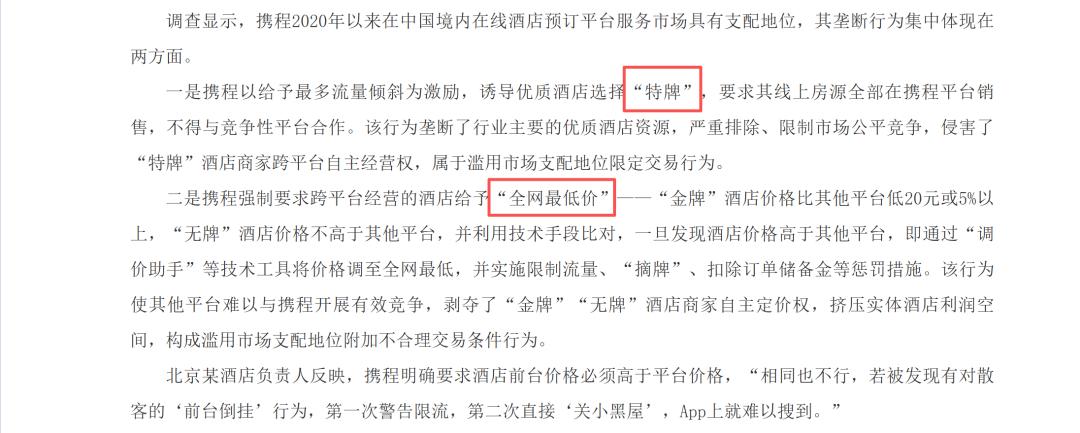
The moat that Ctrip has built in the past may now put it back on the same starting line as Meituan and Fliggy. Ctrip's advantages are facing reconstruction.
The slowdown in growth in the second quarter is a sign. Ctrip spent 20 years accomplishing one thing: turning the pricing power of Chinese hotels into impressive figures on its financial statements. But now, both its internal business model and the external environment are changing quietly, and Ctrip's era of rapid expansion has come to an end.
This article is from the WeChat official account "Data Reading Society", written by Lu Su, and published with authorization from 36Kr.