Li Xiang vs Lei Jun, who on earth has a better understanding of family cars?
When refrigerators, large TVs and comfortable sofas have become standard features, can the in-car experience of family vehicles be further differentiated?
On the evening of September 16, Li Xiang delivered a new answer sheet.
The all-new Li Auto i9 is launched with only one Home version, priced at 369,800 yuan. It is the highest-tier all-electric SUV in Li Auto's current pure electric product line, and also another new answer Li Xiang (Founder, Chairman and CEO of Li Auto) has prepared for family-oriented vehicles.
Compared with the brand's other flagship SUV, the L9, the i9 is 90,000 yuan cheaper, which clearly shows Li Auto's strong desire for sales growth. However, the lower price does not mean Li Xiang has given up his persistence in redefining pure electric products.
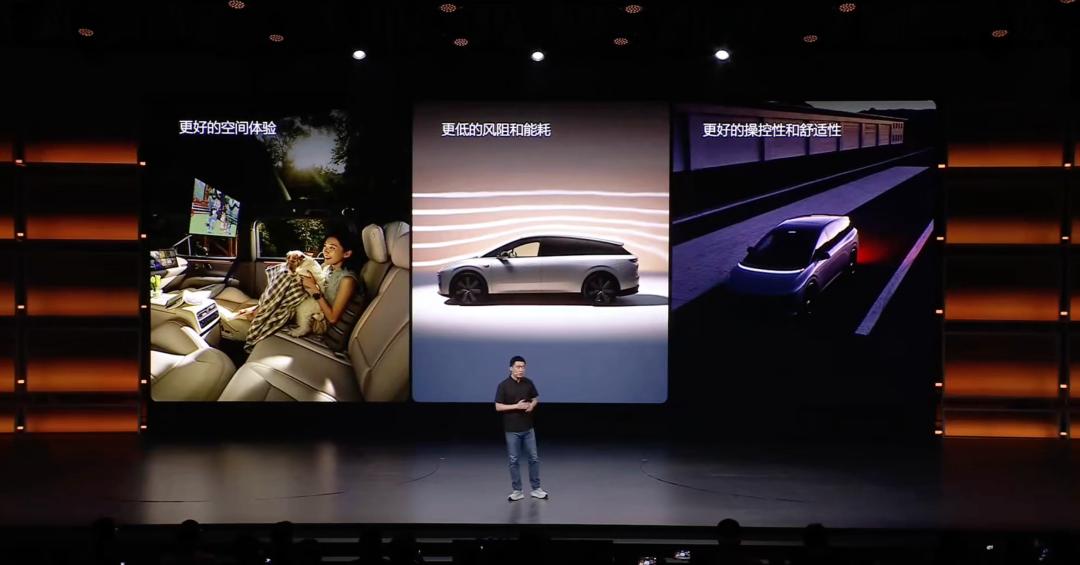
Li Xiang believes pure electric SUVs need their own new form
Li Xiang still refuses to make it a conventional product, but defines it as a "new-form family flagship SUV", and reuses the "Home" naming, making it the second model with a Home version following the MEGA.
According to Li Xiang's statement at the launch event, what the i series aims to do is to abandon the traditional SUV form, explore whether a better product can be built on a native pure electric platform, and finally get three answers: better spatial experience, lower wind resistance and energy consumption, better handling and comfort.
This actually continues Li Xiang's product logic that started from the MEGA: Pure electrification should not only mean a switch of power source, but also redefine the way a car is used by leveraging the changes in platform and space.
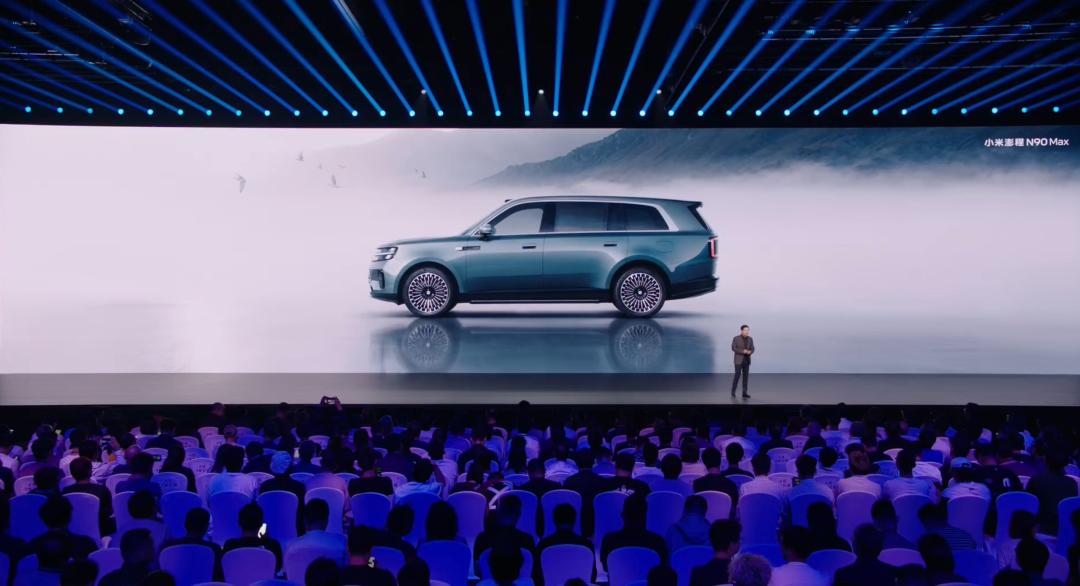
Xiaomi Pengcheng retains the traditional shape of SUVs
Interestingly, the Xiaomi Pengcheng N70 and N90 launched just 9 days ago offer another answer for the upgrading of family vehicles.
Different from Li Xiang, Lei Jun (Founder, Chairman and CEO of Xiaomi) did not try to redefine a new car form, but tried his best to retain the original look of SUVs.
However, through engineering optimization, Xiaomi has integrated a fully flat floor, super-long slide rails and swivel seats into the car, delivering a spatial experience that is no worse than MPVs with the form of a standard SUV.
Li Xiang and Lei Jun, one trying to redefine a car form and the other trying to build a better SUV. Although there is a big gap between the selling prices of their products, the contest between the two product masters on redefining family vehicles is absolutely wonderful.
NO.1 [ Li Auto i9: An SUV closer to MPV ]
The Li Auto i9 is a large pure electric SUV with a length of 5225mm and a wheelbase of 3168mm, adopting a 2+2+2 6-seat layout. Its appearance still features the classic design of the i series, with a short front overhang and a single-box streamlined body, which looks more similar to an MPV as a whole.
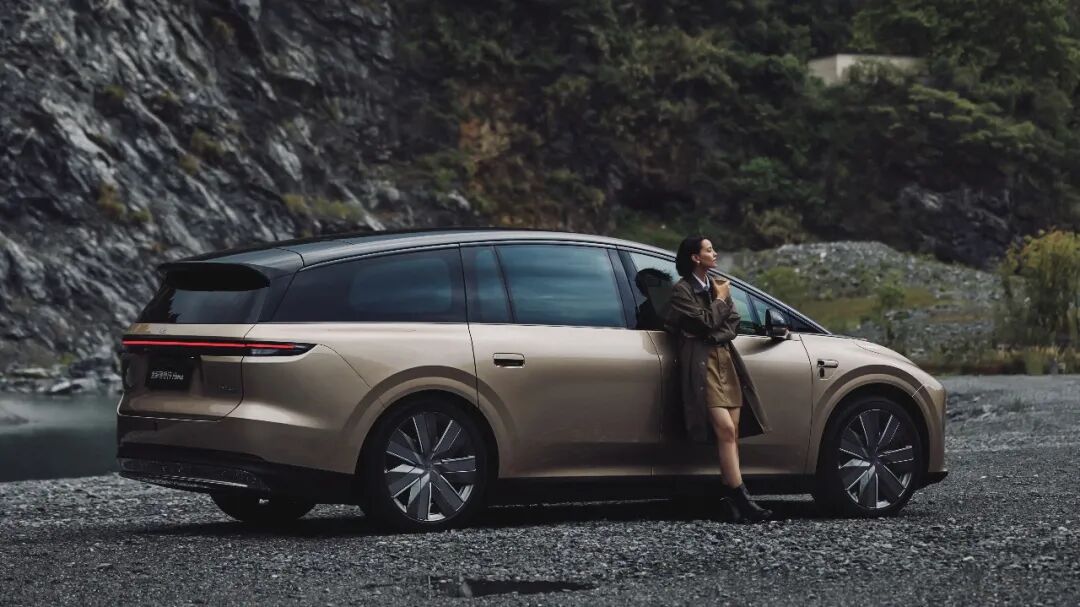
The special shape gives the i9 a lower drag coefficient and a larger cockpit proportion
This is also Li Xiang's answer for SUVs in the electric era.
On one hand, the pure electric platform no longer needs to reserve a large front compartment for the engine, which allows the A-pillar to move forward, the front end to be shortened, and more space to be left for the passenger compartment.
On the other hand, it does not maintain a high body like traditional MPVs. Its body height is only 1752mm, which reduces the frontal area and energy consumption while lowering the center of gravity and visual height, avoiding the driving feel of an MPV.
In fact, the i series is not designed to be a chauffeur-driven car like the MEGA that pursues the optimal passenger experience, but to find a balance between multi-person riding and daily driving, giving the driver a little more "right to comfort".
In terms of spatial layout, the i9 still draws a lot of design ideas from MPVs.
The two independent zero-gravity seats in the second row support front-back adjustment and rotation. After parking, the second row can turn to the third row to realize the face-to-face sitting function, which is the same as that of the new generation MEGA.
The third-row seats are also made thicker, and support backrest angle adjustment and front-back adjustment, which are no longer just two emergency seats fixed at the rear of the car.
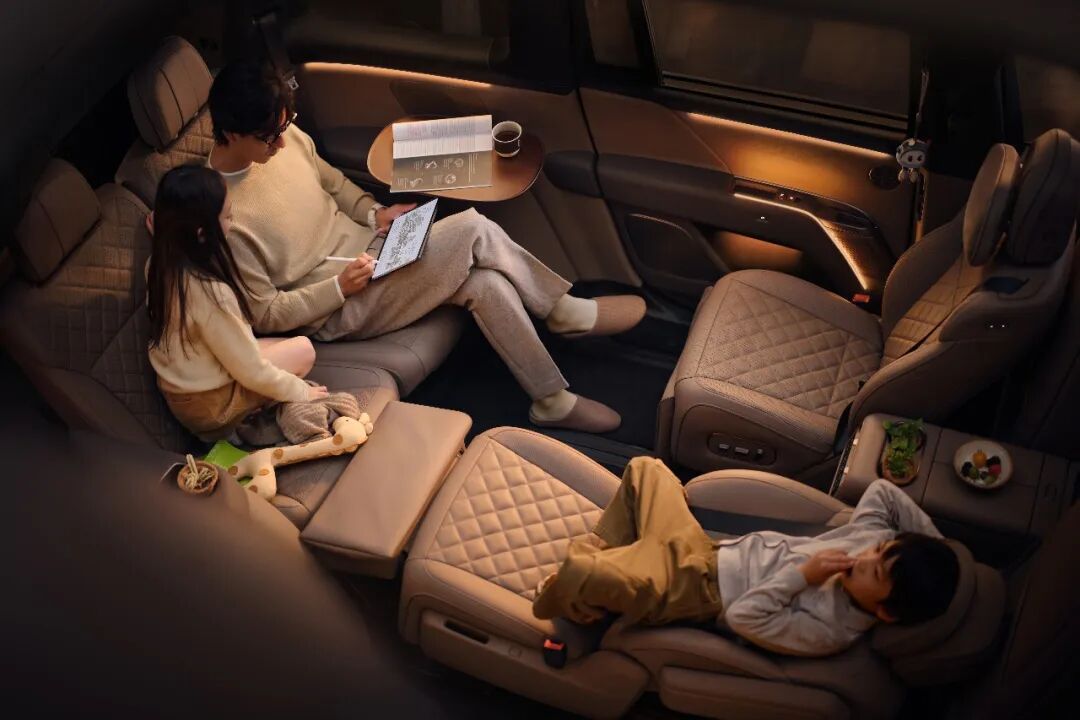
After the second-row seats rotate 180°, a family scenario is formed
Li Auto also adds many detailed functions around the rear-row scenarios. For example, in addition to the optional floating combined tableboard of the same model as the new generation MEGA, the i9 is also equipped with a newly designed side table that can be inserted into the cup holder of the third-row door, which is convenient for placing water cups, mobile phones or children's picture books when parking.
The zero-gravity seats in the second row can lift the leg rests and combine with the third-row seats to form a recliner or a large bed. The side windows of the second and third rows can also be optionally equipped with electric color-changing glass, which can turn the windows completely black with one click.
These functions can actually be realized in cheaper ways. Privacy protection can be achieved with shading curtains, and there is no need to specially equip a side table for temporary placement of items.
But at the level of the i9, Li Xiang obviously does not want to compromise.
As long as a certain scenario is considered important enough, he is willing to continue to invest resources in the last bit of experience, even if the marginal benefit of this part of the investment may not be that high.
After all, redefining the product form and usage mode of pure electric SUVs is the original aspiration Li Xiang has had from the very beginning.
NO.2 [ Xiaomi Pengcheng: An SUV with the soul of MPV ]
Xiaomi Pengcheng takes another route.
On September 7, Xiaomi launched two models at one time, the N70 and the N90. The N70 is a large 5-seat range-extended SUV, while the N90 does not follow the trend of making a large 6-seat layout, but retains the traditional 7-seat layout, and also has an exploration version with a large 5-seat layout and a native electric lifting roof.
Xiaomi did not transform the body into a new species that requires users to re-accept just to achieve variable space. The advantage of this is that users have no psychological threshold to accept it, especially for a new product line that has just started like Pengcheng.
But the problem also lies here, "refrigerators, large TVs and comfortable sofas", "large 6-seat and large 7-seat layouts" are already very common, leaving little room for Xiaomi to make innovations.
But objectively speaking, Lei Jun has still made something different.
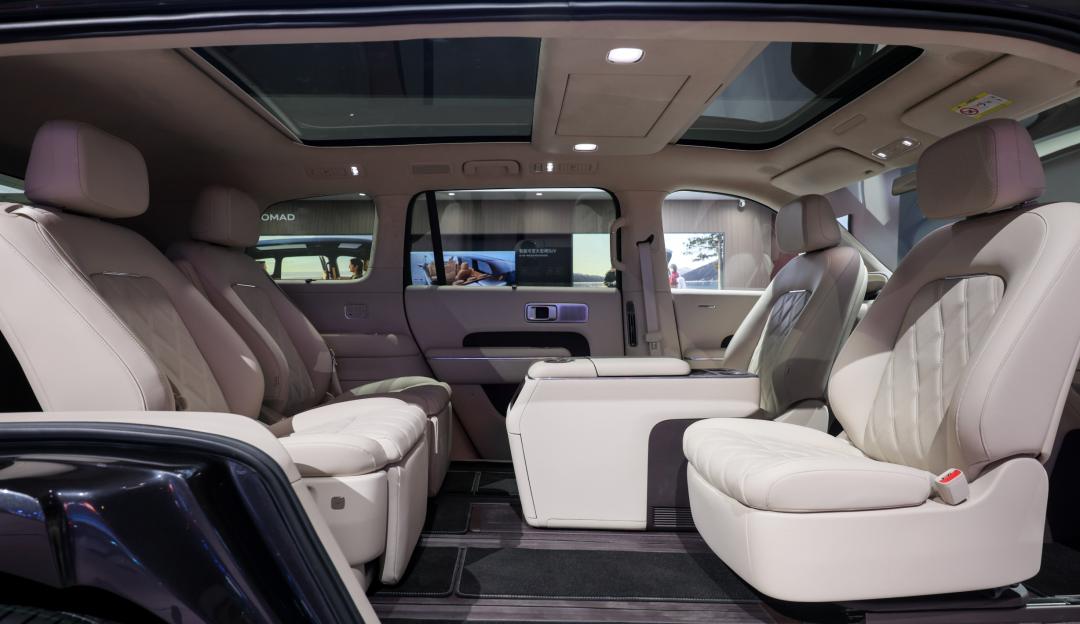
Xiaomi Pengcheng uses the front two rows of seats to form a face-to-face sitting mode
The most special one is the N70. It is essentially still the most conventional 5-seat SUV, but it integrates a face-to-face living room through a fully flat floor, long slide rails and swivel seats.
These things are actually not new. Long slide rails and swivel seats have been made by others long ago, and Zeekr MIX has even realized face-to-face sitting between the front and rear rows. It's just that no one realized in the past that putting this solution into a mainstream product can best reflect its real value.
And Lei Jun just seized this opportunity to put these functions into a 5-seat SUV, which not only does not deviate from the mainstream market, but also gives users an extra reason to buy.
For the N90 with a 2+2+3 seat layout, Lei Jun also follows the same idea of face-to-face sitting of the front two rows.
The advantage of this is that the comfort of the first and second rows of seats is relatively higher, and the front center armrest box installed on the slide rail can also be used like the N70. When sitting face to face, the armrest box slides to the middle to act directly as an island table, and a large table board can also be inserted into the armrest cup holder.
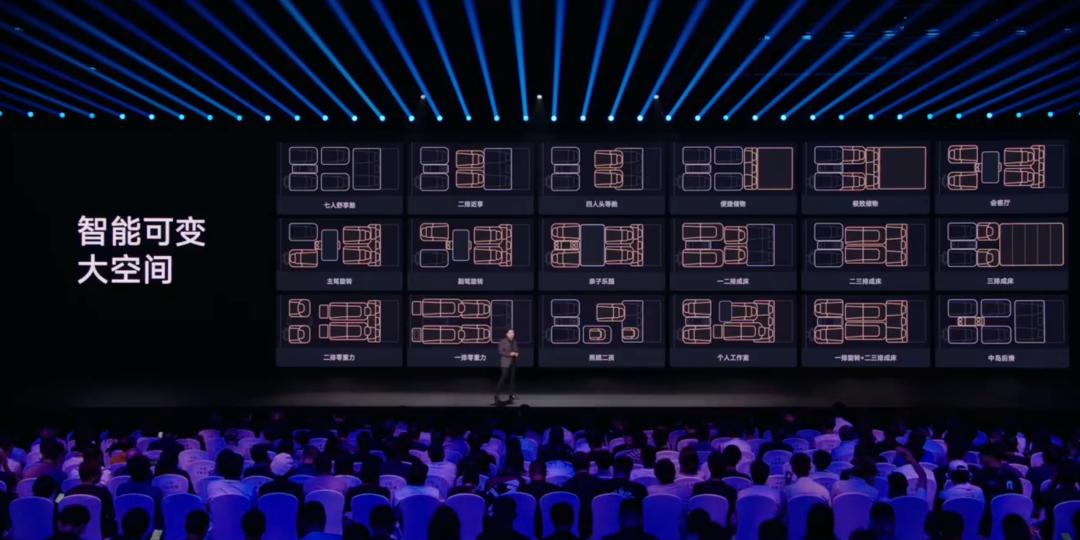
Based on the square fully flat floor, the seats can move flexibly to realize multiple layouts
But it is not as simple as it seems to actually implement this set of functions. If the seats want to move back and forth in a large range inside the car, the premise is to have a square enough fully flat floor.
However, both the N70 and N90 are range-extended SUVs, the battery, fuel tank, rear electric drive and exhaust system all need to be arranged in a limited space. In order not to sacrifice the ground clearance of the SUV, the in-car space is often occupied. Especially at the rear axle position, the electric drive, suspension and wheel arch will intrude inward together, which is also the most difficult part to optimize.
In order to solve these problems, Xiaomi has specially developed a Kunlun platform from the architecture level.
First, the high-power main drive motor is placed on the front axle to free up as much space as possible for the rear. Even if four-wheel drive is required, only a 100kW small motor is added to the rear axle, and the volume is further reduced through coaxial integration and front-mounted electronic control, which finally reduces the floor thickness at the rear electric drive position by 145mm.
The battery pack is also re-laid out for space, the control modules that originally occupied the top height are moved to the front and rear ends, and then a 60L fuel tank is squeezed between the battery and the rear electric drive. At the same time, the springs and shock absorbers of the rear suspension are arranged separately, the angle of the shock absorber is readjusted, and the integrated H-arm connecting rod is adopted to minimize the rear row bulge caused by the suspension intruding into the car.
Finally, the N70 is equipped with a fully flat floor with a length of 2.58 meters, on which 5 slide rails are laid, with the longest one reaching 1.56 meters. Both rows of seats can move back and forth in a large range, which enables the spatial gameplay of face-to-face sitting, working and resting.
However, this kind of space freedom does not come without a price.
The starting price of the N70 is only 209,900 yuan, and the N90 is only 269,900 yuan. To re-develop a set of platform at this price, plus this whole set of spatial mechanisms, means high engineering development and manufacturing costs, so compromises have to be made in other aspects.
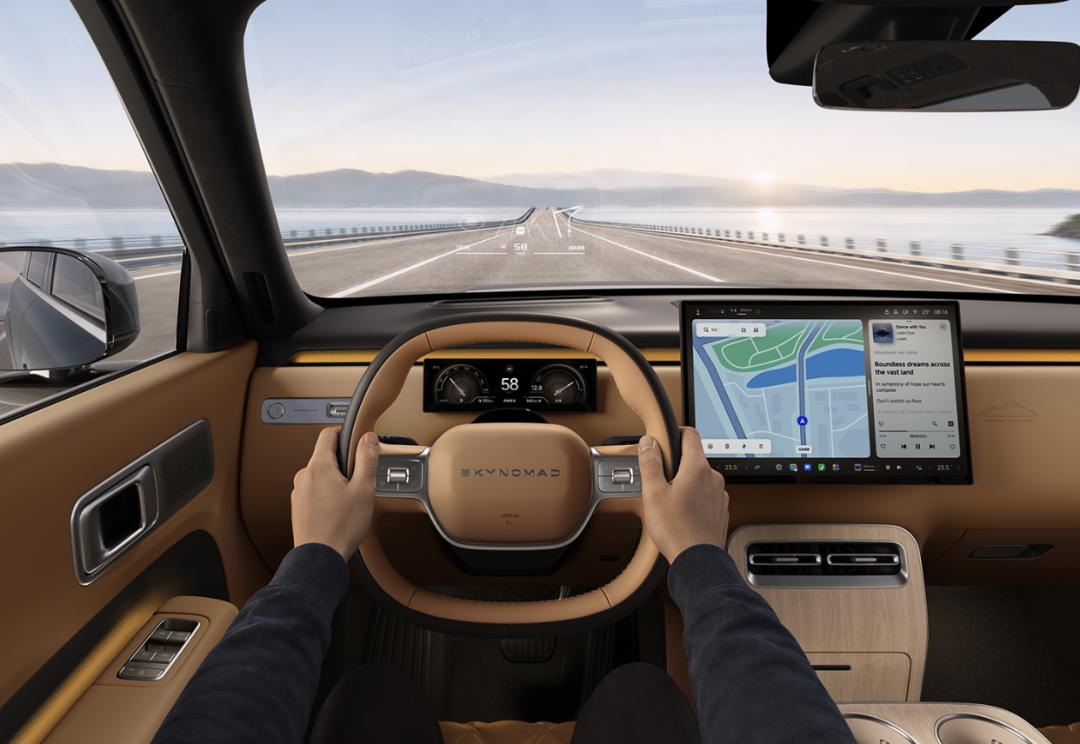
The front row is only equipped with a single entertainment screen, and the size of the instrument panel is average
Neither the N70 nor N90 is equipped with the current mainstream dual-screen in the front row, and the rear entertainment screen, refrigerator, welcome pedal, etc. are all included in the optional package; the platform only adopts the conventional 400V architecture, and the cells are supplied by CALB and Sunwoda; the investment in the material and shape of the interior is also obviously not as high as that of SU7 and YU7.
But this is not a fundamental problem.
Lei Jun never intended to make a perfect product at the price of more than 200,000 yuan. The original goal of Pengcheng is to concentrate the limited cost on the parts that can really form differentiation, make other parts meet the basic needs, and then keep the price attractive enough.
Judging from the performance of more than 10,000 locked orders in 4 minutes after its launch, this product definition method has achieved initial success.
NO.3 [ Final Notes ]
From the perspective of product definition methods, Li Xiang and Lei Jun take different paths.
Li Xiang still does not give up his ideal of redefining SUVs, and is more willing to make a product as extreme as possible. Lei Jun prefers to land the product in the mainstream market, and under the limit of fixed cost, concentrate the funds on the parts that are most likely to form differentiation.
The paths are different, but what they are doing behind is actually the same thing.
When most family vehicles are still piling up materials around refrigerators, screens, seats and parameters, they are actively breaking away from the inefficient involution, and rethinking