Has the entire industry long suffered under CATL's dominance? Automakers collectively take confrontational actions, leading CATL's market capitalization to plunge by 800 billion yuan.
CATL, the undisputed king of the battery sector, is facing a severe test from the capital market.
From September 15 to 16, CATL's share price plunged sharply for two consecutive days. At the close of trading on September 15, it stood at 316.36 yuan per share, down 6.16%; on September 16, its share price once fell below the 300-yuan mark, closing at 305.48 yuan per share with a 3.44% drop, hitting a new low in nearly a year, and its total market value shrank to 1.4 trillion yuan.
It is worth noting that the lithium battery sector rose sharply today (September 16), the Wind Lithium Battery Index increased by 1.67%. Among peer companies, Sunwoda (SZ: 300207) surged 11.67%, CALB (HK: 3931) rose 7.49%, Gotion High-Tech (SZ: 002074) gained 2.87%, and EVE Energy (SZ: 300014) edged up 0.62%.
Amid the widespread rally, CATL was hit by capital sell-offs. Back in early May this year, CATL's share price once peaked at 468.75 yuan per share, with a total market value of nearly 2.2 trillion yuan. In just over four months, CATL's market value has evaporated by nearly 800 billion yuan, representing a decline of 36%.
The "Ning King" that was once wildly sought after by capital, why is it suddenly abandoned now? Has the moment of crisis really arrived for CATL?
The "de-CATL" trend among automakers continues to escalate
Multiple institutional analyses point out that the main reason for CATL's sharp share price drop is the recent wave of "de-CATL" among automakers.
For many years in the past, as the largest power battery manufacturer, CATL has held unshakable discourse power in the new energy vehicle industry chain. Especially in high-end new energy vehicles, CATL's batteries have almost become the standard configuration. Due to CATL's overly dominant position and extremely high product prices, automakers have long been full of complaints.
Back in 2022, Zeng Qinghong, then Chairman of GAC Group, publicly complained that power batteries account for 40% or even 60% of the total vehicle cost, and automakers are "working for CATL". In the first half of this year, CATL's profit reached as high as 43.3 billion yuan, while the total attributable net profit of 15 mainstream listed automakers was only 21 billion yuan, less than half of CATL's figure.
After being troubled by the "Ning King" for so long, automakers finally decided to break the deadlock. Entering 2026, many leading automakers have successively launched the "de-CATL" initiative.
In June this year, Li Auto (HK: 2015), CATL's once largest customer, released the new generation facelifted L8 model, which fully switches to Sunwoda cells, with the battery packs produced by a joint venture between Li Auto and Sunwoda, removing CATL from the supply chain of this model.
On September 4, Xiaomi Auto launched its "Dragon Armor Battery", whose cells are supplied by CALB and Sunwoda, with CATL completely absent from the supply chain.
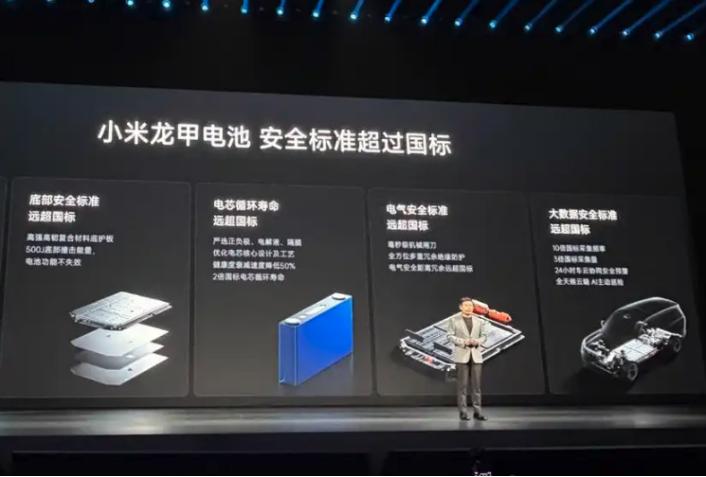
Lei Jun, Chairman of Xiaomi Group, announced the launch of the Xiaomi Dragon Armor Battery system, stating that its safety standards far exceed national requirements.
On September 7, Li Auto announced that all its models will be equipped with self-developed batteries, and all MEGA vehicles locked in for order after that will use the self-developed 5C battery to replace the 5C battery previously supplied by CATL.
In addition, Li Auto also invested 2.65 billion yuan to increase its stake in Sunwoda EV Battery, raising its shareholding to 11.17% and becoming the second largest shareholder to further deepen its partnership with Sunwoda. The pure electric version of the AITO M6 under Harmony Intelligent Mobility is equipped with lithium iron phosphate batteries from Gotion High-Tech, ending CATL's exclusive supply arrangement. CALB has become the largest supplier for XPeng Motors (HK: 9868), and XPeng's entire MONA series is exclusively supplied by CALB, while CATL only retains supply positions in a small number of high-end long-range variants.
The "de-CATL" trend among automakers has eventually set off huge waves in the capital market, with large institutional capital having serious concerns about CATL's future development, leading to continuous selling of CATL's shares and a sustained decline in its share price.
On September 15, CLSA released a research note stating that investors are currently generally concerned about negative factors including the potential hit to demand from rising energy storage system prices that CATL may face, and the possible shift of customers such as Xiaomi Group and Li Auto to other battery manufacturers, with no positive catalysts visible in the short term.
China Energy Net noted that veteran journalist Hu Xijin also stated on social media on September 16 that the narrative of "de-CATL" is escalating, which has affected the capital market's expectation of its future profitability and led to this round of share price decline.
However, Hu Xijin also pointed out that although the "de-CATL" trend has shown initial signs, a large part of it is industry sentiment complaints that have not been fully translated into actual actions, and the narrative is somewhat exaggerated.
Will the "Ning King" be dethroned?
So, will the "de-CATL" trend among automakers really push CATL into crisis? Is CATL's market position still stable?
The 2026 semi-annual report shows that CATL achieved revenue of 2769.17 billion yuan in the first half of the year, a year-on-year increase of 54.8%; its attributable net profit reached 432.84 billion yuan, equivalent to earning 240 million yuan per day, up 41.98% year on year. Its profitability remains extremely strong.
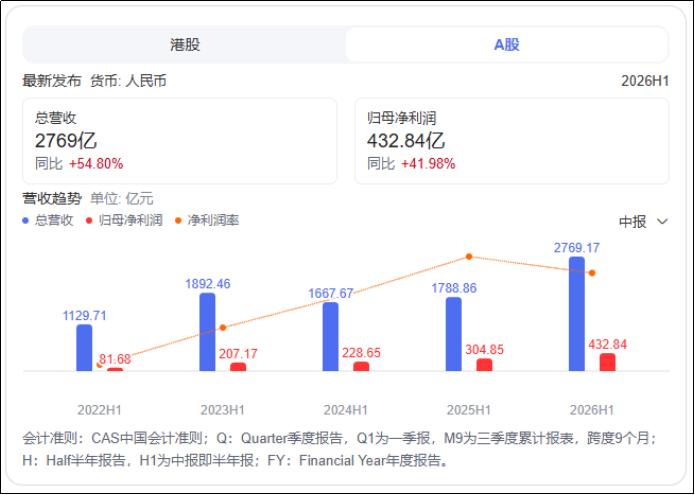
CATL's revenue and profit growth from H1 2022 to H1 2026
In terms of market position, CATL's global power battery market share still ranked first in the first half of this year, reaching 40.2%, up 2.2 percentage points year on year; its energy storage battery shipments also ranked first globally, with a market share of 27.1%. Whether for power batteries or energy storage batteries, CATL's market share is far higher than that of other manufacturers.
In addition, CATL's current capacity utilization rate is close to 95%, its operating cash flow stands at 60.2 billion yuan, and its monetary funds on the books reach 372 billion yuan, far outpacing second-tier battery manufacturers.
All these data indicate that CATL's operation has not been greatly affected, and it is unlikely that automakers and other competitors will shake CATL's market position in the short term.
Although there will be no operational crisis for the time being, the capital market's patience with the "Ning King" is indeed declining. Especially recently, CATL has continuously released positive news, but none of these have dispelled the doubts of the capital market, which is a bad signal.
On July 24, CATL announced the largest share repurchase plan in the history of A-shares, claiming that it will spend 20 billion to 40 billion yuan in real money to repurchase its own shares and cancel all of them. This news brought a short-term rise in CATL's share price, but in the following more than a month, CATL delayed the repurchase action.
It was not until September 14 that CATL disclosed that the company had completed its first repurchase, buying 604,300 shares at a trading range of 330.15 yuan per share to 331.61 yuan per share, with a total cost of about 200 million yuan.
Normally, repurchase news will drive up share prices. However, this news from CATL failed to boost its share price, and instead was followed by a 6.16% plunge on September 15.
On September 15, CATL released two more announcements in a row, disclosing that its subsidiaries will participate in the investment of two venture capital funds respectively, with a total subscribed capital contribution of 1.62 billion yuan, and the investment directions cover the new energy industry chain, artificial intelligence, embodied intelligence and cutting-edge technology sectors.
Against the backdrop of increasingly fierce competition in the lithium battery industry, deploying in fields with broader prospects such as artificial intelligence is a relatively sensible choice. However, this move by CATL was also ignored by the capital market, and its share price continued to decline on September 16.
Confidence is more precious than gold. Although CATL is still the absolute leader in the lithium battery sector, investors have sounded the alarm for it. To achieve symbiosis and win-win results with partners such as automakers, and build solid trust with the capital market, the already powerful CATL may need to demonstrate more flexibility.
This article is from the WeChat official account "China Energy Net", written by Han Chenggong, edited by Wang Dong, and published with authorization from 36Kr.