After the 5.18 billion-yuan fine, Trip.com starts to pay back the cost of its high profits.
The most unworthy-of-explanation figure in Ctrip's Q2 financial report is the 2.458 billion yuan net loss attributable to shareholders.
The 5.18 billion yuan anti-monopoly fine and confiscation took effect in July, and how it is recorded in the income statement is only an accounting issue. What cannot be hidden is that even after excluding the fine, Ctrip's profitability is also declining: total revenue in the second quarter reached 15.663 billion yuan, up 6% year on year; adjusted EBITDA was 4.565 billion yuan, down 6.5% year on year; the profit margin dropped from 33% to 29% in the same period last year. Non-GAAP net profit attributable to shareholders fell from 5.011 billion yuan to 4.798 billion yuan, while sales and marketing expenses increased by 15%.
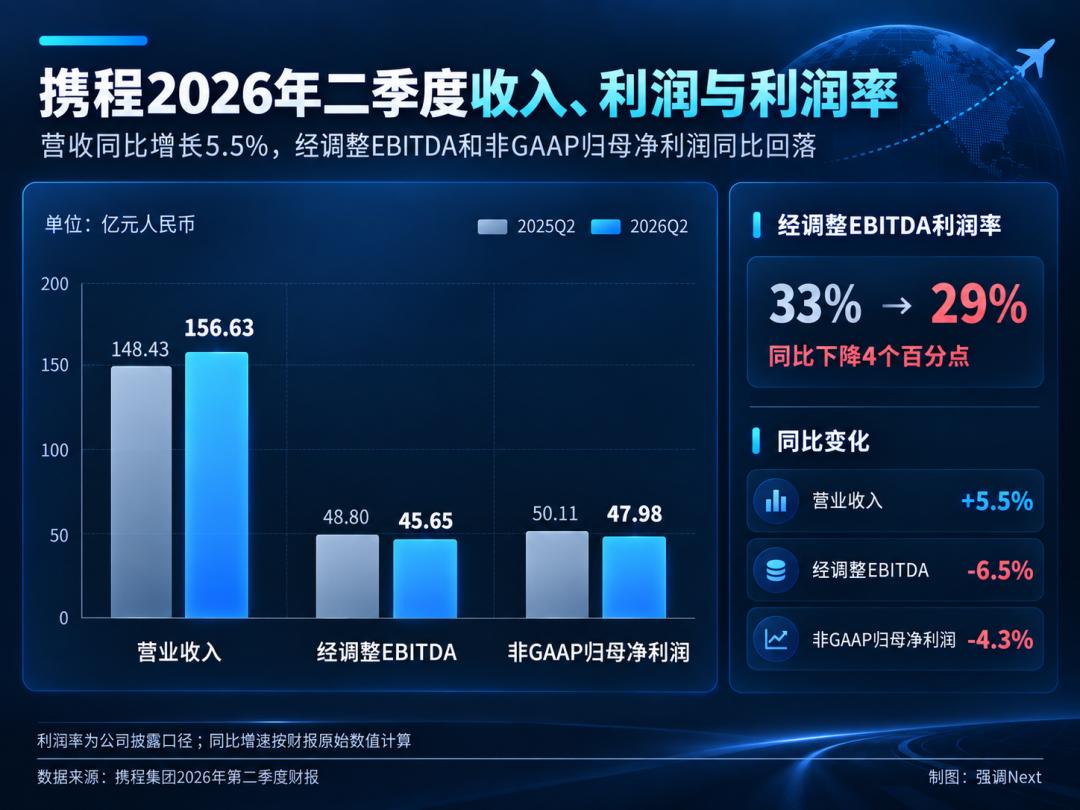
Revenue is still growing, but profits are starting to decline. For every additional transaction Ctrip closes, the cost it has to pay is higher than before.
Revenue is still rising, but profits have already regressed. For every additional yuan of revenue Ctrip generates, the customer acquisition, fulfillment and technology costs it needs to pay are higher than in the past.
This is far more important than a one-off loss. The fine and confiscation only erodes the profit of a single quarter, while the rectification takes away the two tools Ctrip has used for years to turn its market position into high profits: exclusive supply and the lowest price across all platforms.
The fine only explains 0.8 percentage points of the profit decline
The penalty decision from the State Administration for Market Regulation shows that Ctrip restricted hotels from operating on other platforms through cooperation methods such as the "Special Brand" program, while requiring some hotels to provide the lowest price across all platforms, and ensured implementation through methods such as price adjustment tools, traffic restrictions, delisting, and withholding of order reserves.
This mechanism controls both where hotels sell and at what price they sell. Ctrip holds high-value customer groups, and hotels accept the platform's rules to obtain traffic; lower prices and exclusive room types in turn attract users to stay on Ctrip, which is finally reflected in stable commissions and high profit margins.
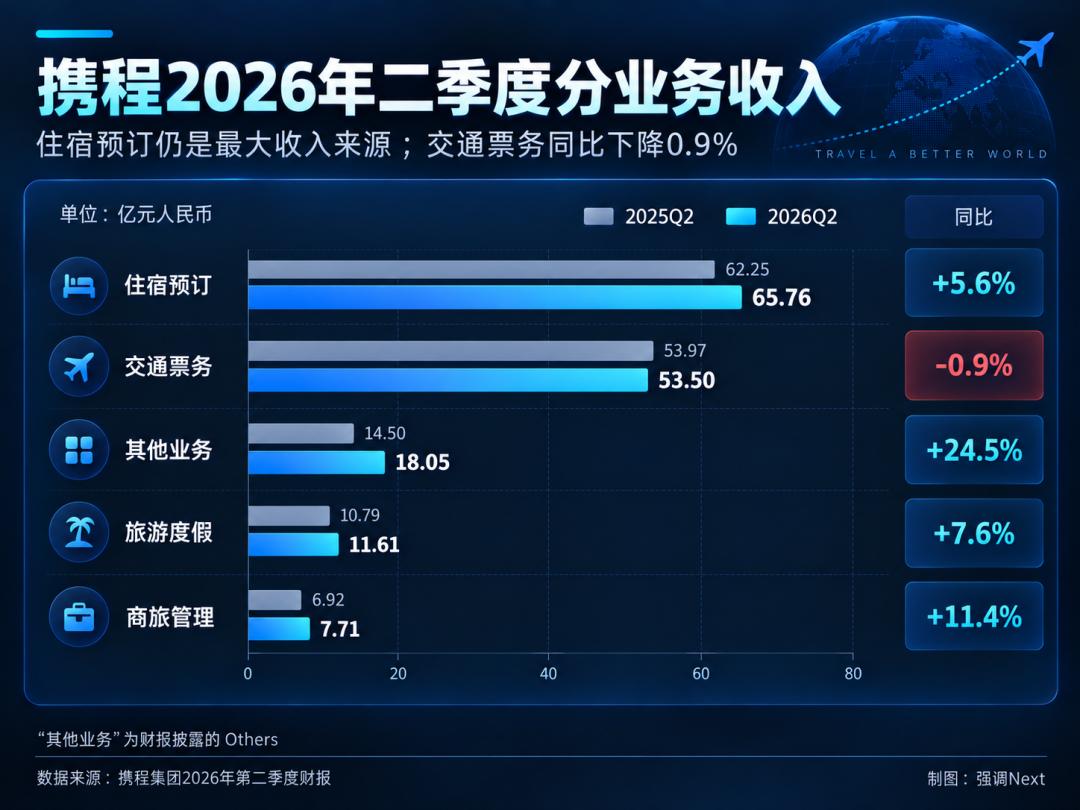
The Q2 earnings report gives the first direct financial impact of the rectification. Ctrip's accommodation reservation revenue was 6.576 billion yuan, up 5.6% year on year, including 122 million yuan in revenue write-offs related to the anti-monopoly penalty. Adding back this amount, the accommodation business actually grew by about 7.6%, and the group's revenue growth rate rebounded from 5.5% to about 6.3%.
The anti-monopoly penalty only dragged down the group's revenue growth rate by about 0.8 percentage points. Even if the full 122 million yuan is regarded as an EBITDA impact, it only accounts for 39% of the year-on-year decrease in EBITDA for the quarter. It cannot explain the entire decline in profits.
The more complete answer is hidden in the expense statement.
In the second quarter, Ctrip's sales and marketing expenses increased by 15.5%, cost of revenue increased by 12.1%, and product R&D expenses increased by 8.3%, all three of which outpaced revenue growth. The sales and marketing expense ratio rose from 22.4% to 24.5%, the cost of revenue ratio rose from 19.0% to 20.2%, and the product R&D expense ratio rose from 23.6% to 24.2%.
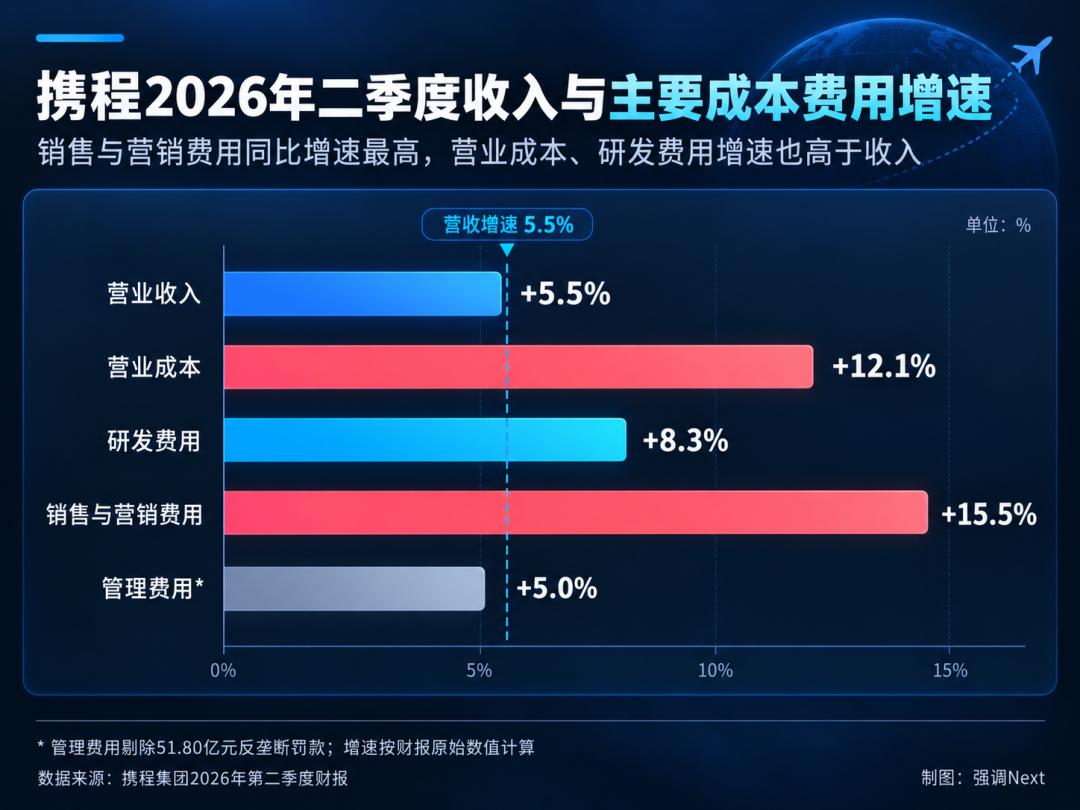
According to the calibre stated in the financial report, the total of the three expense ratios rose by about 3.9 percentage points, which is almost equivalent to the 3.7 percentage point drop in the adjusted EBITDA margin. Excluding the fines and confiscations, the administrative expense ratio remained basically unchanged.
Ctrip's organization and daily management did not deteriorate suddenly. The decline in profit margins comes from more specific aspects: customer acquisition is more expensive, fulfillment costs are higher, and technology investment is still increasing. Ctrip has started to repurchase the conversion rate that was previously achieved through supply control with real money.
The company has cancelled the original primary and secondary distribution plans, replaced them with a new multi-level cooperation system, and adjusted the hotel ranking algorithm. The management also acknowledged that domestic business will experience fluctuations during the period when hotel partners switch to the new model.
The long-term impact will not appear as a sudden disappearance of hotel orders, but will gradually fall on the commission rate, traffic allocation efficiency and subsidy cost. The second quarter only showed the first sign of this trend.
Visitor volume rises, tourism revenue per capita shrinks
Another problem Ctrip encountered is that the domestic tourism market has moved from "recovery" to a stage of "volume growth and price decline".
Data from the Ministry of Culture and Tourism shows that in the first half of 2026, the number of domestic tourist trips reached 34.63 billion, up 5.4% year on year; total tourism spending was 3.21 trillion yuan, with an increase of only 2%. Calculated based on these two growth rates, the average tourism spending per capita decreased by about 3%. The growth rate of tourist trips in the second quarter further dropped to 4.8%.
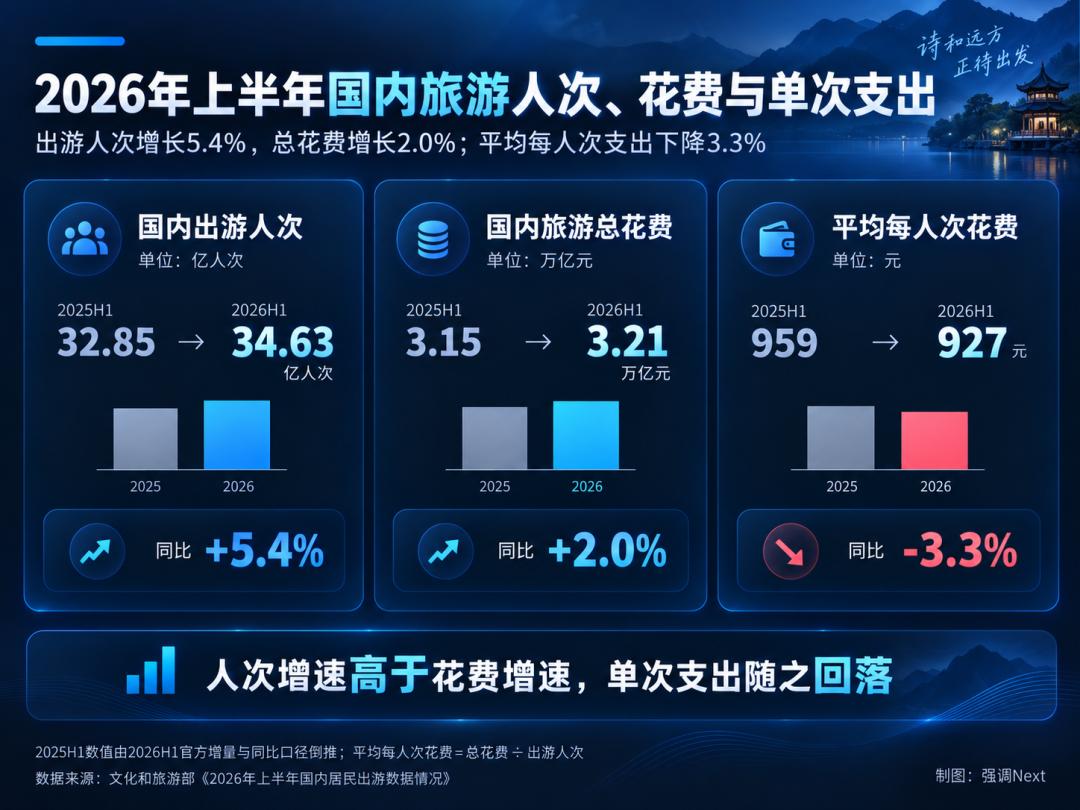
People are still willing to travel, but they pay more attention to the total price of air tickets, hotels and itineraries. Ctrip's revenue grew by 5.5%, which is roughly close to the increase in the number of tourist trips, but its adjusted EBITDA fell by 6.5%. The platform has gained the growth in tourist volume, but has not obtained profits of the same quality.
Accommodation reservation is Ctrip's largest source of revenue, accounting for 42% of the group's revenue in the second quarter; transportation ticket revenue was 5.35 billion yuan, down 1% year on year. Affected by oil prices, geopolitical conflicts and transport capacity, transportation ticketing is inherently more difficult to raise prices stably than hotels, and profit growth ultimately depends on the accommodation sector. But hotel operators are also under pressure.
Huazhu's RevPAR in China region only increased by 1.1% in the second quarter, and its occupancy rate has declined year on year for six consecutive quarters; for mature hotels that have been open for more than 18 months, same-store RevPAR decreased by 3.0%. At the same time, according to media reports, Huazhu's direct sales proportion has long remained at 75% to 80%, and OTA channels only account for 20% to 25%. The harder it is for hotels to make profits, the less reason they have to continue to hand over the lowest prices, memberships and customer relationships to platforms.
In the past few years, the most profitable business for OTAs was the expansion of hotel supply and the revenge travel of consumers. Platforms did not need to own properties, and could draw commissions from each transaction. Now consumers are cutting their budgets, hotels are safeguarding their profits, and regulations prohibit platforms from locking prices. Under the triple pressure, it is difficult for Ctrip to continue to obtain both consumer premiums, hotel concessions and high platform profits.
In the same market, Ctrip's profits decline first
The macro environment is not a universal explanation.
In the second quarter, Tongcheng Travel's revenue was 4.987 billion yuan, up 6.8% year on year; accommodation reservation revenue increased by 8.0%; adjusted EBITDA increased by 7.3%, and adjusted profit increased by 9.8%. Tongcheng's EBITDA margin is only 25.5%, which is still lower than Ctrip's 29%, but one is rising while the other is falling from 33%.
A year ago, the gap in EBITDA margin between Ctrip and Tongcheng was about 7.5 percentage points, and now it is only 3.6 percentage points, which has narrowed by almost half.
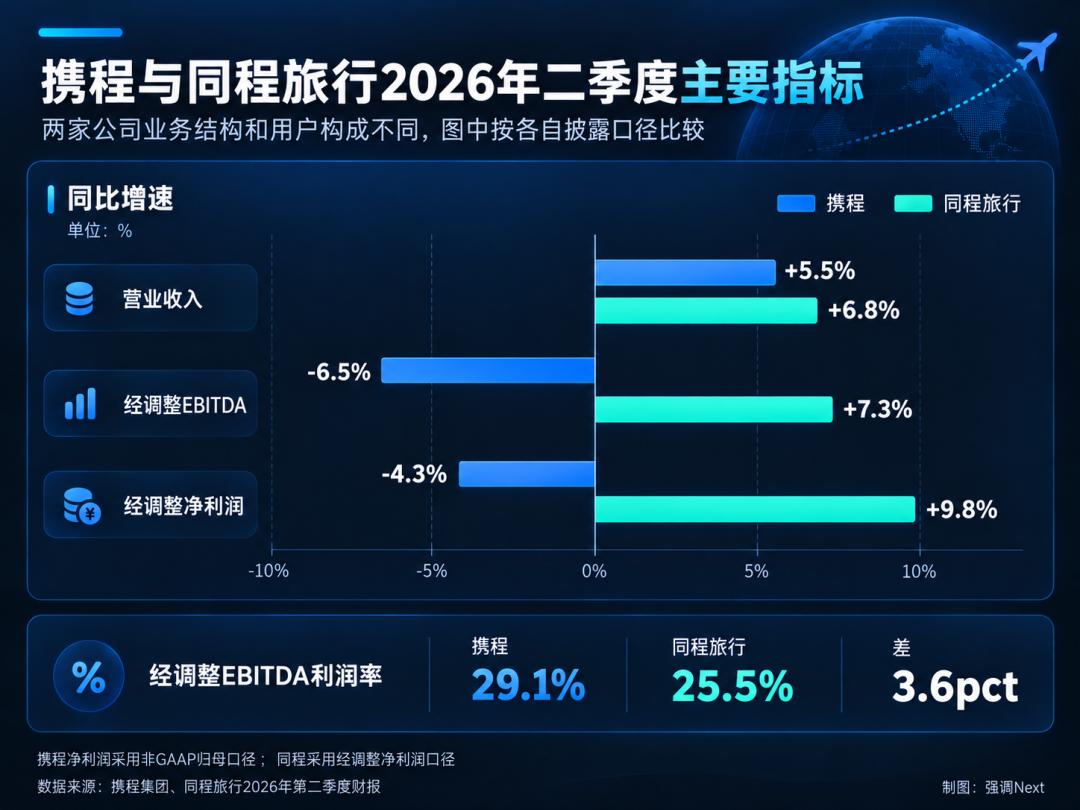
The tourism market is not so bad that all platforms have to sacrifice profits. Ctrip's troubles are more concentrated on itself: it used to enjoy stronger supply control and higher profit margins, and now it is the first to bear the cost of rule changes.
Tongcheng relies on the WeChat entry, lower-tier markets and lower per customer unit price to generate incremental business, and extends its business to hotel management; Meituan, AutoNavi and Douyin capture tourism decisions from local consumption, maps and content scenarios; hotel groups such as Huazhu and Atour retain high-frequency customers in their direct sales channels through membership systems.
What Ctrip is facing is no longer another OTA that copies a list of hotels, but the content entry before transaction, price comparison during transaction and membership relationship after transaction are taken away separately.
Ctrip's most solid assets still exist: mid-to-high end users, cross-category packaging capabilities, complex itinerary processing and after-sales services. When problems such as flight delays, cross-border ticket refunds and changes, and multi-city itinerary failures occur, what consumers need is not a 50-yuan discount coupon, but someone who can handle the order properly. This is also the reason why Ctrip can still maintain a higher profit margin so far.
But service capabilities and market control are two different things. The former should charge for solving problems, while the latter charges by restricting the choices of merchants. The rectification is forcing Ctrip to use the former capability to fill the gap left by the latter profit.
Overseas incremental business requires profit investment first
The answer Ctrip gives is globalization.
In the second quarter, the revenue of its international platform increased by more than 50% year on year, and the revenue from inbound tourism maintained a high double-digit growth. Data from the National Immigration Administration also supports this direction: in the first half of the year, the number of entry and exit personnel nationwide increased by 10.8%, the number of inbound foreigners increased by 20.4%, and the number of visa-free inbound foreigners increased by 30.6%. Cross-border tourism is indeed growing faster than the overall domestic market.
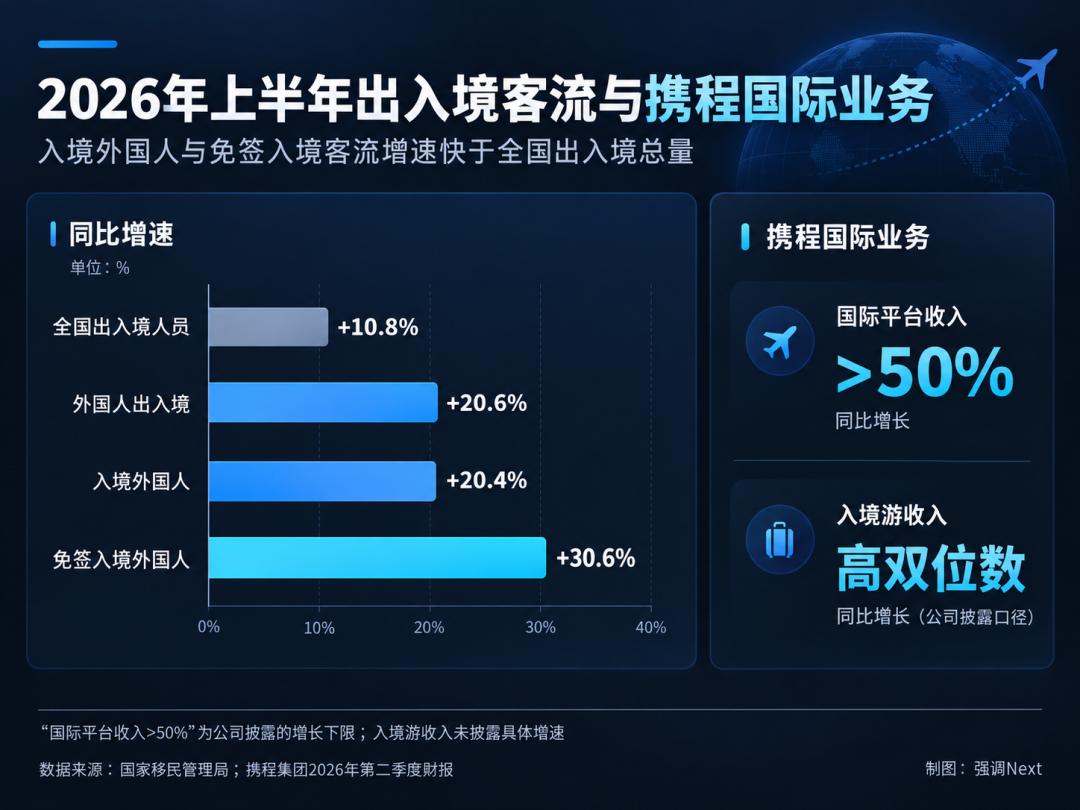
The problem is that the international business is not a translation of the domestic high-profit model.
The "World-to-world" mentioned by Ctrip means that both the source of tourists and the destination are outside China. Ctrip needs to re-purchase brand awareness in unfamiliar markets, supplement local hotel and transportation supply, and handle multi-language, payment, exchange rate, refund and change, and 24/7 customer service. Booking, Expedia and Airbnb have already occupied user mindsets and supply relationships. Every time Trip.com enters a new market, it has to pay for customer acquisition and local operation costs first.
The revenue of the international platform increased by more than 50% in the second quarter, but the group's revenue only increased by 5.5%. The base of the high-growth business is still limited, and the domestic accommodation and transportation sectors continue to determine the group's growth rate. At the same time, Ctrip's sales and marketing expenses increased by 515 million yuan, accounting for more than 60% of the quarter's revenue increment. The company clearly stated that the increase in expenses mainly came from global expansion.
The unit profitability of the Trip.com brand may be improving, but in the group's financial statements, internationalization is still in the investment period. Overseas business has provided revenue increment, but has not yet become the second profit engine.
Ctrip still has 100.5 billion yuan in cash, short-term investments and time deposits on its books, and it is fully capable of fighting this battle. Capital is not the constraint, the rate of return is.
If international revenue continues to grow at a high speed but the marketing expense ratio cannot come down, Ctrip is only using the profits accumulated in the domestic market to purchase overseas scale. Only when international orders form repurchase, supply density and brand mindset, globalization will become the second profit engine.
OTAs cannot only act as toll stations
Ctrip's management repeatedly emphasized "value, experience and service quality" in the financial report, which is not just a public relations statement, because the original profit model has been restricted.
Hotels can operate on multiple platforms, and prices are becoming more and more transparent. In the future, if OTAs want to charge high commissions, they need to prove that they can bring truly new users to hotels, or help consumers complete complex transactions that hotels cannot handle on their own.
AI is further weakening the traditional search entry. In the second quarter, the number of orders assisted by Ctrip's TripGenie increased by about 400% year on year, and nearly 60% of the interactions were related to hotel, air ticket and attraction reservations. The base number has not been disclosed, and this set of data cannot yet prove how much revenue AI has contributed, but it is enough to show that Ctrip is defending new traffic entries.
When users can directly ask Doubao, Wenqian or other AI assistants to compare prices, generate itineraries and place orders, the value of OTAs that only provide search lists will continue to decline. Ctrip must keep TripGenie in front of users, while accessing external AI platforms to avoid retreating to the background and only acting as an inventory and fulfillment supplier.
Hotel direct sales, content platforms and AI assistants can all take away search and price comparison businesses. The only part that Ctrip can charge for in the long term is cross-border payment, dynamic packaging, complex fulfillment and emergency after-sales service.
The value of OTAs is shifting from controlling supply to taking transaction responsibilities.
When evaluating Ctrip in the future, there is no need to focus too much on the return to positive net profit after the penalty. What is more important is whether the accommodation revenue can continue to outperform the industry after the exclusive rules are cancelled; whether the growth rate of sales and marketing expenses