The AI pharmaceutical division spun off from ByteDance has secured a massive 2 billion-yuan first-round financing.
On September 16, Anew Labs, an AI pharmaceutical startup, announced the completion of a $290 million financing round, drawing widespread attention from the whole industry. In addition to setting a new record for the largest single-round financing of domestic AI pharmaceutical enterprises this year and attracting an ultra-luxury investor lineup, the most special point of Anew Labs is that its entire team is derived from ByteDance's AI pharmaceutical business. Up to now, ByteDance still retains a 56% equity stake in Anew Labs.
In fact, Anew Labs is not an isolated case of ByteDance in the AI pharmaceutical field. Isomorphic Labs spun off from Google DeepMind's drug discovery business, EvolutionaryScale founded after being cut by Meta, and BioMap founded under the leadership of Robin Li, founder of Baidu, all were born with sufficient capital support from tech giants, becoming the most dazzling stars in the primary market and being wildly sought after by capital.
These tech giants with ambitions in the pharmaceutical sector have almost become the best talent cradle for AI pharmaceuticals, continuously creating new star projects. For example, Deepspin Technology, which just completed its angel round of financing in August, has its core team coming from Baidu's former AI protein team. Behind the separation and integration between tech giants and emerging AI pharmaceutical enterprises, it reflects a key turning point of AI pharmaceuticals. The growth path of AI pharmaceuticals in the future may be completely different from the era of algorithms, computing power and traffic that tech giants are good at.
ByteDance, Two Emerging AI Pharmaceutical Players
Three months ago, ByteDance spun off its entire AI pharmaceutical business that had been operating internally for 5 years, injecting the core team, algorithm platform and existing pipeline assets into a new entity named Anew Labs.
The team spun off from ByteDance can be traced back to 2020 at the earliest. ByteDance began to lay out the AI drug discovery track in that year and launched special talent recruitment. The team was formally established in 2021 with a total size of about 50 people, composed of AI4S algorithm talents and senior pharmaceutical experts. The leader of the team is Liu Kai, the later founder of Anew Labs. Liu Kai joined ByteDance in 2021. Before that, he worked in IDG Capital and Volcanic Stone Investment for 7 years in venture capital. Now, IDG Capital has become one of the lead investors in this financing round of Anew Labs, which is a later story.
The organizational mode of ByteDance's AI pharmaceutical team was not a pure research group from the very beginning. It undertakes the complete functions from basic model research to industrialization. Therefore, Anew Labs has inherited quite considerable resources, which is enough for it to stand at a starting point much closer to the final goal.
Specifically, the first layer is the model. In 2025, ByteDance's internal AI4S team released the molecular structure prediction models Protenix and Seedfold. In 2026, Protenix was iterated to version v2, and the protein binder design tool PXDesign was launched at the same time. The platforms gradually made public later include AnewSampling, AnewOmni, AnewSynth, AnewFEP, scNext, as well as AnewMind, a large scientific reasoning model for drug R&D decision-making.
The second layer is the pipeline. In April 2026, ByteDance became an unusual participant at the Annual Meeting of the American Association of Immunologists. At the meeting, ByteDance disclosed a preclinical IL-17 small molecule inhibitor, claiming that it is the world's first full-spectrum IL-17 small molecule inhibitor, which can achieve comprehensive blockade of the three subtypes of IL-17 family AA, AF and FF at the small molecule level. In addition, the publicly disclosed drug pipelines of ByteDance currently include IL4R and two projects with undisclosed targets, totaling four candidates, all of which are in the preclinical stage.
The third layer is the organization and capital structure. After the spin-off, Anew Labs takes Yangpu, Shanghai as its domestic headquarters, and sets up offices in San Jose and Singapore at the same time. ByteDance continues to provide computing power support from Volcano Engine. With the support of ByteDance, the investors of this round of Anew Labs include HSG (formerly HSG China), IDG Capital, GL Ventures, co-led by 5Y Capital, with participation from Gaorong Ventures, Chunhua Ventures, Boyu Capital, and Shanghai Future Industry Fund and China Biopharmaceuticals are also on the investor list.
As for the reason for the spin-off, ByteDance's official statement points to one thing: the industry logic and management mode of AI pharmaceuticals are different from ByteDance's other businesses, so it is necessary to establish a suitable organizational incentive form with an independent entity. According to Reuters sources, this decision is intended to promote the long-term development of the business.
In fact, Anew Labs is not the only star AI pharmaceutical project created by ByteDance. Gu Quanquan, who left ByteDance in June 2026, announced the establishment of Geodesic Intelligence on September 10, and simultaneously released three products: NovaDDE, a scientific reasoning agent platform for drug discovery, NovaAtom-Lite-Preview, the first preview version of the all-atom structure prediction model NovaAtom, and NovaLab, a self-built automated wet laboratory. Geodesic Intelligence is positioned to connect agents, foundational models and wet experiment closed loops, focusing on AI-driven new drug discovery. Before leaving ByteDance, Gu Quanquan once led ByteDance's SeedFold, SeedProteo and DPLM series of large protein models, which are not the same entity as the AI pharmaceutical business line injected into Anew Labs.
Tech Giants and Their Uninternalizable Pharmaceutical Ambitions
Apart from ByteDance, the world's most top-tier AI pharmaceutical enterprises at present also all originated from tech giants.
In 2019, Alexander Rives, an algorithm researcher at Meta's AI research institute FAIR, launched the ESM project to build a protein language model that allows machines to read protein sequences. The first-generation model ESM1b was trained with about 27 million protein sequences. In 2022, the parameters of the second-generation model ESM2 reached 15 billion. The supporting structure prediction model ESMFold predicted more than 600 million protein structures from the collection of all microbial genes in the environment, with quite powerful performance. By 2023, Meta proposed to reduce costs and increase efficiency, cutting 10,000 employees in one year, and the AI protein research team led by Alexander Rives was also laid off. It is claimed that the reason Meta gave for the layoff at that time was that the team was too academic, and the company wanted to shift to profitable projects.
Subsequently, 8 founding members of this team set up their own business, continued to use the ESM name to found EvolutionaryScale, with Rives serving as CEO and chief scientist. Regarding this change, Rives said that the team was about to push the model to the next level, and Meta was not a biotechnology company. In June 2024, EvolutionaryScale completed a $142 million seed round of financing, with Amazon and Nvidia NVentures participating. In July of the following year, EvolutionaryScale announced the completion of Series A financing, raising about $540 million, with a valuation of about $3.3 billion.
At the same time, EvolutionaryScale's products were iterated rapidly. The parameters of the third-generation model ESM3 reached 98 billion, and its representative achievement esmGFP has about 58% sequence similarity with the known green fluorescent protein. EvolutionaryScale does not build its own pipelines, and only provides authorization cooperation to pharmaceutical companies through the Forge platform. In November 2025, EvolutionaryScale was acquired by Chan Zuckerberg Biohub, the charity research institution of Mark Zuckerberg and his wife. The whole company was merged into the institution, and Rives became the head of science at CZI.
In November 2021, DeepMind, Google's AI company, spun off its drug discovery business and established AI pharmaceutical company Isomorphic Labs. Demis Hassabis, co-founder and CEO of DeepMind, also served as founder and CEO of the new company, which was wholly owned by parent company Alphabet. In 2024, Demis Hassabis shared the Nobel Prize in Chemistry for developing AlphaFold, an AI model that can predict protein structures.
Capital entered the market faster than expected. In March 2025, Isomorphic Labs' first external financing round was led by New York venture capital firm Thrive Capital for $600 million. In May of the following year, sovereign wealth funds from Abu Dhabi, Singapore, the United Kingdom and other regions participated in Isomorphic Labs' Series B financing, with a financing amount as high as $2.1 billion.
Isomorphic Labs' technological and commercialization progress is equally amazing. In February 2026, IsoDDE, a self-developed drug design engine released by Isomorphic Labs, claimed that it increased the accuracy of predicting the binding structure of proteins and small molecules from 23.3% of AlphaFold 3 to about 50%, raised the accuracy of predicting the binding structure of antibodies and antigens from 17% to 39%, and the affinity index for predicting the binding strength of drugs and targets was also claimed to exceed traditional physical simulation methods without requiring experimental crystal structures.
Although it has not yet established a dry and wet experiment closed loop to verify the model's capabilities, Isomorphic Labs has established commercial cooperation with many MNCs. In January 2024, Isomorphic Labs signed a multi-target small molecule cooperation agreement with Eli Lilly, with a down payment of $45 million and milestone payments of up to $1.7 billion. Two days later, Novartis joined, with a down payment of $37.5 million and milestone payments of up to $1.2 billion. In January 2026, Johnson & Johnson joined, covering new drug forms such as small molecules, biologics, peptides and molecular glues, and the total potential scale of the two disclosed cooperations is nearly $3 billion.
In China, the pharmaceutical ambitions that tech giants are unwilling to internalize have also created star AI pharmaceutical projects and extreme product forms in the primary market. In August 2020, Robin Li, founder of Baidu, led the establishment of BioMap and served as its chairman. In the early stage of its establishment, he held about 40% of the shares directly and indirectly. The technical base of BioMap is the xTrimo multimodal life science large model, with the latest parameters of 268 billion, which is claimed to be able to compress the R&D cycle from 5-10 years to 1-2 years. Its commercialization covers more than 800 institutional users around the world.
One of the most notable transactions of BioMap is the cooperation with Sanofi, with a $10 million down payment and a potential total value of more than $1 billion. In addition, in June 2026, BioMap and Harbour BioMed jointly established MegaStream TechBio, transforming from an AI platform to an AI + Biotech entity. Before that, in March 2026, BioMap submitted its listing application to the Hong Kong Stock Exchange in a confidential form to sprint for IPO.
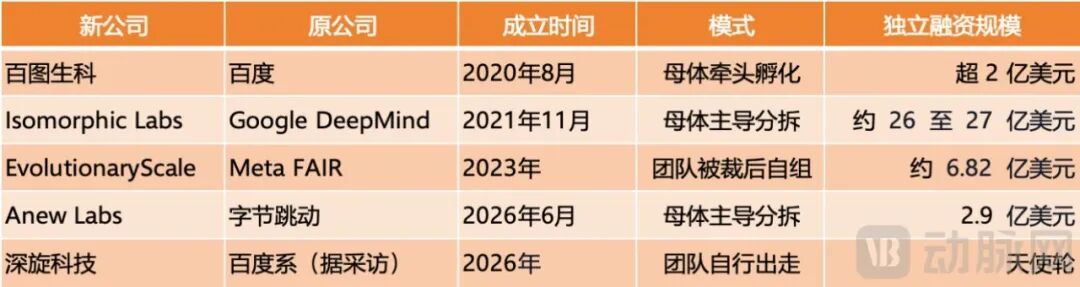
Data sources for some AI pharmaceutical teams that spun off from tech giants: VCBeat Database
Interestingly, in August 2026, Deepspin Technology, an AI pharmaceutical startup located in Nanshan, Shenzhen, completed its angel round of financing, with investors including BlueRun Ventures and Shuimu Tsinghua Alumni Seed Fund. All core members of the company came from Baidu's AI protein research team. Deepspin Technology bets on a rarely noticed indicator by the outside world, the legality of structures, and has released the general biomolecule foundational model Melo-1 Preview, claiming that multiple indicators exceed AlphaFold 3.
Although the modes of separation and integration are not exactly the same, these AI pharmaceutical teams that left tech giants have similar extreme technical capabilities and technical pursuits. Perhaps for capital that has always been chasing high returns, compared with the gimmicks repeatedly mentioned by the media, the unique sensitivity to technological trends and gaps formed by these AI pharmaceutical teams after years of immersion in tech giants is the most scarce element.
The Turning Point of AI Pharmaceuticals: The Pure Tech Approach No Longer Applies?
In a sense, the reason why AI4S teams leave tech giants is not the business itself, but the mismatch of operation modes.
On the one hand, tech giants settle accounts on a quarterly and annual basis, and assess the demonstrable results in the current period. Drug R&D takes a decade as a cycle, and most projects may be eliminated in the middle stage. There are similar differences in talent pricing. Overseas Biotechs price scientists with options and milestone payments, but the compensation system of tech giants cannot provide these two tools. Tech giants have no shortage of computing power, capital and talents, but lack the patience to assess projects with a ten-year cycle, the evaluation mechanism that accommodates high failure rates, and the incentive tools to price biomedical talents. The difference lies in the operation mode of the organization, and has nothing to do with the scale of investment.
On the other hand, and more importantly, the technical level of mismatch is more direct. Tech giants are best at making models larger and approaching the upper limit through the scale effect of computing power, but this logic fails in AI4S, because the end point of drug R&D is not in the digital world. Language models process texts written by humans, while the properties of proteins and molecules are determined by physical laws. A difference of several angstroms in a hydrogen bond is enough to change a candidate molecule from bindable to unbindable.
The methodology thus diverges. One path continues to build larger models and brush performance rankings; the other path integrates physical constraints and experimental data into the model, so that the algorithm is physically valid and can be verified by wet experiments. For physical and chemical modeling, high-quality experimental data and wet experiment closed loops, tech giants have neither accumulation nor easy access to internal support. Computing power can build larger models, but cannot produce experimental data and mechanism understanding that can only be obtained through years of engagement with wet experiments, and such investments are also difficult to pass the internal project approval process.
Of course, not all tech giants can't find a way to be compatible with AI pharmaceuticals. Huawei has established a pharmaceutical corps, which only focuses on underlying technologies and does not develop its own pipelines. Tencent focuses on capital investment, heavily investing in Insilico Medicine and XtalPi. Ali Health and JD Health focus on medical AI and medical services. Overseas, OpenAI cooperates with Novo Nordisk, and NVIDIA cooperates with Eli Lilly in the form of investment or partnership.
The advantages of separating tech giants from AI pharmaceuticals are obvious. Drug R&D has almost no positive cash flow in the first ten years, which requires a shareholder structure that can withstand long-term no dividends and continue to increase investment. The financial system of tech giants and the public market cannot provide such a structure, but the Biotech equity in the primary market can. Therefore, independent entities can use the Biotech equity structure to recruit talents, and allow the capital market to price separately. Anew Labs obtained $290 million in financing just three months after the spin-off. The incentive tools have also been replaced at this step: options and milestone payments replace annual salaries and job levels, and the returns of scientists are linked to the risks they take. Another practical reason for independence is that the dry and wet closed loop requires design, experiment and judgment to be completed by the same team, while the project system of the parent entity separates these three things into different budgets.
However, the parts that cannot be solved by separation are also clear. It changes the investors and incentive methods, but does not change the success rate of science. The cost and elimination rate of clinical trials will not change due to the change of equity structure. There is no direct correspondence between the financing scale and clinical results. Isomorphic Labs has raised about $2.6 billion in five years, and the total value of its two disclosed cooperations is nearly $3 billion, but no molecule has entered human trials so far. In addition, independence does not mean a safety margin. Recursion Pharmaceuticals recorded a net loss of more than $600 million in 2025 and drastically cut its pipelines, and BenevolentAI was delisted the following year.
In essence, the separation of tech giants and AI pharmaceuticals is a redistribution of risks. Whether this redistribution can bring benefits can only be judged when the molecules designed by AI can truly pass clinical trials in batches and enter application scenarios.
This article is from the WeChat official account "VCBeat" (ID: vcbeat), author: WANG Shiwei, authorized for release by 36Kr.