Fierce "De-Ninghua" Trend: The Counteroffensive of Second-tier Battery Manufacturers
In 2026, a subtle shift of power is taking place in the power battery industry.
At the beginning of September, all automakers successively released their performance reports. Against the backdrop of fading subsidies and slowing market exit, vehicle manufacturers are facing tough times. CATL, which was the first to release its results, has been pushed to the forefront of public attention, with claims that "the profit of this single battery maker is higher than the combined profit of 15 A-share listed vehicle manufacturers". Four years ago, the "working for others" theory put forward by Zeng Qinghong, Chairman of GAC Group, seems to have become a reality.
The public opinion advocating "de-CATL" is growing increasingly fierce at the moment. But this time, second-tier battery manufacturers seem to have found a way to break the deadlock, sounding the clarion call for counterattack through the cell direct supply model.
01 CATL takes the lion's share, second-tier players get the leftovers
At the 2026 China Power Battery Conference, Yin Tongyue, Chairman of Chery, made a remark that caused a huge stir: "The industry agreed to share risks and achievements, but now battery manufacturers are taking a larger share of the benefits."
Judging from the interim reports, this statement is not wrong. It is not just CATL that is in the spotlight: among the top 10 battery manufacturers by global market share, Chinese enterprises account for half. However, from a fundamental perspective, we believe it is obviously biased to attribute the criticism to second-tier battery manufacturers alongside CATL.
(1) Industry beta drives growth, but the total increment of four battery manufacturers is only 40% of CATL's
Excluding CATL, four leading second-tier battery manufacturers (CALB, Gotion High-Tech, EVE Energy, Sunwoda, all ranking within the top 10 in market share) recorded a total revenue increase of 47.8 billion yuan in the first half of this year compared with the same period last year, nearly half of CATL's increment.
It seems that the cyclical dividend of the entire battery industry has eaten up the market profits. But if we break down this 47.8 billion yuan increment in detail, we will find that the second-tier battery manufacturers have not gained much dividend in the passenger vehicle power battery sector:
· Of CALB's 10.67 billion yuan increment, 4.82 billion yuan comes from the energy storage business, accounting for nearly 50% of the total increment, while the power battery increment is only 5.84 billion yuan, which also includes the increment from commercial vehicles.
· Of EVE Energy's 17.5 billion yuan increment, energy storage batteries grew by 4.8 billion yuan, consumer batteries grew by 1.33 billion yuan, and the increment of power battery products was only 4.53 billion yuan.
· Of Sunwoda's 11.1 billion yuan increment, energy storage batteries grew by 3.34 billion yuan, and electric vehicle batteries grew by 6.53 billion yuan.
Only Gotion High-Tech, which has the smallest increment, derived almost all its growth in the first half of the year from power batteries. In total, of the 47.8 billion yuan net increment, the increment of power battery products is 25.36 billion yuan, accounting for 53%, only about half of the total.
The fanfare of the boom is obviously mixed with exaggeration. In the first half of the year, CATL's power battery increment disclosed in its financial statements reached 605.2 billion yuan. The total net increment of the four leading second-tier battery manufacturers is only about 41.9% of CATL's.
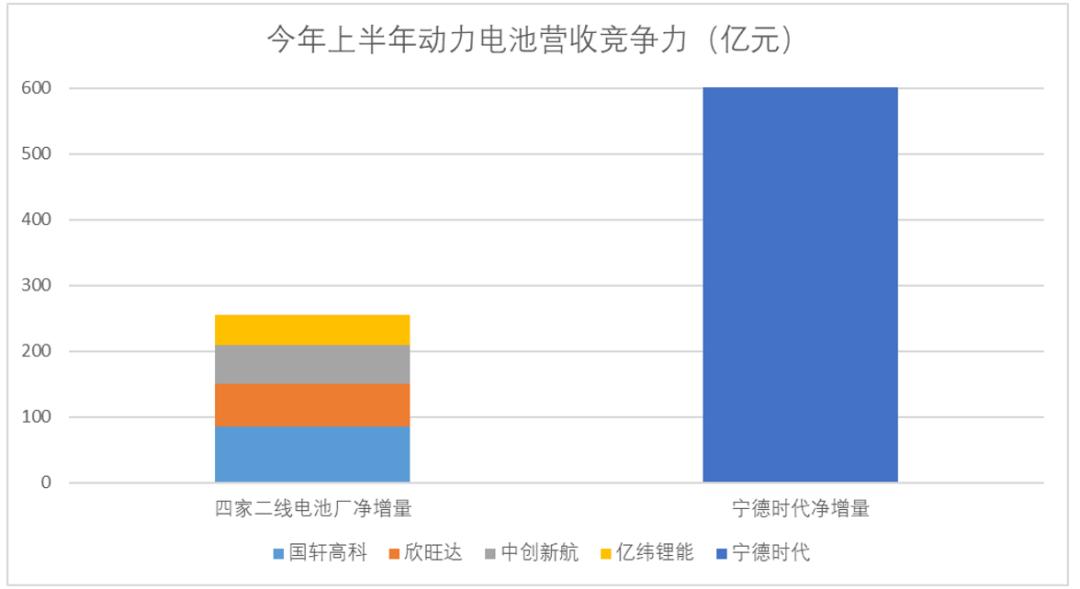
At the end of last year, this figure was 46.7%. Although second-tier battery manufacturers delivered solid performance in the first half of the year, this was mostly driven by industry beta, rather than snatching more market share from CATL.
(2) Locking prices, seizing share, CATL wants to take all the benefits
From CATL's perspective, it definitely wants to seize more market share through this upward cycle of industry beta, rather than just reaping profit returns. As we mentioned in the previous analysis of CATL's Q2 financial report ("CATL's anxiety is exactly the same as NVIDIA's"): grabbing market share is CATL's top priority.
The core reason is that at the current window, CATL has two core advantages that cannot be shaken in the short term:
First: The cost advantage brought by more upstream mineral rights holdings will be amplified during the price upward cycle.
Since the average domestic battery-grade lithium carbonate price hit the bottom in June 2025, it has risen by more than 300% cumulatively by the peak in April-May this year. If the price system transmits normally, downstream demand will definitely shrink.
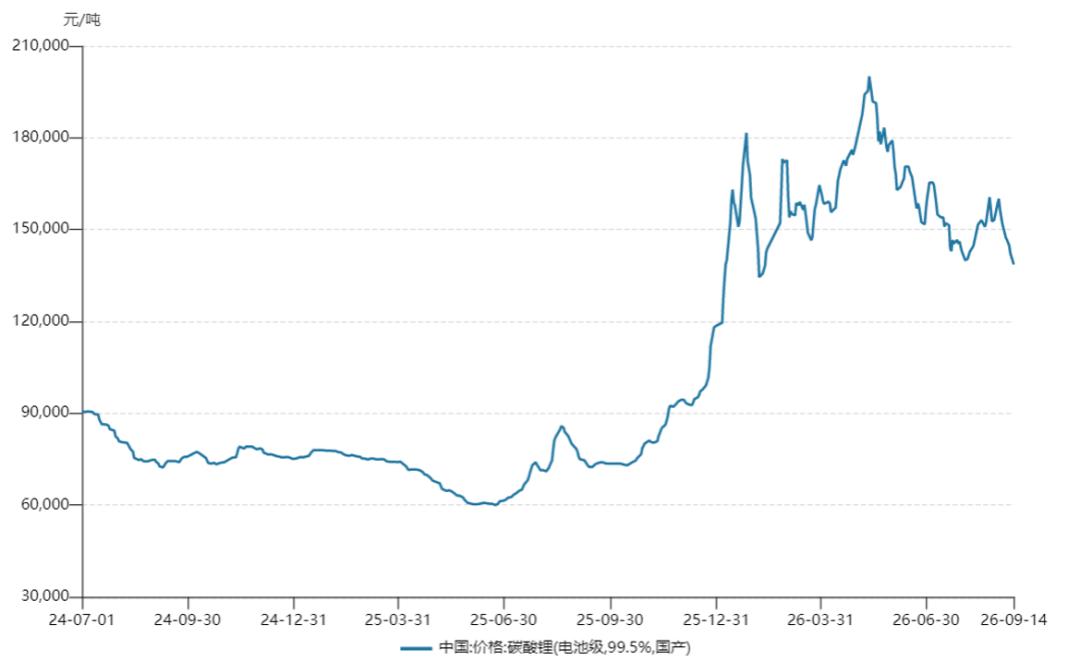
CATL has been continuously deploying upstream resources in recent years, with moves in Indonesia, Yichun of Jiangxi, and shareholding in China Molybdenum, which will undoubtedly greatly reduce its cost pressure. According to previous reports from China.com, the self-sufficiency rate of CATL's key metal resources has reached 35%, far exceeding the industry average of 10%-15%. According to the calculation of Soochow Securities, its self-owned lithium mine deployment alone can reduce its cost by 10%-15%.
Second: In the current consumer market, the brand recognition of power batteries is split between CATL and all other brands.
CATL has been strengthening brand building since 2022. In the first half of this year alone, CATL's sales expenses increased by 33.4%, with intensive advertising placement. In the Brand Finance 2025 Top 500 Chinese Brands, CATL's brand value reached 19.64 billion US dollars, up 3.2% year on year, ranking 20th.
Except for BYD's FinDreams which produces batteries for self-use, all other battery brands are generally perceived by consumers as "not CATL" when it comes to vehicle sales.
Based on the above two points, it is actually very easy for CATL to convert its advantages into tangible profits. But the reality is that the gross profit margin of CATL's power battery business in the first half of 2026 has dropped by 321bps, narrowing the gap with second-tier battery manufacturers such as Sunwoda and CALB.
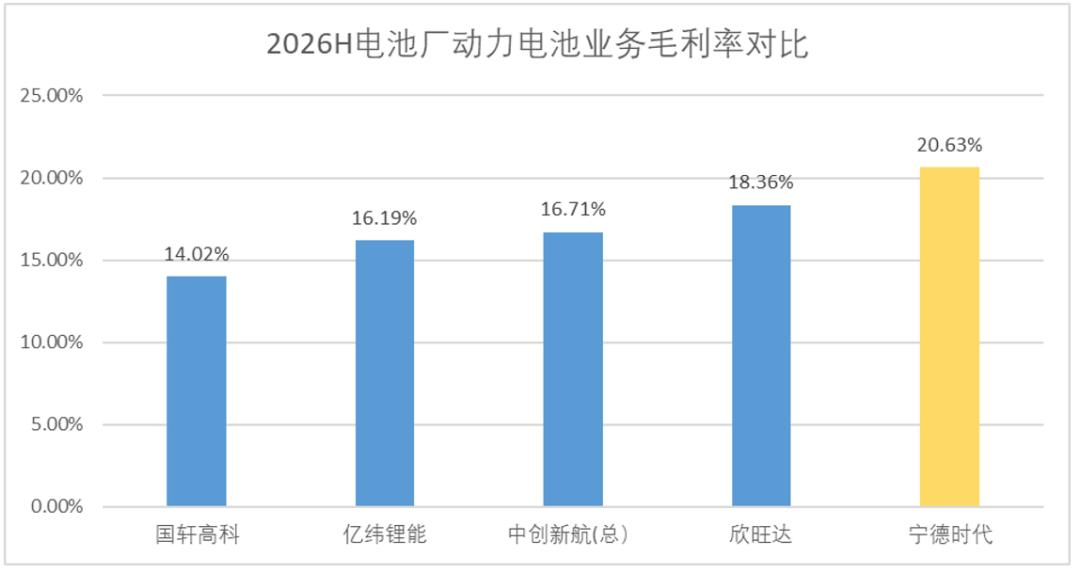
The only plausible explanation is that CATL is deliberately lowering its shipment price in exchange for more market share, which also explains why CATL was able to capture more new increments in the first half of this year.
02 Leave a gap for the besieged, demand spillover leaves room for opportunity
In the theory of industry life cycle, economists Michael Gort and Steven Klepper, professor of economics at Carnegie Mellon University, through empirical research tracking the market evolution of 46 products, put forward a classic statement of the expansion phase: during the dividend period of industry development, the concentration degree is more likely to decline.
For CATL, although it is unwilling to easily give up its market share, the industry is currently in the expansion dividend period, and there are still opportunities for second-tier battery manufacturers to benefit from CATL's capacity spillover. There are two main reasons:
(1) CATL intentionally holds back inventory, with inventory growth far higher than second-tier battery manufacturers
Although we have been emphasizing that grabbing market share is CATL's top priority at the current stage, CATL obviously has concerns about the pace of market expansion. Whether it is antitrust supervision or the relationship between upstream and downstream of the supply chain, CATL obviously does not want to attract too much public opinion pressure.
In its statement during the interim report period, CATL revealed that its battery system production capacity in the first half of the year was 525 GWh, and its output was 498 GWh. The calculated capacity utilization rate is as high as 94.86%, close to full production. The capacity utilization rate of the four second-tier battery manufacturers ranges from 65% to 86%.
From the disclosed capacity, Gotion High-Tech's total capacity is about 130 GWh, EVE Energy will have about 200 GWh by the end of 2026. Sunwoda and CALB have not disclosed their capacity figures, but according to their capacity layout, the capacity put into operation at the current stage is probably around 120 GWh. The total capacity of the four manufacturers is not much different from that of CATL.
Judging from the inventory balance, the current inventory level and net growth of CATL are significantly higher than the total of the four second-tier battery manufacturers.
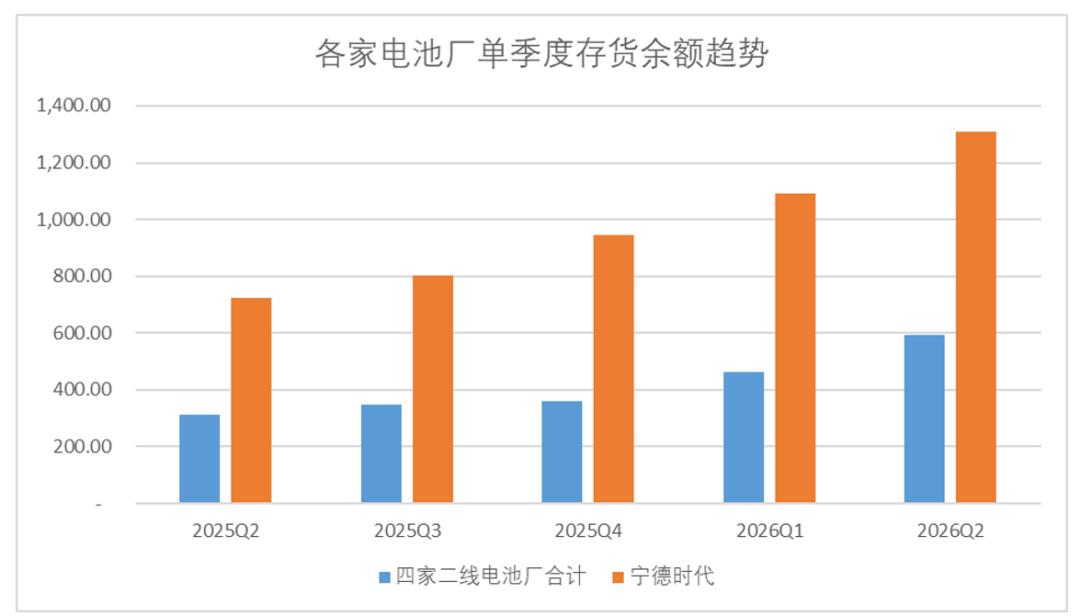
Even with different capacity utilization rates, the net increment of CATL's inventory level is obviously far higher than the reasonable level of the total of second-tier battery manufacturers. It is very likely that CATL is actively holding back inventory to keep the share growth rate from rising too fast.
(2) Sales volume declines, but the average battery capacity per vehicle increases sharply
Since the beginning of this year, the overall growth rate of new energy vehicles has slowed down significantly. According to data from the China Association of Automobile Manufacturers, in the first half of 2026, the output and sales of new energy vehicles in China increased by 6.7% and 7.3% year on year respectively, significantly lower than the same period last year.
The most obvious perception in the automotive industry is that affected by the fading subsidies, the market increment has slowed down.
But at the same time, as vehicle configuration becomes increasingly competitive, cruising range has basically become the core quantifiable competitiveness of various products. Without large-scale technological iteration, the only way to increase cruising range is to expand battery capacity.
From 2022 to 2024, the average battery capacity per vehicle was in the range of 46kWh to 47kWh, with very slow growth. But in 2025, the trend reversed, and the average capacity rose to 53.1kWh. From January to April 2026, the average battery capacity per vehicle has reached 67.8kWh, up 33.8% year on year.
This means that the total battery value of two new vehicles in 2026 is enough to produce three vehicles in 2024. Therefore, although the downstream sales growth rate slows down, the increment of battery manufacturers still exists.
On the one hand, CATL is either deliberately holding back inventory or facing real capacity constraints, on the other hand, the increment of battery shipment volume remains. All in all, for second-tier battery manufacturers, even if CATL seems unbreakable, the spilled demand still brings strong industry beta in the short term. This is undoubtedly a counterattack window for second-tier battery manufacturers.
Nowadays, automakers have also handed the weapon to second-tier battery manufacturers.
03 Counterattack against CATL: Cell direct supply model becomes a heavy weapon
In this year's interim report period, EVE Energy separately disclosed the operating revenue of battery materials in its segmented business income. Although it did not specify the definition of battery materials, part of it may come from the trade of precious metals in the upstream industrial chain, and part may come from the non-product direct supply to downstream customers.
In fact, since the beginning of this year, automakers have found a new "self-development" model to hedge the risks of restricted battery supply and potential high cost. The core method is cell direct supply.
Last November, the unified standard cell tailor-made by Gotion High-Tech for Volkswagen has entered the stage of large-scale mass production and delivery.
In April this year, Tesla announced the adoption of the "cell procurement + independent assembly" model, purchasing power cells from Sunwoda and completing the assembly of modules and battery packs (PACK) on its own.
In September, after completing the shareholding in Sunwoda, Li Auto announced that its new generation L8 has fully switched to Sunwoda cells, and the battery pack is produced by a joint venture between Li Auto and Sunwoda.
Also in September, four extended-range SUVs of Xiaomi's Pengcheng series were officially launched, all equipped with Xiaomi's Dragon Armor battery. Among them, the 76kWh ternary system Dragon Armor battery for three high-end models is supplied by CALB.
There is no doubt that almost all leading automakers have completed the adaptation with second-tier battery manufacturers within this year, and most of them adopt the model of cell direct supply + automaker assembly. This cell direct supply model has indeed hit the core weakness of CATL at the current stage:
First, the Pack cost and profit are transferred to automakers. Battery manufacturers earn a little less, but CATL's brand competitors will change from second-tier battery manufacturers to automakers, and automakers can reduce the cost of brand premium.
The cost of power battery system is composed of the comprehensive cost of cells, structural parts, BMS, box, auxiliary materials and manufacturing expenses. According to previous reports from Autohome, the general Pack cost of passenger vehicles is about 0.25 yuan/Wh, and that of buses is about 0.23 yuan/Wh. Cells account for about 80% of the total cost, and Pack cost accounts for about 20% of the total battery pack cost.
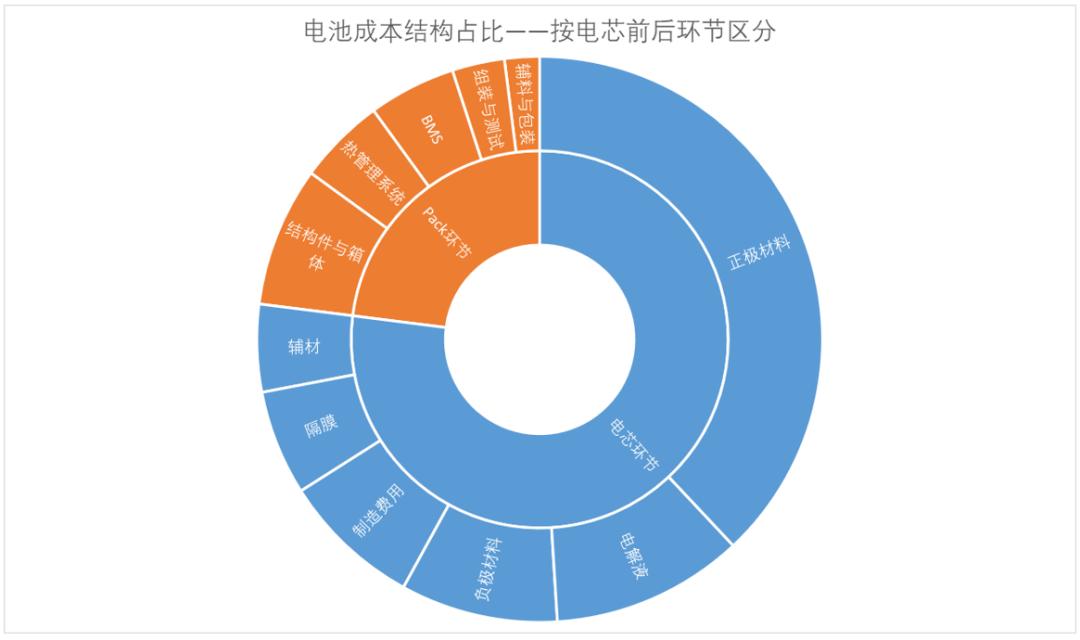
Figure: Breakdown of battery cost structure, source: Autohome, collated by Financial Report Journal
At the same time, the Pack link is also the link with the most concentrated gross profit margin, including battery brand premium and adaptation cost. As mentioned earlier, even when CATL is actively lowering its gross profit margin, its brand premium (relatively higher gross profit margin) is still about 3%-4%.
Assuming that the gross profit margin of the Pack link is 15%, and the battery cost accounts for 40% of the vehicle cost, under the cell direct supply + automaker assembly model, the overall gross profit margin of the automaker can be increased by 1.2%, and with the brand premium, it can reach about 4%-5%.
For new energy vehicle manufacturers facing extremely fierce involution at the current stage, cell direct supply is obviously a more economical approach.
Second, under the market promotion caliber, the stubborn problem of battery brand dependence can also be solved together. At the current stage, the core demand factor of the consumer market for batteries is safety.
In the past, as long as automakers adopted finished products from second-tier battery manufacturers, their brand value would be lowered, because second-tier battery manufacturers did not have the ability to spend huge sums of money on marketing their safety performance. If the finished products are branded by automakers, the situation will be significantly