Is Geely, which sold its factory to CATL, more responsible than "the likes of Xiaomi"?
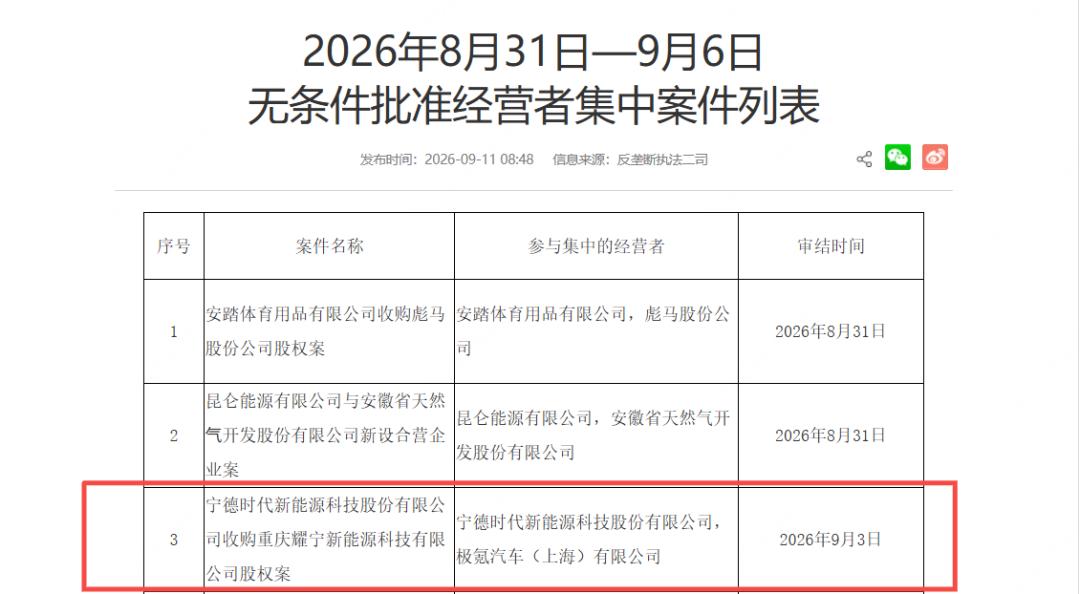
On September 11, the State Administration for Market Regulation released its latest batch of unconditionally approved operator concentration cases, including the case of CATL acquiring the equity of Chongqing Yaoning New Energy Technology Co., Ltd.
Chongqing Yaoning New Energy Technology is a power battery factory deployed in the Geely system. The project has a planned production capacity of 30GWh, and was once regarded by the market as a key layout for Geely to improve its power battery industry chain.
Once the news came out, different interpretations quickly emerged in the market, among which the claim that Geely is abandoning self-developed batteries spread rampantly.
After all, new energy vehicle enterprises have been strengthening their battery layouts in the past few years. New players such as Xiaomi and Li Auto keep emphasizing self-developed batteries, hoping to master more core technologies; but Geely has taken the opposite path this time, handing over battery assets to CATL, which is also regarded as a strategic concession.
On September 16, Geely responded to this, stressing that Geely has not abandoned self-developed batteries, and the statement of "8.5 billion yuan investment" is not accurate. Geely said that Chongqing Yaoning is a newly built factory, and the relevant cooperation is only part of the strategic cooperation between Geely and outstanding external battery manufacturers, which does not mean that Geely gives up self-development or reduces the proportion of self-development.
Why did Geely choose to let Zeekr join hands with CATL to become the operator of the new battery factory when Xiaomi and other brands are turning to second-tier battery manufacturers? Since Geely has not abandoned self-developed batteries, why did it choose to hand over battery assets like Yaoning to CATL?
Lessons from Zeekr, Not a Precedent for Follow-up
Before choosing the battery route of "self-development + leading supplier", Geely has actually explored more diversified supply chain models.
In the early stage of the rapid development of new energy vehicles, power batteries once became the biggest anxiety of automakers. On the one hand, the sales of new energy vehicles grew rapidly, and the demand for batteries was released quickly; on the other hand, CATL quickly took the leading position in the industry with its scale advantage, and automakers gradually lacked bargaining power in the supply chain.
For complete vehicle enterprises, it is not the most ideal choice to completely rely on a single supplier for core components. Therefore, supporting more battery suppliers and establishing a diversified supply system became the choice of many automakers at that time, and Geely also explored its own power battery layout through investment, cooperation and other methods.
Among them, the cooperation with Sunwoda is a typical attempt. In 2021, Geely and Sunwoda jointly established Shandong Geely Sunwoda Power Battery Co., Ltd., planning to deploy power battery production capacity.
At that time, this was not a special choice. In the stage of rapid development of new energy vehicles, more and more automakers began to try to cooperate with second-tier battery enterprises, and the reason was very simple:
On the one hand, CATL quickly occupied the leading position in the industry with its first-mover advantage and scale effect, and automakers hope to reduce their dependence on a single supplier; on the other hand, rapidly expanding enterprises such as Sunwoda, CALB, and EVE also hope to bind complete vehicle factories to enter the first echelon of the power battery industry with the advantages of low prices and high serviceability.
But for Geely, this supply chain exploration did not develop as originally envisaged.
Power batteries are different from other auto parts. For ordinary parts, automakers can continuously adjust through supplier management and quality optimization; however, power batteries directly determine the core experience of the whole vehicle, and once problems occur, it is the vehicle brand that ultimately bears the pressure.
And Zeekr just became the test field in this supply chain exploration.
In 2023, some models of Zeekr 001 were equipped with power batteries supplied by Sunwoda. Originally, choosing a second-tier battery enterprise like Sunwoda was an attempt by Geely to reduce supply chain dependence and cultivate a domestic battery supply system.
As the delivery and usage time of vehicles increases, problems related to power batteries gradually emerge. After the Zeekr 001 WE86 model was equipped with the cells supplied by Sunwoda, some car owners successively reported problems such as reduced charging speed, abnormal battery capacity degradation, and abnormal power display.
In December 2024, Zeekr launched a winter care campaign for relevant vehicles, providing free replacement of power battery packs for vehicles with detected abnormalities.
Subsequently, around the relevant power battery issues, Geely's subsidiary Viridi E-Mobility and Sunwoda Power had a dispute.
In December 2025, Viridi E-Mobility filed a lawsuit with the Ningbo Intermediate People's Court of Zhejiang Province, suing Sunwoda Power.
Viridi believes that some power battery cells delivered by Sunwoda Power from June 2021 to December 2023 have quality problems, which have caused relevant losses, and demands that Sunwoda Power compensate 2.314 billion yuan, and bear the relevant interest and litigation costs at the same time.
This lawsuit finally ended in a settlement, with Sunwoda Power paying 608 million yuan.
For Geely, what really matters is not how much compensation the 2.3 billion yuan claim finally turns into. More importantly, this experience proves again that the core contradiction of the power battery supply chain is not whether there are suppliers, but who can undertake the responsibility of long-term delivery for high-end brands.
Supporting second-tier battery enterprises helps automakers get rid of dependence on a single supplier; but for high-end brands like Zeekr, the uncertainty in the growth process of suppliers will eventually be transmitted to users and the brand.
Unfortunately, Zeekr's experience did not stop later entrants from continuing to bet on similar routes.
Facing the competition in the new energy era, new power automakers like Xiaomi still choose to reduce costs by binding second-tier suppliers and self-developed batteries, trying to prove that they have mastered core technologies.
Geely, Dares Not Use Zeekr Owners as Test Subjects
The fact that Yaoning was taken over by CATL this time does not mean that Geely has withdrawn from the battery business. To be more precise, this is a choice for Zeekr and CATL to jointly enter the power battery manufacturing sector.
According to the information disclosed by the State Administration for Market Regulation, after the transaction of CATL acquiring the relevant equity of Chongqing Yaoning New Energy is completed, CATL and Zeekr Automobile (Shanghai) Co., Ltd. will jointly participate in the operation of Yaoning New Energy.
This also means that Yaoning is not simply divested from the Geely system, but has become a battery project jointly operated by Zeekr and CATL; for Zeekr, this is another confirmation of its future battery route:
On the one hand, Geely has not abandoned its own battery technology system. From Viridi E-Mobility to Shield Battery and Golden Brick Battery, Geely still hopes to master battery technology and vehicle application capabilities; on the other hand, Zeekr will also carry out deeper cooperation with CATL, adopting CATL's mature cell system.
In other words, what Geely chose is not "abandoning self-development", but allowing Zeekr to have both an independent system and the capabilities of a leading supply chain. The core reason behind this lies in the most important link of power batteries - the cell.
Compared with links such as battery pack design and vehicle integration, cells rely more on long-term accumulation. The material system, production process, yield control, and data feedback after millions of vehicles are installed cannot be replicated by an automaker in a short period of time.
The real barrier of CATL is not just manufacturing batteries, but also the stable cell system and manufacturing capabilities established after years of large-scale competition.
For a high-end brand like Zeekr, choosing CATL is not because Geely is incapable of making batteries, but because Zeekr no longer needs to be the "test field" for Geely's self-developed battery growth process.
Users who buy new energy vehicles worth hundreds of thousands of yuan will not increase their trust just because the automaker owns a battery factory, but they will care: whether the range is stable, whether fast charging is reliable, and whether the battery is still safe after years of use.
After all, high-end models of high-end brands can explore technical routes, but users cannot be allowed to bear the cost of supply chain growth.
In addition to reconfirming the battery route, the takeover of Yaoning by CATL also conforms to the resource optimization direction that Geely is promoting.
In August 2026, An Conghui, the new chairman of the board of Geely Auto, stated at the interim performance meeting that in the next stage, Geely will further deepen the "One Geely" strategy, continuously optimize business and resource allocation, improve system collaboration efficiency, reduce unnecessary internal transactions and redundant construction, and promote more valuable businesses that have been formed or are being cultivated to be incorporated into the listed system of Geely Auto.
Yaoning itself is a newly built power battery factory that has not yet been put into production.
Instead of continuing to invest resources in building new battery production capacity, Geely might as well let CATL, which has mature manufacturing experience, participate in it, which can reduce redundant construction while retaining its own capabilities in battery technology and vehicle application.
This is also the biggest difference between Geely and new power brands like "Xiaomi and its peers".
For emerging automotive brands, self-developed batteries are more of a way to build technical trust. They need to prove to the market that they are not just "assemblers" that integrate the supply chain, but automotive enterprises with the ability to define core technologies and products.
But for Geely, which already has a high-end brand like Zeekr, the real problem is no longer to prove that it can do everything, but how to make users believe that every vehicle delivered by Zeekr can stand the test of time.
It can be seen that handing Yaoning over to CATL is not Geely abandoning self-developed batteries, but an automaker that has experienced supply chain exploration finally choosing to let the most suitable people complete the most important link.
This article is from the WeChat Official Account "Foci Hyperfocus", written by Sean, and published with authorization from 36Kr.