After Luo Yonghao's two public endorsement appearances, Chicecream kicks off its "comeback overtime match".
Four years ago, the public opinion label "ice cream assassin" pulled Chicecream down from the altar of new consumer brands. This brand, which once became a hit with its "premium ice cream" positioning, slid from top-tier popularity all the way to operational stall, until it officially entered bankruptcy liquidation last year, becoming one of the landmark samples of the ebb of the new consumption bubble.
This month, Chicecream completed its brand restart in a low-key manner.
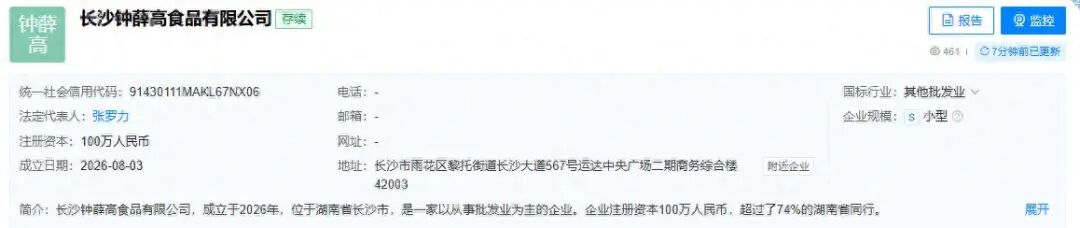
Tianyancha App shows that the brand has registered and established a brand new operating entity. After taking over the original brand's intangible assets, it returned to the market with a brand new pricing system.
In terms of pricing, the classic light milk flavor is 6.9 yuan per piece, and the velvet cocoa flavor is 7.9 yuan per piece, which is almost 50% lower than the unit price of 13-20 yuan in its peak period.
It is worth noting that Luo Yonghao, who just complained about Mr. Wild Man ice cream and has always held a strict attitude towards brands, also publicly spoke out in defense of Chicecream these two days, with words full of regret for the brand.
Facing this half-price return, public attitudes are sharply divided: some people bluntly said "if it had been sold at this price earlier, it would not have gone bankrupt at all", while others insisted that "I will not buy it even if the price is reduced".
More people, with a bystander mentality, are curious: in today's cold drink industry whose pattern has been completely restructured, can this brand, which carries the imprint of controversy and historical baggage, really have a second life?
Chicecream's Second Breakthrough: First Cross Three Major Mountains
To replicate the glory of the past, Chicecream has to face a more complex market environment than before.
From the overall industry market to the competition pattern, from consumer psychology to brand reputation, almost all variables have changed. Its "second venture" has to cross at least three major mountains.

The first major mountain is that the pre-packaged ice cream market has entered a stock era.
Apparently, the overall market still has a slight growth, but it is mainly driven by new categories such as freshly made ice cream, while the pre-packaged ice cream sector itself is shrinking.
According to the offline channel monitoring data from WinWin between June 2024 and May 2026, the year-on-year growth rate of sales and the converted shipment volume of the ice cream category showed a downward trend in most months.
In the second quarter of 2026, the sales of this category decreased by 13.1% year-on-year; the sales volume of traditional packaged ice cream plummeted by 40% to 50% year-on-year. A joint survey of 127 regional wholesalers in six provinces and one municipality in East China shows that the overall shipment volume in the summer of 2026 decreased by 48.6% year-on-year, and the decline of the mid-to-high-end category above 10 yuan reached as high as 61.3%.
What is more critical than the decline in sales volume is the downward shift of the price range. In the current domestic ice cream market, the 3-6 yuan price range accounts for more than 80% of the market share, which is the absolute main force of consumption; the overall proportion of the mid-to-high-end track above 6 yuan is less than 20%, with very limited growth space.
The second major mountain is the diversified diversion of consumption scenarios.
Today's consumers already have better choices when they want to have a cold treat.
On the one hand, the freshly made cold drink track is rising rapidly. Tea and coffee brands such as Bawangchaji, Mixue, Heytea, and Luckin have successively laid out categories such as ice cream, smoothies, and sorbets, focusing on fresh on-site production, visible ingredients, and rich taste, providing a stronger experience than pre-packaged ice cream at the same or even lower price.
For consumers, spending seven or eight yuan on a cup of freshly made fresh fruit cold drink is far more attractive than a pre-packaged ice cream that has been frozen for a long time.
On the other hand, the fresh snack and low-temperature dessert tracks continue to gain popularity. Products such as iced bread, iced mochi, and iced mousse have both snack attributes and cooling functions, covering a wider range of scenarios and continuously diverting the consumer group of traditional ice cream.
Coupled with the popularization of instant retail, the threshold for consumers to obtain ice products has been greatly reduced, and the former "convenience" advantage of pre-packaged ice cream no longer exists.
The third major mountain is the solidified mindset of consumers about the brand's negative reputation.
For Chicecream, the heaviest burden is the accumulated negative sentiment of consumers behind the former "ice cream assassin" label.
What the public resented back then was not the high price, but more about the bad experience that the brand hid in the convenience store freezer without clearly marking the price, and consumers were "stabbed in the back" when checking out, as well as the perception of excessive marketing and overpricing that did not match the actual product quality.
This leads to the subsequent public opinions such as "the ice cream can't melt", no matter true or false, consumers take them for real. In today's era where short-form video entertainment is prevalent, once this kind of mental cognition is formed, it is unlikely to be quickly reversed by a single price reduction.
Looking at the new consumption field, most internet-famous brands that fell from the altar eventually cannot escape the fate of gradually fading out of the market.
To put it bluntly, it is very difficult for consumers to build trust, but it collapses quickly, and repairing it requires an extremely long cycle.
However, despite the numerous challenges, Chicecream does not have no chance to make a comeback.
Establishment After "Breaking" Is the Best Rebirth
In the business world, there is no completely dead track, only brands that are trapped in old paths and refuse to turn around.
Many brands that we are familiar with today have once been mired in the quagmire of reputation and growth bottlenecks.
Their ultimate way to break through is not to stick stubbornly to the original place, but to actively separate themselves from past labels, controversies and paths, switch to a new track and a new identity, and cultivate a second growth curve.
The most typical example is Jia Guolong's new brand "Tianbian".
Last year, Xibei Oat Noodle Village fell into a reputation low due to the pre-made food controversy, and the growth of its main brand stagnated.
As stubborn as Jia Guolong, he also jumped out of the main brand and launched a brand new independent brand "Tianbian Casserole Braised Noodles", which completely separated from Xibei's past controversies in terms of brand name, positioning and product line.
The new brand focuses on "ordering and making on site, open kitchen with bright stoves", the whole process from kneading noodles to braising is transparent and visible, which accurately meets consumers' core demands for freshness and on-site production.
By reusing Xibei's supply chain, quality control and store operation capabilities accumulated over many years, the passenger flow of Tianbian brand quickly caught up with the weekend level of Xibei's stores after its opening, and achieved new growth against the general trend of the decline of the full-service catering sector.
Its comeback logic is very simple: do not dwell on repairing the stains of the old brand, but use the new brand to carry the old capabilities, avoid controversies, and directly embrace new market demands.
The same logic also applies to Jiangxiaobai.
In the early years, Jiangxiaobai became a hit with copywriting marketing and became the pronoun of young people's Baijiu, but it also always carried the controversies of "poor taste, selling feelings, and charging IQ tax". With the adjustment of the Baijiu industry, the growth of its main brand reached the ceiling.
Jiangxiaobai's team's solution is to incubate a brand new independent brand Meijian, entering the low-alcohol green plum wine track.
In terms of category, brand name and consumption scenarios, Meijian is completely separated from the past Jiangxiaobai, only reusing the team's catering channel resources accumulated over many years, binding with dining scenarios such as hot pot and barbecue, and quickly opening up the market.
Nowadays, Meijian has become the group's second growth curve. The outside world only remembers the copywriting controversy of Jiangxiaobai, but ignores the team's channel operation capabilities.
Instead of clinging to the old path, switching to a new brand and a new track, the capabilities can still realize their value.
Wei Long's launch of konjac snacks is also a classic operation of category separation.
Wei Long started with spicy strips, but has long been trapped in the industry's stereotype that "spicy strips = junk food", which leads to resistance from parent groups and difficulty in upgrading the brand to a high-end level.
However, Wei Long did not stay in the spicy strip track all the time, but actively jumped out of the comfort zone, opened up a brand new category of konjac snacks, and entered the healthy casual snack track with low calorie and high dietary fiber.
With its mature channel network and taste R&D capabilities, konjac snacks quickly became a phenomenal hit product, with annual sales exceeding 1 billion yuan, accounting for more than 40% of the group's total revenue. It not only supported the second growth curve, but also weakened Wei Long's single label as a "spicy strip brand" in turn, reshaping the brand image of a healthy casual food enterprise.
In general, separation does not mean denying past capabilities. It is precisely to liberate the core capabilities from outdated brands and restricted tracks, and release them again in new battlefields with more growth space.
Back to Chicecream, it is essentially facing the same choice. If consumers' stereotypes cannot be completely reversed, they will always look at the brand with tinted glasses.
Instead of insisting on repairing the reputation of the old brand, it is better to learn from the ideas of these brands: retain the core capabilities such as product R&D, supply chain, and quality control, but actively separate from the past in terms of brand positioning, price system, and channel layout.
It can even launch a brand new affordable sub-brand, use a new name, new image and new price to enter the mass market, avoid past controversies, and thus more easily open up sinking channels and reach a wider range of consumers.
After all, a brand is just a container for capabilities, not the capabilities themselves. The past glory, as well as the controversies, only belong to the old track.
Daring to separate from the inappropriate past and putting the core capabilities in a more appropriate place may be the way to cultivate a real second life.
This article is from the WeChat official account "Shanxiang Finance" (ID: IPOxscj), the author is Shanxiang Finance, and it is published with authorization from 36Kr.