Jensen Huang hits back at Ray Dalio: Is AI a bigger financial bubble?
In 2026, the most valuable question in the global tech industry is: Is AI actually a bubble?
Centered on this question, two globally renowned veteran figures got into a heated argument that drew the attention of the whole world.
One is Ray Dalio, founder of Bridgewater Associates, the "prophet" on Wall Street who made an accurate early warning before the 2008 financial crisis.
He has repeatedly warned on multiple public occasions that the AI market has shown typical bubble characteristics, comparable to the eve of the Great Depression in 1929 and the dot-com bubble in 2000.
The other is Jensen Huang, CEO of NVIDIA, the world's most powerful chip tycoon. At an event in Taipei in June 2026, he directly lashed out: Only "lunatics" would question the returns on AI investment, because this technology has already created trillions of dollars in value.
One claims the bubble is about to burst, while the other says anyone who doubts it is a lunatic.
What the two talked about seem to be two completely different things in the same world.
This war of words was triggered by Ray Dalio, founder of Bridgewater Associates, issuing a new warning about the ongoing AI boom recently.
He believes that the current AI market has entered the early stage of a typical financial bubble. While it is still far from the extreme frenzy around 1929 and 2000, danger signals have already emerged.
Previously, he also stated that the current level of the AI bubble he observed is roughly 80% of the peak of those two major historical bubbles.
Jensen Huang did not follow this narrative. His core refutation is that today's AI is not a bunch of concept stocks with no revenue support.
NVIDIA is delivering real chips, cloud service providers are building real data centers, enterprises are purchasing real computing power, and AI is being integrated into software, customer service, R&D and industrial processes.
To simply classify it as a bubble is to conflate real industrial demand and asset price fluctuations into a single issue.
The reason why this debate has drawn widespread attention is that neither of the two is an outsider.
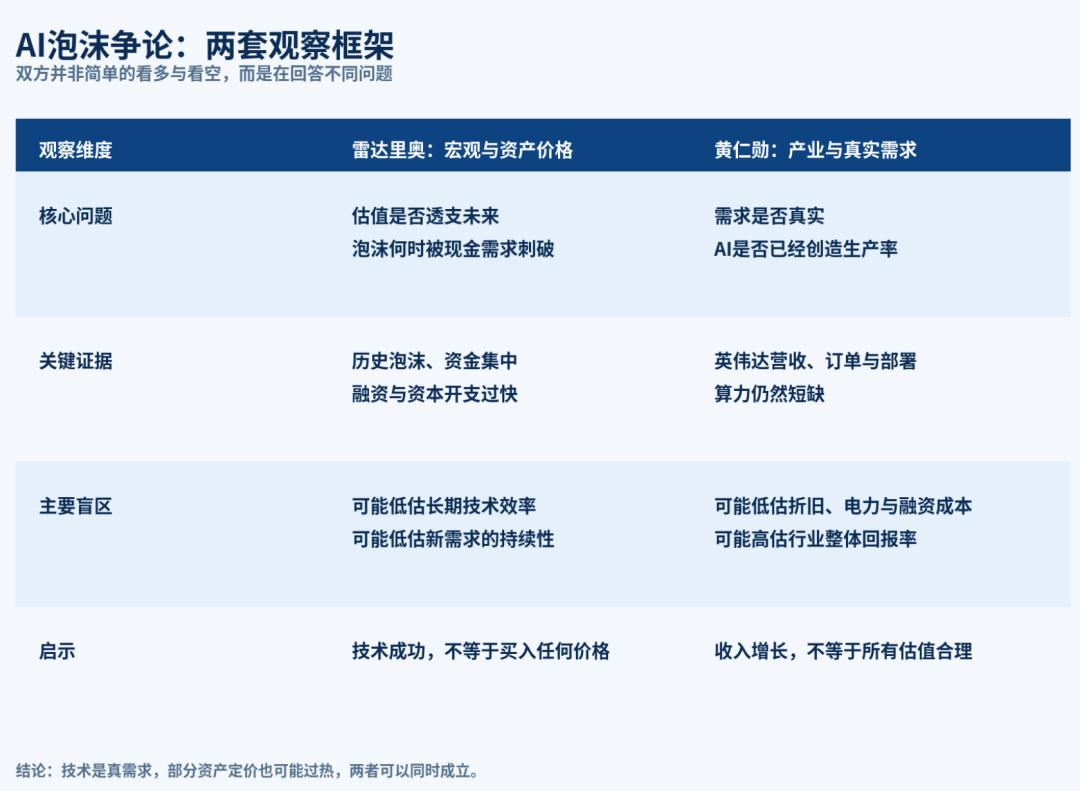
Ray Dalio is good at identifying risks from the long-term cycles of debt, liquidity and asset prices, while Jensen Huang stands at the forefront of the global AI infrastructure.
One focuses on whether money will suddenly become more expensive, and the other focuses on whether there is enough computing power available. Seemingly refuting each other, they are actually observing two sides of the same wave.
Ray Dalio's concern is not that "AI is useless"
Many people misinterpret Ray Dalio's view as being bearish on AI, which is inaccurate. What he is really alert to is that technological value, corporate value and stock prices are being compressed by the market into the same story at an increasingly fast pace.
First, capital expenditure is growing too rapidly. AI infrastructure is a heavy-asset business, which requires upfront investment in chips, servers, networks, land, power and cooling systems.
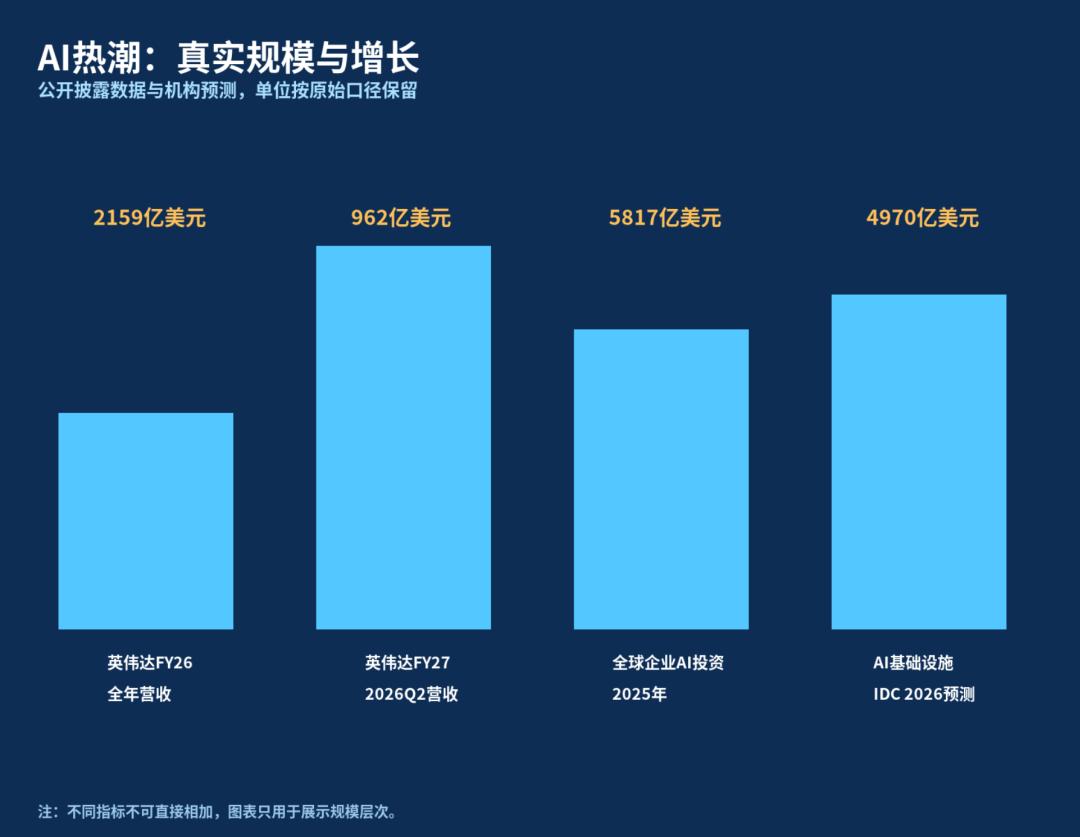
IDC estimates that global spending on AI infrastructure will approach 497 billion U.S. dollars in 2026.
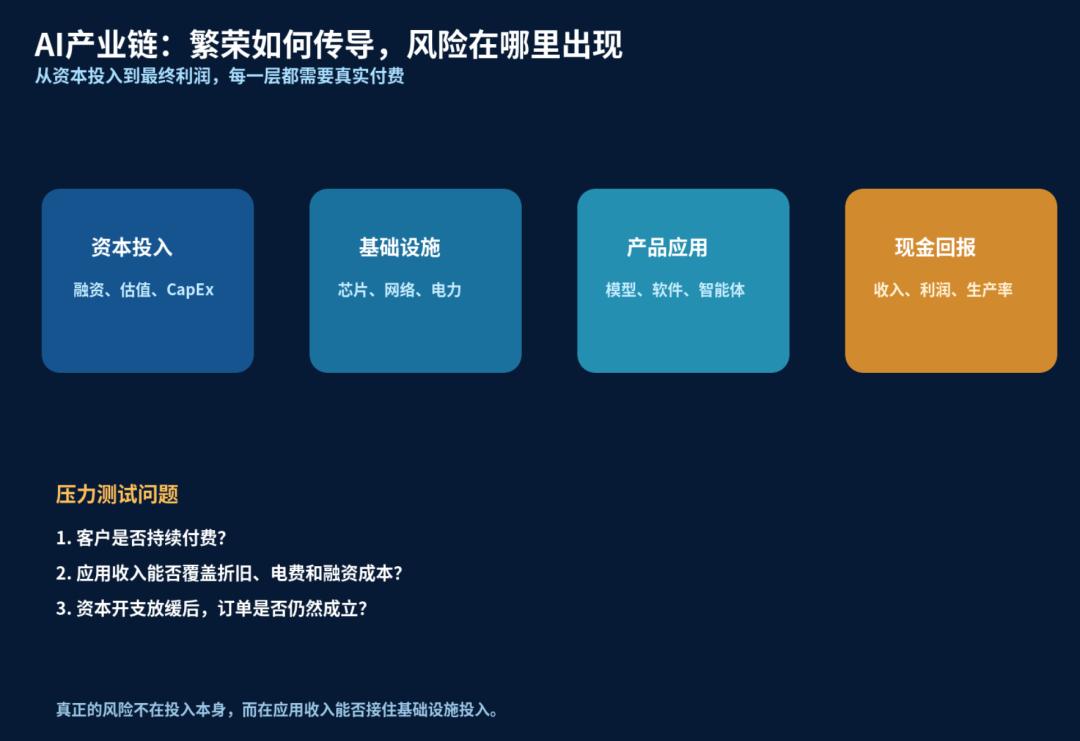
This figure not only reflects strong demand, but also indicates that the industry has entered a stage of high investment. As long as the growth of model calls and enterprise payments keep up, the investment will drive expansion; if the growth of application revenue lags behind depreciation, electricity bills and financing costs, problems will be transmitted from valuation to order volume.
Second, capital is concentrating on a small number of companies. NVIDIA's strong performance does prove that the demand for AI computing power has been realized, but not every company in the industrial chain has seen simultaneous improvements in revenue, profit and cash flow.
The market is likely to extend credit to the entire track in advance just because of the real growth of leading companies. The most dangerous stage in history is often not when the technology does not exist, but when good technology is priced excessively high.
Third, there is a possibility of "mutual investment, mutual procurement and mutual expectation raising" in the AI industry. Large model companies need chips and cloud services, cloud vendors need models to drive customers, and the capital market gives higher valuations to related companies based on future orders.
This cycle can accelerate construction in the early stage, but it also requires end users to pay real money to complete the closed loop. Otherwise, the industrial chain may seem prosperous, but the cash flow may thin out at the end of the chain.
Ray Dalio's most important reminder is not that "a crash is imminent", but that bubbles usually do not end because everyone suddenly realizes that the technology is fake.
The more common scenario is that financing becomes more expensive, investors need cash, and enterprises start to cut budgets, so the valuation that was originally maintained by high expectations suddenly loses its supporters.
Why did Jensen Huang refute so firmly?
Jensen Huang's tough stance also has its industrial logic.
Data released by NVIDIA shows that its full-year revenue for fiscal 2026 reached 215.9 billion U.S. dollars, a year-on-year increase of 65%; in the fiscal quarter ending July 26, 2026, the company's revenue reached 96.2 billion U.S. dollars, a year-on-year increase of 106%, of which data center revenue was about 89 billion U.S. dollars, a year-on-year increase of 117%.
This is not a long-term promise on a PPT, but orders and revenue that have already been recorded in the financial statements.
For Jensen Huang, if the market indiscriminately labels AI as a bubble, the first to be accidentally hurt will not be projects with no products, but infrastructure companies that are delivering products and continuously expanding production capacity.
NVIDIA's business model has expanded from single GPU supply to systems, networks, software ecosystems and complete machine platforms. It wants investors to see a continuously upgraded computing platform, rather than a one-off chip market boom.
More importantly, the demand for AI computing power does not fully rely on chatbots.
Traditional data centers are shifting from general-purpose computing to accelerated computing. Generative AI brings new demands for model training and inference, while intelligent agents turn a single question and answer into continuous calls.
What Jensen Huang has repeatedly emphasized is that these several demands are occurring at the same time, so the ceiling of the computing power market cannot be estimated only by the number of current applications.
But Jensen Huang's stance also has inherent limitations. He is one of the biggest beneficiaries of AI infrastructure, so he cannot evaluate his own industry from the perspective of a macro investor.
NVIDIA's high growth can prove that the demand is real, but it cannot automatically prove that the valuations of all AI companies are reasonable, let alone prove that every dollar of capital expenditure in the future will get the same return.
What is happening in the AI wave and what is the market ignoring?
Relevant data from the AI Index of Stanford University shows that global enterprise AI investment reached 581.7 billion U.S. dollars in 2025, a year-on-year increase of 130%.
This shows that AI has moved from laboratories to enterprise budgets, but it also means that the industry is shifting from "whether there is demand" to "whether the demand can generate profits".
The detail that the market is most likely to ignore is that the cost structure of AI is becoming more and more similar to that of traditional industries.
Deploying a model does not mark the end of the process. It requires continuous inference, storage, bandwidth, power and operation and maintenance.
Enterprises cannot automatically gain efficiency just by purchasing a model. Data cleaning, process transformation, permission management and employee training will all increase real costs.
The second detail is power. The International Energy Agency points out that the power consumption of data centers increased by about 17% in 2025, and the rapid expansion of AI computing power is turning technical problems into energy problems.
The U.S. Energy Information Administration estimates that total U.S. power consumption will rise from 4.195 trillion kilowatt-hours in 2025 to 4.270 trillion kilowatt-hours in 2026 and 4.349 trillion kilowatt-hours in 2027, and data centers are one of the important sources of incremental demand.
The future of AI depends not only on how fast chips can run, but also on whether the power grid can keep up.
The third detail is the time lag in productivity realization. Revenue of chip manufacturers can be recognized upon equipment delivery, and revenue of cloud vendors can be recognized when computing power is leased, but the efficiency improvement of end-user enterprises often takes several quarters or even years to manifest.
Prosperity in the upstream followed by realization in the downstream is the stage in the technology cycle that is most likely to create illusions.
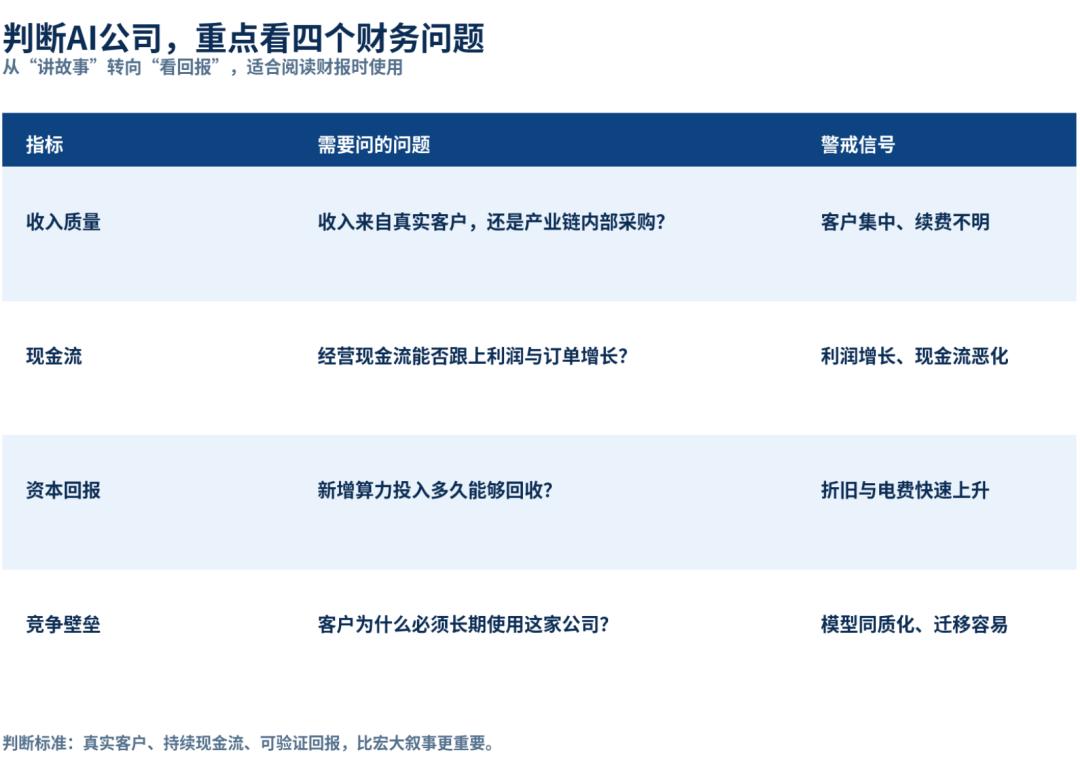
This also explains why two seemingly contradictory facts appear simultaneously in the current AI market: NVIDIA's performance is extremely strong, and the valuations of some AI startups are also very high; at the same time, investors are beginning to ask about model revenue, customer retention, inference costs and free cash flow.
The former indicates that the industry is growing, while the latter indicates that the capital market is demanding proof of profit from this growth.
What deserves more vigilance is not the word "bubble"
Labeling AI as a bubble easily misleads people into thinking that the technology has no value; labeling AI as something that will never have a bubble easily hides valuation risks behind industrial enthusiasm.
A more objective judgment is that AI technology is already a real demand, but there may be partial overheating in the pricing of AI assets.
NVIDIA's revenue growth is valid, but the valuations of some AI companies may still be overdrawn; data centers do need more computing power, but some projects may be delayed due to insufficient power, financing and customers; AI can improve efficiency, but improving efficiency does not mean every enterprise can turn this efficiency into profits.
Ray Dalio's strength is reminding the market not to only look at the growth curve, but also to pay attention to financing conditions, cash flow and return on capital.
Jensen Huang's value is reminding the market not to deny the ongoing technological revolution just because of the fear of bubbles. Neither of the two voices can alone serve as an investment conclusion.
For enterprises, the really important question is not "whether to embrace AI", but whether every dollar invested can clearly state what costs it will save, what revenue it will generate, and within what period the investment can be recovered.
For investors, the really important question is not "whether AI will change the world", but after it changes the world, whose income statement the value will eventually fall into.
History does not repeat itself exactly, but it always rhymes.
Railways changed the world, but that does not mean every railway company deserves a high valuation; the Internet reshaped business, but that does not mean all Internet stocks can survive the cycles.
AI may be the most important technological wave in the past few decades, but great technology and great investment have never been the same proposition.
Therefore, the most memorable sentence in this debate is: Do not deny the technology just because there is a bubble; and do not abandon valuation discipline just because the technology is real.
The companies that can truly survive the next round of adjustment are not the loudest voices, but those that have real customers, continuous cash flow and verifiable returns.
This article is from the WeChat Official Account "Investment Banking Circle", written by Senior Sister of Investment Banking, and published with authorization from 36Kr.