Placing a high-stakes bet on self-driving vehicles, CAOCAO Mobility is fighting a do-or-die battle.
On one side lies the highly stressful financial situation, on the other side the grand RoboX transformation vision, leaving Cao Cao Mobility and Gong Xin facing a highly challenging test.
Losses Narrowed, But Severe Cash Crunch Remains
Before becoming a ride-hailing driver, Zhou Hui was an entrepreneur. He and several friends ran a Douyin e-commerce business in Hangzhou for over a year, but failed to find a viable path, so he returned dejectedly to his hometown in Hebei. Before figuring out his next life plan, Zhou Hui needed a source of income, so he came to Beijing and registered as a ride-hailing driver on the Cao Cao Mobility platform.
Although Cao Cao Mobility does not have as many orders as Didi, it has a low entry threshold. He only needs to pay a monthly rent of 5,200 yuan to lease a "Cao Cao 60" vehicle.
However, after driving a ride-hailing vehicle for more than two months, Zhou Hui decided to quit. "I have paid the rent for 3 months, and I will stop working after finishing the last month," Zhou Hui told *Caijing Tianxia*.
"The ride-hailing industry is far too competitive," Zhou Hui said bluntly, noting that the main reason he did not want to continue was that the job was not profitable. Zhou Hui made a rough calculation: he drives 10 hours a day, with a daily revenue of 400 to 500 yuan. After deducting 20% to 30% of platform commission, vehicle rent and charging fees, his net income per day is only over 200 yuan. At this income level, it is very difficult to save money in Beijing.
It is not only Zhou Hui who cannot save money. The Cao Cao Mobility platform he works for is also facing capital problems.
Founded in 2015, Cao Cao Mobility is affiliated to the Geely system. Li Shufu, founder and chairman of Geely Holding Group, holds a 73.41% stake in Cao Cao Mobility through his wholly-owned Ugo Investment Limited, making him the controlling shareholder of the company. On the shareholder list of Cao Cao Mobility, there is also a person named Gong Xin, who holds a 2.58% stake and serves as the CEO of the company.
Gong Xin is a veteran in the mobility sector. He once served as the head of Didi's main business division, and joined Cao Cao Mobility as CEO in 2021. Gong Xin has participated in many key milestones of Cao Cao Mobility. The first major event after he took office was to promote Cao Cao Mobility to complete a 3.8 billion yuan Series B financing, leading the company to transform into an independent mobility service provider. After that, he proposed the "N³ Strategy" to launch exclusive customized models such as the Cao Cao 60. In June 2025, Cao Cao Mobility was officially listed on the Main Board of the Hong Kong Stock Exchange, becoming "the first domestic shared mobility stock".
However, Gong Xin still has to face extremely severe financial challenges.
Cao Cao Mobility's heavy historical burden, coupled with the aggressive strategic choice of "exchanging scale with liabilities and betting on the future with capital" in recent years, has kept the company's operation and capital chain in a tight state.
On August 27, Cao Cao Mobility released its mixed first-half annual report. The good news is that in the first half of 2026, the company's revenue exceeded 100 billion yuan, the loss for the period narrowed by 17.5% year-on-year to 3.8 billion yuan, and the gross profit margin reached 9%, up 0.3 percentage points from the same period of the previous year. The platform's operating scale grew steadily. During the same period, the GTV (Gross Transaction Value) of the Cao Cao Mobility platform increased by 13.6% year-on-year to 124.45 billion yuan, the average monthly active users reached 44.6 million, up 17.1% year-on-year; the average monthly active drivers reached 758,000, up 36.8% year-on-year.
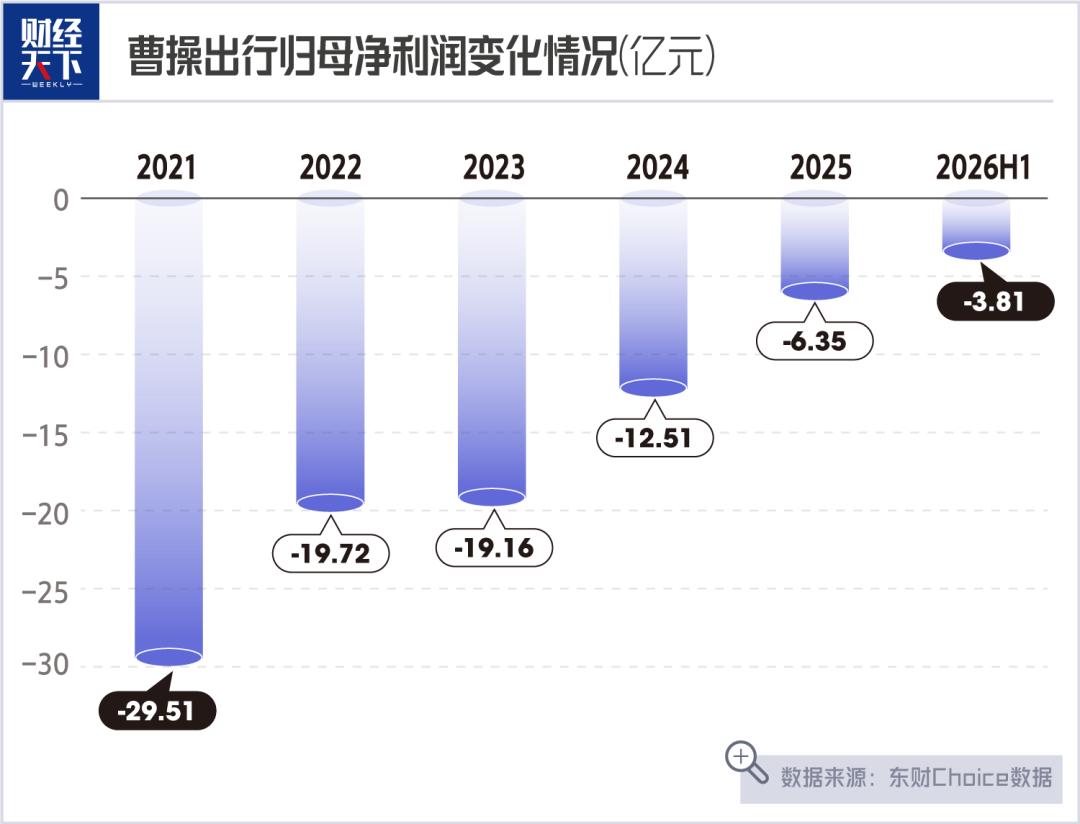
The bad news is that the net cash flow from operating activities of Cao Cao Mobility in the first half of 2026 was only 65.99 million yuan, plummeting by more than 80% compared with 340 million yuan in the same period of the previous year. In response, the company explained that this was the change in working capital caused by the time difference between payment collection and payment. At the same time, Cao Cao Mobility's cash reserves have also shrunk significantly, from 2.33 billion yuan in the first half of 2025 to 1.56 billion yuan in the first half of 2026.
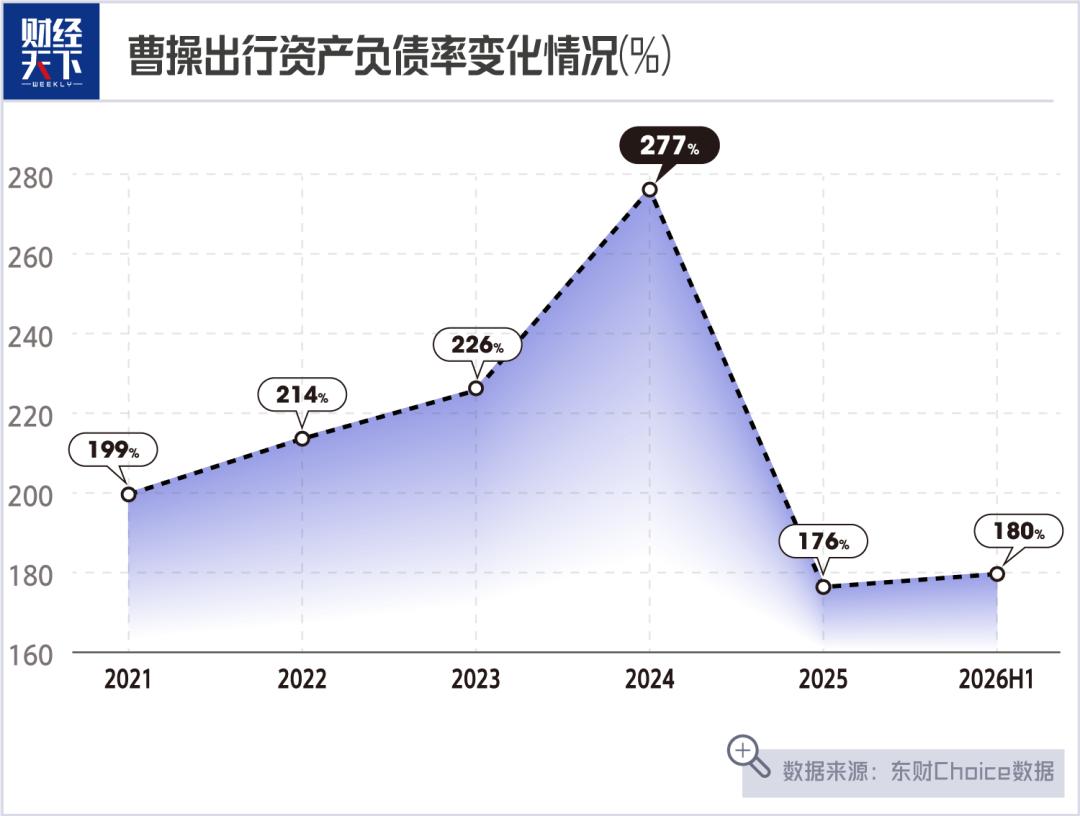
By the end of June 2026, the total liabilities of Cao Cao Mobility stood at 9.381 billion yuan, with total assets of 5.221 billion yuan, and the asset-liability ratio was as high as 179.69%. The company is highly dependent on Geely Holding and external financing channels to maintain operations.
This can be seen from the fundraising behavior of Cao Cao Mobility at the beginning of this year. On January 28, Cao Cao Mobility issued an announcement on placing new shares, proposing to raise 383 million Hong Kong dollars through discounted additional issuance. This fundraising was only 7 months after its IPO.
Looking back at the revenue structure of Cao Cao Mobility, in the first half of 2026, the revenue of the company's core mobility service sector increased by 13.9% year-on-year to 9.79 billion yuan, while the vehicle sales revenue plummeted by about 60% to 300 million yuan.
Cao Cao Mobility's mobility services are highly dependent on aggregation platforms such as AutoNavi and Baidu. From 2022 to 2024, the order GTV received by Cao Cao Mobility from the aggregation platforms accounted for 49.9%, 73.2% and 85.4% of the company's total GTV in the same period respectively. A representative of Cao Cao Mobility told *Caijing Tianxia* that since 2023, the company has greatly increased its cooperation with aggregation platforms, and devoted more management energy to improving service quality and brand awareness.
Relying on aggregation platforms can certainly quickly access a large number of orders, but this is by no means a free gift, and there are extremely high channel costs behind it. In the first half of 2026, the commission paid by Cao Cao Mobility to the aggregation platforms was 830 million yuan, accounting for 6.7% of its GTV. This is the gross profit margin bottleneck that Cao Cao Mobility cannot break through, and the company can only reduce other expenses to cut losses.
Financial reports show that in the first half of 2026, Cao Cao Mobility's general and administrative expenses and R&D expenses were 290 million yuan and 100 million yuan respectively, down 37.0% and 14.0% year-on-year. The two expense ratios decreased by 2.1 and 0.3 percentage points respectively, saving a total of about 190 million yuan.
Is It Too Late to Enter the RoboX Track Now?
After more than 10 years of development in China's ride-hailing industry, the growth of user scale has basically peaked, and the industry has entered a stock era. In this almost saturated market, the competition focus has shifted to Robotaxi. Platforms such as Didi and T3 have made layouts one after another, and Cao Cao Mobility is no exception.
In mid-June this year, Cao Cao Mobility announced at the 2026 International Automotive and Supply Chain Expo (Hong Kong) that it would officially launch a comprehensive AI transformation and release the new RoboX strategy. Under the new strategy, Cao Cao Mobility is no longer positioned as a ride-hailing platform, but as a physical AI mobile technology platform, whose service targets are not only people, but also "goods".
According to the plan, by 2030, Cao Cao Mobility will deploy a total of 100,000 Robotaxis and 100,000 Robovans (unmanned urban delivery vehicles). In April this year, Cao Cao Mobility's Robotaxi prototype, the Eva Cab, was unveiled at the Beijing Auto Show, and it is expected to be mass-produced and rolled off the production line in June 2027.
Before the mass production of Eva Cab, Cao Cao Mobility has been conducting verification work around vehicle scheduling, energy replenishment and operation, remote safety and other links. Last February, Cao Cao Mobility deployed the first generation of Robotaxi in Hangzhou and Suzhou, which has been iterated to the second generation this year, with a vehicle scale of about 140 units. Cao Cao Mobility said that the overall progress of the current business is in line with expectations.
Compared with peers, Cao Cao Mobility's progress is somewhat slow. As of the second quarter of 2026, Apollo Go's Robotaxi business has covered 28 cities around the world, with a total of more than 23 million public travel service orders, and it has achieved per-vehicle economic (UE) break-even in Wuhan. WeRide has covered more than 60 cities in 13 countries around the world, holds autonomous driving licenses in 8 countries, and has achieved phased operating profitability in some overseas regions. As of the first half of 2026, Pony.ai's global fleet size is close to 2,000 vehicles, and its App has more than 1.5 million registered users in China. Didi, which is also a ride-hailing platform, is continuing to put vehicles into operation, with the goal of expanding its fleet size to more than 1,000 vehicles by the end of this year.
In the competition of Robotaxi, the gap between players is not only reflected in explicit figures such as fleet size, but also in their respective cost reduction paths. Wang Haojun, co-founder and CFO of Pony.ai, once explained that the cost of Robotaxi is roughly divided into two parts: hardware depreciation cost and operating cost, each accounting for about 50% of the total cost. Some technology companies that entered the Robotaxi track earlier in China have iterated some of their models to the sixth and seventh generations, and have made a lot of optimizations in the cost of a single vehicle.
The BOM (bill of materials) cost of the ADK (autonomous driving kit) of Pony.ai's 7th generation Robotaxi is 70% lower than that of the previous generation. By 2027, the total cost of its fully unmanned Robotaxi can be controlled within 230,000 yuan. The per-vehicle cost of Apollo Go's 6th generation mass-produced unmanned vehicle RT6 has dropped to the 200,000 yuan level, down more than 60% from the previous generation. Backed by Geely Holding, Cao Cao Mobility's Eva Cab also has a very competitive per-vehicle cost.
In addition to hardware costs, there are operating costs. Some people may think that one of the most important capabilities of ride-hailing platforms such as Didi, Cao Cao Mobility and OnTime is operation. In the Robotaxi field, their operation capabilities are a dimensionality reduction blow to players in other tracks.
However, Lyu Liang, a senior practitioner in the autonomous driving industry, told *Caijing Tianxia* that the operation system of Robotaxi is different from the traditional operation system, and ride-hailing platforms do not have inherent advantages in this regard. "Remote takeover and ground service systems need to be built from scratch."
An executive of an L4-level autonomous driving technology company also expressed a similar view. He believes that both ride-hailing and Robotaxi require vehicle cleaning and maintenance, dealing with traffic police, and handling passenger emergencies. Human drivers on ride-hailing platforms can handle all situations, while Robotaxi has no driver, making it more difficult to deal with emergencies. "For car manufacturers and mobility platforms, Robotaxi is actually a new species, which cannot be automatically grafted," the executive said.
Industry insider Liu Xiao told *Caijing Tianxia* that for new players, Robotaxi is a highly challenging project. First of all, the industry has high safety and technical thresholds, and early-entrant companies have deeper accumulation, knowing what "good data" is, "know-how is very important". Secondly, to cold start a fleet of 1,000 Robotaxis from scratch requires huge cost expenditures in vehicles, R&D and operation teams. But Liu Xiao believes that Cao Cao Mobility still has opportunities to enter now. "New players can learn from mature experience, which can shorten the time for the 0-to-1 stage of the unmanned driving demo."
Liu Yu, a former employee of an L4-level autonomous driving company, also believes that it is not too late for Cao Cao Mobility to enter the Robotaxi field at the moment. "The entire industry is far from saturated." Besides, Cao Cao Mobility has inherent advantages in doing Robotaxi.
Cao Cao Mobility said that in the Geely system, the company is first an independently operated technology mobility platform, and also an important business platform of Geely Holding Group in the field of smart mobility and future mobile services. It plays a role in connecting vehicle manufacturing, intelligent driving technology and real mobility operation scenarios, and is the most important commercial carrier of the group's RoboX strategy. In other words, Cao Cao Mobility's RoboX strategy is backed by the Geely system, with Geely Auto responsible for vehicle manufacturing and Qianli Technology responsible for technology support.
"Relying on the Geely system, Cao Cao Mobility's natively customized models combined with large-scale fleet procurement can narrow the cost gap with peers," Lyu Liang analyzed, "but the premise is that the vehicle loading scale is large enough, otherwise the scale effect cannot be released."
On one side lies the highly stressful financial situation, on the other side the grand RoboX transformation vision, leaving Cao Cao Mobility and Gong Xin facing a test full of temptation and challenges.
This article is from the WeChat official account "Caijing Tianxia WEEKLY", author: Caijing Tianxia, published by 36Kr with authorization.