"Judongche" tightens customer lead acquisition standards, punctures the false prosperity of automotive live streaming
In September, complaints from automotive live streamers flooded social media platforms.
Some streamers said that in the past, the average traffic investment cost to obtain a lead (contact information such as phone numbers left by users) was about 70 yuan, but in some recent sessions, the cost has risen to 500 yuan; other streamers claimed that after entering September, "the number of leads will be directly cut by 40% or even 70%"; what's more, a 4S store manager told Diandian that all four automotive live streamers in the store had resigned at the beginning of the month.
The trigger came from a notice titled "Notice on Functional Adjustment of Dongche Cloud Store Component Products" marked with the logo of Juyongche. For a brief introduction, Juyongche is an integrated automotive business platform that integrates the automotive businesses of Dongchedi and Douyin, providing services for automakers and dealers from online customer acquisition to offline transaction; Dongche Cloud Store is the back-end tool used by 4S stores to host live streams on Douyin and collect customer information.
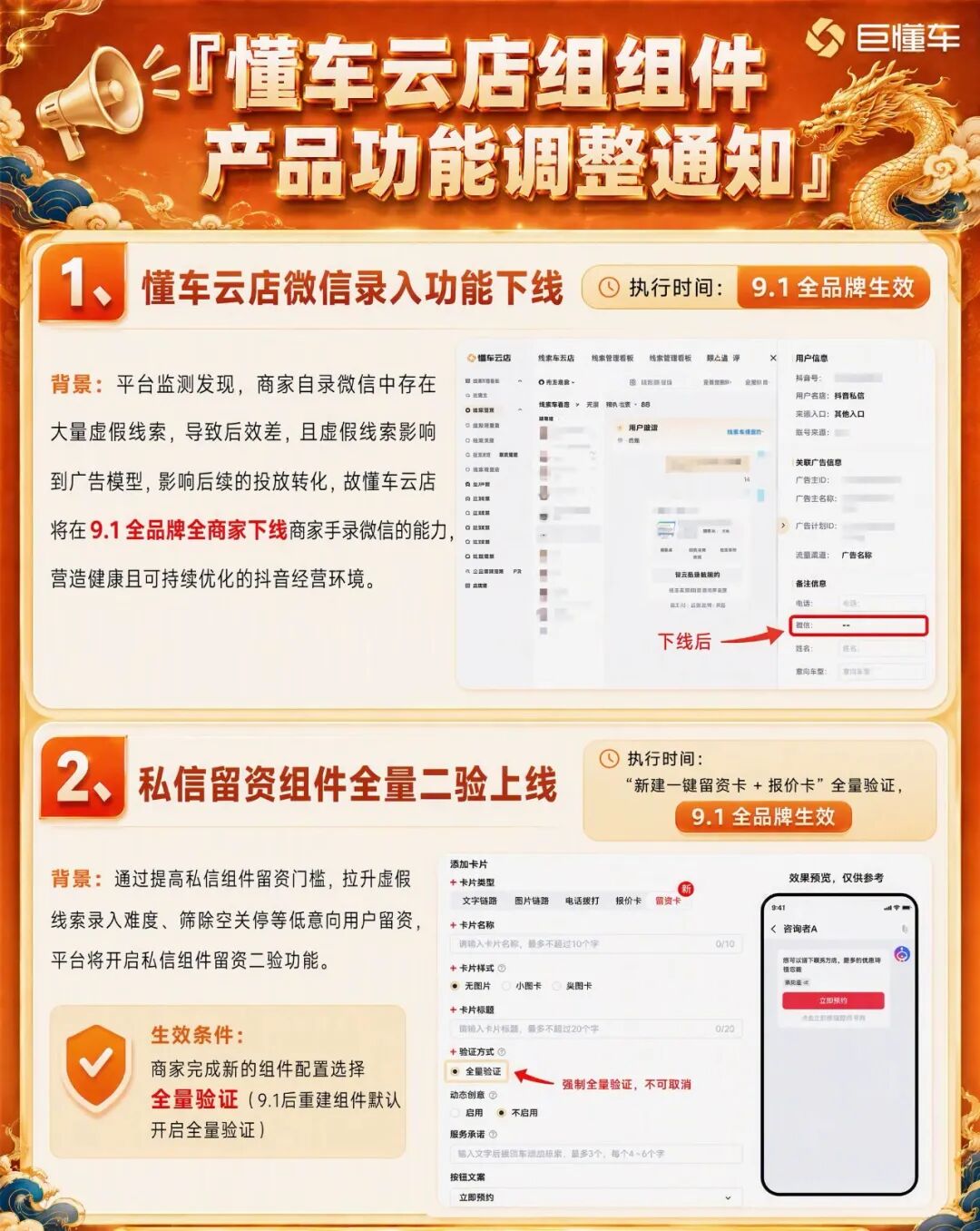
Source: Screenshot from the Internet
The notice shows that starting from September 1, all brands and merchants can no longer manually supplement WeChat IDs. When users submit contact information through the "One-click Information Retention Card" or "Quotation Card" in the live stream room, they need to enter the SMS verification code again, and merchants cannot skip this step. In the past, users only needed to click the card, or even leave their WeChat ID in private messages, and merchants could record them as a sales lead; now, users need to confirm that they are willing to leave their real phone numbers.
The reason given in the notice is also straightforward: there are a large number of false leads in the WeChat IDs manually entered by merchants. These numbers are not only difficult to convert into store visits and transactions, but also cause the platform's advertising system to learn wrong results, affecting subsequent traffic delivery. Enabling secondary verification is also to increase the difficulty of entering false leads.
For streamers whose performance is calculated based on the number of leads, one more verification step means that more users may exit halfway, and the difficulty of meeting performance targets has doubled. But this adjustment affects far more than just streamers.
Juyongche disclosed that in 2025, there were more than 30,200 active automotive stores on Douyin, and Douyin generated more than 810,000 automotive sales leads every day. The number of leads has become a crucial pillar for automakers to promote in-store live streams, for 4S stores to assess streamers, and for the platform to obtain advertising revenue. The platform clearly knows that tightening the entry will reduce the number of leads, but it still insists on squeezing out the moisture, which shows that the issue of dealing with false leads is extremely urgent.
How False Leads Are Generated
Automotive live streaming originally solved the problem of insufficient foot traffic in physical stores, but later gradually evolved into a business centered on phone numbers.
The 810,000 daily leads announced by Juyongche show that this customer acquisition method has reached a considerable scale. But in fact, the information of the same user may have been repeatedly recorded through multiple channels. Li Kai (pseudonym), an automotive live streamer, told Diandian that he finally got a lead, only to find that the user had already left information at secondary dealers or other platforms. The platform recorded a new lead, but the store may not actually get a new customer.
Many 4S stores take the number of leads as the main performance assessment standard for streamers, first of all because it is easy to calculate. Zhou Qing (pseudonym), marketing manager of a joint-venture brand store, once told Diandian that stores with good traffic and information retention performance can get additional rewards from automakers, and top stores have received bonuses of tens of thousands or even hundreds of thousands of yuan. Such incentive measures are also adopted by many other brands.
The incentives from manufacturers passed down to the stores will eventually become the number of leads that streamers must complete every day. Diandian learned that nowadays, many automotive live streamers have a monthly lead task of more than 600, and under the financial pressure of the stores, lead cost has also become an important assessment indicator.
Yang Le (pseudonym), a live streamer for an off-road vehicle brand, told Diandian that in the past, the brand would subsidize 65% of the store's traffic investment cost, but now this proportion has dropped to around 45%. After the subsidy was reduced, the boss put forward stricter requirements for streamers, not only changing the assessment indicator to the number of valid leads (the phone number can be connected, and the user confirms that they have the intention to buy a car in the near future), but also requiring streamers to control the cost of each valid lead below 65 yuan. Assuming that a store invests 650 yuan in traffic for one live stream, the streamer must obtain more than 10 valid leads, otherwise the performance salary will be affected. In reality, Yang Le said many of her colleagues cannot meet the standard.
When phone numbers are directly related to salary and subsidies, streamers start to find various ways to make up the required quantity. Yang Le said that the common practice in the past was to repeatedly ask the audience if they had seen the quotation sheet, and then guide them to click the card below the screen. Users thought they were just checking the price, but they left their mobile phone numbers after clicking in; some streamers in order to complete the task as soon as possible, choose borderline content or use small gifts to attract users to leave information. Yang Le has also seen streamers of different brands exchange leads, on the surface both sides completed the task, but in fact the store got a large number of invalid leads.
A more direct way is to buy ready-made leads. According to media reports, there are live streaming bases or MCN institutions in Zhengzhou that specialize in producing and selling leads. They use standardized streamers, fixed scripts and multiple accounts to collect phone numbers in batches, and then price them according to conditions such as user interaction time, consultation depth and the city where the user is located. The price of a so-called valid lead ranges from tens of yuan to hundreds of yuan. A dealer interviewed in the report said that some stores buy these numbers just to complete the assessment as soon as possible and get the manufacturer's subsidies.
The "falseness" of these leads is not exactly the same. Some are fake numbers themselves; some numbers are real, but users only leave them to get quotations or gifts, and have no intention of buying a car in the near future; some users do plan to buy a car, but their contact information has been repeatedly recorded by different platforms and stores.
Dealers are not completely unaware of the moisture in these data. Qiu Ming (pseudonym), former regional manager of a luxury car brand, said that investors are generally aware of the existence of false leads and data packaging, but it is difficult to distinguish them one by one. After the natural foot traffic decreased, stores cannot easily stop traffic investment, so they can only look at the most intuitive number of retained information first.
Watered-down Leads Erode the Platform's Advertising Business
The losses caused by false leads are not just a batch of unreachable phone numbers. For platforms that make money from advertising, wrong data will also make advertising delivery less and less accurate.
The basic logic of automotive live streaming advertising is not complicated. The store first tells the platform that it wants to find people who are more likely to leave contact information; the platform then summarizes the age, region and browsing habits of these users based on who left their phone numbers in the past, and pushes the next round of advertisements to similar groups. The automotive marketing solution of Ocean Engine also shows that the advertising system will find users who are more likely to complete information retention according to the goals set by merchants; after merchants continue to mark which leads are valid, result in store visits or transactions, the system can also adjust subsequent delivery accordingly.
The problem is that the platform can only learn according to the results it receives. If a person who leaves the number just to get a gift, a number exchanged by streamers, and a person who is really planning to buy a car are all marked as "success", the system will be difficult to distinguish who is just easy to click, and who is more likely to visit the store and buy a car. The next round of advertising will still look for people who are easy to leave their phone numbers, gradually forming a cycle where "low-quality leads are regarded as good results, and the platform sends more similar users".
Nowadays, many streamers have doubts about the audience pushed by the platform. Streamer Qi Xin (pseudonym) told Diandian that in the past, the live stream room could receive leads even without audience interaction, but recently 10 people spoke and no one completed the information retention, and the visitors of several accounts were "just like robots". Another streamer Li You (pseudonym) also said that the interaction in the live stream room increased significantly, users kept asking about car models, prices and store addresses, but left after asking, and no longer checked the private messages in the background.
Stores spend money on traffic investment, but keep receiving leads that are difficult to convert, so the advertising cost required to sell a car on average will rise; when this cost exceeds the range that the store can afford, dealers will reduce investment, or divert the budget to other channels. This is also where the urgency of the platform's implementation of the new regulations lies.
The financial report of Autohome for the second quarter of this year shows that its largest business lead service revenue was 560.4 million yuan, down 23.5% from the same period last year. The company explained in the financial report that the decline was mainly affected by the reduction of dealer expenditure and the decrease in the number of paying dealers under the background of shrinking car sales.
Dongchedi's preparation for this risk began long before the introduction of this verification rule. In 2021, Dongchedi piloted the CPS model (merchants pay according to transactions) in Chongqing. In 2022, Dongchedi announced that it will fully switch its dealer membership products to this model from 2023. Platforms such as Autohome and Bitauto are also gradually focusing on transaction results.
The clear demand of automakers for real leads is also driving the platform to take action. The announcement for recruitment of suppliers for the precision advertising operation project released by Dongfeng Nissan this year shows that it requires suppliers to aim at increasing the number of in-store test drives or transactions of customers who leave information online, and test the cost of store visits, test drives and order locking.
It Is Harder to Improve Live Streaming Quality Than to Make Information Retention Difficult
The platform hopes to make leads more solid, but the first thing that changes is the immediate work performance of streamers.
On Xiaohongshu, some streamers said that after entering September, they only got one lead after two hours of continuous live streaming, and it is estimated that 500 yuan of traffic investment was consumed; another streamer said that 14 people clicked in one of her live streams, but only 3 people finally left information, the cost of a single lead reached 200 yuan, and she was immediately criticized by the manager. She said that she had been an automotive live streamer for a year, and encountered the rule change just one month after joining the new company, "I really don't want to do this job anymore".
The store where Yang Le works has not fully switched to the new component yet. The manufacturer's staff once asked the store to replace the component, but she was worried that it would affect the information retention, so she suggested that the person in charge keep the old version for the time being. Therefore, as of the interview on September 7, the back-end information retention of this store does not require secondary SMS verification for the time being. Even so, she still said that once the new regulations are fully implemented, "I will resign immediately".

Source: Screenshot from the Internet
The new regulations hit a position that already has high employee turnover. A study by the Autohome Research Institute on more than 660,000 dealer store personnel from 2023 to 2025 shows that in the first three quarters of 2025, the turnover rate of dealer marketing personnel reached 66%, the sales position was close to 70%, followed by the online sales position; the annual turnover rate in previous years even exceeded 85%.
The operating pressure of physical stores makes it difficult to relax the assessment standards immediately. The "2025 National Automobile Dealer Survival Status Survey Report" released by the China Automobile Dealers Association shows that in 2025, only 23.5% of dealers are profitable, 55.7% are in a loss state, and the contribution of new car sales to the overall gross profit is negative 25.5%.
Therefore, the attitude of dealer investors is very contradictory. Some investors that Qiu Ming has contacted do not reject the reduction in the number of leads. They have realized that if the remaining users are more likely to visit the store and complete transactions, the store can spend less on traffic investment. But at the same time, he judged that automakers still hope that dealers will maintain online investment, some brands will even set a minimum traffic investment amount, and stores may not immediately adjust the performance assessment methods for streamers.
What is more difficult to change is the live streaming content. Many insiders told Diandian that gaining the trust of the audience is the key to the success of automotive live streaming, but few streamers have such ability.
Yang Le has seen such a streamer. She once worked in a 4S store where the general manager was very familiar with the products, "he can even explain how many screws there are on the car clearly", and when he directly asked users to click the information retention entry, the audience was willing to cooperate. Qiu Ming believes that the problem is that there are very few people who truly have product capabilities and content expression skills, and they may not be willing to work as ordinary streamers in 4S stores; many stores under operating pressure lack training funds, and the managers themselves do not have the ability to continuously explain products.
This means that after the number of false leads decreases, the number of valid leads may not necessarily increase. After the rules change, only when all links in the entire chain, from manufacturers to streamers, from assessment standards to live streaming content, change accordingly, can the industry get through the growing pains of transformation.
This article is from the WeChat official account "Diandian", author: Zhai Fangxue, published with authorization from 36Kr.