Desk lamps are transforming from lighting fixtures into home learning terminals: 6AM Homework uses remote tutoring machines to tap into the after-school connection gap for 100 million primary school students.
When AI starts to be integrated into smartphones, automobiles, home appliances and even toys, the value boundary of traditional hardware is being redefined. For educational hardware, this round of intelligentization is not just about adding a large model entrance to the device, but more importantly, rediscovering the unmet needs in family learning scenarios.
The niche that Shenzhen 6AM Technology Co., Ltd. has chosen is the family desk for children after school.
Founded in 2020, 6AM Technology's brand "Vicam" mainly develops remote tutoring machines for families at the primary education stage. The product combines desk lamp, camera, audio and video communication, mobile App and AI learning capabilities, allowing parents to remotely view homework and learning status even when they are not around their children, and complete problem explanation, checking, annotation and communication.
Different from traditional learning machines that mainly focus on content, question banks and independent learning, 6AM Technology aims to solve a more specific problem — when children start learning, the people who can provide help may not be by the desk.
At present, 6AM Technology is seeking Series A financing, and the raised funds are planned to be mainly used for market promotion, channel construction, product and AI capability upgrading, as well as user operation and service system construction.
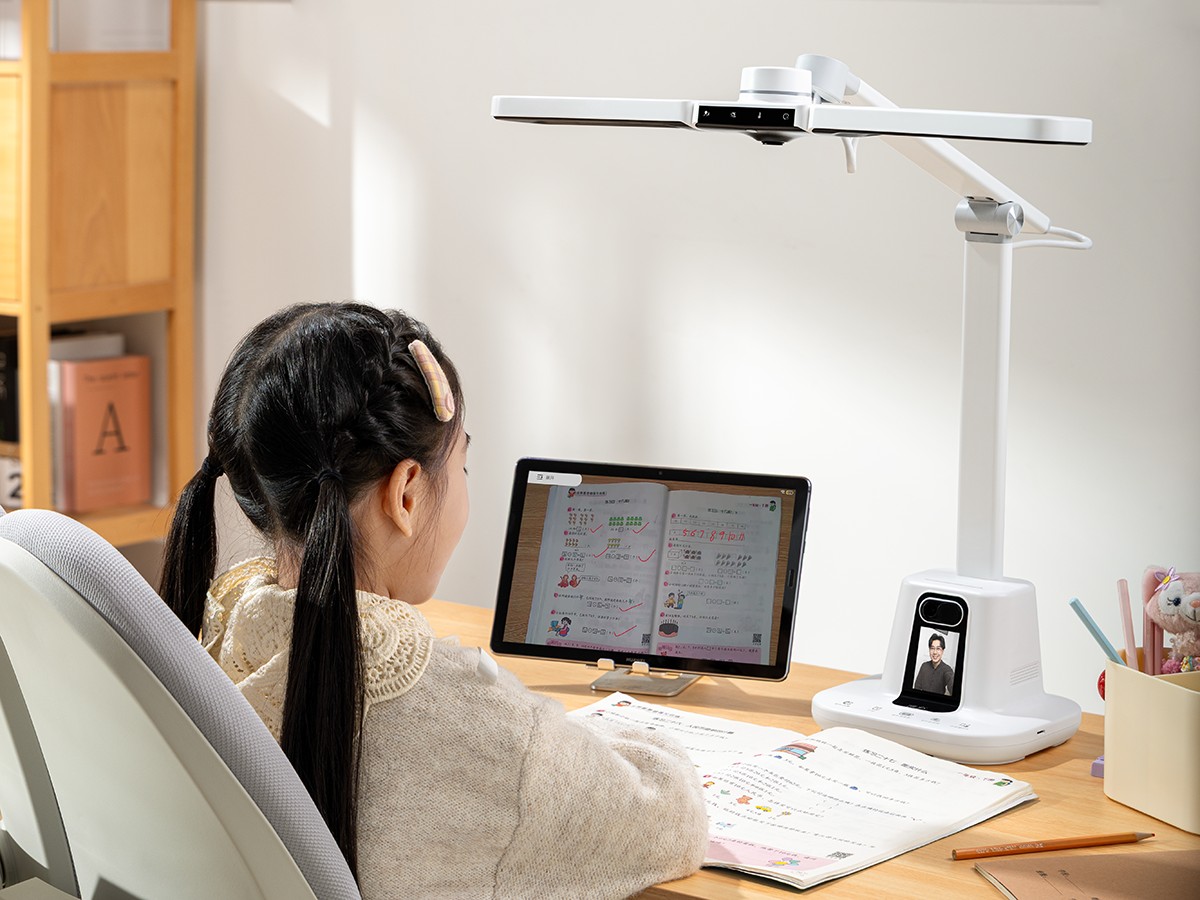
Behind more than 100 million primary school students, there are massive "connection gaps" in family after-school learning
Children finish school in the afternoon while their parents are still at work; children stay at home all day during winter and summer vacations while their parents still need to work normally; the elderly can pick up, drop off and take care of children, but may not be able to handle specific learning tasks such as math problems and English dictation; some parents are on long-term business trips or live separately from their children, making it even harder to participate in their children's daily learning process.
These are all very familiar scenarios for Chinese families.
According to the *2024 National Statistical Communiqué on the Development of Education* released by the Ministry of Education, the number of primary school students in China has exceeded 100 million. Data released by the National Bureau of Statistics of China, UNICEF and the United Nations Population Fund shows that the number of children affected by population mobility in China reached 138 million in 2020, accounting for 46.4% of the total child population in the country, of which the number of left-behind children is about 66.93 million.
Besides the large base of families with primary school students, family lifestyles are also constantly changing. Situations such as dual-income families, cross-city employment, children being taken care of by the elderly, and mismatched schedules between parents and children during winter and summer vacations have made a long-standing problem increasingly prominent: when children need help, their parents may not be able to be by the desk.
A survey of existing paid users conducted by 6AM Technology also presents similar characteristics. 77.46% of the respondents mentioned that they "live separately from their children and cannot tutor them in person"; in addition, children procrastinate on doing homework and need supervision, there is a time gap between school dismissal and parents' off-duty time, and parents often work overtime or go on business trips, which are also the concentrated reasons for purchasing the product.
In the past, such demands were mostly solved temporarily by phone calls, WeChat video calls or home cameras.
But these tools are not designed for homework tutoring.
Ordinary home cameras are mainly used for care, and they are far away from the desk, so it is difficult to see clearly the words and formulas on the test paper as well as children's writing process; essentially, they are still one-way observation devices, not suitable for continuous two-way communication between parents and children around a certain problem. At the same time, when the camera plays the role of "supervising learning", children are also prone to have resistance psychology of being monitored.
Mobile video calls can realize two-way communication, but they require children to hold the mobile phone to aim at the homework, and constantly adjust the lens when reading problems, explaining problems and communicating. Meanwhile, they also bring content unrelated to learning such as short videos and games to the desk.
Learning tablets mostly solve the problems of content supply and independent learning.
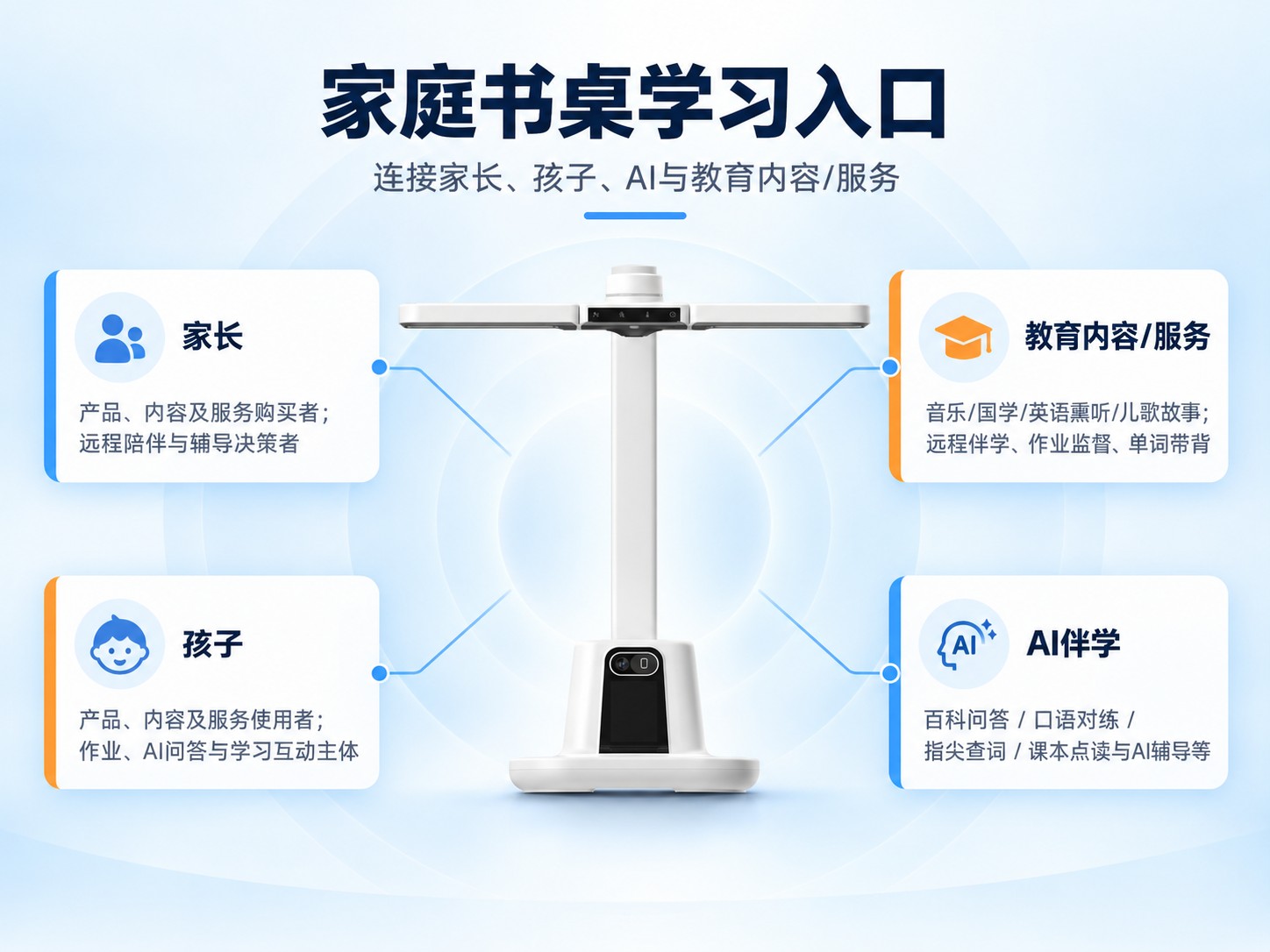
Accordingly, 6AM Technology positions its product as "family desk learning entrance": instead of adding another learning screen, it is better to make the desk that children use every day a learning scenario where parents can participate remotely and AI can provide help at any time.
The product design of 6AM Technology is developed around this scenario. Parents can connect to the desk-end device through their mobile phones to view real-time homework pictures with a maximum clarity of 2.5K; when children encounter problems, they can directly call their parents through the device; after finishing homework, they can also take photos and upload them for parents to check and annotate remotely.
The flagship product C5 Pro is further equipped with a front camera, allowing parents to see both the homework and the child's status at the same time. The tablet can also be used as an external interactive screen, and the annotations made by parents on the mobile phone can be displayed synchronously in front of the child.
This means that what parents see is no longer just "whether the child is sitting at the desk", but they can truly participate in the explanation of a problem, a dictation or the check of a homework.
Another key to supporting this experience is high-frequency real-time audio and video connection.
Different from occasional video calls, once remote tutoring becomes a daily family behavior, the clarity, delay, network adaptability of the video and long-term communication costs will directly affect product experience and business model.
6AM Technology has independently developed the S-NAA video transmission technology, which dynamically adjusts encoding and transmission parameters according to the home network status through intelligent QoS strategy, and optimizes images for homework scenarios such as textbooks, test papers, printed characters and handwritten characters.
At the same time, according to the calculation of 6AM Technology, the unit communication cost of its self-developed audio and video communication solution is more than 95% lower than that of directly purchasing third-party RTC services on the market. For educational hardware that generates a large number of video connections every month, this means that the company can make video tutoring a high-frequency function without significantly increasing the usage cost for users.
From this perspective, the technical barrier of 6AM Technology lies not only in "the camera can see more clearly", but also in establishing a set of high-definition image, real-time connection and low-cost large-scale communication system suitable for family homework scenarios.
AI takes on another part of the work. At present, the product has covered learning scenarios such as word lookup, encyclopedia Q&A, translation, composition and story generation, multi-round dialogue, as well as textbook point reading, dictation and oral practice.
In this product logic, parents and AI are not in a mutually exclusive relationship: parents are responsible for companionship, supervision, explanation and communication, while AI supplements the capabilities of instant Q&A and independent learning.
As a result, the desk lamp has begun to evolve from a lighting device to a family learning terminal that connects children, parents and AI.
From eye-protecting desk lamps to family learning terminals, intelligentization opens up new category space
From the perspective of the larger consumer hardware market, another variable that 6AM Technology cuts into is the continuous intelligentization of traditional hardware.
Televisions have evolved from display devices to Internet content entrances, speakers have become smart home entrances after adding voice assistants, and automobiles are also evolving from transportation tools to intelligent terminals.
Similar changes are taking place in desk lamps.
Compared with the scale of the entire lighting industry, the data of eye-protecting lamps and smart desk lamps can better reflect the changes in family desk scenarios.
Data from Huajing Industry Research Institute shows that the market size of China's eye-protecting lamp market has reached 10.409 billion yuan in 2024. At the same time, data from JD Big Data Research Institute shows that the overall transaction volume of the desk lamp category increased by 15% year-on-year in 2024, of which the year-on-year growth rate of vertical eye-protecting lamps exceeded 100%, and smart and eye-protecting desk lamps together contributed 40% of the sales of the entire desk lamp category.
The intelligentization trend is also reflected in the shipment structure. According to IDC data sorted out by China Merchants Industry Research Institute, the shipment volume of smart lighting in China is expected to be about 39.57 million units in 2024, of which desk lamps account for 9.9%. Calculated based on this caliber, the annual shipment scale of smart desk lamps is close to 4 million units. It should be noted that this statistical caliber refers to "smart desk lamps", which is not exactly the same as learning eye-protecting lamps, but it can still reflect that the intelligentization of desk lamps has formed a certain consumer base.
These changes mean that desk lamps are gradually undertaking more functions such as eye protection, perception, interaction and learning from simply "illuminating the desktop".
This is especially important for educational smart hardware.
The desk lamp itself is a mature device on the family desk, and there is no need to re-cultivate the habit of "why children put it on the desk". Therefore, compared with creating a new type of learning hardware, adding cameras, AI and connection capabilities at a high-frequency, fixed position that naturally belongs to the learning scenario has natural scenario advantages.
The remote tutoring machine can be understood as the result of this continuous evolution of intelligentization:
Traditional desk lamps solve lighting problems, eye-protecting desk lamps solve the eye-use environment, smart learning lamps add learning capabilities, and remote tutoring machines further solve the problem of human-to-human connection.
It is precisely for this reason that its potential market cannot be simply equated with the traditional learning machine market.
It not only undertakes the consumer demand formed by eye-protecting desk lamps, but also enters the hundred-billion-level educational smart hardware market, and at the same time tries to cover scenarios that were difficult to be solved by traditional educational hardware before, such as long-distance families, dual-income families, children taken care of by the elderly, and no one to tutor children during winter and summer vacations.
From this perspective, remote tutoring is only the most clear entry point of the product at present, and the greater value may lie in — whoever can occupy the family desk for a long time will obtain the entrance to connect to family learning demands.
Preliminary verification completed with 50,000 devices, moving from products to family learning platforms
Whether a new hardware category can finally be established, in addition to the market logic, the more critical indicator is whether consumers will actually use it after buying it home.
Since 2020, 6AM Technology has formed a product matrix with multiple price ranges. At present, the A3 Pro is positioned as an entry-level product, the C3 is the main model, and the C5 Pro undertakes the upgrading of dual cameras, AI companion learning and subsequent service capabilities. According to the data provided by the company, 6AM Technology has activated a total of about 50,000 devices and registered about 105,000 users; about 900,000 video calls are made every month, with a total call duration of about 150,000 hours, about 220,000 homework pictures are generated per month on average, and about 450,000 AI Q&A interactions are completed.
For a hardware with "remote connection" as its core differentiated capability, 900,000 monthly video calls are more worthy of attention than pure device sales.
It at least shows that for some families, remote tutoring is no longer an additional function that is only tried once when buying the device, but has gradually become a recurring family behavior.
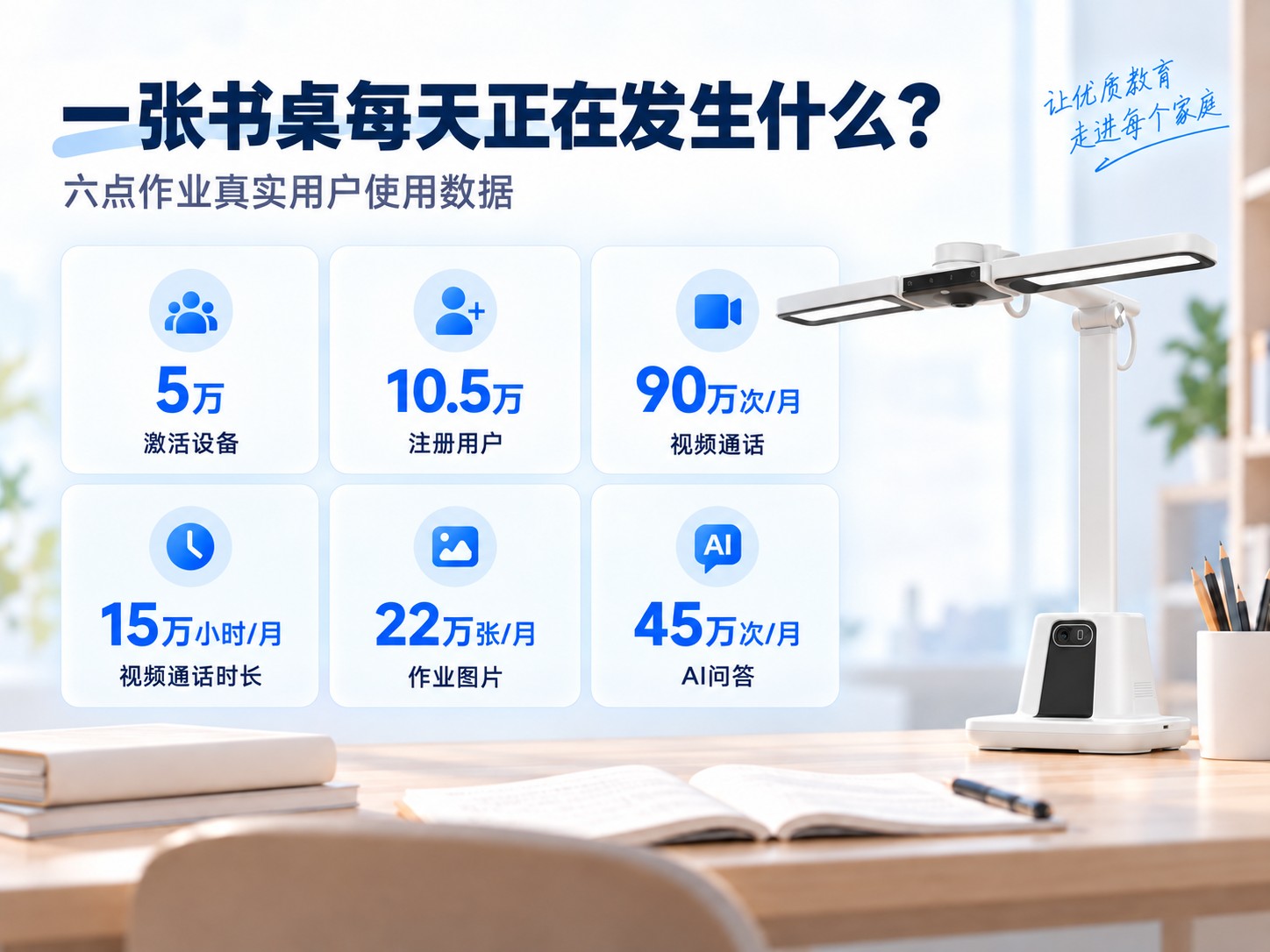
More importantly, this high-frequency connection leaves space for the subsequent business model.
At present, 6AM Technology still takes hardware sales as its main source of income, and at the same time begins to explore AI membership, learning content and companion learning services. Its business logic is: first enter the family desk through hardware, and then provide continuous services around children's long-term learning process.
Therefore, "family desk learning entrance" is not just a product positioning for 6AM Technology.
If you break down a family learning process, you will find that there are multiple demands at the same time: children need a proper light environment, need to look up words and ask questions, need supervision, need to communicate with parents, and sometimes need teachers or other people to provide tutoring.
In the past, these demands were undertaken by desk lamps, mobile phones, learning machines, cameras, parents and tutoring services respectively.
What 6AM Technology tries to do is to gradually connect these scattered demands through a device placed on the desk for a long time.
In terms of the team, founder Jiang Qunbing graduated from Tianjin University, with dual bachelor's degrees in Chemical Engineering and Technology, and Computer Science and Technology. He once engaged in R&D and management of core network IMS related products at Huawei, and later served as the general manager of the Smart Home BU of Tenda. Other core members of the team have backgrounds in consumer electronics channels, audio and video communication and Internet of Things R&D respectively.
At this stage, the sales of 6AM Technology are still mainly concentrated in online channels. In the next stage, the company plans to expand content channels such as Douyin and Xiaohongshu in addition to JD and Tmall, and try to cooperate with distributors, offline experience points and educational institutions.
For 6AM Technology, what needs to be verified in the next stage is no longer just "whether there is demand for remote tutoring", but whether more families can gradually establish a new product perception:
The desk lamp on the child's desk can not only be responsible for lighting, but also become a window for parents to remotely enter their children's learning process, as well as an entrance for AI and educational services to enter the family learning scenario.
Once this entrance forms a stable usage habit, the value boundary of the remote tutoring machine will no longer be limited to an educational hardware itself.