Halved, fiercely denounced, and under window guidance, humanoid robots have started to go through their tribulation period.
The demystification of humanoid robots is now underway.
On August 19, Unitree Robotics was listed on the Sci-Tech Innovation Board, hailed as the "first humanoid robot stock" in the A-share market. However, the glory of its first trading day quickly gave way to a sharp plunge in share price and market capitalization, as the once-full moon of its market value shrank to a crescent.
While Unitree's share price kept falling, another "plunge" was unfolding inside the industry. Shao Tianlan, founder of Mech-Mind, which was listed on the Hong Kong Stock Exchange not long ago, posted successive criticisms on WeChat Moments targeting "scheme-assembling" embodied intelligence enterprises, explicitly naming Galaxy Universal. Later, Qianxun Intelligence, Xinghaitu, and Xingdong Jiyuan were exposed to have been reported by their peers. The market also spread news that the regulatory authority had carried out informal "window guidance" for humanoid robot IPOs.
These seemingly isolated incidents are in fact two sides of the same value reevaluation: as humanoid robots move from PPTs and Spring Festival Gala stages to the spotlight of the capital market, the biggest contradiction in the industry is no longer the technical story of "whether a robot prototype can be made", but whether a sustainable real business that is not driven by related-party transactions and has core technical capabilities can be built.
The halving of Unitree's market capitalization may mark the end of the capital carnival. The fundamental base of the entire industry has not deteriorated; what has changed is the way the capital market examines this sector, which will also kick off a round of industry elimination focused on "real technology, real orders, and real implementation".
01 Unitree's "roller coaster" reflects the reality of industry development
Listing is about to complete its first month, how has Unitree Robotics performed?
On August 19, Unitree Robotics was listed at an issue price of 150.80 yuan per share, opening at 1100 yuan on the first day of trading, corresponding to a market capitalization of about 444.9 billion yuan. As of September 15, it closed at 469.8 yuan per share, falling for 6 consecutive trading days, with a total market capitalization of 190 billion yuan, about 57% lower than the market value on the first day of listing.
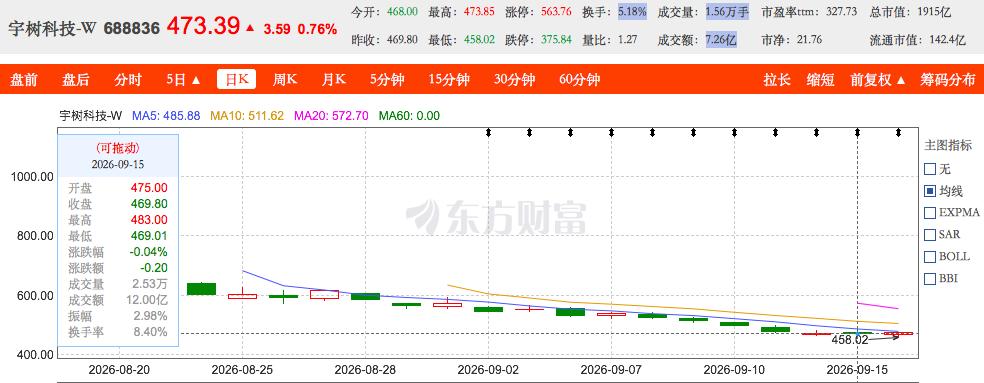
The sharp reversal of Unitree's share price actually had early omens. Before listing, considering Unitree's issue price-earnings ratio as high as 219 times, some securities firms reminded investors to make rational investments. The average static price-earnings ratio of its general equipment manufacturing industry is only 38.56 times, and the P/E ratio of comparable Hong Kong-listed company UBtech is about 19.37 times. However, Unitree Robotics still acted out of common expectations, and its intraday dynamic P/E ratio once exceeded 800 times on the first day of listing.
The reasons for the sharp plunge of Unitree Robotics' share price, apart from the equity chip structure factor, lie more importantly in the correction of its fundamentals, which covers two aspects: on the one hand, the valuation at listing has overdrawn the expectations of decades of future development. Unitree is regarded by the market as the scale and anchor of the industrial value of humanoid robots, and its pricing largely includes the expectation of the trillion-yuan market in the long term, rather than the pricing based on current performance. Once market sentiment cools down, the high valuation is bound to see a sharp correction. On the other hand, the company has reached a performance inflection point, with increased revenue but no corresponding profit growth. Financial reports show that Unitree's revenue in the first half of 2026 was 1.152 billion yuan, a year-on-year increase of 48.54%, with the growth rate dropping significantly. Its non-net profit deducted was 244 million yuan, a year-on-year decline of 19.34%. The profit decline came from the upfront investment in R&D and marketing expenses, with R&D expenses increasing by more than 82 million yuan year on year.
What deserves more attention is the revenue structure disclosed in Unitree's interim report: scientific research and education accounts for as high as 73.6%, commercial consumption accounts for 17.39%, and scenarios such as real industrial manufacturing, inspection, and logistics only account for about 9% in total. This means that Unitree's products are mainly used in research fields rather than on production lines, and there is a very obvious gap between this status quo and the "mass production + industrial penetration" required by hundreds of billions of market capitalization.
Objectively speaking, Unitree Robotics itself is not a poor-performing company. It is one of the very few whole-machine companies in the global humanoid robot track that have achieved large-scale profitability. Its full-year revenue growth rate in 2025 was 332%, with full-stack self-developed core components and a gross profit margin of over 60%. During its listing roadshow, Unitree Robotics also depicted the development path of its own robots: in the short and medium term, humanoid robots will mainly focus on scientific research, application development, education and teaching, cultural performance and intelligent services; in the medium and long term, it is committed to providing systematic services for industrial, household and social scenarios.
Therefore, even with the sharp plunge in share price, Unitree has not stopped its industrial layout, which is also the key to distinguishing "pure story-telling enterprises" from physical hard technology companies. For example, out of the 4.202 billion yuan Unitree plans to raise through IPO, 624 million yuan will be invested in the manufacturing base, and 2.022 billion yuan will be invested in the R&D of embodied intelligence models, aiming to complete the full-chain capabilities of "hardware ontology + brain model".
Since its official listing, Unitree has registered subsidiaries in Tianjin and Chengdu respectively to build industrial clusters. On the model side, it has released the world-action large model UnifoLM-X2-1.0. On the product side, it continues to iterate the G1 humanoid robot and As2 quadruped robot, and launched the GD01 manned transformable mecha, etc.
But it is undeniable that Unitree Robotics' share price will continue to find its reasonable range. For example, CITIC Securities gives a reasonable market capitalization range of 50.6 billion to 55.9 billion yuan, which still has a lot of room for downward adjustment compared with the current market value.
02 Criticism, reports and "window guidance": structural anxiety behind the controversy
If the avalanche of Unitree's market capitalization is only a superficial section of the industry, then the recent internal industry debate has directly made the core contradiction of the track public.
According to media reports, Shao Tianlan, founder of Mech-Mind, which was listed on the Hong Kong Stock Exchange not long ago, recently posted criticisms of the current situation of the embodied intelligence industry on WeChat Moments for two consecutive days, pointing directly to many "scheme-assembling" embodied intelligence enterprises in the industry that use related-party transactions to generate false and unsustainable revenue, lack PMF (Product-Market Fit), create hype with "big news", and plan to go public only two or three years after their establishment.
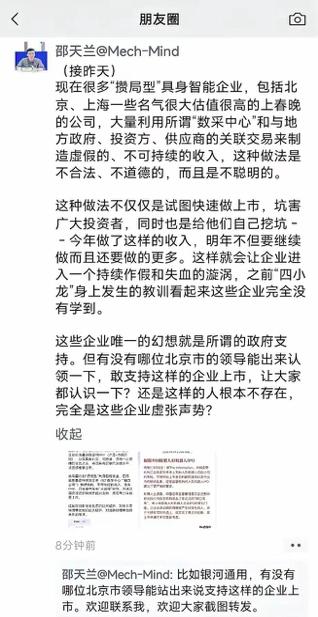
The core logic of Shao Tianlan's query is: enterprises sell humanoid robots to data collection centers, and after the capital flow, buy back the training data collected by the robots to form a closed capital loop. The revenue is generated on the books, but there is no real industrial application demand, and the orders are unsustainable. Once listed, the enterprise must continue to expand similar revenue in the second year, and will fall into a cycle of continuous blood loss.
The "scheme-assembling" embodied intelligence enterprises mentioned by Shao Tianlan include some well-known, high-valuation companies in Beijing and Shanghai that have appeared on the Spring Festival Gala, and he even explicitly named Galaxy Universal in the comment section. Galaxy Universal later released an official statement saying that it would not participate in unnecessary verbal disputes, and filed a report with the public security organs at the same time.
The reason why this round of criticism has aroused widespread resonance is that it touches on a sensitive point that the industry has tacitly accepted: when the technical route has not yet converged and real demand has not yet expanded, what kind of revenue counts as valid?
At the same time, there are also online rumors that leading embodied intelligence enterprises Qianxun Intelligence, Xinghaitu, and Xingdong Jiyuan may face key major assessments this month, and they have recently been reported by a peer to the "examiner", and the specific content of the report has not yet been made public. In response to the rumors, a representative of Qianxun Intelligence said that the online information is not true; the media contact person of Xinghaitu said that they are not aware of the relevant situation for the time being; the representative of Xingdong Jiyuan said that they will not make an official response for the moment.
Behind these series of incidents is the news that the IPO atmosphere for humanoid robots is getting tighter. According to media reports, people familiar with the matter said that domestic regulatory authorities have recently given informal "window guidance" to some investment banks and investment institutions to raise the approval threshold for humanoid robot enterprises' IPO applications. The new requirements mention that enterprises planning to go public need to prove that they can generate sustainable revenue, are moving towards loss reduction, or have truly important technological innovations.
On closer inspection, this is not difficult to understand, because the current reality faced by humanoid robots seems prosperous but is actually fragile. In terms of shipment data, the global shipment of humanoid robots in the first half of 2026 is about 19,100 units, a year-on-year increase of 272%, and Chinese manufacturers account for more than 97% of the total. However, the vast majority of these orders come from scientific research procurement, scenario demonstration, and data collection, and there are very few large-scale orders that are actually implemented in factory assembly lines, warehouse posts, and household civilian scenarios. In terms of commercialization, the industry faces problems such as high cost, limited operation capability, and insufficient universality. Humanoid robots can mostly complete single-point simple tasks, and their adaptive capability in complex environments is insufficient; the hardware cost remains high, and in most scenarios, the comprehensive use cost of robots is higher than that of human labor, and the ROI has not turned positive.
If the above informal "window guidance" is true, then this may mean that the evaluation system of embodied intelligence is changing. In the past, the market paid more attention to whether the robot can be manufactured, how its motion performance is, and whether its model capability is leading. As the industry enters the stage of commercial verification, real repurchase, performance cost, operating cash flow, ROI, sustainable revenue, and whether the enterprise truly has independent and controllable hard core technology, are becoming more important issues than financing amount, valuation and order scale.
According to incomplete statistics, there are currently 28 domestic embodied intelligence and humanoid robot enterprises planning or promoting IPOs. Previously, the Hong Kong Stock Exchange's 18C Specialized Technology Channel and the Sci-Tech Innovation Board's hard technology policy have provided capitalization windows for unprofitable cutting-edge technology enterprises, and a large number of enterprises applied for listing relying on prototypes and a small number of project orders. After the implementation of the window guidance, the capitalization dividend of the track will shrink significantly, and enterprises that rely solely on government projects, one-time performance orders, and related-party transactions to package revenue will face stricter scrutiny on their IPO path.
03 The knockout round kicks off: what to compete for after reevaluation?
In the past two years, more than 300 start-ups in China's embodied intelligence industry have emerged, with the total financing scale reaching 570 billion yuan in 2025, and it rose rapidly to 935 billion yuan in the first half of 2026. The valuations that were pushed up in the primary market in the past are now being re-priced in the secondary market.
At present, there are two core criteria for the value reevaluation of humanoid robots: first, sustainable commercial capability takes precedence over technical parameters. Those fancy technical demonstrations and promotions in the past are gone. The capital market will return to the essence of business, that is, whether the buyer is a market-oriented industrial customer, whether there is stable repurchase of orders, whether the revenue is non-related-party transaction, and whether the enterprise can continuously reduce losses. The valuation weight of those one-time project orders and state-owned capital data collection orders will be greatly reduced. Second, underlying original technological innovation, rather than component assembly. The valuation of "assembly plants" that only purchase reducers, motors, and controllers externally to complete whole-machine integration and shell assembly will continue to be under pressure. Only enterprises that have the capability of self-developed core components, embodied basic models, ontology control algorithms, and long-term independent iteration can enjoy valuation premium.
When facing industry competition, Unitree Robotics once said that the core of industry competition will focus on the capabilities of reducing the cost of core components, obtaining real orders and closing commercial loops for scenario applications. It is expected that the industry will soon enter the stage of reshuffling and integration, and resources will further concentrate on leading enterprises with core technical barriers and extreme cost control capabilities. Unitree Robotics also believes that technology and cost are the two core factors, so while building the "brain + cerebellum + ontology" technology system, the company is also actively seeking cost reduction.
The latest report from Orient Securities also mentions that in the first half of 2026, the prosperity of the humanoid robot industry chain is on the rise, the industry revenue has achieved rapid growth, and the shipment volume of whole-machine and component manufacturers has both accelerated. The expansion of application scenarios in the humanoid robot industry is showing marginal acceleration, among which embodied intelligence manufacturers that actively deploy in vertical scenarios and whole-machine manufacturers with stronger model generalization capabilities are expected to gain greater competitive advantages.
Overall, in the next three to five years, the humanoid robot industry will not cool down, but will enter a stage of fierce competition and survival of the fittest. The competition and differentiation will probably focus on three battlefields: first, scenario positioning. Scenarios such as industrial inspection, logistics sorting, and special operations that are "dirty and tiring" will be implemented first, and the first one to get through the single-point commercial loop will win; second, cost and mass production. The increase in the localization rate of core components will drive the continuous decline of whole-machine cost, and the large-scale delivery capability determines the lower limit of profit; third, data and models. The scale and quality of real machine data will determine the upper limit of the intelligence of the "brain".
04 Conclusion
If we combine the halving of Unitree's market capitalization, peer debates, and tightened IPO approvals, this series of events has completed a collective "demystification" of the humanoid robot track.
Of course, the long track of humanoid robots will not end just because of a valuation correction. But Unitree Robotics' "roller coaster" performance finally makes the whole industry recognize and face the reality: the value of your enterprise is no longer determined by the Spring Festival Gala stage and grand future visions, but by the balance sheet and repurchase orders from the production lines.
This article is from WeChat Official Account "Lai Ka Think Tank" (ID: laikazk), written by Gong Yan, and authorized for release by 36Kr.