Doubao Work has played its "Team Agent" card, will Workbuddy and Qwen follow suit?
This summer, the AI office competition has intensified sharply. Tencent, Alibaba and ByteDance have successively completed the integration and consolidation of their product lines, shifting from isolated function iteration to competition with a more complete product ecosystem.
The trend of this ecosystem competition is becoming clear:
AI tools that only empower individuals are no longer the end point of competition. All players are moving deeper, embedding AI capabilities into existing enterprise workflows and the daily collaboration rhythm of teams. The one that completes this step will secure a more stable position in the next stage of competition.
On September 15, the 2026 Feishu Future Infinite Conference was held in Beijing, where Feishu 8.0 and "Doubao Work Partner" were unveiled simultaneously. The former has completed a systematic platform-wide reconstruction oriented to Agent, while the latter is China's first team-level agent product, embedded into the organizational system as an independent collaboration subject, becoming an organization-level intelligent role accessible to all employees with shared context.
This is not a solo breakthrough by one major tech company. Tencent WorkBuddy is accelerating the interconnection between WeChat and WeCom, while Alibaba's Tongyi has also been deeply embedded into DingTalk's office workflow. The three players have embarked on three completely different exploration paths based on their respective ecological advantages.
The competitive focus of the office AI track is also shifting from the function competition of personal efficiency tools to the deep implementation of organization-level intelligence.
Why does Doubao Work choose team Agent as the breakthrough point?
As China's first team-oriented agent product, the core breakthrough of Doubao Work Partner is to enable the Agent to enter the organizational workflow as an independent collaboration subject.
In terms of specific product form, Doubao Work Partner has an exclusive account system and persona, which can be pulled into any group chat, invited to meetings, and access documents and data within the authorized scope like a real employee. All enterprise employees can directly @ it to initiate collaboration, without the need for separate configuration and repeated context feeding for each individual.

In terms of the permission system, it fully follows Feishu's organizational structure rules. Enterprise administrators can uniformly configure the access scope, set the upper limit of AI usage, and trace all operation logs, with the security boundary consistent with that of real human employees. More critically, it has continuous team memory: it can remember group chat history, document content, meeting conclusions and project progress, so the accumulated team experience will not be lost with personnel turnover, and can be called across groups and reused across projects.
Within the authorized scope, Doubao Work Partner can invoke Feishu's full-stack product capabilities, even attend meetings on behalf of others with context and synchronize meeting minutes after the meeting. Enterprises can also configure multiple work partners for different departments or projects to undertake different functions such as content, data and operation respectively.
The core premise for all this to work is the native deep integration between Feishu and Doubao Work, rather than the simple interconnection of two separate products. The reconstruction of Feishu 8.0 essentially upgrades Agent from a "function caller" to a "first-class citizen" of the platform. The officially disclosed adaptation logic is divided into three layers: natural collaboration between humans and Agents, Agents using all products like humans, and clear permissions for enterprises to manage Agents just like managing people.
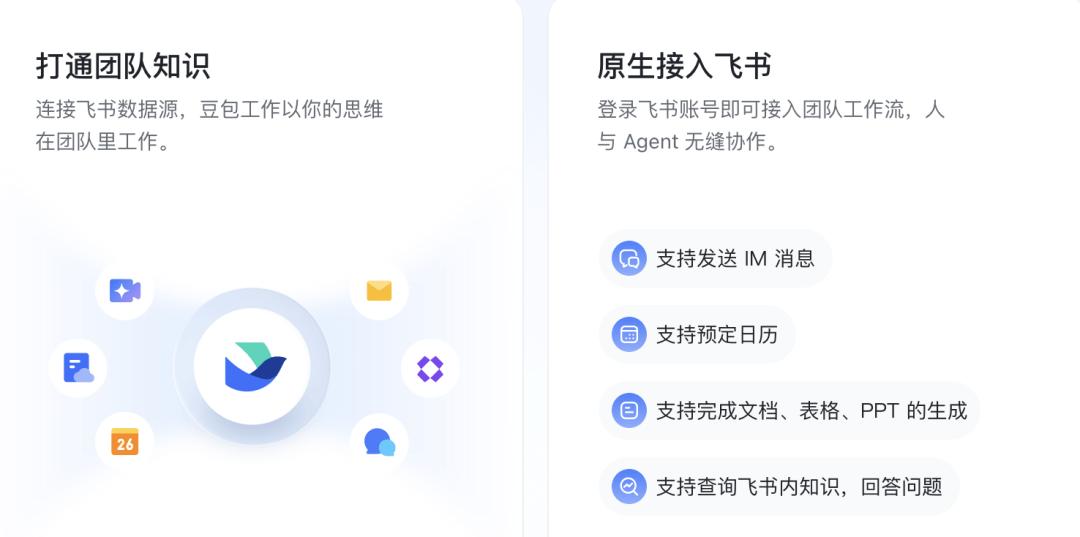
The foundation of this logic is the all-in-one collaboration infrastructure precipitated by Feishu over the past decade — group chat, documents, meetings, calendars, tasks, multidimensional spreadsheets and project management are all natively interconnected, with data, permissions and workflows flowing smoothly in the same system. Agents do not need to splice context across platforms or repeatedly adapt to the interfaces of different tools.
On the other side, there is the execution-side capability support provided by Doubao Work. Since its official release in August this year, Doubao Work has rapidly iterated core capabilities such as desktop-side Computer Use, browser automation, and multi-Agent collaboration, which can directly operate local applications, independently decompose complex tasks, invoke tools and promote process implementation. When Feishu's organizational context meets Doubao Work's execution capabilities, the office Agent has crossed the stage of standalone operation and become a collaborative role that knows "how to work in this team".
The reason why ByteDance takes team Agent as the core breakthrough point is not a single-point product innovation, but a strategic choice supported by both organizational structure and infrastructure precipitation.
Feishu's core confidence in building team Agents comes from its infrastructure accumulation and data precipitation after years of deep cultivation in the collaborative office field. Its customer groups cover multiple tracks such as Internet, technology and new energy, and are also continuously penetrating into traditional industries such as manufacturing, FMCG and energy, with high product acceptance among knowledge-intensive teams.
What these customers precipitate on the platform is not scattered usage records, but complete team work data: discussions and decisions in group chats, knowledge precipitation in documents, meeting minutes, project progress nodes, and personnel division system. These real organizational contexts are exactly the premise for team Agents to exert value — only by understanding the collaboration logic and project rhythm of the organization can Agents truly participate in the workflow, rather than just mechanically executing an isolated instruction.
For ByteDance, this release means that the integration of Feishu and Doubao Work has moved from function interconnection to native reconstruction. The collaboration infrastructure precipitated by Feishu over ten years has found a new value outlet, and Doubao Work has also established its unique recognition in the crowded office AI track with the differentiated form of team Agent.
Workbuddy interconnects with WeCom, Tongyi embeds into DingTalk, AI office shifts to systematic operation
From a global perspective, extending AI from personal assistants to team collaboration scenarios is the common exploration direction of leading players in the office track. However, different players have different basic markets and different entry paths, resulting in differentiated product forms.
The first to explore the team Agent model was Claude. In June, Claude Tag was officially launched on Slack. It joins Slack channels as an independent identity, with channel-level memory and permissions. Anyone in the channel can @ it to assign tasks, and it will independently decompose execution steps, invoke corresponding tools, and promote work asynchronously, even find problems and follow up unfinished discussions in the Ambient active mode. Anthropic disclosed that about 65% of the code of its product team has been generated by the internal version of Claude Tag so far.
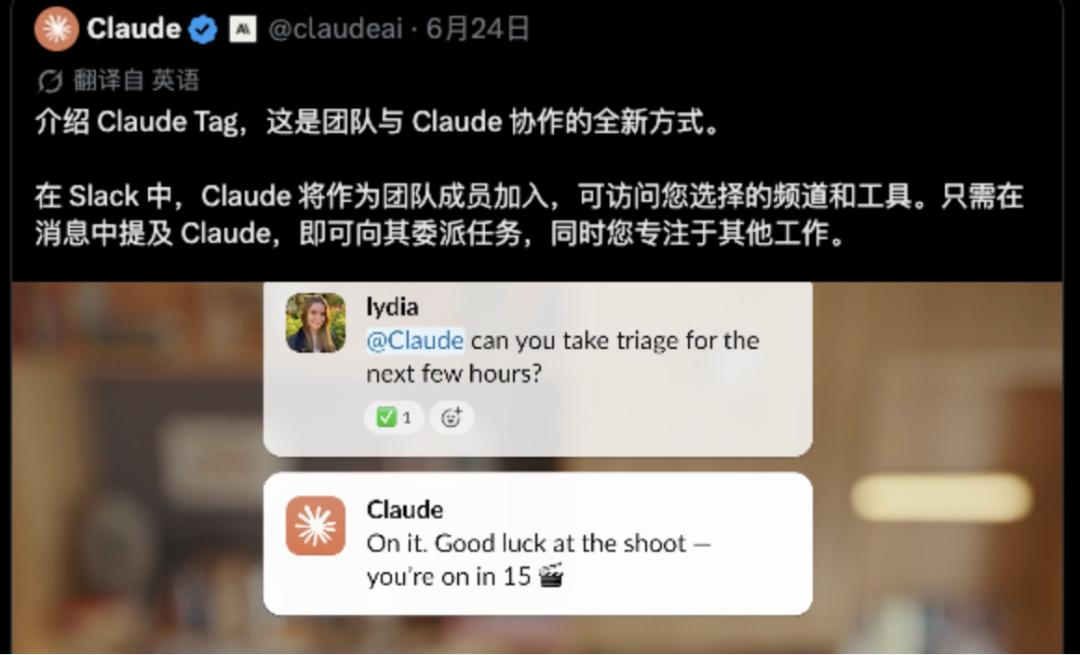
The limitations of this route are also obvious: Slack is essentially an instant messaging connector, and core office capabilities such as documents, spreadsheets and approvals all rely on third-party applications. The Agent's context needs to be spliced across platforms, and its capability boundary highly depends on the coverage of access tools.
In August, the collaboration between WorkBuddy and WeCom ushered in a key upgrade. With the help of the officially opened CLI interface of WeCom, WorkBuddy can directly invoke core capabilities in the WeCom system, including documents, spreadsheets, emails, schedules, and address books. Users only need to give instructions to WorkBuddy in natural language, and it can directly drive WeCom to complete a series of operations such as sorting out documents, updating spreadsheets, and arranging meetings.
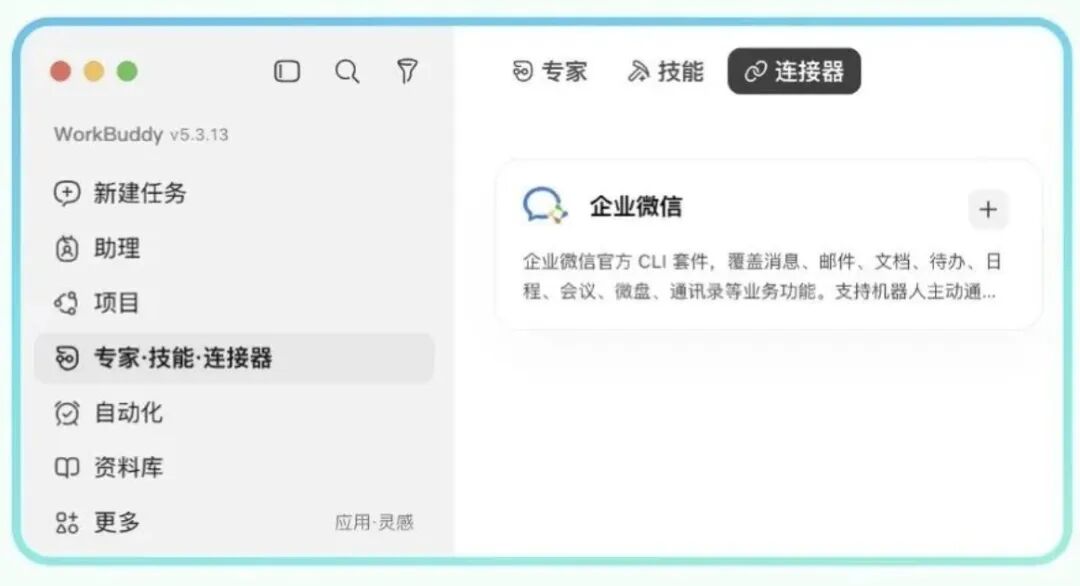
Backed by tens of millions of enterprise organizations connected by WeCom, WorkBuddy can be directly embedded into the existing work links of enterprises, and quickly implement AI capabilities without requiring enterprises to build additional collaboration infrastructure. At the same time, WorkBuddy can also connect Tencent Meeting, Tencent Docs, Tencent Cloud and other product matrices, stringing office nodes scattered in different tools into a complete task chain.
Alibaba follows the route of "native embedding of AI capabilities into office workflows". Tongyi Office is developed under the overall planning of the DingTalk business line, and its collaboration with DingTalk has moved from the early connector docking to deep native embedding within DingTalk — users can directly arouse Tongyi Office in the DingTalk workbench, and all operations are completed in a closed loop within the DingTalk interface.
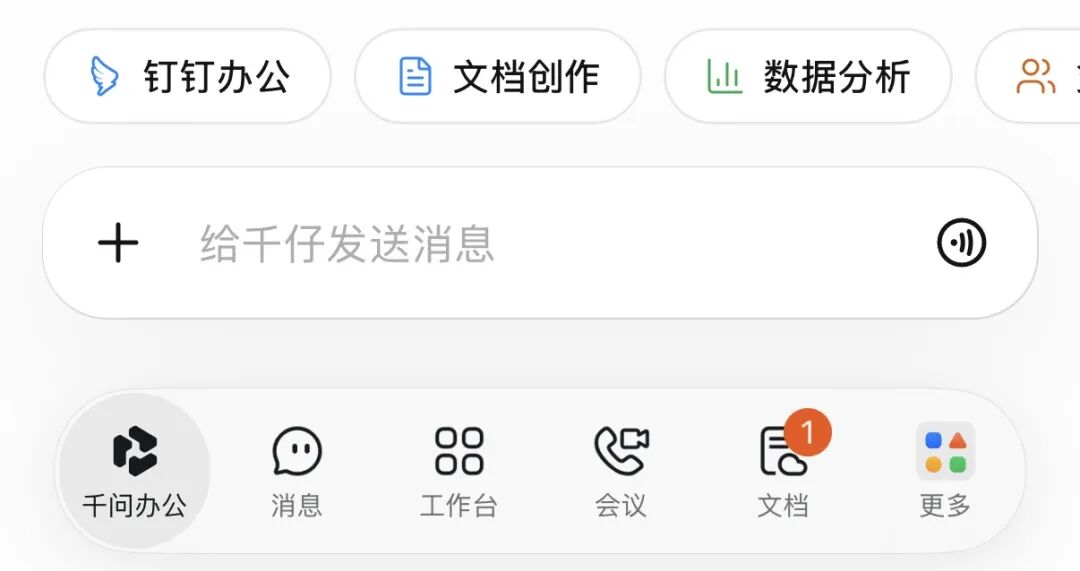
Inside DingTalk, Tongyi Office can directly read and write DingTalk data, drive the whole process of office with natural language, with capabilities covering core scenarios such as group chat management, meeting efficiency improvement, document collaboration, and process automation, connecting 25 business modules and more than 1000 commands.
Different from the team Agent model of Doubao Work Partner, Alibaba does not add a new "AI colleague" to the team, but decomposes and injects AI capabilities into each original process node of DingTalk such as messages, meetings, documents and approvals. These are two different product evolution paths: the former reconstructs the collaboration subject, while the latter optimizes the original process.
It is not difficult to see that these leading players have taken completely different paths: WorkBuddy relies on the WeCom ecological entrance to make an AI collaboration tool embedded in work links; Tongyi + DingTalk deeply cultivates office workflows to make native embedded capability components; Feishu + Doubao Work builds native team-level Agents based on the full-link collaboration platform. Their common direction is to promote office AI from individual tools working alone to group applications serving organizations.
To integrate AI office into organizational collaboration, architectural barriers and product genes need to be broken through first
Institutions such as Gartner and IDC predict that the scale of China's enterprise-level AI Agent market will reach 44.9 billion yuan in 2026, with a year-on-year growth of 112%. The core of competition is extending from the comparison of single product capabilities to the comprehensive contest of "whether AI can truly integrate into organizational workflows".
On this path, ByteDance is relatively ahead. Feishu is responsible for providing complete organizational context and collaboration infrastructure, Doubao Work is responsible for outputting Agent execution capabilities, and Doubao Work Partner is the product form of their integrated implementation. The barriers of this native integration are not only at the technical level, but also lie in the organizational structure and product collaboration efficiency.
However, the value of team Agent is highly dependent on the digitalization level of enterprises, and the complexity of multi-Agent collaboration, the cost control of token usage, and enterprises' concerns about core data security are all issues that need to be verified for the large-scale implementation of this model. At present, Feishu 8.0 has completed platform-wide Agent adaptation, and Doubao Work Partner has entered the stage of targeted co-creation with enterprises. The next key step is to extend the product capabilities verified in knowledge-intensive teams to more industries and transform them into large-scale market coverage.
Tencent holds the ecological advantage of WeCom, and its collaboration with WorkBuddy is upgrading from function docking to ecological opening, but the practical obstacles of this route are also very clear. WorkBuddy belongs to the Tencent Cloud system, while WeCom belongs to the WeChat Business Group. They belong to two independent business lines, and the collaboration between the two is more about capability docking based on the MCP mechanism, rather than underlying native integration.
Although WorkBuddy and WeCom have opened up capability invocation at present, the integration of their contexts is not complete, and the underlying interconnection of data, permissions and organizational memory cannot be realized.
Perhaps because the organizational barriers within Tencent are difficult to break through in the short term, WorkBuddy is also vigorously promoting the enterprise version at the same time. However, for enterprise customers, this means that they need to additionally adopt a new set of work tools, with high migration cost and user education cost.
Alibaba's basic market is the huge enterprise customer base of DingTalk: covering more than 26 million enterprise organizations, with extremely high penetration in industries such as manufacturing, government affairs and education. The collaboration between Tongyi Office and DingTalk is moving from connectors to native embedding, and the in-DingTalk entrance, organization-level Skill and multi-person workbench are all clear product signals.
However, the core limitation of this route is exactly hidden in DingTalk's product gene. The underlying logic of DingTalk is process control, whose core logic is standardization, efficiency and top-down management. The embedding of Tongyi's AI capabilities essentially improves the efficiency of this set of control processes.
This means that AI can only optimize execution efficiency within the established process framework, and structural problems outside the process such as cross-departmental information barriers and non-standard collaboration losses are beyond its capability scope. AI is always a tool component in the process, not an independent collaboration subject, and will not actively promote matters across nodes. The underlying logic of humans calling tools has not changed. This limits DingTalk's imagination space in creating new collaborative relationships and breaking organizational boundaries.
Conclusion
The industry consensus is already clear: the ultimate value of office AI is not to replace individual efficiency tools, but to reconstruct the collaboration paradigm of organizations. When AI becomes a "collaborative subject to work with", enterprises' knowledge precipitation, decision-making links and execution processes will all be redefined — experience will no longer be lost with personnel turnover, information will no longer be stuck due to departmental barriers, and execution will no longer be promoted manually layer by layer.
In this process, the role of office platforms is also changing: it not only carries the daily collaboration between people, but also supports the diverse collaboration between humans and Agents, and between Agents; it not only precipitates all the historical knowledge and work data of the enterprise, but also drives daily decision-making execution and project promotion.
The answer to this competition never lies in technical parameters, but in the real work scenarios of millions of enterprises. The one who can make AI completely eliminate the boundary of tools and truly become a native part of organizational collaboration will hold the right to define the next-generation office form.