"Emotional value" is unreliable, UBTECH is ushering in a major industrial test.
U1 delivery expectations have plummeted, but that does not mean it is unimportant.
Today, UBTECH U1 robots have started deliveries.
This bionic humanoid robot, officially launched on June 30, targets the home companion market, and its core selling point is its ability to deliver "emotional value" to users.

Image source: UBTECH press conference
This product has received more than 13,000 orders. Senior executives of the company made a bold statement at the press conference that they will guarantee the delivery of 10,000 units this year. If UBTECH fulfills this promise, the industry landscape is expected to undergo drastic changes.
According to statistics from the Humanoid Robot Scenario Application Alliance, the top 5 humanoid robot enterprises by sales volume in H1 2026 are UBTECH (16123 units), Agibot (8400 units), Unitree Robotics (5900 units), Luoju (2000 units), and Rokae Robotics (1600 units).
If UBTECH delivers 10,000 U1 units, the company will most likely become the top seller of humanoid robots with a steep lead over other players in the industry this year.
Last year, the competition among industry players for the top sales position was quite intense. The "General Embodied Robot Market Radar" report released by market research institution Omdia showed that Agibot ranked first in the world in shipment volume with an annual shipment of 5168 units, accounting for 39% of the market share. Unitree released an official announcement stating that the company's humanoid robot shipments last year exceeded 5500 units, excluding other robot products such as dual-arm wheeled robots.
However, variables have emerged in this promising prospect. At the recent earnings call, the company's senior executives stated that the actual deliverable volume of the U1 series this year is only 1500 to 2000 units.
With the sharp drop in the expected delivery of U1 that can provide emotional value, UBTECH still needs to go all out on the industrial end for the rest of this year.
01 To make a profit in Q4, does UBTECH still rely on industrial end products?
At the earnings call, the management sent a clear signal.
UBTECH CFO Zhang Ju stated that the original expectation of achieving break-even on a single-quarter basis in the fourth quarter of 2027 remains unchanged, and the company is striving to achieve this goal ahead of schedule. The adjusted EBITDA (Earnings Before Interest, Taxes, Depreciation and Amortization) for the fourth quarter of this year "has a chance to turn positive". This is the first time since UBTECH went public at the end of 2023 that the management has anchored the profit expectation to a specific quarter.
The signal is clear enough, but the pressure is also significant.
Under the realistic constraint that U1 robots can only be delivered in 1500 to 2000 units this year, UBTECH's goal of achieving positive EBITDA in Q4 largely depends on the performance of the company's products on the industrial end.
The U1 robot is a product with a wide price range, with a price range of 119800 to 990000 yuan. For this product, the company's senior executives said that 1500 to 2000 units will be delivered this year.
In this case, the market cannot clearly determine how much revenue the U1 robot can bring to the company in the second half of the year, so the performance of UBTECH on the industrial end has naturally become a key concern for the market.
In the first half of 2026, UBTECH's revenue reached 1.269 billion yuan, a year-on-year increase of 104.2%. Among them, the revenue from full-size humanoid robot products and solutions reached 590 million yuan, a year-on-year increase of 1445%, with 921 units sold. The proportion of this revenue jumped from 6.1% in the same period of the previous year to 46.5%, making it the largest source of revenue for the company in one fell swoop. The gross profit margin of Walker S2 exceeds 70%, the bill of materials cost has dropped from about 350000 yuan to about 180000 yuan, and the average selling price has dropped from 700000-800000 yuan to 600000 yuan. This is a rapidly validated industrial-level profit model.
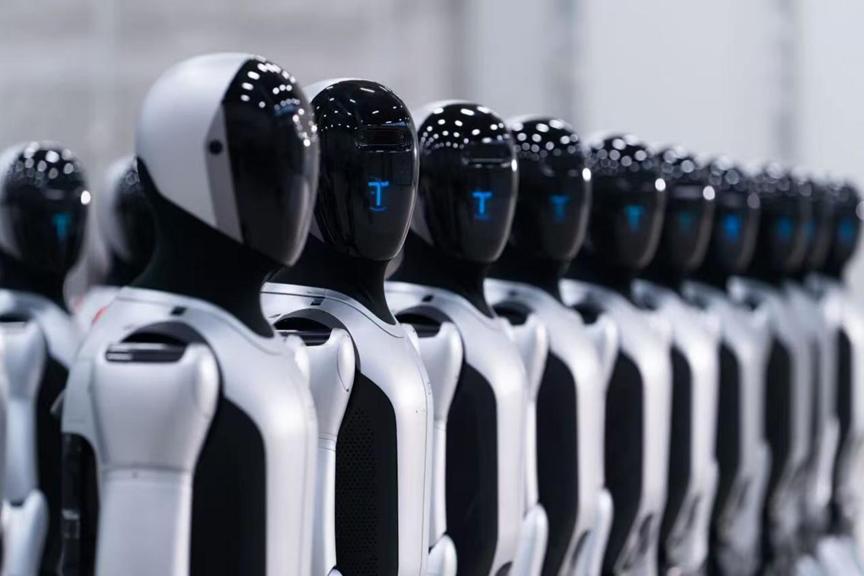
UBTECH has waited for far too long. Over the past six years, the company has accumulated a total loss of more than 5 billion yuan, with a loss of 339 million yuan in the first half of 2026 (a year-on-year reduction of 23% in losses).
The revenue in the first half of the year was 1.269 billion yuan, and the full-year target is 3.5 billion to 4 billion yuan, which means that 2.2 billion to 2.7 billion yuan needs to be completed in the second half of the year, nearly twice that of the first half.
The pressure is obvious, but UBTECH's order reserves are not weak. According to the research report of Caitong Securities, UBTECH's total new order amount in the first half of 2026 exceeded 1 billion yuan, including 3 100-million-yuan-level orders: the first batch of 100 Walker S2 units purchased by Airbus for aircraft assembly, which is the world's first order introducing humanoid robots into the aviation manufacturing field; long-term supply agreements worth more than 500 million yuan signed with automakers such as BYD, Geely, Audi FAW, and NIO; the State Grid's total budget for embodied intelligence procurement in 2026 is 6.8 billion yuan, with about 8500 units of equipment, and UBTECH is listed as one of the 5 core ontology suppliers. The institution defines 2026 as the year of "large-scale commercialization" for UBTECH, with industrial orders accelerating release, and the coverage density of the three core scenarios of aviation manufacturing, automotive industry, and intelligent manufacturing is increasing rapidly.
02 U1 has limited contribution to UBTECH's performance this year, but it is still very important
Although U1 may make a limited contribution to UBTECH's performance in 2026, its strategic significance may be far more profound than selling a few more Walker S units in the short term.
The core reason is that U1 is opening up a brand new track for UBTECH: consumer-grade humanoid robots.
The B-end industrial market is UBTECH's fundamental market, but this market has a ceiling. Industrial customers have long verification cycles, limited procurement volume per customer, and extremely strict delivery standards that calculate the production line rhythm by the hour. Walker S2's entry into Airbus's supply chain and the acquisition of orders from leading automakers are of extremely high value, but the essence of industrial business determines that it is a "slow money" business -- slow signing, slow delivery, and slow revenue recognition.
The C-end market is different. The global consumer electronics market is a huge market facing hundreds of millions of families, and the potential user base far exceeds any single industrial scenario. The launch of U1 makes UBTECH a pioneer in the consumer-grade super-bionic humanoid robot track -- while Agibot and Unitree are competing for the throne of industrial mass production, UBTECH has chosen another path, taking the leading position in an almost blank market.
The ceiling of this track is much higher than that of the B-end.
The dimension of brand value cannot be ignored either. The brand awareness established by U1 on the C-end can never be obtained by Walker S on the B-end. Consumer-grade products naturally have social communication attributes. Users unboxing, posting photos, and sharing short videos, every share is free promotion for the UBTECH brand.
C-end user data can also feed back the iteration of AI models. UBTECH's self-developed Thinker 1.0 base large model ranks first in 9 embodied intelligence lists, and Thinker-VLA achieves a 75% success rate in the whole process of the industrial handling loading and unloading scenario laboratory. More interactive data from user scenarios means faster model evolution speed. This data flywheel effect is difficult to establish in industrial scenarios.
Of course, the challenges are real. The product has limited functional boundaries, the user stickiness of emotional companionship has not been verified by the market, and the price threshold still exists. This makes user word-of-mouth after the first batch of deliveries extremely important. The feedback on the product on social media will largely have a positive or negative impact on subsequent orders.
UBTECH is taking two paths at the same time: the U1 represents the consumer-grade route, which enhances topic popularity and brand momentum through the selling point of emotional companionship; the Walker series represents the industrial route, which accumulates real value through delivery capabilities and production line performance.
The hard power of industrial end products largely supports the lower limit of UBTECH; while opening up the C-end market behind U1 determines the upper limit of UBTECH.
This article is from the WeChat Official Account "Alpha Workshop Research Institute", written by Si Che, and published with authorization from 36Kr.