The space battle at the 300-kilometer orbit has broken out. Who will seize the dominant voice in the next-generation AI infrastructure field?
From satellite internet to space-based AI Infra: When communication, perception and computing begin to integrate in orbit, the very low Earth orbit (VLEO) is no longer just an orbital layer at a lower altitude, but a new layer of global intelligent infrastructure.
Over the past few years, the global AI industry has poured massive investments around one core focus: computing power.
GPUs, ten-thousand-GPU clusters, data centers, power supplies and liquid cooling have formed the main line of this round of AI infrastructure construction. However, as AI evolves from chatbots to robots, drones, autonomous driving, unmanned ships and industrial intelligence, a new infrastructure issue has begun to emerge:
If AI is to truly understand and control the physical world, where does the data come from?
In the future, the AI network will need to connect not only billions of mobile phones, but also robots, drones, vehicles, ships, industrial equipment and sensors spread all over the world. They are not only the execution terminals of AI, but also the "eyes and ears" for AI to perceive the physical world.
The problem is that the vast majority of current AI infrastructure is still built on the ground, while a large amount of high-value data is exactly generated in oceans, mines, deserts, polar regions, forests and ocean shipping routes where optical fibers and 5G are difficult to cover in an economical manner.
AI has already possessed an increasingly powerful "brain", but it still lacks a "nervous system" that covers the entire planet.
This could be the real opportunity for the next-generation space infrastructure.
Signal from SpaceX: Communication and AI are being integrated into the same infrastructure map
A notable signal comes from SpaceX, but its more significant meaning does not lie in SpaceX itself, but in the fact that the global space infrastructure is being reinterpreted by AI.
In July 2026, SpaceX submitted an application for the Gen3 NGSO system to the US FCC, planning to deploy up to 100,000 satellites. The application documents show that the system consists of two VLEO orbital shells, with nominal altitudes of approximately 323–327.5 km and 473–477.5 km respectively; as of now, the application is still under regulatory review.
What is more noteworthy is that this application directly incorporates "AI" into the demand logic of the next-generation network: Gen3 is oriented to global consumers, enterprises, government users and tens of billions of AI-driven devices, and emphasizes the demand of AI for large-scale uplink capacity — high-definition spatial, visual and audio data need to be continuously transmitted to support real-time decision-making and industrial automation.
100,000 satellites with a minimum altitude of 323 km are not the end point of this change, but more like an industry signal: When the connected objects expand from "humans" to tens of billions of machines, the value of communication networks is extending from providing internet access to perception data collection, wide-area interconnection and computing power collaboration.
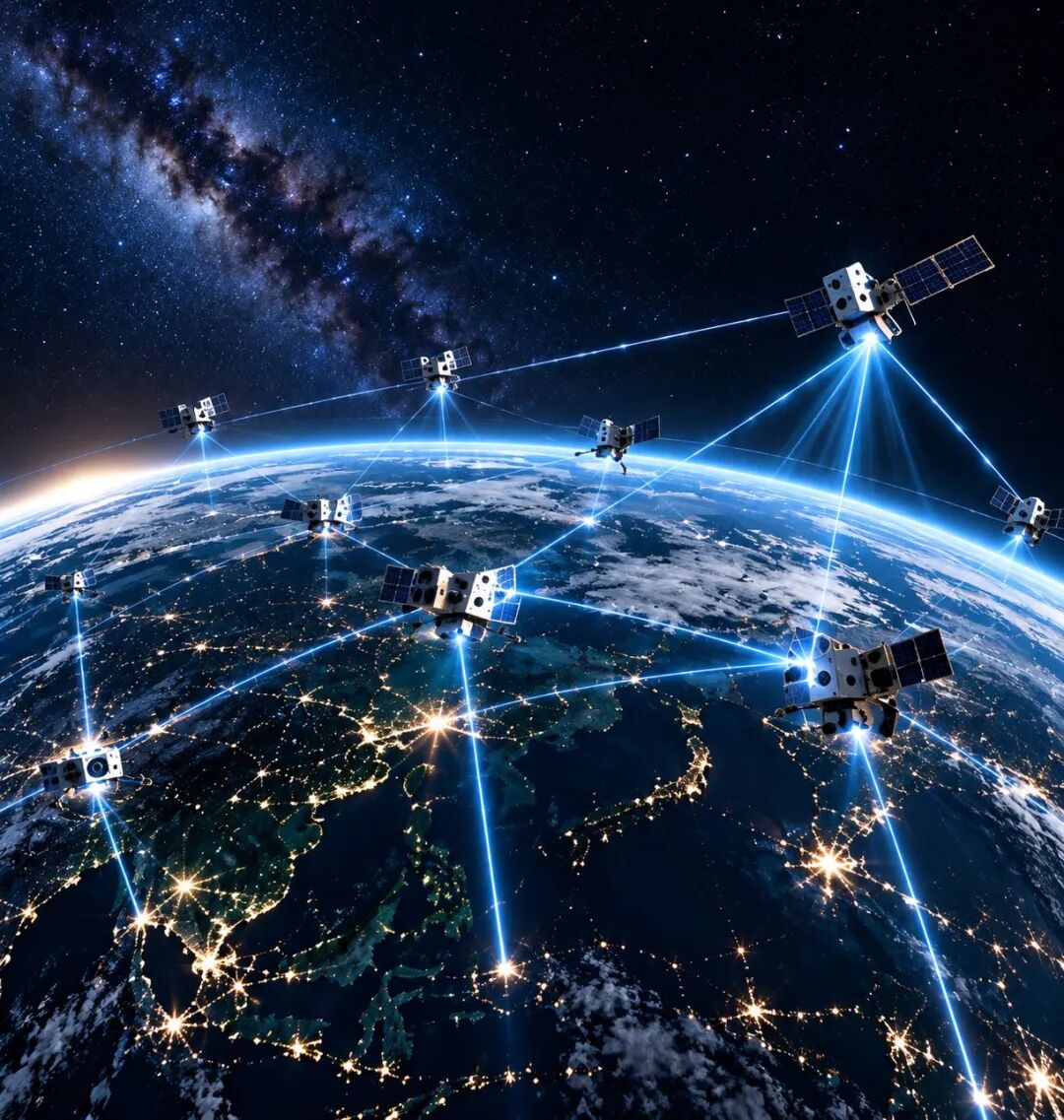
At the same time, SpaceX is also independently advancing the concept of space AI computing power such as on-orbit data centers. The communication constellation and space computing power are not the same system, but the two paths are pointing to the same larger proposition: AI infrastructure is expanding from a single ground-based computing cluster to a global distributed system that includes near-Earth space.
Therefore, what is really worth discussing may not be "how many more satellites SpaceX has applied for", but a bigger question: when AI starts to connect the entire physical world, do humans need to add an additional layer of global space infrastructure beyond ground cloud and edge computing?
Over the past few decades, communication networks have been mainly built around human needs. Watching videos, browsing web pages, downloading files — data mainly flows from the cloud to users, so the network naturally prioritizes downlink transmission.
But robots are exactly the opposite. A drone continuously generates high-definition video; an autonomous vehicle constantly generates visual and 3D point cloud data; ocean-going ships generate radar, visual and marine environment data; robots and unmanned equipment in mining areas continuously generate industrial data.
These devices do not simply consume data, they are data sources themselves.
Therefore, an important change is taking place in communication demands in the AI era: from "delivering the internet to people" to "delivering the physical world to AI".
In cities, this can be achieved by relying on optical fibers and 5G. But if AI truly enters the physical world, it must step out of cities. Oceans, mines, deserts, forests, polar regions, shipping routes — these places are exactly the scenarios where the value of unmanned operation and automation is particularly prominent.
As a result, a previously less prominent infrastructure demand has emerged: how to make the data generated anywhere on Earth accessible to the global AI network?
If we compare the future AI system to the human body, large models and super data centers will increasingly resemble a powerful "brain".
But the brain cannot exist independently of the nervous system. It needs eyes and ears to obtain information about the physical world, needs nerves to transmit information back to the brain, and also needs to transmit the decisions of the brain back to the body.
Ground cloud data centers are the brain, responsible for large model training, heavy-duty inference and massive storage; robots, vehicles, drones, ships and sensors are the nerve endings, responsible for perceiving the physical world and executing decisions.
And between the two, a neural network that truly covers the entire globe is needed.
Today, this network is mainly composed of optical fibers, 4G and 5G. However, ground-based networks naturally have geographical boundaries. When AI begins to enter oceans, skies, deserts and polar regions, it is difficult to achieve true global coverage only with ground infrastructure.
Thus, near-Earth space has begun to demonstrate new infrastructure value: it is not simply adding a satellite internet, but supplementing a "space-based neural layer".
Traditional communication satellites are more like relay stations: receiving signals and then forwarding them.
But with the development of on-board computing, laser communication, remote sensing and software-defined satellites, the next-generation intelligent satellite node can simultaneously assume three roles: perception, connection and computing.
Perception: Continuously obtain Earth information through optical, radio frequency and other payloads. Connection: Connect downwards to robots, drones, vehicles, ships and sensors, and connect horizontally to other satellites through inter-satellite laser or microwave links. Computing: Complete data preprocessing, feature extraction, compression, and even part of lightweight AI inference in orbit.
As a result, a new system architecture has emerged: Satellite nodes act as "neurons", inter-satellite links act as "synapses", and the entire constellation is like a space neural network covering the entire globe.
In such a network, data does not necessarily have to be all transmitted back to the ground before starting calculation. The node closest to the data can complete preprocessing first, different nodes can collaborate to process tasks, and only the truly high-value data is transmitted to the large ground AI model.
In the future, as on-board computing power continues to increase, computing tasks can even be dynamically migrated between different satellite nodes. At that time, a constellation is no longer just a communication network, but also begins to have the characteristics of a "distributed computer".
After Cloud+Edge, there may also be Space
Over the past decade, the global computing infrastructure has evolved from Cloud to Edge. The AI era may require a third layer.
Cloud, responsible for large model training, complex inference and massive data storage. Edge, robots, vehicles, factories and urban edge nodes are responsible for local real-time computing. Space, responsible for global perception, wide-area connection, on-orbit precomputing and cross-regional data flow.
The future form of AI Infra may thus gradually evolve from "Cloud + Edge" to "Cloud + Edge + Space".
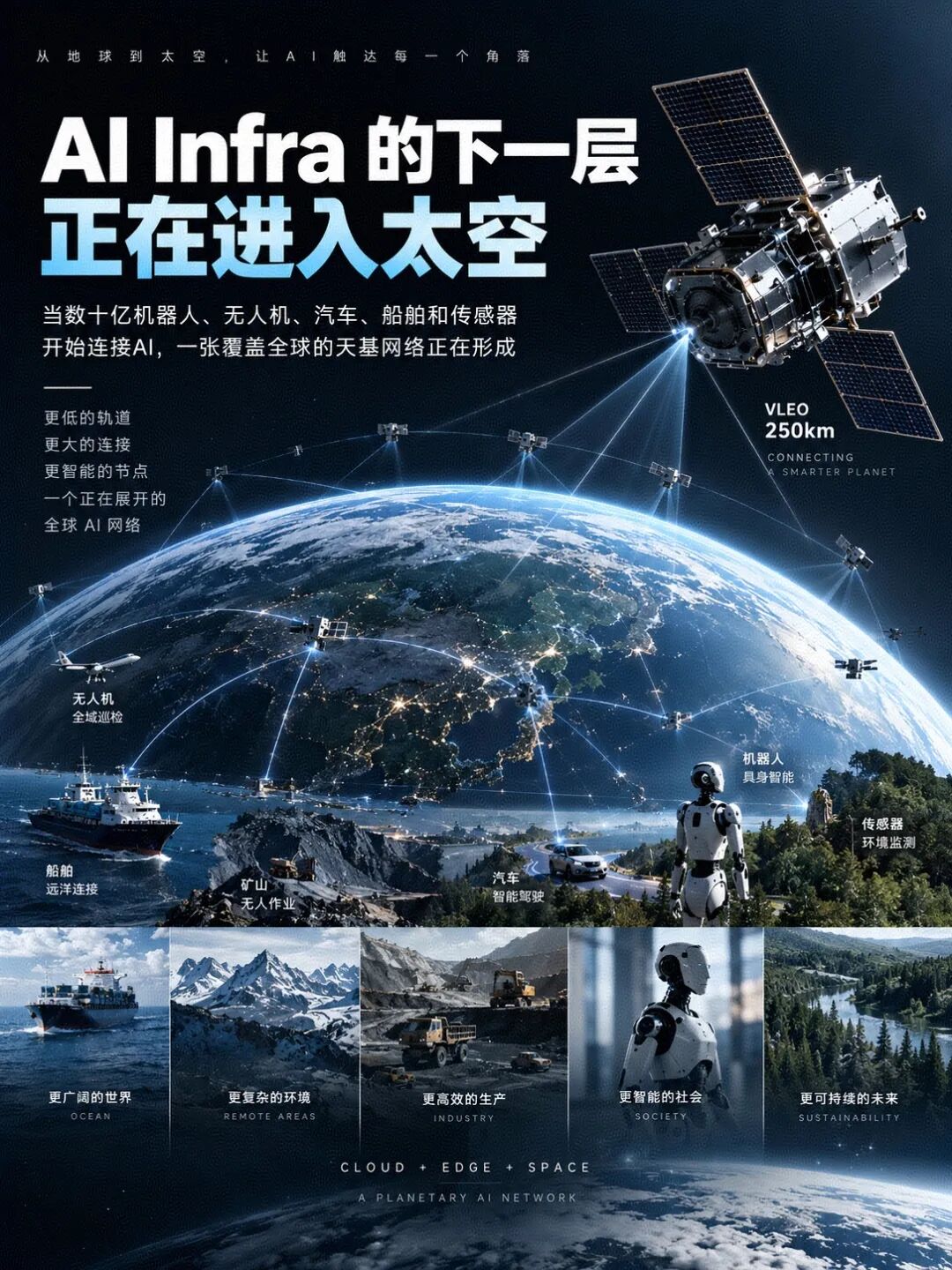
This also provides a way to re-understand "space computing power". What is really worth paying attention to may not be simply moving more GPUs into space, but the integration of communication, perception and computing starting in orbit.
Computing power solves the problem of "where to compute", communication solves the problem of "how data flows", and perception solves the problem of "where the data of the physical world comes from". The three may eventually converge into the same space-ground AI infrastructure.
Why is this network likely to operate at an altitude of about 300 kilometers?
This is where VLEO — Very Low Earth Orbit — comes in.
If satellites only broadcast signals, there is no fundamental problem with a higher orbit. But if the objects to be connected in the future are robots, drones, vehicles and small sensors, the situation will be completely different.
Satellites can be equipped with larger antennas and energy systems, but a robot, a drone or a sensor cannot infinitely increase the antenna size and transmission power. What is truly scarce is the capability on the terminal side.
The lower the orbit, the shorter the propagation distance, the more favorable the link budget usually is, and the lower the latency. Therefore, lowering the satellite altitude from the 500-kilometer level to the 300-kilometer level not only means improved latency, but more importantly, makes it easier for smaller, lower-power, more common terminals to access the global satellite network.
Therefore, what is really noteworthy about VLEO may not be "satellites flying as low as about 300 kilometers". It may become the layer of AI infrastructure closest to the physical world.
As satellites gradually evolve from communication tools to intelligent nodes that integrate connection, perception and computing, the core of competition is also changing: What next-generation space companies are competing for may no longer be a certain type of satellite, but the infrastructure position in the future global AI network.
Some commercial aerospace teams in China have already started to lay out in advance along this direction. KunSpace is one of the early domestic startups that have laid out along this logic. The company chooses the 250km-level VLEO as its entry point, but its goal is not just to "fly satellites at lower altitudes", but to reconstruct the satellite platform around the next-generation space network.
This is also the difference between its logic and the traditional satellite manufacturing logic. VLEO requires the joint optimization of propulsion, low-resistance structure, energy, materials, on-board computing and whole-satellite control, which essentially tests system-level engineering capabilities. The ESA's judgment on the VLEO technical roadmap also lists low-resistance platforms, electric propulsion, atomic oxygen-resistant materials and large-scale manufacturing as key capabilities.
The core team of KunSpace has practical experience in hundreds of satellite engineering projects, and has gone through overall design, constellation development, mass production delivery and on-orbit operation. Compared with single-point technologies, this kind of experience of "having developed satellites, completed mass production, and built constellations" may be a more difficult-to-replicate threshold for entering the next-generation space infrastructure competition.
"250 kilometers is just our physical entry point, not the end point," said a relevant person in charge of KunSpace. "If billions of robots, drones, vehicles, ships and sensors need to access AI in the future, then the space network will eventually connect not only people, but the entire physical world. We aim to build the space-based infrastructure that connects data, intelligent terminals and computing power in the AI era."
Following this logic, the company's path is gradually expanded from whole satellite to platform to network: First verify the VLEO whole satellite capability, then form a scalable platform that can be replicated on a large scale, and finally turn a large number of satellites into intelligent nodes with communication, perception and computing capabilities. If this judgment holds, VLEO is only the starting point. What is really worth competing for is the new layer that emerges when the global AI infrastructure extends from the ground to space.
VLEO is not the end point, but a new physical base
If this direction proves feasible, the future industrial competition for VLEO will not stop at "who can build a satellite at an altitude of about 300 kilometers".
The first stage is to achieve stable flight. A lower orbit means more significant atmospheric drag, which puts higher requirements on propulsion efficiency, energy, low-resistance structure, atomic oxygen protection and whole-satellite coordination.
The second stage is to achieve reliable connection. The network needs to allow mobile phones, robots, drones, vehicles, ships and sensors to access at lower costs, while forming high-speed inter-satellite connections.
The third stage is to achieve powerful on-orbit computing. AI computing power is gradually embedded into satellite nodes, data completes preprocessing and partial inference closer to the location where it is generated, and then collaborates with the large ground models.
Communication, perception and computing may eventually merge into a new type of space infrastructure. Therefore, VLEO is not the end point. It is more like a new physical base. The huge imagination space lies in forming a global AI network on top of this base.
If VLEO eventually becomes a new space infrastructure layer in the AI era, the opportunities in the industrial chain will also change accordingly. China may embrace a new "platform opportunity".
What is needed in the future may not just be more satellites, but a new generation of intelligent satellite platforms redesigned around VLEO. Low-resistance structures, high-efficiency electric propulsion, high specific power energy, software-defined satellites, on-board computing, inter-satellite communication, as well as large-scale low-cost manufacturing, may all become new industrial segments.
More importantly, these capabilities do not only serve a certain type of payload. Communication, remote sensing, AI computing, the Internet of Things and even more applications in the future may all be built on the same set of space platforms.
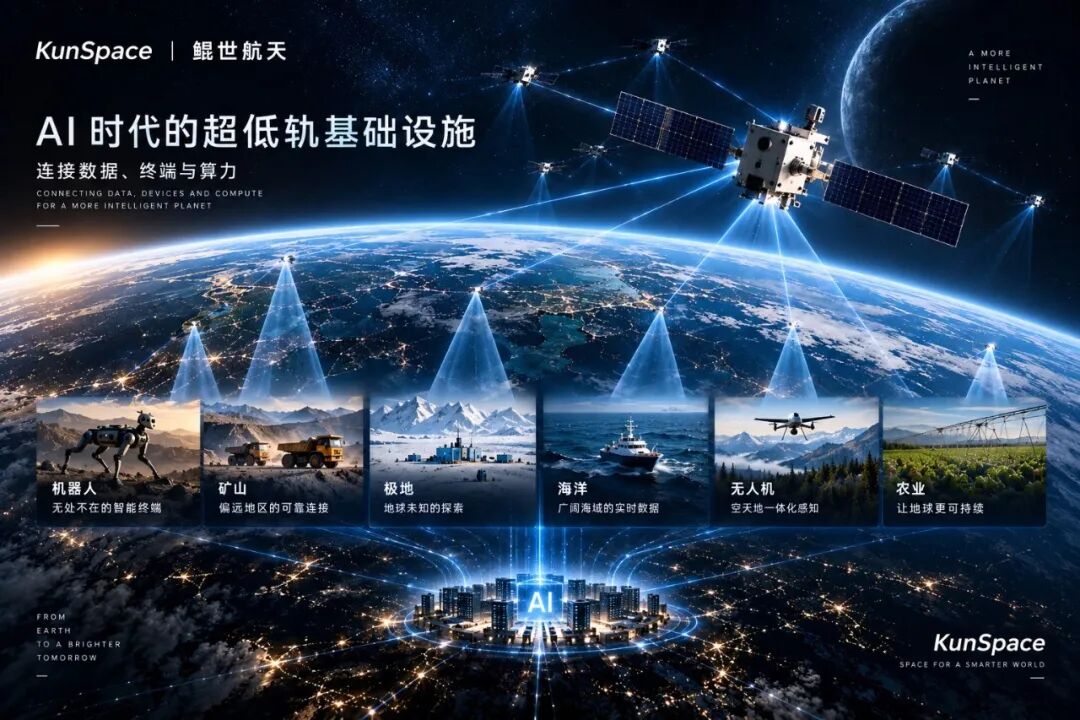
From national-level satellite internet constellations, commercial remote sensing, direct-to-device satellite connectivity and space computing, to commercial aerospace companies like KunSpace that are exploring 250km-level VLEO platforms, the industry focus is gradually shifting from "whether we can manufacture satellites" to "whether we can build the next-generation space infrastructure in a low-cost and large-scale manner".
If this trend continues, what is truly scarce may not be a single satellite, but replicable platform capabilities, continuous networking capabilities, and the ultimate network capabilities that support communication, perception and computing.
Looking ten years ahead, the entire picture will become clearer.
Ground data centers provide the "brain"; robots, vehicles, drones, ships and sensors become the "nerve endings"; optical fibers and 5G/6G form the ground neural network; low-Earth orbit and VLEO satellites covering the entire globe fill in the parts that cannot be economically covered by ground networks, and gradually undertake perception, connection and computing functions.
Communication, perception and computing power will eventually flow between the ground and space. At that time, the "satellite internet" we talk about today may no longer be sufficient to describe this system.
It is more like a planet-scale distributed computer covering the entire Earth, and VLEO is the space infrastructure layer closest to the physical world.
Over the past decade, humans have invested huge amounts of capital to build increasingly powerful "brains" for AI.
In the next decade, an equally important question may be: who will lay the nervous system that covers the entire planet for this brain?
SpaceX is simultaneously advancing toward lower orbits, direct mobile phone connectivity and