After outsourcing our brains to AI, humans are collectively getting dumber.
You have been reborn.
In your past life, with ChatGPT in your left hand and Claude in your right, you could finish any plan assigned by your supervisor quickly and perfectly.
In this life, you open your eyes, and everything seems perfectly normal.
You open your browser, only to find that the web version of GPT that was working just now is no longer responding. You hit refresh, and it returns a 404 not found error. Then you switch to Claude, only to find your account has been banned, and you can't help laughing out of anger.
But you find that GLM, Kimi, and Doubao are all inaccessible too. The only thing that still works is Siri, which you can call up, but well, it's basically useless.
You glance at the message your supervisor just sent: Can you submit the plan today?
You recall that plan from your past life: the outline was built by AI, the data was sorted out by AI, and the wording was polished by AI. The only real human words you said were a couple of curses at AI, complaining about what garbage it had produced.
Suddenly you realize you can never go back to that afternoon when you typed so hard that your keyboard was smoking. Would you regret having relied so heavily on AI in your past life at this moment?
Although... this whole story is made up, Shichao has actually been thinking about this recently: If I use AI every single day, will it really damage my intelligence?
Shichao went to ask several of his stubborn colleagues. Of course, none of them would easily admit that they can't live without AI, but the overall tendency is quite obvious: everyone says their work efficiency would drop significantly if they lose access to AI. You can still get the work done, but it would be as difficult as surviving on a deserted island.
With a rigorous attitude, Shichao looked up relevant studies, and found that AI does have quite a lot of impacts on our brains...
A foreign researcher conducted a dedicated study on this exact topic, with real practicing doctors as research subjects. The title of the study is "Endoscopist deskilling risk after exposure to artificial intelligence in colonoscopy".

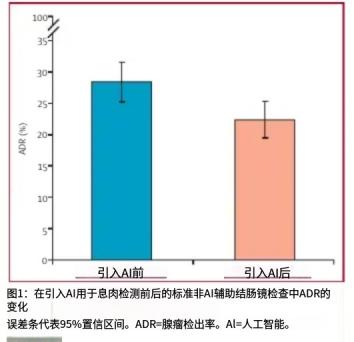
The background of the study is that four endoscopy centers in Poland previously introduced an AI tool for detecting intestinal polyps. This tool can mark positions in real time on the colonoscopy footage, to remind doctors where the suspicious polyps are located.
Later, when everyone was getting used to using the tool, the researchers compiled statistical data and found that three months after the introduction of AI, if the doctors were put back into a scenario without AI assistance, the adenoma detection rate would drop from 28.4% before AI was introduced to 22.4%, a full 6 percentage points lower.
These doctors are not newbies at all — they have an average of 28 years of relevant work experience.
Even these senior, experienced doctors are negatively affected after using AI, let alone us?
On the surface, AI lowers the threshold for many tasks, making you learn things super fast and write code extremely efficiently. But lowering the threshold and lowering your own ability are two sides of the same coin in most cases.
Let me tell you another story: researchers from the Wharton School at the University of Pennsylvania published a study in *PNAS Nexus*. It's a large-scale project with more than 10,000 participants in total.
The main test was to have two groups of people learn about certain topics at the same time, such as how to grow vegetables, how to prevent financial fraud, and so on. One group could only use ChatGPT, while the other could only use traditional Google Search.
After the learning phase, everyone was asked to write a piece of advice based on what they had learned.
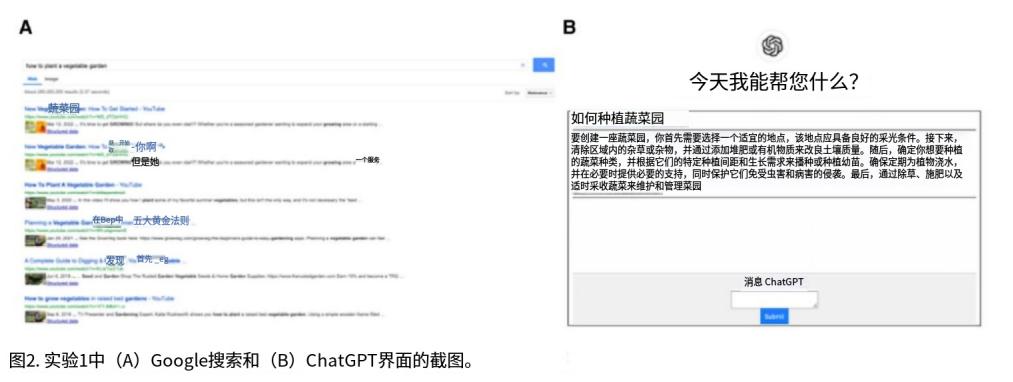
The result showed that people using AI did have higher efficiency, finishing the task much faster than those using search engines.
But after a round of blind review by the judging panel, most of the participants who used AI were easily identified, because the content they wrote was too superficial with high plagiarism similarity. No one would bother to read that kind of stuff.
The researchers then wondered if it was because the AI didn't attach source links, leading to insufficient in-depth research. So they ran another round of experiment, where they specifically added real-time web links to the AI-generated content.
The result still didn't change. Statistics showed that only a quarter of the participants ever clicked on the original source links. The food was literally fed to their mouths, but they were too lazy to chew it!
So, for you who have read this far, how long has it been since you last clicked on a link attached to an AI response? (https://academic.oup.com/pnasnexus/article/4/10/pgaf316/8303888)
Some researchers have even shifted their research focus to the physiological structure of the human brain itself. They suspect that AI will produce physical impacts on the brain.
For example, researchers from the MIT Media Lab directly put testing devices on the heads of their test subjects.
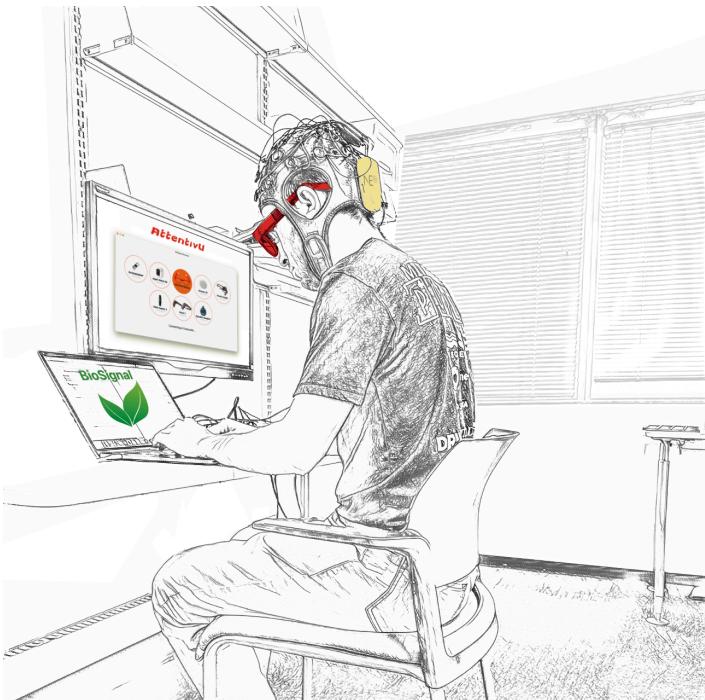
They recruited three groups of people to do the same task: write an argumentative essay, which is similar to the essay writing section in the college entrance examination. One group wrote the essay completely from scratch on their own, the second group could use Google to look up information, and the last group could directly use ChatGPT.
While they (or the AI) were racking their brains to finish the task, the researchers had everyone wear an electroencephalogram (EEG) device throughout the whole process. This device can record the electrical signals generated by different regions of the cerebral cortex, and analyze the degree of synchronization between these regions.
The more frequent and synchronized these signals are, the more it usually means that different brain regions are working more closely together to process information.
The test results showed that the group that relied entirely on their own brain had the strongest synchronization between different brain regions; the group that used search engines ranked in the middle; while the synchronization level of the AI-using group was extremely poor.
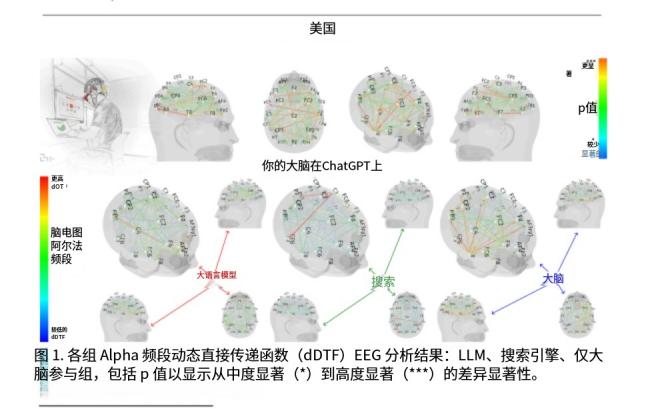
When you are highly dependent on AI, your brain will work slower than usual, staying in a "slacking off" state.
Not only that, the researchers also conducted a spot check, and found that many people who used AI to write the essay could not even remember what they had just written, nor could they quote any sentences from the article. The output they produced didn't belong to them at all!
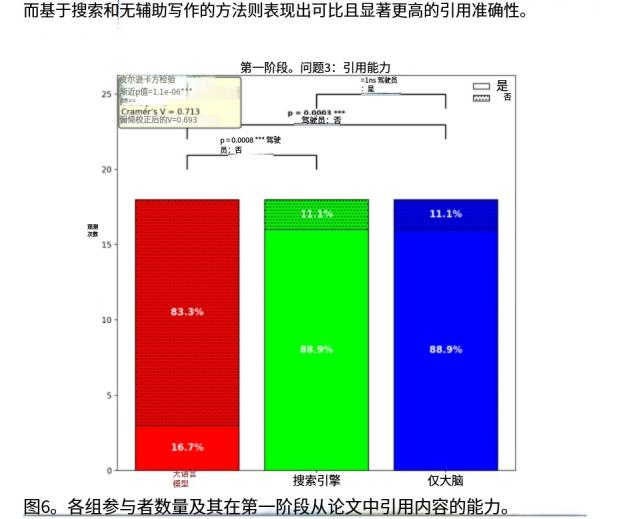
This phenomenon has a name, called "Cognitive Debt".
That is to say, when you use AI to produce a bunch of outputs that exceed your own level of understanding, you don't actually master them at all. It's like you owe a debt of knowledge, and you can't even pay it back with Ant Credit Pay.
Debt always brings pressure, which is exactly why you feel more tired at work after using AI...
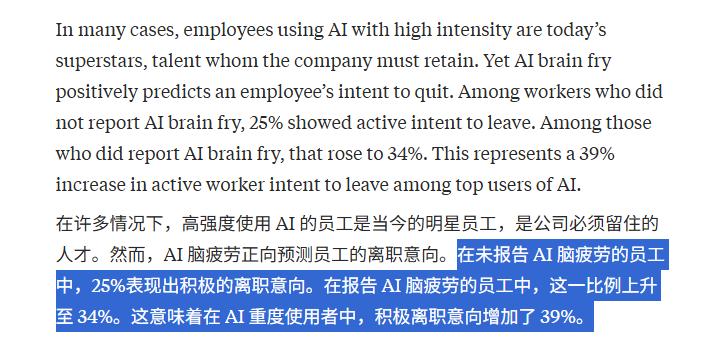
Harvard Business Review surveyed nearly 1,500 workers a while ago, and found that the most tormenting way of working nowadays is "watching AI work".
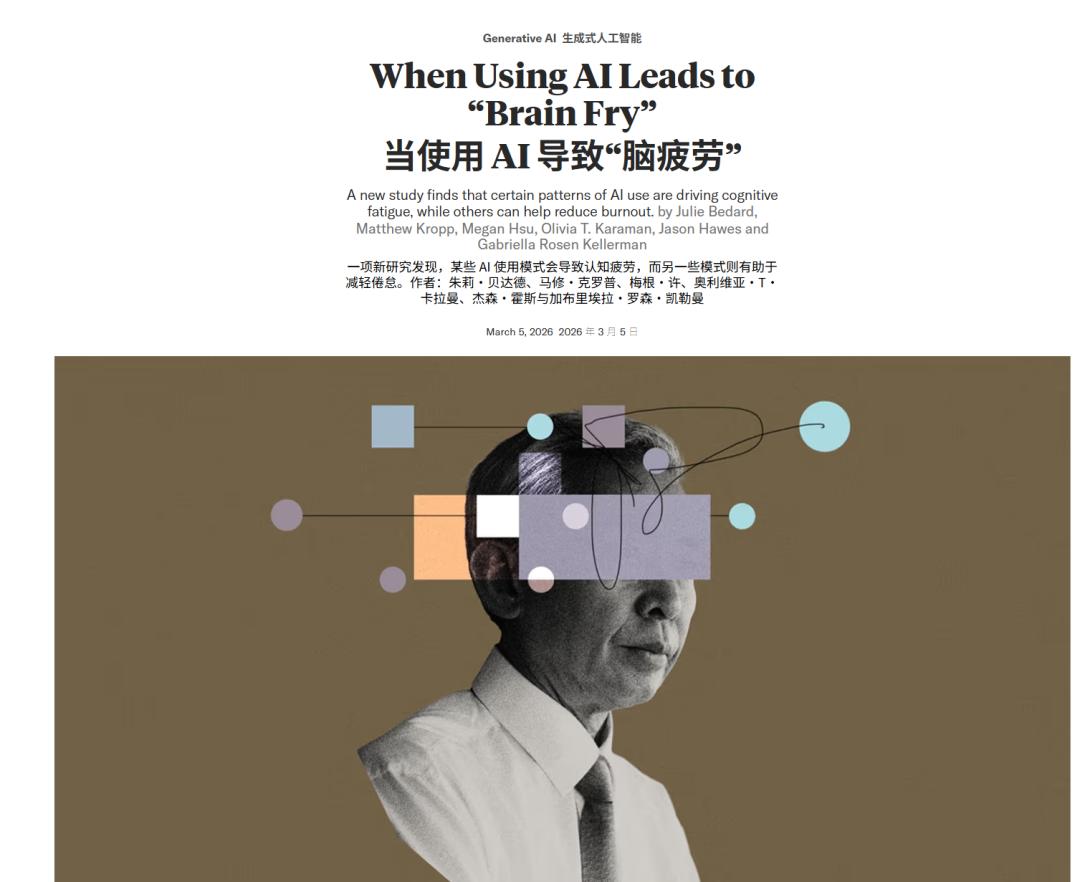
You have to keep an eye on AI all the time to prevent it from spouting nonsense, and keep prompting and correcting it nonstop.
Although you can slack off while AI is "thinking", you can't really relax. You have to watch AI and also watch out for your boss, stuck in a limbo state between supervisor and supervisee.
As a result, these workers who are in the state of "Schrödinger's slack" have 12% higher mental fatigue and 19% higher sense of information overload than usual. Researchers call this "AI brain fry", which will also increase the employee turnover rate.
Reading up to here, Shichao guesses some of our readers may panic: Oh no, is my brain almost broken by AI?
Shichao can only say that this trend does exist, but there is no need to rush to get anxious.
Our brain is not that fragile actually. If you feel it's not working well, it only means you don't use it enough, not that there is something wrong with it. So far, there is no solid scientific evidence proving that AI will cause brain atrophy.
None of the studies mentioned above have detected any structural impacts of AI on the brain.
So what exactly has AI changed about us? From Shichao's perspective, it lowers our thinking intensity. Just like how you crank up the thinking intensity of GPT, the stronger the AI's thinking capability is, the less willing you are to use your own brain. Shichao calls this the "Law of Conservation of Intelligence".
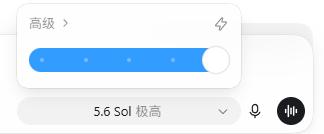
You silly, Sam Altman is reducing your intelligence for your own good.
In fact, there is a very counterintuitive mechanism in psychology called "desirable difficulty".
In the past, when we searched for solutions to problems online, we had to open multiple web pages, avoid being redirected to pornographic sites, and finally extract the useful information. This process is annoying and frustrating, but your ability to distinguish information and connect logical threads is exactly trained through this process.

What about now? AI feeds the finished result directly to your mouth, making everything effortless and comfortable. But the problem is, human memory and deep understanding can only be formed through getting stuck and making mistakes.
When we outsource the thinking process to AI, we are essentially outsourcing our cognition to AI as well.
There is nothing wrong with outsourcing itself, just like how calculators take over our computing ability. But the problem is, what you outsourced this time is exactly the core ability of "figuring things out independently".
It hasn't physically shrunk your brain yet, but it has indeed changed our habit of using our brain. You dig less into things, learn things more superficially, and your brain becomes more and more unwilling to think on its own.
Once the habit changes, over time, some skills that are no longer used frequently will naturally fade away gradually.
But can we quit using AI?
It's already impossible! Your peers are using it, your supervisor is using it. The giant wheel of the era keeps rolling forward, and no one can go back to that afternoon when we did all the work completely manually.
Maybe in the future, thinking will really become a form of entertainment just like mental abacus calculation?
Image and Reference Sources:
[1] BUDZYŃ K, ROMAŃCZYK M, KITALA D, et al. Endoscopist deskilling risk after exposure to artificial intelligence in colonoscopy: a multicentre, observational study[J]. The Lancet Gastroenterology & Hepatology, 2025, 10(10): 896-903. DOI:10.1016/S2468