The rankings of the six provincial capitals in central China are about to undergo major changes.
I did a quick review of the data of the six major provincial capitals in central China over the past five years: Wuhan, Changsha, Zhengzhou, Hefei, Nanchang and Taiyuan, and came to a clear conclusion: The ranking of these six central provincial capitals is about to see a major shake-up. In the next five years, the ranking pattern will most likely evolve into Wuhan, Hefei, Changsha, Zhengzhou, Nanchang, Taiyuan.
01
Wuhan, the unshakable top performer
As the saying goes, the barracks stay the same while the soldiers come and go. Wuhan is the unbreakable barracks of central China, and its position as the leading city in the region is as steady as a rock. This can be verified both from its performance in the first half of this year and its development speed over the past five years.
In the first half of this year, Wuhan's GDP growth rate ranked 5th among 29 trillion-yuan GDP cities, and 3rd among 27 provincial capitals. Compared with other central provincial capitals, its actual growth rate ranked second, and its GDP increment ranked first, which means Wuhan is still expanding its competitive advantages.
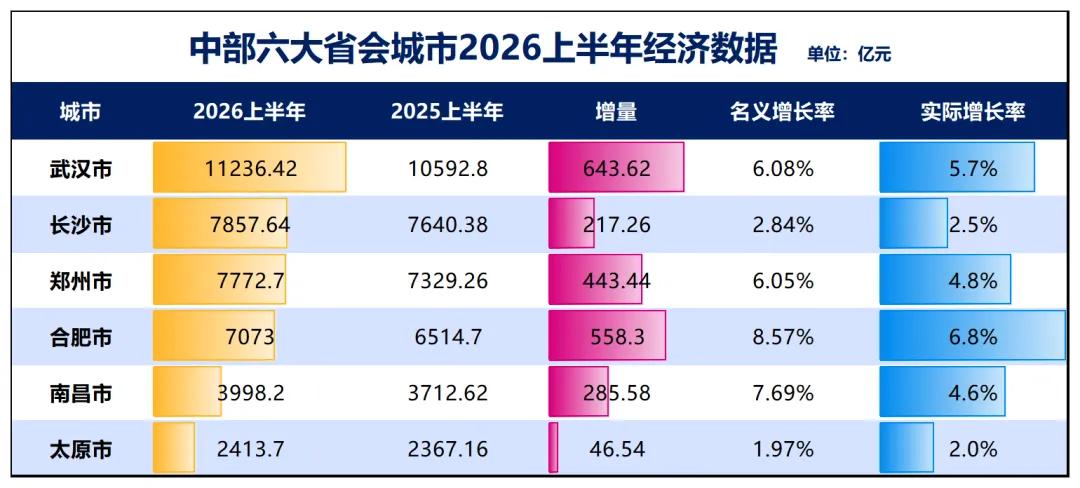
Graphics: Urban Finance; Data: Statistics bureaus of all involved cities
Looking back at the past five years, the conclusion remains the same.
Over the past five years, Wuhan's GDP increased by 662.579 billion yuan, with a growth rate of 42.7%. Both indicators rank first among central provincial capitals, outperforming the dark horse Hefei. Even compared with all 27 provincial capitals across the country, Wuhan's GDP increment in the past five years still ranks first, and its growth rate is at the top level.
The core reason why Wuhan has achieved such results is that it has completed industrial transformation. Speaking of Wuhan, the first thing that comes to mind is the automobile industry, after all, the central enterprise Dongfeng is headquartered here. From the data perspective, the automobile industry was indeed Wuhan's leading industry before 2024. In 2023, Wuhan had four 100-billion-yuan industries, among which the revenue of the automobile industry reached 328.85 billion yuan, ranking first, followed by the electronic information industry.
In the past few years, under the impact of new energy vehicles, the traditional fuel vehicle industry in cities including Guangzhou, Chongqing, Wuhan, Changchun and Shenyang has been significantly affected, with a notable decline in the automobile industry.
Chongqing performed much better in response, quickly keeping up with the pace of new energy vehicles, and last year it reclaimed the title of China's top automobile city that it had lost for nine years.
Wuhan is also making corresponding adjustments, and the effect has just begun to show. At its peak in 2017, Wuhan's automobile output reached 1.898 million units, which dropped below 1 million units to 783,100 units in 2024, and rebounded to 945,000 units last year.
Fortunately, in this process, the optoelectronic information industry that Wuhan has laid out for many years has entered the harvest period.
In 2023, the revenue of Wuhan's electronic information industry was 261.991 billion yuan, second only to the automobile industry. In 2024, the revenue of the electronic information industry surged to 313.763 billion yuan, while the automobile industry declined accordingly, making electronic information replace automobiles as Wuhan's leading industry.
This means Wuhan's leading industry has completed the transformation.
More importantly: First, the transformed leading industry of Wuhan is still growing rapidly, especially this year. In 2025, the added value of the computer, communication and other electronic equipment manufacturing industry increased by 18.9%, the smelting and pressing processing industry of ferrous metals increased by 12.1%, the automobile manufacturing industry increased by 11.7%, the electrical machinery and equipment manufacturing industry increased by 11.5%, and the chemical raw material and chemical product manufacturing industry increased by 10.1%. In the first half of 2026, the computer, communication and other electronic equipment manufacturing industry increased by 90.8%.
Second, Wuhan has gathered five leading industries: optoelectronics, automobiles, commercial aerospace, network communication, and biomedicine.
Although Wuhan's automobile industry has dropped to the second place, its decline has been curbed, and Wuhan is accelerating the transformation from fuel vehicles to electric vehicles.
The *Action Plan for the Construction of the Auto Valley Industrial Innovation Corridor (2026-2030)* released this year sets the goals for the "15th Five-Year Plan" period: by 2030, 6 100-billion-yuan vehicle enterprises will be cultivated, the total vehicle output will exceed 2 million units, new energy vehicle output will exceed 1.5 million units, and the revenue of the "vehicle-energy-software-chip-material" automobile industrial ecosystem will exceed 1.3 trillion yuan.
The optoelectronic industry supports half of the country's optoelectronic market, with a complete global industrial chain.
In addition, Wuhan also has three other industries: commercial aerospace, network communication and biomedicine. Together with automobiles and optoelectronics, they form Wuhan's "five valleys" industrial layout, namely "Auto Valley", "Optics Valley", "Network Valley", "Medicine Valley" and "Star Valley".
This means Wuhan still has huge room for growth in the future.
02
Zhengzhou and Changsha, still neck and neck
Both Changsha and Zhengzhou have slowed down.
As the second largest city in central China, Changsha's GDP increment in the past five years was 359.668 billion yuan, lower than Wuhan and Hefei, with a growth rate of 29.6%, lower than Wuhan, Hefei and Nanchang. Zhengzhou's GDP increment in the past five years was 339.422 billion yuan, lower than Wuhan, Hefei and Changsha, with a growth rate of 28.6%, lower than Wuhan, Hefei, Nanchang and Changsha, only higher than Taiyuan.
From a national perspective, as can be seen from the comparison chart of 27 provincial capitals above, the growth rates of Changsha and Zhengzhou in the past five years are relatively low, and their development speed has slowed down significantly.
Especially for Changsha.
In the past five years, Changsha's growth rate outpaced the national average for only one year. In 2021, Changsha's GDP growth rate was 7.5%, while the national growth rate was 8.1%. In 2022, Changsha's growth rate was 4.5%, while the national growth rate was 3%. In 2023, Changsha's growth rate was 4.8%, while the national growth rate was 5.2%. In 2024, Changsha's growth rate was 5%, the same as the national average. In 2025, Changsha's growth rate was 4%, while the national growth rate was 5%.
More critically, in the first half of this year, Changsha's growth rate dropped to 2.5%, 2.2 percentage points lower than the national average, ranking third from the bottom among trillion-yuan cities, only higher than Foshan and Xi'an. Among central provincial capitals, it ranked second from the bottom, only higher than Taiyuan. In this context, Hefei will most likely surpass Changsha. As for the competition between Zhengzhou and Changsha, it will continue.
First, Zhengzhou and Changsha are still inseparable in terms of development.
First of all, Zhengzhou is not developing very fast, but Changsha has slowed down. It is still uncertain whether Zhengzhou can surpass Changsha, but the second largest city in central China will eventually give way to Hefei.
In the past few decades, Wuhan has always remained the top city in central China, but the title of the second largest city in central China has alternated between Zhengzhou and Changsha. According to historical data, from the reform and opening up in 1978 to 2006, Zhengzhou basically led Changsha for nearly 20 years, only surpassed by Changsha once in 1988.
In 2007, Changsha overtook Zhengzhou for the first time, and then expanded the gap to 115.72 billion yuan in 2015, which became the largest gap between the two cities in history. After 2016, Zhengzhou kept making efforts to narrow the gap with Changsha, and finally overtook it in 2018.
But the leading situation only lasted for two years, and Changsha overtook Zhengzhou again in 2020, and expanded the gap again in the past five years.
Overall, against the background of the comprehensive rise of central cities in the past 20 years, the rankings of both Zhengzhou and Changsha have risen a lot. In 2005, Zhengzhou ranked 23rd nationwide, and Changsha ranked 24th. In 2025, Changsha ranked 15th, rising 9 places in 20 years, and Zhengzhou ranked 16th, rising 7 places.
Zhengzhou and Changsha have different development paths in the past few decades, and each has its own strengths.
Zhengzhou is a city favored by policies. Relying on its central position in the railway era, Zhengzhou became the provincial capital of Henan. In the past ten years, Zhengzhou has obtained a large number of policy benefits, such as the title of national central city (the national land planning approved last year no longer retains this statement, which will be explained later), the national-level airport economic comprehensive experimental zone, and the hub title of China-Europe Railway Express (Zhengzhou, Xi'an, Chengdu, Chongqing, Urumqi).
In terms of transportation, since Zhengzhou is located in the center of the Central Plains, its position as a high-speed railway hub is very prominent. In 2022, Zhengzhou officially built the first "meter-shaped" high-speed railway hub city in China.
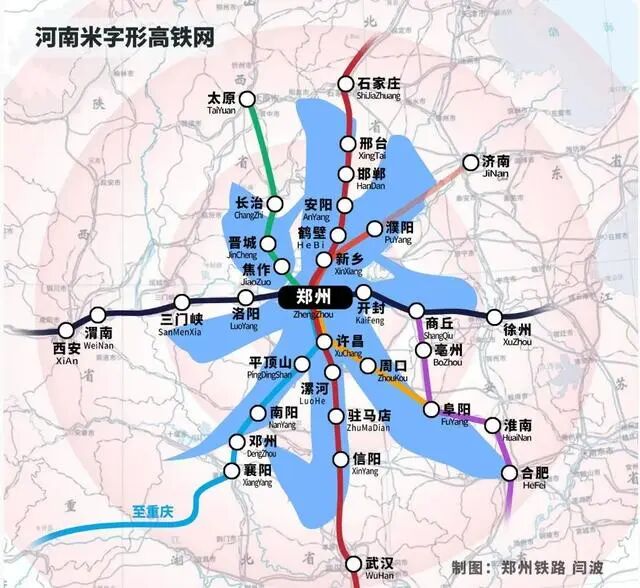
Compared with Zhengzhou, Changsha's presence in central China is much weaker, and it gets far less policy support. In terms of geographical location, due to the existence of Wuhan and Zhengzhou, Changsha cannot compete for better transportation resources, but it is already pretty good compared with other cities.
Looking at the industry alone, neither Zhengzhou nor Changsha is that strong.
Zhengzhou's biggest industrial label is electronic information. Foxconn has made Zhengzhou an important global production base for Apple mobile phones, and also driven the development of Zhengzhou's electronic information industry. But the problem is, Foxconn's strong performance does not mean that Zhengzhou's electronic information industry is strong.
Over the years, Zhengzhou has been making up for its industrial shortcomings, and has been laying out industries such as automobiles, electronic information, new materials, biomedicine, and new energy. But up to now, there are still not enough industries that can support the city's future development.
The situation in Changsha is similar. The most outstanding industry in Changsha is still construction machinery. Sany Heavy Industry, Zoomlion, and CRCC Heavy Industry constitute Changsha's most distinctive industrial business card. The construction machinery industry is too strong, but new industries have not yet developed enough to take over.
In the years of rapid development of real estate and infrastructure, Changsha has gained huge industrial dividends relying on construction machinery. But now the real estate industry has entered a adjustment period, the era of rapid growth of traditional infrastructure has passed, and the construction machinery industry has entered a fluctuation and adjustment cycle.
Changsha has also been looking for new growth points in recent years, and has laid out industries such as new energy vehicles, advanced energy storage materials, electronic information, and biomedicine, with enterprises including BYD already settled in. But compared with Hefei, Changsha does not have a complete new energy vehicle industrial chain; compared with Wuhan, Changsha does not have a super industrial cluster like the optoelectronic information industry.
In summary, neither Zhengzhou nor Changsha has seized a sufficiently large emerging industry, which determines that it is difficult to widen the gap between the rankings of Zhengzhou and Changsha in a short time. Zhengzhou's advantages lie in location, population, transportation and policies. Changsha's advantages lie in industrial foundation, scientific and educational resources and urban attractiveness. If Zhengzhou can truly develop the airport economic zone, advanced manufacturing and emerging industries, it will have a good chance to overtake Changsha again. If Changsha can expand industries such as new energy vehicles, energy storage and electronic information, it will also have the opportunity to keep its position as the second largest city in central China.
The core point is that whoever finds a new industrial pillar first will win.
03
Hefei, becoming the second largest city in central China?
In the next five years, Hefei will be the strongest competitor of Changsha. Although it currently ranks fourth in central China, it will most likely take the throne of the second largest city in central China within five years.
The core lies in two points: First, Hefei's industrial strength has surpassed that of Changsha. Both cities are driven by industrial development, and industry is the main driving force for the development of the two cities.
Hefei's industrial revenue reached 1.606661 trillion yuan in 2025, while Changsha's industrial revenue in 2024 (the 2025 data has not yet been released) was 977.567 billion yuan. This year, Hefei's industrial added value is still growing rapidly. In the first half of the year, the added value of industries above designated size in the city increased by 25.6% year-on-year, hitting a new high in recent years. By the end of the year, Hefei's industrial revenue will undoubtedly enter the top 15 of industrial cities across the country.
Second, Hefei has seized the most potential industries at present and in the future. Nowadays, competition among Chinese cities has entered the "era of hard technology". Only cities that can get tickets in the fields of chips, biomedicine, artificial intelligence, precision instruments and high-end manufacturing can truly secure their positions in the next round of growth cycle.
Today's Hefei has gathered the industrial matrix of "display panel + new energy vehicle + artificial intelligence + memory chip", which is Hefei's biggest confidence. The data shows that several leading industries of Hefei have maintained rapid growth in the past two years.
According to the *2025 Statistical Yearbook* released by Hefei, Hefei had three 100-billion-yuan industries in 2024: the first is the electrical machinery and equipment manufacturing industry, the second is the computer, communication and other electronic equipment manufacturing industry, and the third is the automobile manufacturing industry.
In 2025, the computer, communication and electronic equipment manufacturing industry grew by 60%, and grew by 92.5% in the first half of this year. With continuous rapid growth, it has become Hefei's leading industry. The added value of the automobile manufacturing industry grew by 11.1% in 2025, and grew by 16% in the first half of this year.
In contrast, Changsha's industrial revenue in 2024 was less than 1 trillion yuan, and it will only be half of Hefei's by the end of this year. Its signature industrial construction machinery has fluctuated with the changes of the real estate industry in recent years. In addition to the construction machinery industry, among the 41 major industrial categories divided by the Ministry of Industry and Information Technology, Changsha's previous pillar industry was tobacco. In 2021, the tobacco manufacturing industry was the only manufacturing industry in Changsha with revenue exceeding 100 billion yuan.
In recent years, the electronic information industry and automobile industry have developed gradually. According to the