Over the past five years, Shanghai's commercial sector has become more internationalized.
In July 2021, the State Council of China approved Shanghai, Beijing, Tianjin, Guangzhou, Chongqing to take the lead in fostering and building international consumption center cities. At that time, Shanghai's commercial sector was standing at a transition point between the old and the new — growth of traditional department stores peaked, shopping malls entered stock competition, and the curtain of urban renewal had just been raised.
Five years later, the figures outline a clear trajectory. In 2025, the total retail sales of consumer goods of the five cities exceeded 6.2 trillion yuan in aggregate; sales from tax refund for overseas visitors rose by 86% year on year, accounting for two-thirds of the national total; the number of inbound foreign visitors made up one-third of the national total, and imports of consumer goods accounted for half of the national total, the "gravitational field" effect of international consumption has become evident.
Focusing on Shanghai, the total retail sales of consumer goods reached 1.66 trillion yuan in 2025, representing a year-on-year increase of 4.6%. More convincing than the total volume growth is the structural change in the in-depth profile of the data, a clear evolution context has emerged: Shanghai's commercial sector is moving from the expansion of "quantity" to the reconstruction of "quality", completing a paradigm shift from "goods consumption" to "service consumption".
01.
Five-year Stock and Increment Trajectory: Quantity Peaks and Declines, Single Project Volume Continues to Rise
According to the big data of Winshang.com, by the end of 2025, the stock of commercial projects in Shanghai reached 553, covering a total commercial GFA of 33.7494 million square meters. A total of 170 new projects were added in the five years, with an incremental GFA of 9.4718 million square meters. The total number of high-quality first stores and flagship stores at home and abroad introduced in the five years reached 1923.
Looking back at the five-year incremental curve, 2021 is an undisputed peak, with 48 new projects added throughout the year, covering 2.8517 million square meters. Benchmark projects including Qiantan Taikoo Li, Ruihong Xintiandi, Jiuguang Center, and North Bund Raffles were launched into the market intensively, presenting a substantial "opening gift" for the first year of the construction of the international consumption center city.
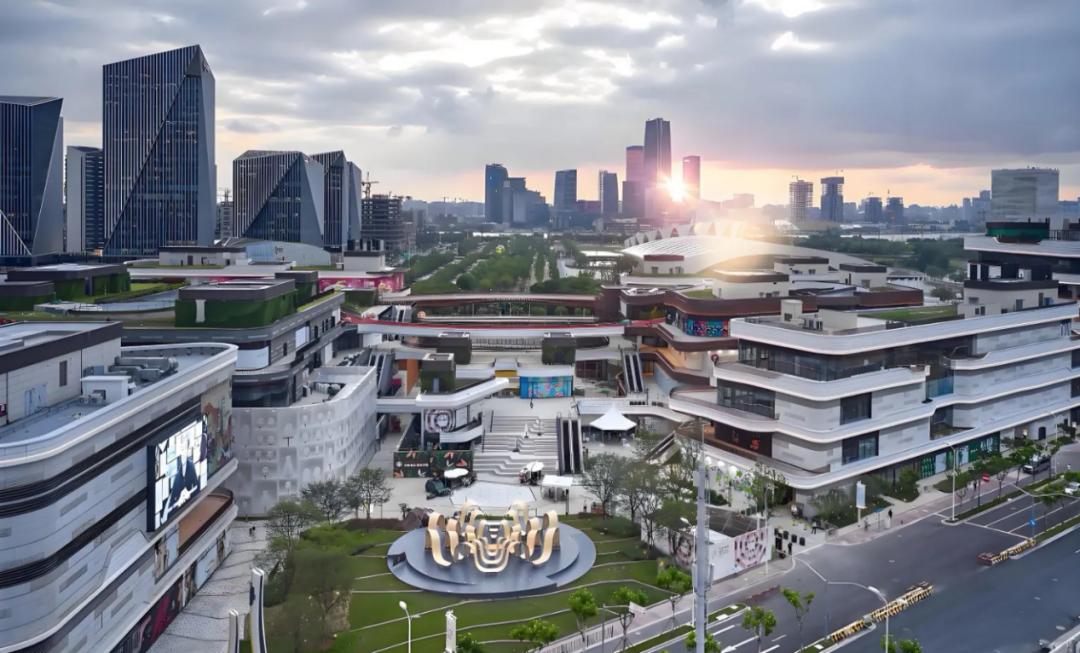
Qiantan Taikoo Li
In 2022, impacted by the external environment, the increment plummeted to 15 projects covering 765,000 square meters, the lowest level in the five years. However, this was not stagnation, but a period of accumulation of strength. The renovated CITIC Pacific Plaza returned to the market, and Suhewan MixC World was launched, the stock renewal and boutique projects began to form an important part of the increment.
From 2023 to 2025, the increment picked up steadily. It is worth noting that although only 29 new projects were added in 2025, the total GFA reached 2.0843 million square meters, large-scale projects including Hongqiao Qianwan Impression City MEGA (260,000 square meters) and Luyue Tiandi (166,000 square meters) were launched intensively, reflecting Shanghai's commercial sector's orientation of "valuing quality over quantity" on the incremental end.
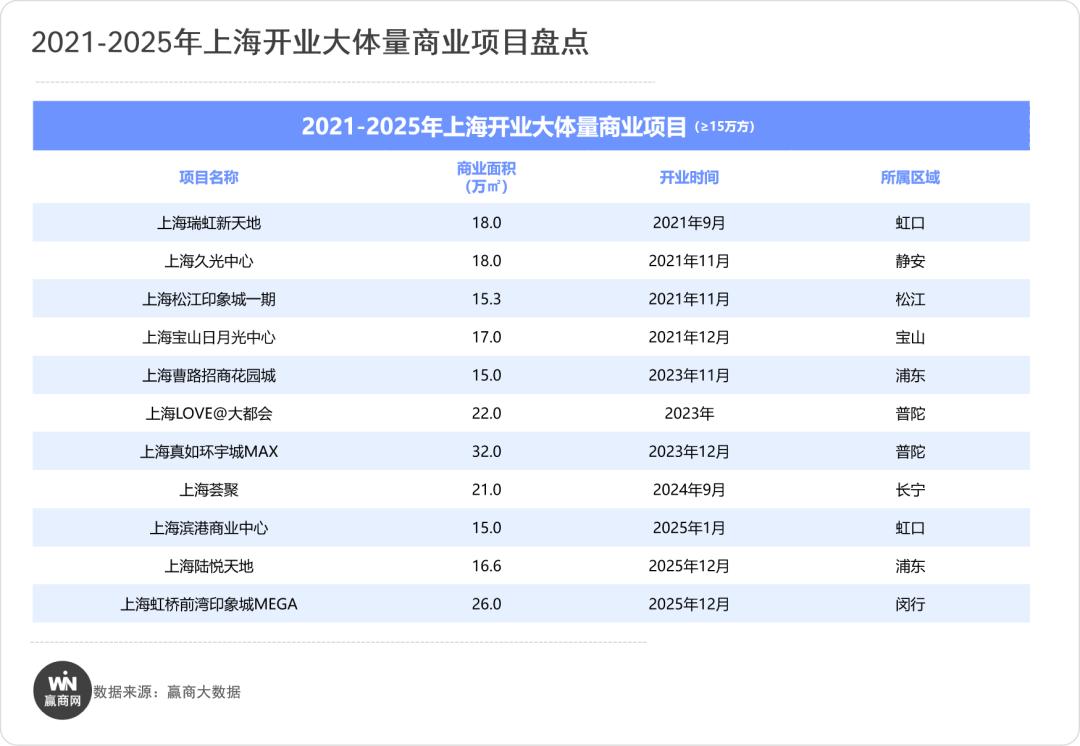
In this series of data, we can see that Shanghai's commercial sector is gradually shifting from "incremental expansion" to "stock operation". Among more than 60 projects planned to open in 2026, the proportion of stock renovation and renewal projects is significant. Pacific Department Store is renovated into "New 600 YOUNG", CapitaMall Qibao Longcheng is transformed into "Jiahuan Plaza", Yu City Fashion is upgraded to "Xinghui Chenghuang", Shanghai's commercial sector has entered the "renewal era".
02.
Changes in Business District Pattern: Core Areas Stably Iterate, Emerging Areas Rise in Multiple Spots
If the stock and increment data depict the "quantity" of Shanghai's commercial sector, the evolution of business district pattern and spatial form writes the "soul" of Shanghai's commercial sector.
Over the past five years, Shanghai's business district ranking has undergone a profound structural reconstruction. Traditional core business districts and emerging business districts have completed level leapfrogging on their respective tracks, jointly shaping a new urban commercial pattern of "multi-core symbiosis".
Several major traditional core business districts including Middle Huaihai Road, West Nanjing Road, East Nanjing Road, Xujiahui, Small Lujiazui-Zhangyang Road have always occupied the top of Shanghai's commercial pyramid by virtue of mature commercial ecology, dense high-energy projects and continuous renewal and iteration.
Emerging business districts constitute the most dynamic variable in the past five years.
Qiantan has grown from the planning concept of "Lujiazui 2.0" to a municipal-level business district with independent consumer appeal; Xuhui Riverside relies on the artistic resources of the West Bund Cultural Corridor to embark on a differentiated path of "culture + commerce"; Zhenru and Linkong have risen by leaps and bounds with the launch of benchmark projects; Suhewan and Caoyang Road have formed regional consumption agglomeration relying on the strong driving force of a single benchmark project.
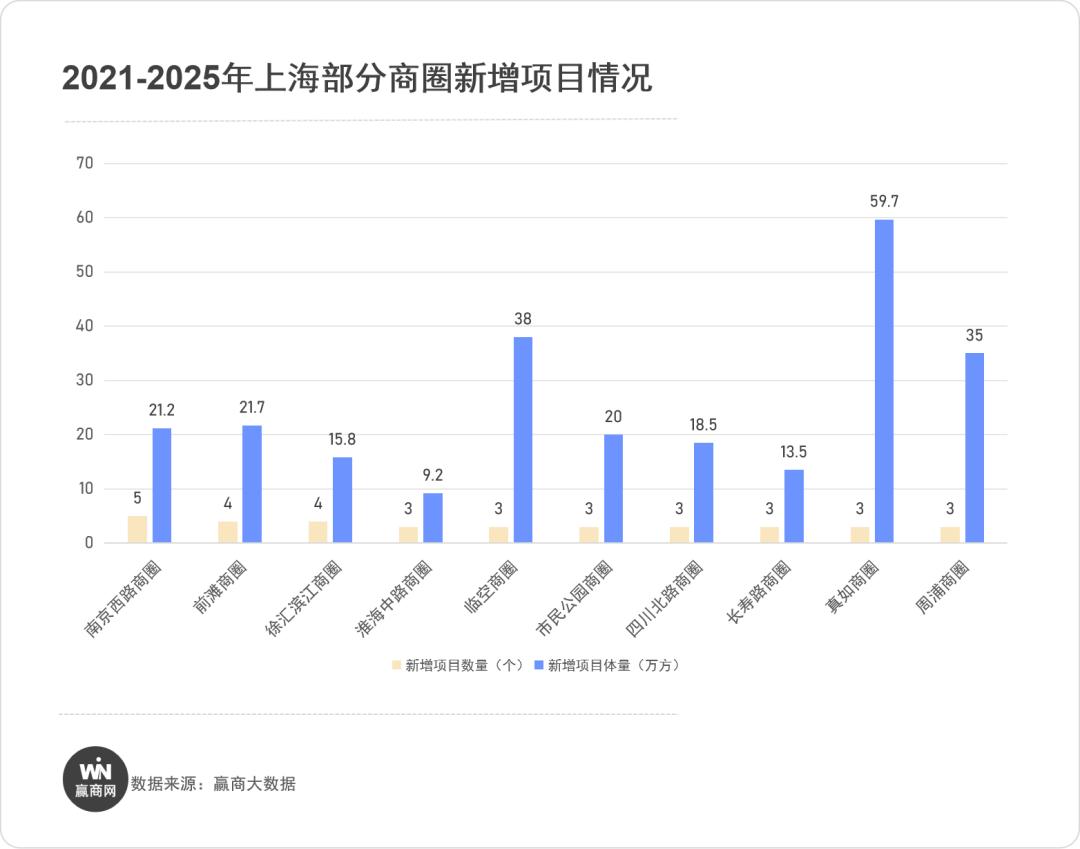
From the perspective of new project distribution, West Nanjing Road ranks first with 5 new projects, followed by Qiantan and Xuhui Riverside with 4 new projects respectively, and business districts including Linkong, Zhenru, Middle Huaihai Road, Xujiahui each have 3 new projects launched. Commercial resources no longer concentrate unidirectionally in traditional core areas, but spread orderly to the east and west wings, and the new towns in the north and south along the context of urban renewal.
Core business districts continue to evolve. West Nanjing Road Business District has welcomed the upgraded CITIC Pacific Plaza and the newly launched JC PLAZA Jin Cang Wen Hua Plaza on the basis of heavy luxury benchmarks including Plaza 66, HKRI Taikoo Hui and Jing'an Kerry Centre. At the end of 2025, Hang Lung Properties even obtained the original site of Westgate Mall through a 20-year operating lease, making the "high-end commercial ecological closed loop" of West Nanjing Road more complete. Middle Huaihai Road Business District has welcomed new projects including Xintiandi Dongtaili and HAI550 in addition to traditional forces including IAPM, K11 and Hong Kong Plaza.
Xujiahui Business District has pressed the acceleration button of urban renewal. Shanghai No.6 Department Store was demolished and rebuilt in 2024, and will be transformed into a complex "New 600 HUB" integrating brand flagship stores and serviced apartments; Pacific Xuhui Store is renovated into "New 600 YOUNG" and will be fully launched in 2026. A new Xujiahui planned with a "butterfly-shaped functional structure" is about to emerge.
Rise of emerging business districts. While core business districts evolve, the rise of emerging business districts constitutes the most dynamic narrative of Shanghai's commercial sector in the past five years. Qiantan Business District has become the most dazzling "new star" in the five years with 4 new projects. The first phase of Qiantan Taikoo Li, with an open block form and heavy luxury positioning, has become a new landmark of Shanghai's commercial sector upon opening; projects including Qiantan L+PLAZA have been launched one after another, Qiantan has grown from the planning concept of "Lujiazui 2.0" to a municipal-level business district with independent consumer appeal.
Xuhui Riverside Business District has also embarked on a differentiated path. Gate M West Bund Dream Center was launched in the form of a 100,000-square-meter open block, projects including Starlight West Bund Lumina and GATE M West Bund Phoenix Nest form a cluster, relying on the artistic resources of the West Bund Cultural Corridor to create a unique ecology of "culture + commerce".
Zhenru Business District has risen to a municipal-level business district with the launch of Zhenru UniCity MAX (320,000 square meters), and the Linkong Business District has formed a new consumption agglomeration with the opening of Shanghai LIVAT (210,000 square meters) and the renovated return of Bailian Western Suburbs Shopping Center.
03.
The Rise of Non-standard Commerce Resonates with the Wave of Urban Renewal
Over the past five years, the evolution of Shanghai's commercial sector is not limited to the growth of stock scale, but also takes place in the deep dimension of spatial form. Non-standard commerce has moved from marginal attempts to the mainstream stage, forming two-way resonance with the wave of urban renewal. According to statistics from Winshang.com, among the 170 new commercial projects from 2021 to 2025, 36 present non-standard commercial forms, covering multiple types such as open blocks, themed vertical commerce, and stock renovation commerce. When standardized box commerce enters the red ocean of homogeneous competition, non-standard commerce is deeply embedded in the urban context and renewal process, growing from a supplementary format to the most recognizable landscape in the urban commercial ecology.
A number of small-scale projects create a "small but professional" vertical commercial ecology with extremely segmented theme positioning.
Bailian ZX Fun Field focuses on two-dimensional and trendy toy culture with a mini GFA of 10,000 square meters, creating the first "two-dimensional vertical commercial complex" in China; projects including Shanghai TPY Center and Shanghai U479 also target young groups, taking two-dimensional and trendy culture as core labels to create vertical themed commerce; HAI550 even focuses on high-quality lifestyle collection with a very small GFA of 7,200 square meters, proving the survivability and value tension of non-standard commerce in core business districts.
The open block form is another important branch of non-standard commerce. More than 25 new open block projects were added in the five years, deeply integrating commerce with urban space and local culture. Panan Xintiandi creates an open block based on Jiangnan culture, Longhua Temple shapes a unique scene of "folk custom + commerce" relying on the thousand-year-old ancient temple, Gate M West Bund Dream Center links art museum and performance space resources to build an ecology of "art + commerce", making visiting exhibitions, shopping and strolling a coherent consumption experience.
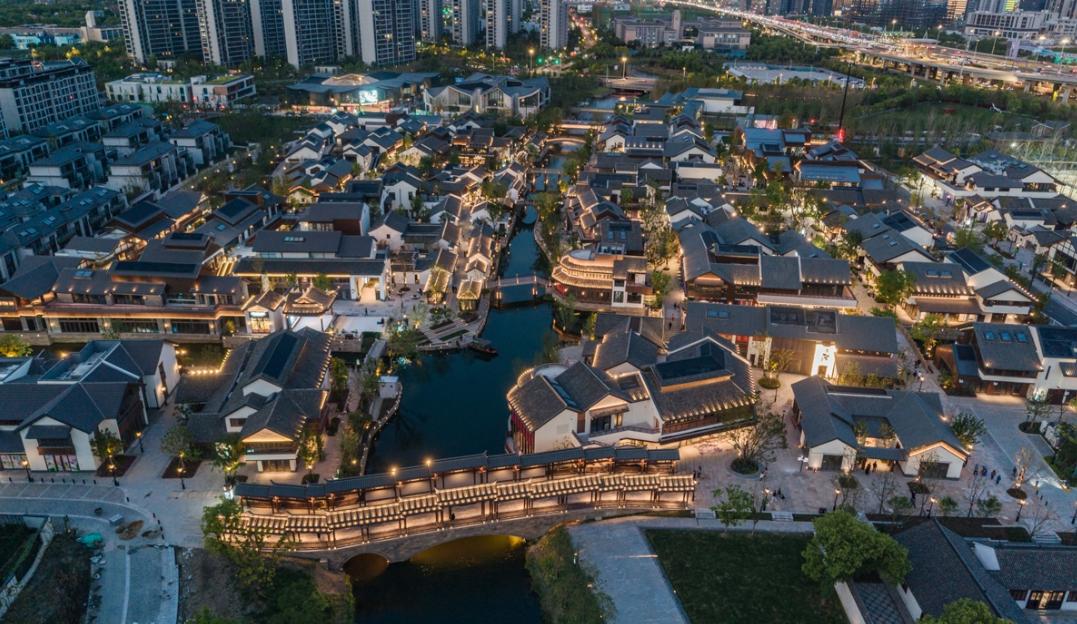
Panan Xintiandi
The non-standard renovation of stock assets is the most significant part of Shanghai's non-standard commerce wave. The renovated Shanghai Paris Spring · Yuehui Tianshan injects two-dimensional theme, Shanghai Women's Goods Store is reshaped into a "she" space, EKA · Tianwu builds a composite commercial community in the form of "open-air architectural museum" based on century-old industrial heritage; projects including Libo · Jiufang and Chuangyi MIX also retain the architectural texture of old factories, injecting multiple functions such as trendy commerce, creative office and cultural performance, making industrial heritage a new carrier of urban commerce.
Over the past five years, the breadth and depth of Shanghai's urban renewal have continued to expand, from the renovation of single projects in core business districts to the functional reconstruction of the entire block, and then to the activation and utilization of industrial heritage and historical lilongs. This non-standard commercial logic has also spread at a broader urban level. The commercial ecology of the "Wutong District" represented by Hengshan Road-Fuxing Road Historical and Cultural Area continues to heat up, master-run stores, buyer stores and characteristic small shops grow naturally along the streets under the plane trees, forming a non-standard commercial sample of "block is commerce, commerce is life", which also constitutes the most lively and unique part of Shanghai as an international consumption center city.
04.
The Scale of First Stores Reaches New Heights Repeatedly, Business Format Transits from Goods to Experience
The evolution of spatial form ultimately falls on the evolution of business format content. Over the past five years, first stores have long surpassed the simple definition of "brand landing for the first time", becoming the core vane of Shanghai's commercial format iteration, scene innovation and model reform, leading the systematic migration of the city's consumption logic from "goods consumption" to "experience consumption" and "service consumption".
From 2021 to 2025, Shanghai has introduced a total of 1923 high-quality first stores. The growth curve maintains an overall upward trend. Except for a short-term correction in 2022 affected by the external environment, the number of first stores continues to rise, hitting a five-year high of 523 in 2025. By the first half of 2026, Shanghai has introduced 216 high-quality first stores.
Over the past five years, the status of Shanghai's core business districts has become more stable in continuous evolution, and the first store data is the most intuitive footnote. From 2021 to 2025, the Middle Huaihai Road Business District introduced a total of 205 first stores, the West Nanjing Road Business District 192, the East Nanjing Road Business District 108, the Xujiahui Business District 91, the Small Lujiazui-Zhangyang Road Business District 85, the five core business districts contributed nearly 40% of the total first stores in the city.
What is more profound than the quantitative growth is the continuous evolution of the first store ecology. In the early stage, first stores were mainly national first stores of international luxury brands and national chain leading brands. With the basic completion of the layout of core brands in Shanghai, the sources of new first stores are increasingly diversified. In the catering track, regional characteristic catering brands including Qiyueshi, Huming Guoqiao and Longweiyin have opened their first stores in Shanghai one after another, injecting differentiated flavor experiences into the market; in the retail field, local designer brands including FPA and MARKGONG cut into core business districts in the form of first stores, filling the gaps in segmented styles; the life service track has even emerged a large number of emerging brands in vertical fields. The first store economy has entered the stage of "ecological prosperity" from "leading by top brands", more diversified brands, more segmented tracks and richer formats jointly build a more resilient commercial ecology.
The inclusiveness of this ecology is also reflected in the project distribution. Projects including Global Harbor Shanghai