The largest acquisition in 12 years: CapitaLand has also set its sights on the student housing business in Hong Kong.
A heavyweight "player" is entering Hong Kong's student accommodation market.
On September 15, market sources revealed that CapitaLand Investment acquired the ibis Hong Kong Central & Sheung Wan Hotel in Sheung Wan, Hong Kong for HKD 2.3 billion, with plans to convert it into student apartments. Upon completion of the renovation, the project will be incorporated into Ascott's hospitality segment under CapitaLand, operated under the "Yuayu" brand, and become its "seed asset" for expansion in Hong Kong.
If this transaction is finally completed, it will be of extraordinary significance.
This will be CapitaLand's first major acquisition in Hong Kong since it purchased The Mercer serviced apartment in Sheung Wan in 2014; at the same time, it will also become the largest deal by value in this round of the "hotel-to-student-apartment" boom in Hong Kong.
Behind this boom lies the increasingly prominent imbalance between supply and demand in Hong Kong's student accommodation market. Statistics show that the number of non-local students enrolled in local universities in Hong Kong has been surging continuously, and the off-campus accommodation gap is approaching 50,000 units.
Against this backdrop, CapitaLand Investment's entry has become a clear signal: Hong Kong's student accommodation, once a marginal niche track, is now being pushed to the main stage of institutional capital competition.
Acquiring the Core Asset in Sheung Wan
The property CapitaLand Investment secured this time is the ibis Hong Kong Central & Sheung Wan Hotel located at 28 Des Voeux Road West, Sheung Wan, Hong Kong. It is a 34-story tower completed in 2012 by Chanco Investment Group, the parent company of the seller Butterfly Hospitality Group, with a 999-year land deed.
The building is of considerable size, with a site area of about 14,600 sq ft and a total gross floor area of 218,000 sq ft, equivalent to about 20,300 square meters. 9 floors are for retail and supporting facilities, and the upper 25 floors are guest rooms, totaling 550 units.
Previously, CBRE had introduced the project to potential buyers through a non-public procedure, and the deal finally went to CapitaLand.
Location is the most solid moat of this transaction. It is understood that the project is within walking distance of the Sai Ying Pun MTR station, only one MTR stop away from the University of Hong Kong, and is exactly located in the corridor with the strongest student rental demand in the Western District of Hong Kong Island.
In the renovation logic of Hong Kong's "City Campus Hostel Scheme", properties close to schools and MTR stations are clearly classified as the most popular category. Hung Hom, Western District of Hong Kong Island and Sha Tin are the three hot spots, and Sheung Wan is exactly one of them.
Sources revealed that the transaction consideration this time is HKD 2.3 billion, with a unit price of about HKD 10,600 per sq ft; if converted based on 550 guest rooms, the price per room is about HKD 4.1818 million.
What is the level of the unit price of about HKD 10,600 per sq ft in Sheung Wan?
It is understood that Hong Kong's office market has undergone in-depth adjustments since its peak in 2019. The unit price of Grade A offices in Central generally ranged from HKD 30,000 to HKD 50,000 per sq ft at the peak, and some core landmarks were even higher. After several years of decline, it has now roughly fallen back to the range of HKD 18,000 to HKD 30,000 per sq ft. The non-core Grade A or Grade B offices in Central & Sheung Wan/Sheung Wan are even lower, with some transaction unit prices falling to HKD 12,000 to HKD 18,000 per sq ft, and some old commercial buildings even below HKD 10,000 per sq ft.
In other words, the unit price of HKD 10,600 per sq ft means that even if the post-renovation operation fails to meet expectations, the underlying value of the asset itself is still supported. The medium and long-term value of the Sheung Wan location will not disappear. What CapitaLand bought is "location and discount" rather than "betting on the hotel market rebound".
What is more noteworthy is the operation team. According to media reports, CapitaLand earlier this year specially appointed Andrew Chan, former Chief Investment Officer of Crystal Group Investment, as the Managing Director in Hong Kong, in charge of the strategy of the long-stay segment.
During his tenure at Crystal Group, Andrew Chan once led the acquisition of commercial and residential buildings such as Incredible Residences in Hung Hom and Hotel Ease Access in Lai Chi Kok, and converted these properties into student apartments through its YX Living platform.
In other words, CapitaLand's acquisition is not a "layman's trial", but is led by a "veteran" who is experienced in renovating student apartments in Hong Kong.
After the renovation is completed, the project will be operated under the Yuayu brand. This is a long-term rental apartment brand specially created by Ascott for the Chinese market, positioned at the mid-range, mainly targeting urban groups such as white-collar workers, returned international students, and international residents.
Seed Asset
Why did CapitaLand target the Hong Kong student accommodation track?
The answer lies in a structural gap amplified by policies. The Hong Kong SAR Government is fully committed to building an "international post-secondary education hub" and a "highland for gathering international high-end talents", and since the 2024/25 academic year, it has doubled the upper limit of non-local student quotas for government-funded post-secondary institutions from 20% to 40%.
The policy dividend has been directly transformed into rigid accommodation demand. Centaline Property estimates that the number of non-local students in Hong Kong will reach 67,800 in the 2027-2028 academic year, of whom about 50,000 need off-campus accommodation. Colliers even predicted that by 2028, the shortage of student hostel places in Hong Kong will be as high as 120,000.
According to data from Cushman & Wakefield, the average ratio of students to hostel places of the eight major universities in Hong Kong is as high as 3.4:1, which means that more than 3 students compete for each hostel place. Even including the about 7,900 new university hostel places added before 2027, the conservative estimate of the total student hostel place gap will still reach 55,400.
Under the gap, policies began to "remove barriers and relax restrictions". To ease the shortage of hostel places, the Hong Kong SAR Government launched the "City Campus Hostel Scheme" in July 2025. The core logic is to simplify development control procedures and encourage the market to convert hotels, office buildings and other properties into student dormitories in a self-financed private manner.
The Policy Address of the same year further expanded the scope to newly rebuilt student dormitories. The Town Planning Board has broadened the definition of "hotel" use to cover eligible student dormitories, and most commercial land converted to student dormitories does not require prior planning approval.
In early August, Bernadette Linn Hon-ho, Secretary for Development, revealed that as of the end of June this year, the Education Bureau had received 40 formal applications under the "City Campus Hostel Scheme", of which 38 were eligible, and it is expected to provide 9,100 hostel places. The certainty of policies is exactly the confidence for capital to place heavy bets.
Why is it called a "seed asset"? For CapitaLand, this ibis hotel is by no means a one-off transaction, but a strategic springboard to leverage Hong Kong's long-stay market.
Ascott itself is already a world-leading accommodation operation platform, but CapitaLand did not have large-scale student apartment or long-term rental product lines in Hong Kong before. This building is exactly the first test site to verify whether the "hotel-to-student-apartment" model works in Hong Kong.
Once the renovation of the 550 guest rooms is successfully completed, and the occupancy rate and rate of return are verified, CapitaLand can take this benchmark asset as an anchor to leverage subsequent fund expansion and large-scale acquisitions.
In other words, the HKD 2.3 billion buys not only 550 rooms, but also CapitaLand's "entry ticket" and "model unit" in the Hong Kong student accommodation track. This building is not the end, but a replicable starting point. What CapitaLand really wants to earn is not the rent of this single building, but the fund management fees and operating income of the entire track.
A Capital Scramble
Compared with traditional real estate, student apartments excel in certainty.
According to statistics from Knight Frank, the rate of return of Hong Kong's student accommodation market is about 4.5% to 5%, that of traditional Grade A offices is 3.7%, and that of small and medium-sized residential properties is only 3.2% and 3.6% respectively. In other words, the rate of return of investing in student dormitories is almost 1.5 times that of ordinary residential properties.
In addition to the rate of return, the occupancy rate is also very solid. Data from JLL shows that as of the end of April 2026, the major student dormitory projects in Hong Kong provide about 6,900 rentable beds, the occupancy rate of major projects reaches 98% to 100%, and the rent has risen steadily by nearly 10% every year since 2022.
In a cycle of high office vacancy rate and slow retail recovery, such a business with "high occupancy, stable cash flow and policy support" has naturally become a choice for institutional funds to hedge risks and preserve and increase value.
CapitaLand is not fighting alone. Multiple heavyweight transactions have taken place in Hong Kong's student accommodation track since the beginning of this year.
Centaline Investment took the lead. In September 2024, it spent HKD 180 million to acquire the Popway Hotel in Tsim Sha Tsui and converted it into 121 beds; in August of the following year, it spent another HKD 335 million to acquire Bonham Crest in Western Mid-Levels, Hong Kong Island, and incorporated it into its student apartment brand "Campus One Communities"; in March this year, Centaline Investment under Centaline Group spent more than HKD 1.5 billion to acquire the landmark Regal Oriental Hotel in Kowloon City, planning to convert it into student apartments.
Other players followed closely. China Merchants Commercial REIT acquired a hotel in Tsim Sha Tsui for nearly HKD 206 million in January this year, and converted it into a student apartment with 85 hostel places; China Resources Land acquired the Y Hotel·Tsuen Wan in Kwai Chung for about HKD 953 million in March; Crystal Group Investment acquired two properties in Kowloon City and Hung Hom for HKD 440 million in June; Singapore's Woh Hup Holdings acquired the bank-owned property of ONEBEDFORDPACE in Tai Kok Tsui; JD Group acquired the Harbour Plaza 8 Degrees Kowloon hotel for HKD 750 million in July...
Rough statistics show that since the beginning of this year, there have been more than 10 publicly disclosed acquisition and conversion cases, with a total transaction value of more than HKD 8 billion.
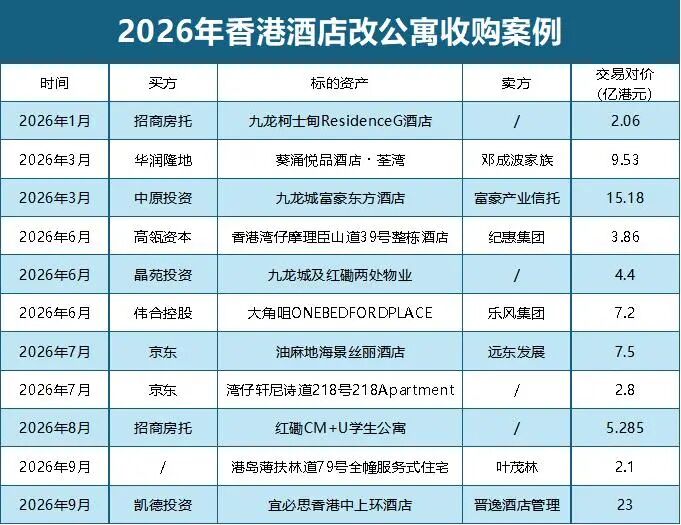
Data source: Public reports, sorted by ViewPoint Index
From e-commerce giants to state-owned real estate enterprises, from intermediary-affiliated funds to Singaporean asset management leaders, all kinds of capital are voting with real money. Hong Kong's student accommodation has changed from a "supporting role" to a "main battlefield".
CapitaLand's entry with HKD 2.3 billion is not only a footnote to this wave, but also indicates that the competition in the track will shift from "expanding territory" to "proving strength through operation".
However, this seemingly profitable business also has hidden worries.
First, the renovation is not zero-cost. To convert hotel guest rooms into compliant student dormitories, it is necessary to add public facilities such as study rooms, laundry rooms and rest areas, and upgrade the fire protection and electromechanical systems. The renovation cost per room cannot be ignored. Second, there is a window period for policy dividends. Once the convenience brought by the "City Campus Hostel Scheme" is tightened as the supply eases, the liquidity of assets may be affected.
More importantly, with a large number of players pouring in, the acquisition premium of high-quality targets in core locations has been raised. If the supply of beds increases intensively in the future, it is still unknown whether the rent and occupancy rate can maintain the current high level.
This article is from the WeChat official account "ViewPoint", author: ViewPoint New Media, published with authorization from 36Kr.