LiDAR giants are collectively making strategic adjustments: some are downsizing non-core businesses, some are expanding their business layout, and some are multiplying their overall value by leveraging existing advantages.
Recently, three LiDAR companies have each experienced a major event.
RoboSense released an announcement, proposing to sell its embodied robot complete machine business and assets for 59.878 million yuan, making it clear that it will "focus on promoting long-term strategic plans" and "develop significant and key incremental components for embodied robot manufacturers beyond LiDAR category products".
Innovusion signed a strategic cooperation agreement with Wuhan Chuneeng Auto, securing the designated order for the front main LiDAR, marking another milestone in its diversified customer portfolio.
Hesai Technology reached a strategic cooperation with 3D native world model enterprise Yingsu Technology at the 2nd China Spatial Intelligence Conference, pushing "spatial intelligence" from a strategic concept to ecological implementation.
The three directions reflect the different strategic approaches of the three companies.
RoboSense is "downsizing", selling off its embodied robot complete machine business to concentrate resources on components.
Innovusion is "expanding its customer base", trying to get rid of the single dependency on NIO.
Hesai is "upgrading its dimension", moving from LiDAR to physical AI infrastructure. Li Yifan, CEO of Hesai, previously summarized the company's three-tier architecture as "Perception - Understanding - Action" at the Q2 earnings call. The Kosmo prototype has received its first batch of orders in July 2026 and is expected to generate revenue in the third quarter. The cooperation with Yingsu Technology is exactly at the "Understanding" layer — transforming the real environment into reusable AI-ready 3D spatial assets.
Subtraction: RoboSense Sells Off Its Robot Complete Machine Business
RoboSense's move is the most "counterintuitive". Embodied intelligence is the hottest track at the moment, but RoboSense has sold off this business segment.
Isn't the robot industry widely recognized as the second growth curve? We don't even need to look at the entire track, just RoboSense itself. In the first half of the year, RoboSense sold 282,600 LiDAR units for robots, a year-on-year increase of 510.4%. The revenue from the robot business has accounted for nearly half of its product revenue, and contributed almost all of its revenue increment in the first half of the year. Why sell such a booming asset?
The answer lies in the difference between "complete machine" and "components".
What RoboSense sold is the embodied robot complete machine business, while retaining the core components. Baima believes that this is a typical contractionary focus: the complete machine business requires self-built production lines, self-bearing inventory, self-acquisition of customers, and full responsibility for profits and losses, featuring heavy investment, slow turnover, difficult sales, and uncontrollable gross margin. In contrast, components are RoboSense's strong suit, and robot LiDAR already accounts for half of its product revenue. Concentrating resources on this segment means replacing its weaknesses with its own strengths.
In addition, if RoboSense continues to advance the embodied robot complete machine business, it will become a direct competitor of other embodied intelligence companies, which is not conducive to the sales of its robot LiDAR products.
Financial data is also forcing RoboSense to make subtraction. In the fourth quarter of last year, RoboSense achieved quarterly profitability for the first time, which was placed in a very prominent position in its earnings announcement. However, after excluding government subsidies, customer compensation and fair value changes of financial assets, RoboSense's operating profit was actually still in deficit. Baima previously pointed out in an article that RoboSense's quarterly profitability has great uncertainty.
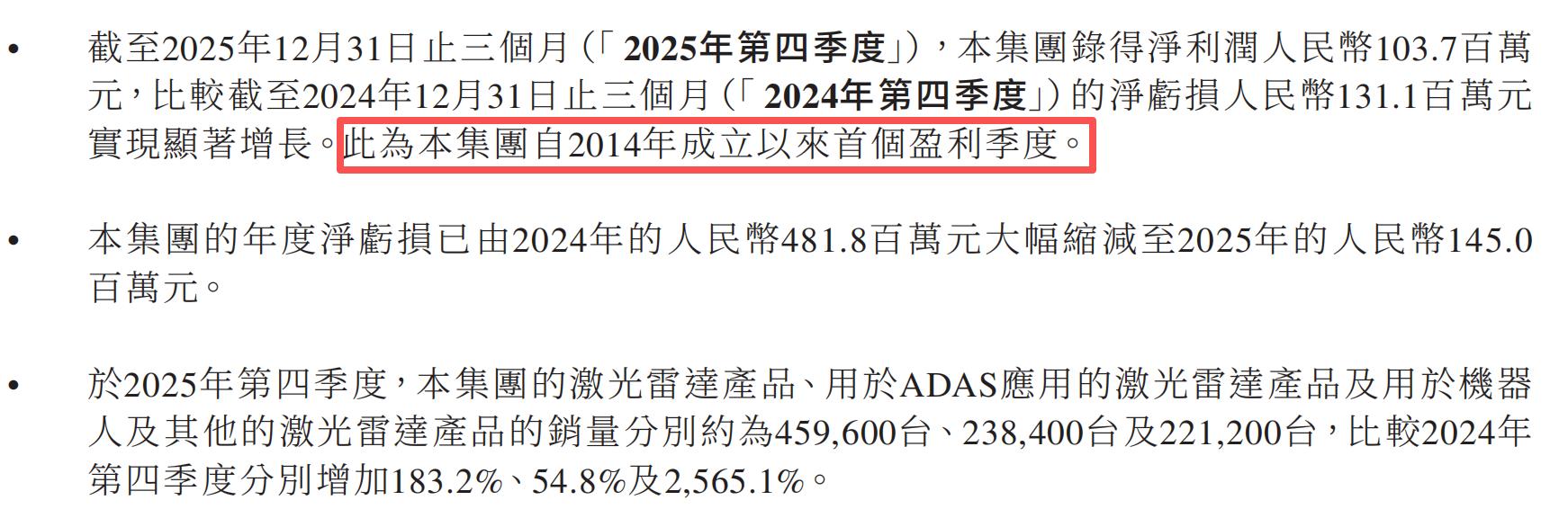
By the first half of this year, RoboSense returned to losses, and the deficit further expanded compared with the same period last year.
RoboSense faces the greatest pressure on automotive products among the three LiDAR giants. In the first half of the year, RoboSense's ADAS LiDAR product sales reached 436,600 units, a year-on-year increase of 98%. The figure seems decent, but RoboSense used to be the company with the highest market share, and its current sales volume is only about half of Hesai's, while Innovusion behind it is showing a "fierce" momentum — its ADAS product sales in the first half of the year reached 416,300 units, with a tiny gap from RoboSense, and its year-on-year growth rate of 346% is far ahead of RoboSense.
Worse news is that the automotive market is still facing cutthroat competition. In the first half of the year, the "gap" between shipment volume growth and revenue growth of the three giants continued to widen. Hesai, RoboSense and Innovusion recorded LiDAR shipment growth rates of 100.8%, 169.6% and 364.8% respectively in the first half of the year, and revenue growth rates of 25.1%, 30.2% and 127.9% respectively; the sales growth rates of the three companies are 4 times, 5.6 times and 2.9 times of their revenue growth rates respectively.
RoboSense has the largest "gap". The direct implication of the widening "gap" is that the unit price of LiDAR is accelerating its decline. The more units are sold, the thinner the profit becomes. If the cutthroat competition continues, losses will only expand further. The robot complete machine business is another heavy-investment segment. Instead of trying to balance two lines of business, it is better to focus on the core business. The 59.878 million yuan obtained from selling the business is not a large amount, but its strategic significance is clear: RoboSense chooses to no longer tell the "complete machine story" and return to its own "comfort zone".
Addition: Innovusion Hedging Single Dependency with New Customers
If RoboSense is making subtraction, Innovusion is a typical example of making addition.
The strategic cooperation with Wuhan Chuneeng Auto in September secures the designated order for the front main LiDAR. This is not a large order, but its significance to Innovusion lies not in the amount, but in the customer structure.
The most widely criticized point of Innovusion in the past is its high dependency on NIO — NIO's proportion in its revenue once exceeded 90% for a long time, and dropped to 86.2% in 2025. Although it is still the absolute largest customer, the downward trend has been established. In the past six months, Innovusion has added new OEM customers such as GAC and started mass production delivery. Its Lingque E series has been equipped for mainstream brands including GAC Aion, Trumpchi, Hyper and NIO Firefly, with a total of 7 new models entering mass production in the first half of the year. This designated order from Chuneeng Auto marks the further deepening of Innovusion's customer diversification strategy.
The confidence for Innovusion to continue making addition comes from the fact that it is the only company among the three that "achieves revenue growth and loss reduction simultaneously": its revenue in the first half of the year reached 139 million US dollars (about 945 million yuan), with a year-on-year growth of 127.9%, the highest growth rate among the three; its gross margin increased from 10.1% in the same period last year to 11.17%; the loss during the period narrowed by 23.16% year-on-year; the proportion of period expenses in total revenue decreased by 26.3 percentage points year-on-year.
Innovusion is rapidly narrowing the revenue gap with RoboSense. In the first half of the year, its revenue of 945 million yuan is only 75 million yuan less than RoboSense's 1.02 billion yuan, and the gap has shrunk significantly compared with the same period last year.
At the product level, in the automotive field, the sales gap between Innovusion and RoboSense in the first half of the year is only 20,000 units, which is very close. According to data from Gasgoo, the installed volume market share of Innovusion in the first half of the year surpassed RoboSense, ranking third.
Multiplication: Hesai Evolving from LiDAR to Physical AI Infrastructure
Among the recent moves of the three companies, although Hesai only signed a somewhat vague strategic cooperation agreement, the imagination behind it is the greatest.
In the first half of the year, Hesai regained the top spot in market share from Huawei. In the global market, according to Yole Group's *2026 Global Automotive Market Report*, Hesai ranks first in global ADAS main LiDAR shipment with a 43% market share.
However, Hesai's ambition is no longer limited to LiDAR. In Hesai's semi-annual earnings announcement released in mid-August, the SGI business appeared frequently, and this segment contributed revenue for the first time and was listed separately.
In Hesai's context, SGI refers to Strategic Growth Business. At present, Hesai's SGI segment includes two major product lines, namely the spatial intelligence platform Kosmo and the robot power module.
Public information shows that Kosmo is a platform integrating AI spatial cameras, algorithms and cloud services, whose core capability is to efficiently transform the real physical environment into high-quality, editable and interactive 3D spatial assets. Kosmo has delivered the first batch of prototypes in July this year, and received orders from humanoid robot companies such as Galaxy Universal, and is expected to start generating revenue in the third quarter.
The robot power module business is relatively easy to understand, and its core products act as the "joints and muscles" of robots. By the end of the second quarter of this year, Hesai has delivered more than 10,000 sets. Its product scope is expanding from dexterous hand modules to full-body joint modules, and the company expects its shipment to grow to six-digit level, that is, more than 100,000 sets in 2027.
Based on the commercial progress of SGI, Hesai raised its full-year 2026 SGI revenue guidance from 100 million yuan to 200-300 million yuan, and expects SGI revenue to reach about 700 million yuan in 2027 and achieve break-even. In the first half of this year, Hesai's R&D expenditure reached 436 million yuan, up 13.9% year-on-year, and the incremental R&D investment is mainly allocated to the SGI business.
It can be seen that Hesai's core "narrative" has gone beyond the LiDAR category, and its main focus is on the strategic growth business. In the first quarter of this year, Hesai announced the official launch of the strategic evolution from "spatial perception" to "spatial intelligence", and the company is "no longer just positioning itself as a global LiDAR leader, but also committed to building underlying infrastructure for the cutting-edge field of physical AI".
From selling LiDAR to selling spatial intelligence solutions, and then moving towards physical AI infrastructure — this is exactly the meaning of "multiplication". Hesai no longer only positions itself as a component supplier, but aims to redefine its position in the AI era.
Judging from business progress, Hesai's strategic shift is not limited to slogans, but is gradually reflected in financial figures.
Industry Context: Rising Volume and Falling Price, Whose Model Is More Resilient
The different choices of the three LiDAR giants will eventually return to the same industry context: the volume is rising, the price is falling, and the price is falling faster than the volume is rising.
As mentioned earlier, there is a huge "gap" between the sales growth rate and revenue growth rate of LiDAR companies. The more units are sold, the slower the revenue growth becomes, which is the most direct manifestation of the industry's cutthroat competition.
We can make a rough deduction by dividing the total revenue by LiDAR shipment: Hesai's average unit price is about 1401 yuan, with a gross margin of 39.7% and a unit gross profit of about 556 yuan; RoboSense's average unit price is about 1418 yuan, with a gross margin of 21.8% and a unit gross profit of about 309 yuan; Innovusion's average unit price is about 2096 yuan, with a gross margin of 11.2% and a unit gross profit of about 235 yuan.
This set of figures explains why the three companies have taken three different paths. Hesai's unit gross profit is 1.8 times that of RoboSense and 2.4 times that of Innovusion. Self-developed chips support its cost advantage, so it has the confidence to pursue "multiplication"; RoboSense's unit gross profit is only 309 yuan, and it also needs to bear the investment in the complete machine business, so it can only shrink and focus through "subtraction"; Innovusion has the lowest unit gross profit, but its gross margin is improving and its loss is narrowing, so it chooses to exchange for scale and time through "addition".
But even for Hesai, its gross margin is also declining — it stood at 39.66% in the first half of the year, down 2.54 percentage points year-on-year. No one wins in the price war, but Hesai is more resilient.
Pattern and Uncertainty: Dual Oligopoly Is Solidified, the Competition for the Third Place Remains Unsettled
From the perspective of industry pattern, the "two strong rivalry" trend in the automotive LiDAR market has been further solidified.
According to statistics from Gasgoo Automotive Research Institute, in 2025, counting the installed volume of blind-compensation LiDAR, Huawei ranked first in the industry with a 41.5% market share; Hesai ranked second with 33.8%, and the two took a clear lead over other players. The "dual oligopoly" trend continued in the first half of this year, with Hesai and Huawei still ranking top two in installed volume, holding market shares of 34.2% and 31.1% respectively, far ahead of Innovusion and RoboSense behind them.
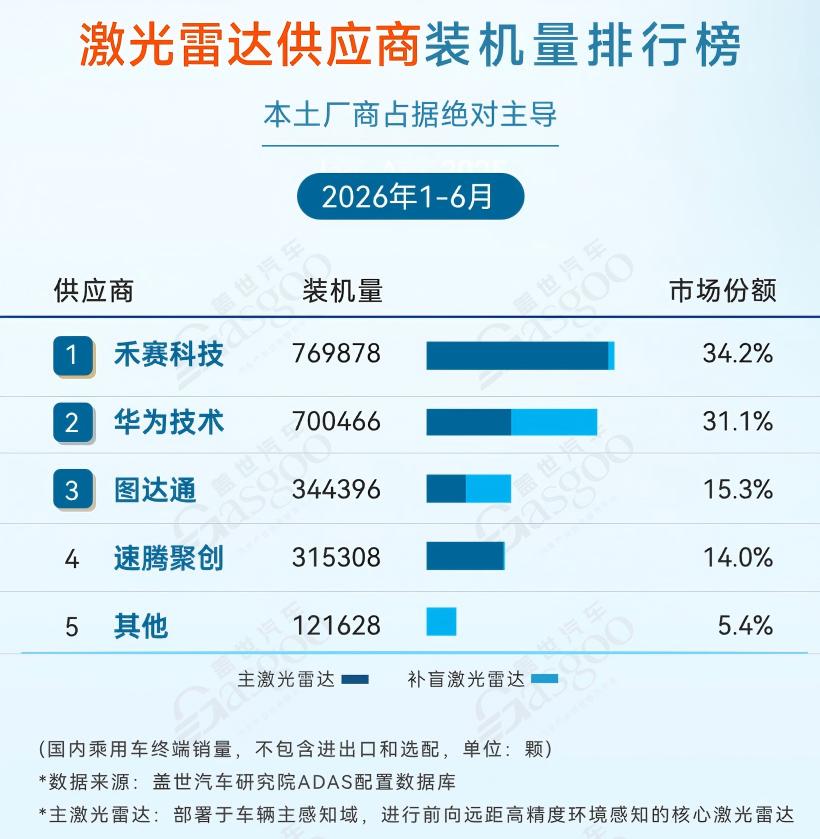
The real uncertainty lies in the "competition for the third place". RoboSense's automotive LiDAR market share in the first half of the year further declined compared with the full-year data of last year, but its overseas designated orders are increasing: as of August 26, the number of mass production designated orders has increased to 194 models, 37 of which come from overseas OEMs and joint ventures, covering the Japanese, North American and European markets. Whether overseas orders can be converted into actual revenue is the key to judging whether RoboSense's automotive business market share can stop declining; Innovusion is steadily advancing with its customer diversification strategy. Which of the two paths can succeed will directly determine the ranking of the second tier.
For RoboSense, there is another risk variable. On August 21, the State Administration for Market Regulation disclosed Geely Auto's recall filing plan: due to possible damage to the internal power IC of LiDAR, Geely recalled a total of about 93,000 vehicles of five models under the Lynk & Co and Geely Galaxy brands, and the involved LiDAR supplier is RoboSense. According to media reports, this is the first large-scale recall in China's LiDAR industry. Market analysis believes that this recall will increase RoboSense's after-sales cost in the short term and disturb customer confidence; whether it will affect RoboSense's subsequent cooperation with Geely on new models in the long run is worth continuous tracking.
Conclusion: Three Algorithms, Unknown Road Ahead
Back to the question we have been focusing on — can companies make money by selling LiDAR?
The answers of the three companies in the first half of the year are respectively: Hesai is "profitable on paper", RoboSense is "losing more money with more sales", and Innovusion is "exchanging losses for scale". At the same time, the three giants have given their own solutions through three moves: RoboSense makes subtraction, Innovusion makes addition, and Hesai makes multiplication.
Behind the three algorithms are three completely different situations. Hesai holds 7.05 billion yuan in cash reserves (including cash and cash equivalents,