Who is the No. 1 player in the AI glasses industry?
Zhang Ming is a manager at a state-backed investment fund. On a business trip to Shenzhen in October 2024, she visited several AI glasses companies but ultimately chose not to invest. At that time, AI glasses had been a hit overseas for about half a year, but the primary market had not reached a consensus on this product form. Many people, like her, chose to observe without making any investments.
A few months later, the situation changed. Around the 2025 Spring Festival, the concept of "Six Dragons of Hangzhou" became popular. A friend from the Alibaba ecosystem recommended Rokid, an AI glasses company based in Hangzhou, to Zhang Ming. The company, which previously made split AR devices, had just started developing AI glasses and had not yet launched its first product. Zhang Ming hesitated for a month, and when she tried to schedule a meeting with the founder again, she could no longer get an appointment.
After that, AI glasses startups emerged one after another, and major tech companies also entered the track almost simultaneously. Xiaomi, Alibaba and Baidu launched AI glasses successively, and even Li Auto released its own product at the end of the year. According to incomplete statistics, nearly 70 enterprises have poured into this track in the past two years, with a new product launched every 9 days on average. In the first 11 months of 2025 alone, the total financing amount of the smart glasses track exceeded 4 billion yuan. Entering 2026, both the financing frequency and the single-transaction amount continue to rise.
When an industry is placed under the spotlight of capital, a familiar phenomenon often appears: all companies that can be associated with this popular concept will put a new label on themselves to compete for the "first place" in the industry. The same goes for AI glasses. AR devices and AR glasses on the market, no matter with or without display functions, with or without AI capabilities, all claim to be AI glasses or smart glasses, and many "first places" have emerged in the industry.
Not long ago, Thunderbird Innovation released a poster showing that 5 third-party statistical institutions ranked it first in the shipment volume of smart glasses in the first half of 2026. Before Thunderbird, companies including Rokid and Xreal had also claimed the "first place" in the industry.
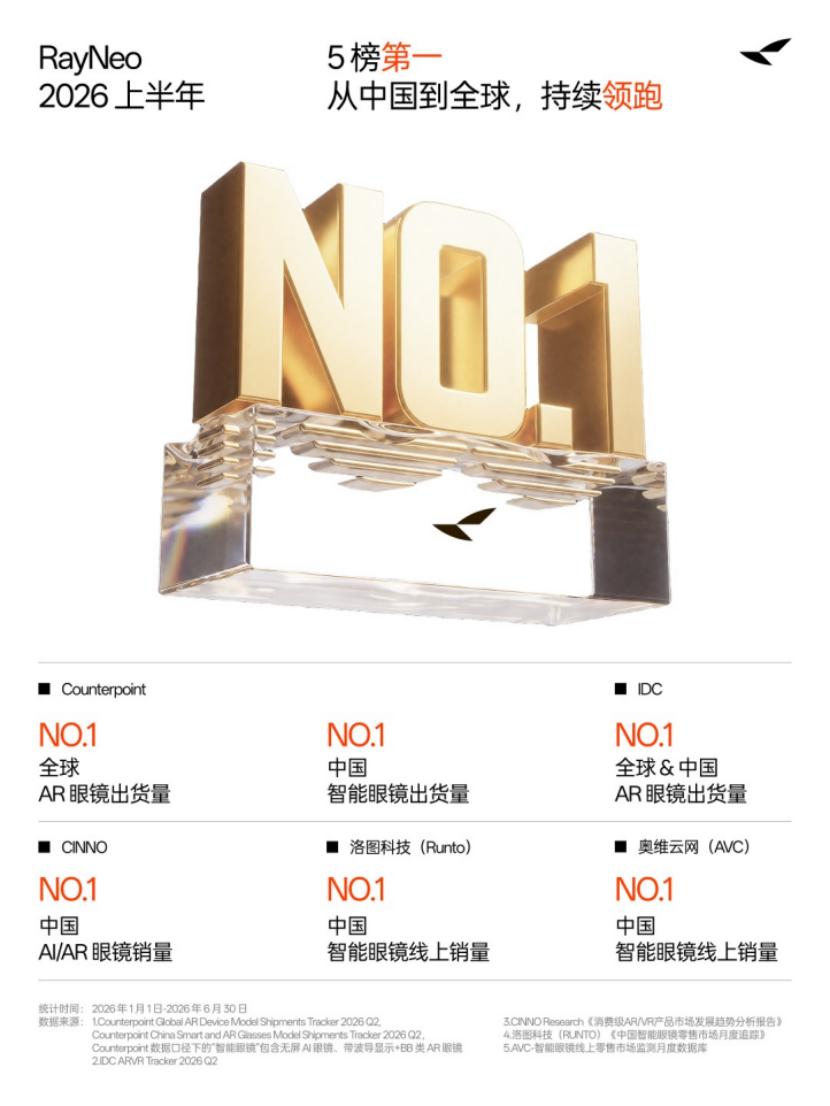
These rankings seem contradictory at first glance, but when you read the limiting conditions carefully, each has its own basis. Some count shipment volume, some compare sales revenue; some cover the global market, some only focus on domestic online channels. What is easier to ignore is that the "glasses" on the lists may not even be the same type of product.
The "first place" is tied to valuation, entry point and bargaining power. Which of these "first places" is more valuable? What is the real market pattern?
01. Five lists, who is the real first?
The reason why the pattern of AI glasses is hard to see through at a glance largely lies in that several product lines are classified into the same market.
One type of product focuses on video viewing and large-screen display, and usually needs to be connected to mobile phones, computers or other external devices. The other type is closer to ordinary glasses, relying on audio, cameras and AI services to provide interaction. Some products also add display functions to present text and information prompts. They are similar in appearance, but the problems consumers need to solve when purchasing are quite different.
At present, the mainstream shipment/sales lists of smart glasses mainly come from five institutions: Counterpoint, IDC, CINNO, Luo Think and AVC. Let's look at them one by one.
Counterpoint and IDC have similar statistical methods, which are divided by display technology type and only count shipment volume.
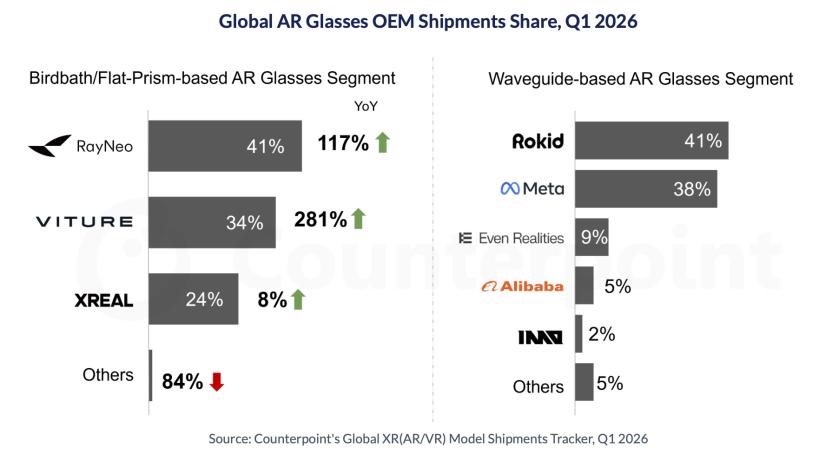
The only public data of Counterpoint available for the first half of the year is the total industry volume. In the first half of 2026, the global smart glasses market increased by 212% year-on-year and 22% month-on-month.
As for the specific data of each company, only the data of the first quarter of this year is disclosed. Counterpoint divides smart glasses into two major categories by display technology: one is closer to traditional AR headsets, which is the geometric optics category emphasizing immersive experience, and Thunderbird ranks first with a 41% shipment share; the other is the optical waveguide route currently widely adopted by display-equipped AI glasses, which does not pursue display quality, usually adopts monochrome (green) display, and focuses on lightweight information prompts, and Rokid ranks first in this branch, with a share of 41% as well.
The former accounts for 58% of the overall market, and the latter accounts for 42%. That is to say, if the differences in display technologies are eliminated and calculated together, Thunderbird Innovation ranks first. IDC's statistical method is similar to Counterpoint, and its public data also ends in the first quarter, but there is no detailed brand ranking.
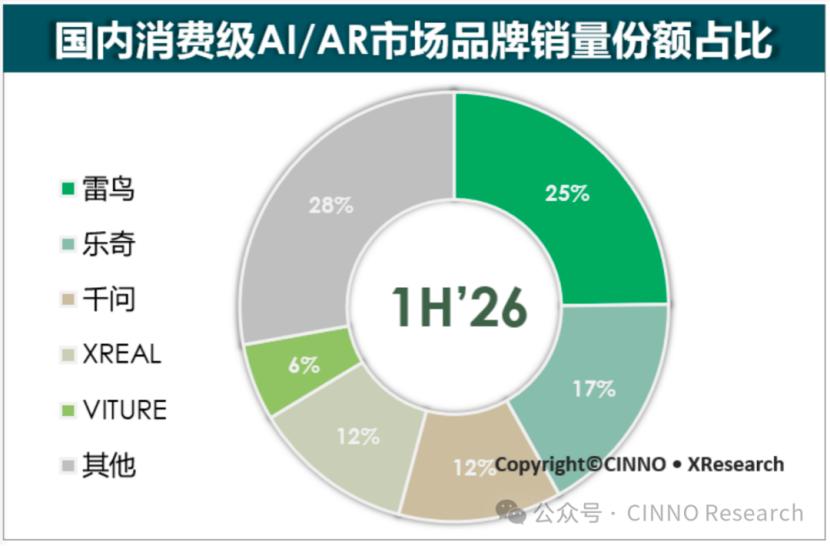
Under the caliber of CINNO, Thunderbird is also ranked first, but CINNO noted in its supporting text that it classifies Thunderbird's main products as split AR glasses, which cannot be used independently and need external devices, belonging to the product form of traditional AR glasses.
AVC and Luo Think both count the online market, one counts sales revenue and the other counts sales volume.
An investor who has long focused on AI glasses told "Dingjiao One" that online is the mainstream channel for AI glasses, but the channel structure varies greatly among different brands. Startups generally rely more on online channels, while large manufacturers such as Xiaomi and Huawei have rich offline channels with a higher offline proportion. Some other brands cooperate with traditional offline optical stores and also have a certain shipment volume. Overall, offline accounts for about 25% and online accounts for 75%.
AVC's data ends in the first quarter. In terms of sales revenue, Rokid ranks first with 120 million yuan, with an average unit price of 3178.1 yuan; Thunderbird's sales revenue is 58.917 million yuan, ranking fourth, but its unit price is only 1921.9 yuan. Converted to shipment volume, it is basically at the same level as Rokid. Luo Think's data is updated to the second quarter. In terms of online sales volume, Thunderbird ranks first and Rokid ranks second.
After cross-verification of the five lists, the real pattern of the AI glasses market can be summed up in two points.
First, Thunderbird's top market share is not entirely supported by AI glasses.
Its product lines cover multiple types. The V series focuses on AI functions such as shooting, and the Air series is biased towards AR video viewing, both of which can be included in the smart glasses market defined by some institutions. The leading total sales volume of the brand may come from the emerging AI interaction demand, or it may include the existing video viewing demand. It is difficult to judge how much each part contributes only by one total number.
Combined with its product lines and unit prices, the best-selling products are the V series focusing on no-display and shooting and the cost-effective Air series for AR video viewing. If we take the boom brought by the popularity of Ray-Ban Meta in 2023 as the node, the former belongs to AI glasses, while the latter can only be classified as AR glasses.
Second, Thunderbird follows the cost-effective route, and its best-selling models are priced below 2000 yuan, which naturally has an advantage in sales volume. Counterpoint, IDC and CINNO all calculate by sales volume. If switched to the sales revenue caliber, Thunderbird has no advantage.
Back to the starting point of the concept of "AI glasses", in September 2023, Ray-Ban Meta launched the first pair of glasses with AI functions. It has no display, only audio, and accesses to AI Q&A capabilities. Later, with the gradual maturity of monochrome optical waveguide technology, AI glasses added display functions, which is the main development line of this product line.
In this process, some companies collectively refer to AR glasses and AI glasses as smart glasses, or add AI functions to AR glasses, which is more like a branch line. When the branch line is merged into the main line for statistics, there will naturally be more "first places".
02. "First place" is not only for reputation, but also for "capital"
From the product perspective, "industry first" does not seem to be that important, because you can get many "first places" as long as you change the statistical caliber. But from the perspective of company development, the first place is very important, because it is related to valuation, entry point and bargaining power.
Valuation is the most direct consideration. Since this year, the financing pace of leading players has accelerated significantly.
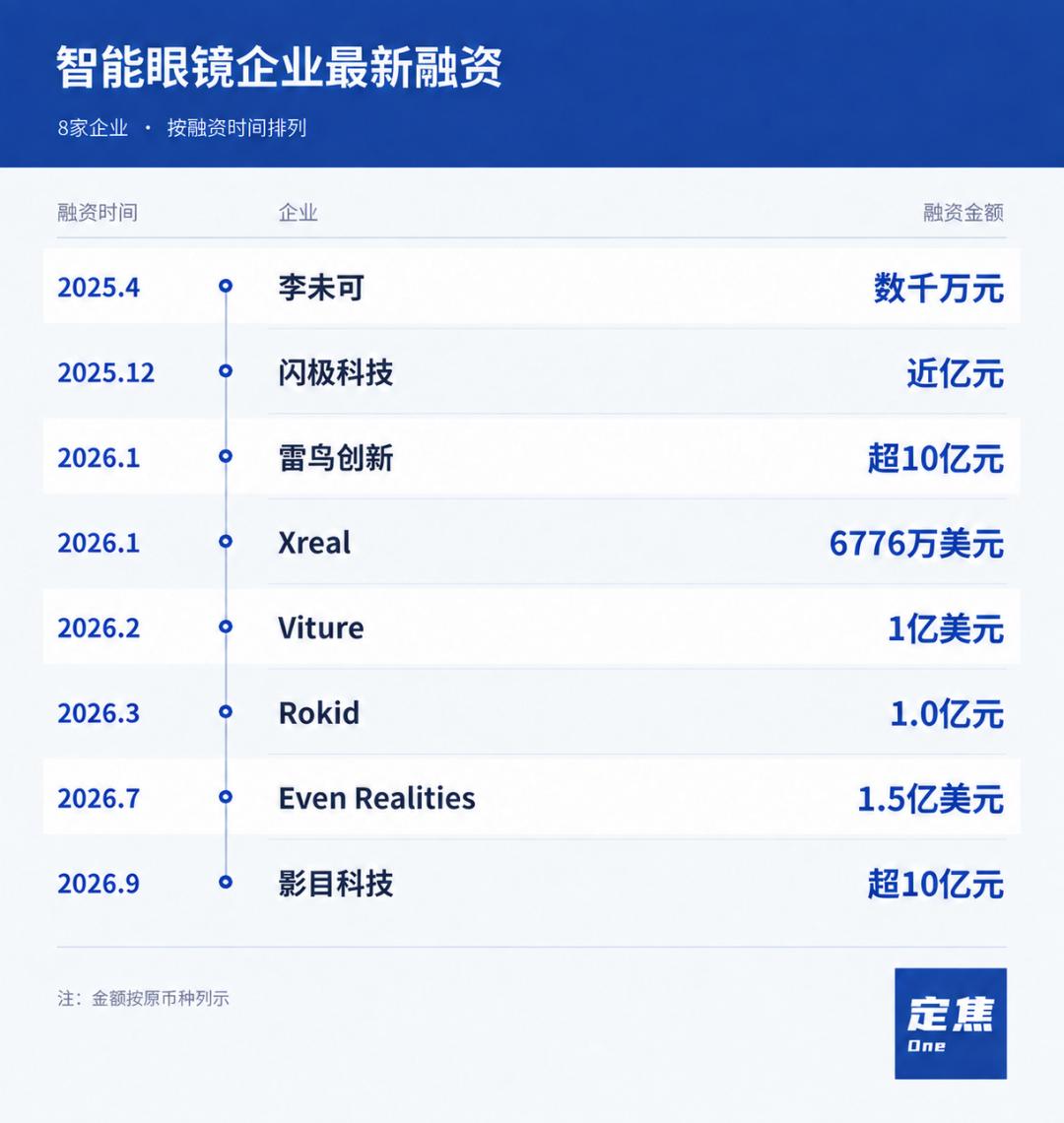
INMO completed a new round of financing in September, and the total amount of its entire Series C financing exceeded 1 billion yuan; Thunderbird raised more than 1 billion yuan in January; Even Realities raised 150 million US dollars in July. Earlier, Sharge and Li Weike received nearly 100 million yuan and tens of millions of yuan respectively in December 2025 and April 2025. It can be seen that leading enterprises either have a single financing close to or reaching the 1 billion yuan level, or raise funds continuously in a short period of time. Under the capital boom, occupying a more advanced position means a greater possibility of getting more financial support.
Zhang Ming told "Dingjiao One" that the current valuation level of AI glasses is not much different from that of other AI hardware, which is about 10 to 15 times PS.
Judging from Xreal's prospectus, this is still a generally loss-making industry, which cannot be measured by profit and business model, so market share has become the most important anchor for valuation. Higher share and larger shipment volume are obviously easier to impress investors.
There is also a more realistic motivation for competing for the first place: to reserve cash.
Getting financing is just the starting point, and reserving cash is a necessary action to cope with the current market. According to Luo Think's data, in July 2026, the monitored retail volume of the smart glasses market on the three mainstream e-commerce platforms of JD, Tmall and Douyin was 74,000 units, down 15.3% year-on-year and 20.9% month-on-month; the retail revenue was 130 million yuan, down 25.8% year-on-year and 43.0% month-on-month. The decline in sales revenue is significantly higher than the decline in sales volume, indicating that under the "hundred glasses war", the price war is certain to happen. All companies need to raise more cash reserves to cope with the increasingly fierce competitive environment.
For companies that still need continuous investment in R&D, stock preparation and channels, such capital scale can support longer-term product exploration. On the contrary, manufacturers with small volume and no advantage in the lists face greater financing difficulties, and it is more difficult for them to survive in this price reduction cycle.
The entry point is a deeper logic. This round of AI glasses boom can be traced back to Meta at the earliest. The whole industry's popularity is built on the imagination of "hardware entry point in the AI era", which is also Meta's original positioning for its AI glasses. When AI can respond to users at any time, glasses may undertake part of the interaction that originally happened on mobile phones.
This vision makes enterprises pay extra attention to user scale. More devices entering the market mean more opportunities to reach users, and may also enhance the attraction to developers and partners. To build an entry point, large volume is a must. Whoever can take the lead in obtaining a larger user base is more likely to become the hardware entry point for AI. This is the simplest and most effective Internet business thinking.
The last point is the upstream bargaining power. Scale will also affect upstream hardware procurement. AI glasses are ultimately a hardware business, and the current cycle is extremely unfriendly to hardware manufacturers in terms of cost. According to data from TrendForce, in the first quarter of 2026, the contract price of conventional DRAM increased by 90% to 95% month-on-month, the contract price of NAND Flash increased by 55% to 60% month-on-month, and the average price of memory chips has increased by more than 400% cumulatively in the past 15 months.
Although the current mainstream AI glasses on the market generally adopt small and medium-capacity memory configurations such as 2GB+32GB and 4GB+64GB, the transfer of upstream production capacity will inevitably lead to subsequent supply shortages and rising costs.
The current price surge has spread from mobile phones and PCs to all terminals with memory. In this context, larger sales volume means stronger bargaining power, more stable supply and lower prices, which can hedge the negative impact of the price war to a certain extent. On the contrary, small-volume manufacturers will face the double squeeze of rising upstream prices and falling downstream prices.
03. Behind the "first place", what is the real demand?
The popularity of AI glasses is obvious to all, and it has indeed opened up a clear demand scenario. At the hardware level, glasses have some characteristics that mobile phones, earphones and other hardware do not have. One point that can be clearly seen at present is "always on". It can be worn for a long time without perception, which will generate many new interaction demands that mobile phones do not have.
Real-time translation, first-person shooting, navigation prompts, and payment that can be completed with a glance, these functions that have been put into use on sold products are all based on the premise that "glasses are always worn on the face".
Shipment volume also supports this point. Omdia statistics show that in 2023, 2024 and 2025, the global shipment volume of AI glasses was 380,000 units, 2.06 million units and 8.7 million units respectively, and it is expected to exceed 15 million units for the whole year of 2026.
As a reference, the estimated sales volume of TWS (True Wireless Stereo) earphones in 2026 is about 400 million units. As AI accessories, the sales volume of glasses is much lower than that of earphones, but the average price of earphones is only a few hundred yuan, while the average price of AI glasses is much higher. From the perspective of single product value, this is already a business that cannot be ignored. The demand is real, but the problems in the industry also exist.
The coexistence of sales growth and lack of scenarios is the most difficult problem for AI glasses at present. There is no "killer-level" scenario yet. Most functions are still in the stage of novelty trial and smartphone substitution. Functions such as translation, shooting and navigation can all be realized by mobile phones, and in most cases, mobile phones perform better. Glasses need to prove that they are irreplaceable, not just more convenient.
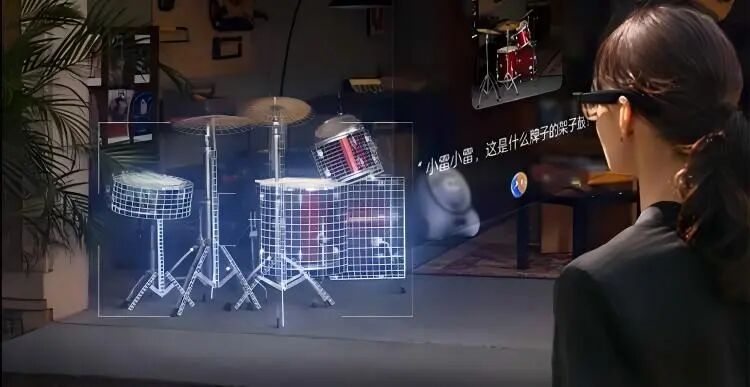
Source: Thunderbird official website
There are also hard flaws at the technical level. With the maturity