What exactly are enterprises choosing when they select an Agent?
Today, leveraging AI effectively has become a proposition that every individual and enterprise must address.
As Agents are being integrated into enterprise workflows, the evaluation criteria for collaborative office tools are also evolving — it no longer only concerns the user experience of human users, but also depends on whether the platform can host both humans and Agents simultaneously, connect models, data and business processes, and build clear governance capabilities. The answer to this question is still taking shape, yet it has already been placed in front of every enterprise.
On September 15, 2026, the 2026 Feishu Future Infinite Conference & Doubao Work Launch Conference was held in Beijing. At the event, Xie Xin, CEO of Feishu, shared his judgment on this change and put forward Feishu's solution.
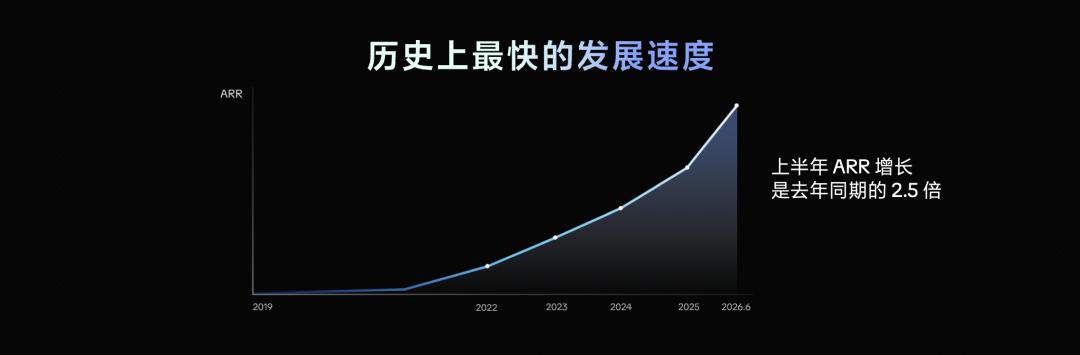
From the results, Feishu has taken the lead in seizing the era opportunity of the AI boom — in the first half of 2026, Feishu's ARR growth reached 2.5 times that of the same period last year, and over 90% of new customers purchased Feishu's AI products concurrently.
Xie Xin stated that over the past decade, collaborative office tools solved the problem of "how humans work together". Entering the AI era, Feishu aims to solve the problem of "how humans and Agents work together". This means that office platforms cannot simply add AI functions, but need to reconsider at the design level: what identity Agents enter the organization with, how they call various capabilities, and how they run and work in a safe, controllable and efficient manner.
Focusing on this proposition, Feishu has achieved native integration with Doubao Work. The two systems are interconnected in the account system, sharing the same enterprise identity and the enterprise's context and tools, so that users can also call Doubao Work anywhere in Feishu to handle tasks.
This year also marks the first joint conference held by Feishu and Doubao Work. At the event, Xie Xin said, "Now, if an enterprise needs to choose a collaborative office platform, Feishu is undoubtedly the best choice. Coupled with the natively integrated enterprise-level Agent Doubao Work, this will be the optimal choice for work in the AI era."
The following is the full transcript of Xie Xin's speech (published after collation):
2026 is a very memorable year for Feishu, because Feishu was established in 2016. In the blink of an eye, Feishu is 10 years old!
Over the past decade, Feishu has been committed to exploring advanced working methods, from initially serving ByteDance internally to gradually serving more and more domestic and overseas enterprises later.
After 10 years of unremitting efforts, we now have a judgment:
Feishu is the best collaborative office product in the AI era.
Over the past decade, Feishu has been dedicated to serving every user well, and we are very lucky to have won the love of many users, becoming the most reputable collaborative office product in the industry.
However, starting from this year, Feishu's service targets have changed for the first time. Feishu no longer only serves humans, we also serve Agents at the same time. So today's conference is also the first joint conference held by Feishu and Doubao Work.
Let's first talk about serving humans. How well does Feishu perform in serving humans?
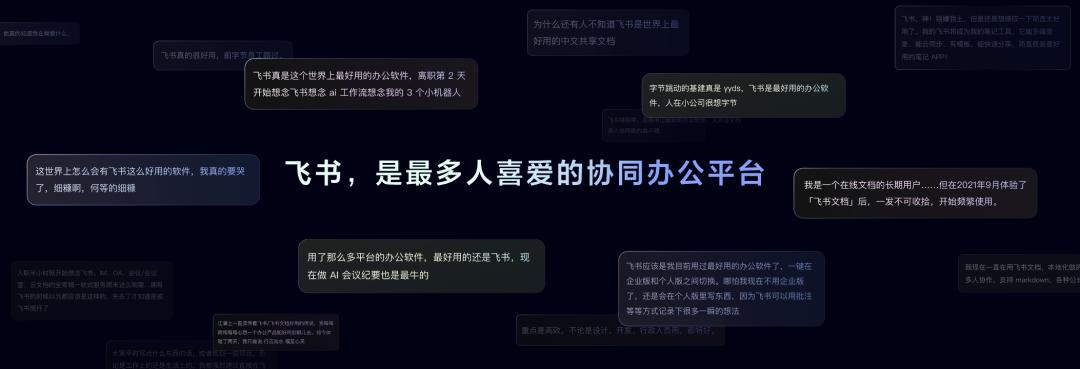
After years of efforts, I believe the industry has a consensus that in the field of collaborative office, Feishu has maintained the best reputation for many years. We can say: Feishu is the most loved collaborative office platform!
How well does Feishu perform for the brand new Agents?
Although Agents have only become mainstream this year, the open platform technology and rich program interfaces required to serve Agents have actually been accumulated by us for many years. Therefore, we also have advantages in this field.
Let's look at several examples:
The starting point for the public to get in touch with Agents is Openclaw, the Agent project that took the world by storm at the beginning of this year, also known as Lobster. Feishu is not only the first Chinese IM platform officially supported by it, but also the de facto most mainstream operating platform in the Chinese-speaking world.
By the middle of the year, we can see that almost every Agent released by any company takes Feishu as one of the first office platforms to be officially supported.
If we look at various articles, videos and cases introducing Agents in daily life, you will find that no matter who is talking about Agents, Feishu is the collaborative office platform that appears most frequently in these contents.
We noticed the CLI projects of office platforms released on GitHub, which are the office software entrances for Agents, allowing Agents to read documents, send messages and check schedules through CLI.
The number of Stars these projects receive is the public vote of global Agent developers, which is the most comprehensive, public and objective indicator.
Feishu and several competitors released their CLI projects at the same time. Looking at the current Star growth curve, the number of Stars of Feishu's project is about 6 times that of its peers.
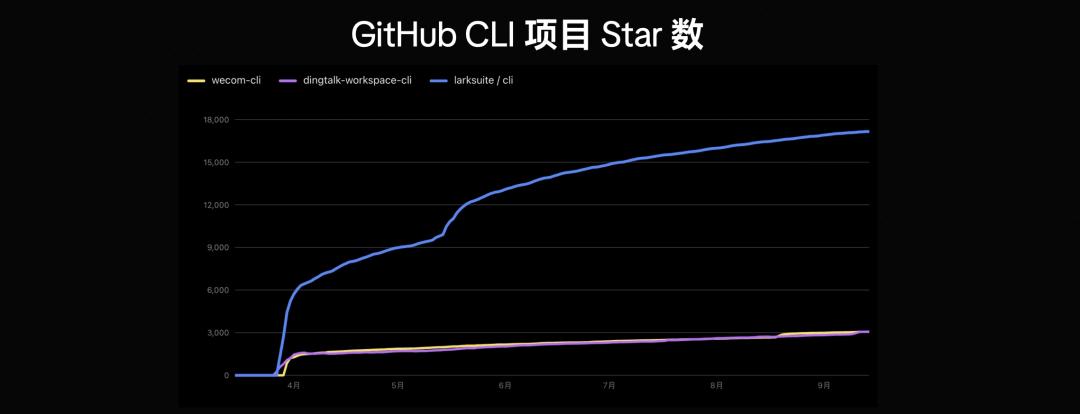
This is the result voted by tens of thousands of developers around the world over the past six months. Therefore, we can say with more confidence: Feishu is the best working platform for Agents!
Serving humans well and serving Agents well has brought real business growth to Feishu.
In the first half of this year, we achieved the fastest development speed in our history. The ARR growth in the first half of the year was 2.5 times that of the same period last year, and this growth rate is far higher than similar products!
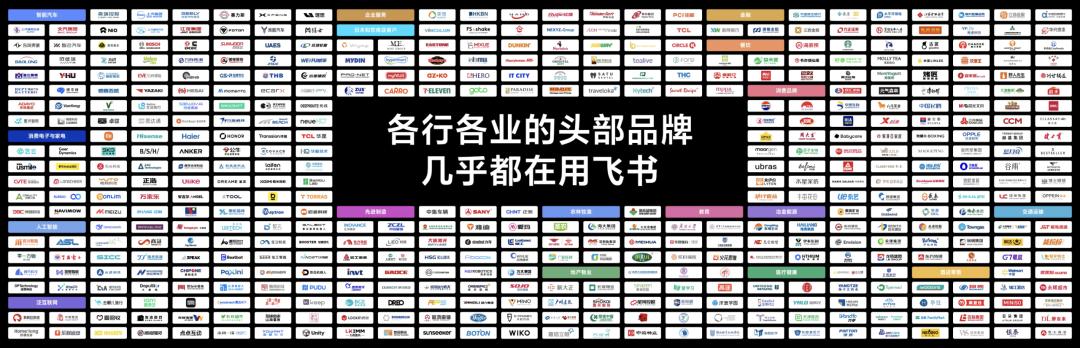
Recently, a large number of leading enterprises have chosen Feishu.
At the same time, we have also increased our attention and support for small and medium-sized enterprises. In the past year alone, the total number of our small and medium-sized enterprise customers increased by 70%. Feishu is not only the choice of large enterprises. Today, more and more small and medium-sized enterprises are also using Feishu.
Redesign Feishu for Agents
Over the past decade, Feishu has been a collaborative office platform for humans to work with each other; today, Feishu is a platform where humans and Agents work together. This means that Feishu itself also needs to be deeply integrated with Agents to create a better working experience for both humans and Agents. This is a huge opportunity and challenge for us.
Today, we officially release Feishu 8.0, the Feishu for Agent version, which is our first answer sheet for the Agent era.
In Feishu 8.0, we have redesigned Feishu entirely for Agents. Feishu is also the first office platform in China to do so.
In short, we hope that Agents in Feishu can "act like humans", which specifically includes the following three aspects:
First, the collaboration between humans and Agents should be as natural and smooth as the collaboration between humans;
Second, Agents can use various products in Feishu just like humans;
Third, enterprises can manage Agents with clear permissions, safety and controllability, just like managing human employees;
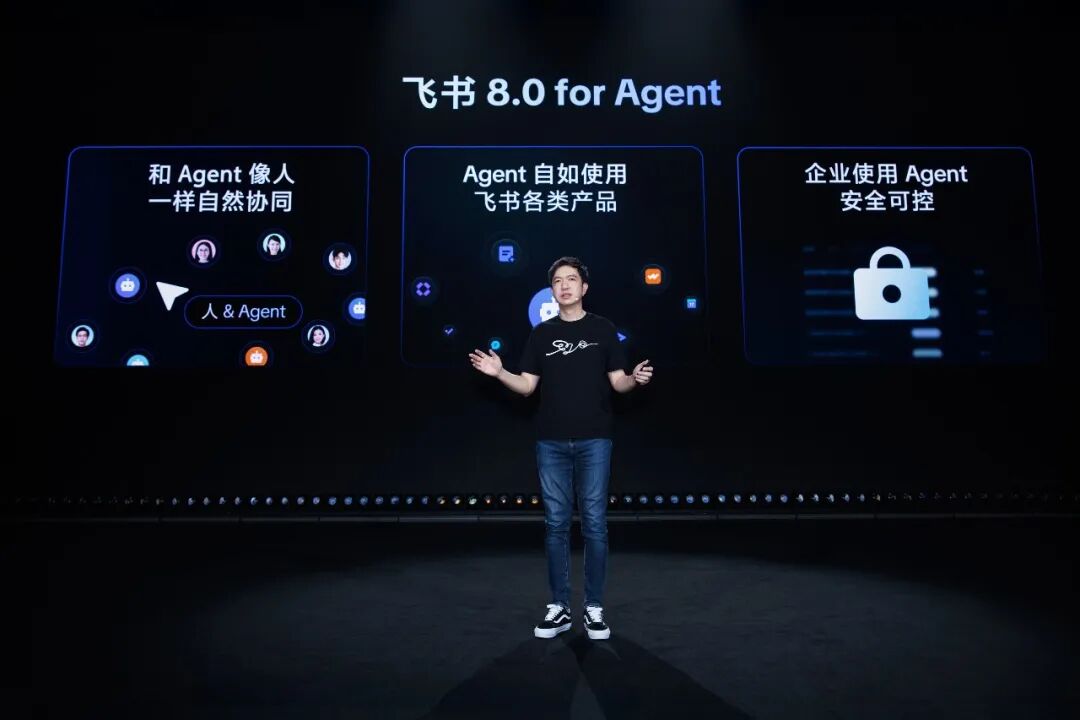
First, we hope the collaboration with Agents can be as natural and smooth as collaborating with humans.
Let's look at group chats first. Everyone knows how to add a person to a group chat, but I believe many friends in the audience have never added an Agent to a group chat before.
In the past, this was indeed a fairly professional operation. Today, adding an Agent is exactly the same as adding a person. What's more interesting is that when there are multiple Agents in a group, one Agent can ask another Agent for help by directly @mentioning it, just as naturally as you @mention a colleague in the group.
Then let's look at documents. In the past, if you had a question when reading a document, you would @mention a colleague in the comment section; today, you can directly @mention an Agent, which will not only answer your question, but also help you modify the document.
In addition, the experience of you talking to Agents in Feishu is as friendly as using an independent Agent client. For example, you can use the slash "/" to call up the quick functions of Agents, and you can also view the thinking process of Agents, etc.
Feishu also supports native preview and even editing of Markdown and HTML format files that Agents tend to generate.
Now let's talk about the second point: we hope Agents can use various products in Feishu just like humans.
Today, Agents can view messages in group chats and reply to them for you, help you write documents, arrange schedules and to-dos, participate in meetings, check cloud drives, read Minutes, and even initiate approvals.
Almost all functions available for human users in Feishu 8.0 can be used by Agents.
This is actually the capability brought by Feishu CLI we mentioned earlier. In the past six months, we have made a large number of iterations to it.
When it was first launched at the end of March, Feishu CLI covered 247 function points, and today it has increased to 767. The call success rate has risen from 78% to 95%, and the call speed has also increased by 39% overall.
Now let's look at the third point: enterprise security control over Agents. This is a concern of many enterprises.
First, let's talk about access permissions. Some enterprises may worry that when employees use Agents, will Agents cross the permission boundary and obtain information they should not see? You can rest assured of this. When each employee uses their own Agent on Feishu 8.0, the Agent will never exceed the original permission scope of the employee.
For the control of Agents, Feishu 8.0 has mainly done the following three aspects of work:
First, full visibility. Administrators can now uniformly understand what Agents are in the enterprise, who created them, who is using them, as well as their activity and risk status.
Second, full controllability. Which employees can use which Agents, what tools Agents can call, what permissions they can obtain, and what resources they can access can all be set uniformly by the enterprise.
During the operation of Agents, high-risk scenarios such as prompt injection, malicious links and other threats may be encountered. Feishu 8.0 provides security protection for these behaviors and scenarios. Administrators can detect risk events in a timely manner, dispose of them according to the situation, and disable Agents with serious risks when necessary.
Third, full traceability. What Agents have done, what tools they have called, and what resources they have accessed can all be queried and traced through logs.
At the same time, Feishu 8.0 will also provide enterprises with AI usage management capabilities, such as setting usage caps, and targeted management of high-consumption models and scenarios; and provide enterprise administrators with API interfaces to support multi-dimensional data analysis and statistics.
Doubao Work is Natively Integrated into Feishu
The three points above describe how Feishu 8.0 becomes an Agent-friendly platform. But a platform alone is not enough.
Recently, Feishu has another most important update — Doubao Work is natively integrated into Feishu. I want to emphasize the word "native" in particular, because it is not an integrated Agent, nor a third-party application that needs to be redirected to open, but a system-level integration.
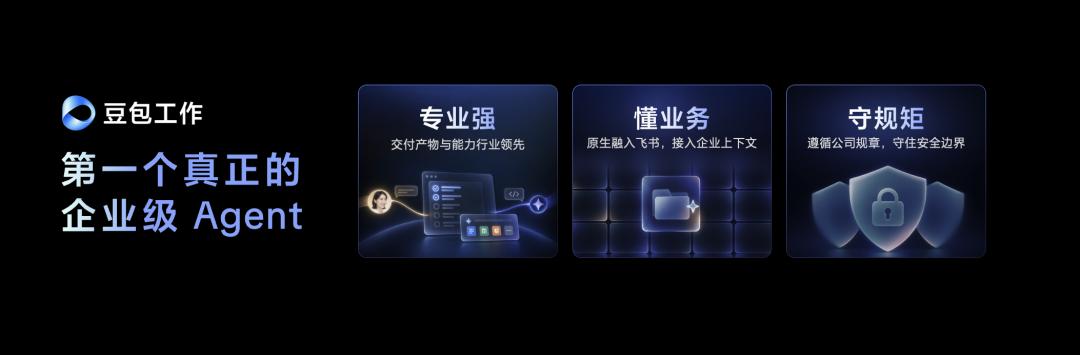
Native integration has three major advantages over third-party Agents:
First, interconnection of accounts. When employees use independent personal Agents to handle work, enterprise data may break away from the original control boundary and face the risk of leakage.
Doubao Work and Feishu are interconnected in enterprise identity, so employees still use Agents in the original enterprise account system, and the permission boundary and security policies can be naturally inherited.
Second, deeper integration of context and tools. Based on Feishu CLI, we have also integrated more capabilities into Doubao Work. For example, Feishu knowledge Q&A is connected to Doubao Work, making the retrieval and use of context more accurate and efficient; so for the same work task, Doubao Work can perform better.
Third, accessible anywhere. Doubao Work exists in every corner of Feishu — you can find it in group chats, documents, and search. This means that any work task at hand can be quickly called up for Doubao Work to help on the spot, without switching tools, no copy and paste, which is very easy to use.
Doubao Work is highly professional, business-aware, and compliant, making it a true enterprise-level Agent.
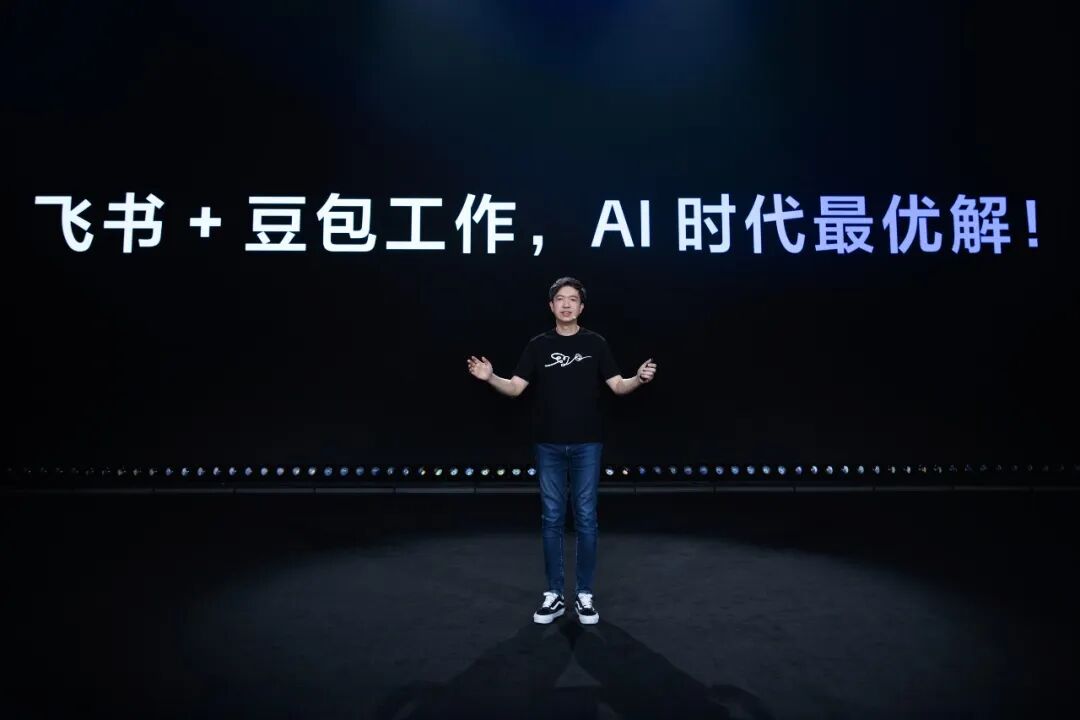
Feishu + Doubao Work = the optimal solution in the AI era.
In addition, I would like to introduce a new product to you.
Today, most of the Agents we use are our personal assistants.
But enterprises have another type of demand: can an Agent become an independent digital employee, with its own permissions and memory, and work with the whole team.
Some time ago, Anthropic released Claude Tag, which is integrated with Slack, and it is also an exploration in this direction.
ByteDance has large models, Agents and collaborative platforms at the same time. Combined with the newly released Feishu 8.0 Feishu for Agent, we have the opportunity to go a step further: not only let Agents run on the collaborative platform, but let them truly integrate into the organization, participate in collaboration, and become a member of the team.