Young people who have no intention of becoming internet influencers are making the overseas version of Qzone wildly popular.
It is a well-established conclusion that young people need new social products; but what kind of new social products young people need is an open-ended question that no one has been able to answer since 2020. This, however, does not stop capital from continuing to provide tangible financial support to those who offer solutions.
On July 22, Yope announced the completion of its $12.3 million Series A financing, bringing its total accumulated financing to $20 million, with nearly 15 million registered users at present; on August 28, Retro also disclosed that it had completed more than $21 million in Series A financing.
It is worth noting that these two products share a common feature: different from the "casual recording" and "daily sharing" gameplay of the previous generation of products, their form is more similar to the early Qzone and MySpace, an application that allows users to decorate their homepages with elements such as music, backgrounds and photos.

The pictures above and below are the promotional images of Bereal and setlog respectively. The previous generation of "anti-Ins" products took new content publishing rules as their core gameplay: BeReal randomly reminds users every day to shoot daily moments and share them with friends, and users can proceed to the next round of publishing after friends browse and interact; setlog, on the other hand, reminds users to shoot and record at every full hour of the day, and users only need to shoot 3-second videos, which will automatically form a Vlog at the end of the day and then be shared with friend groups. | Source: Diandian Data
Acquaintance social products seem to be making a retro comeback.
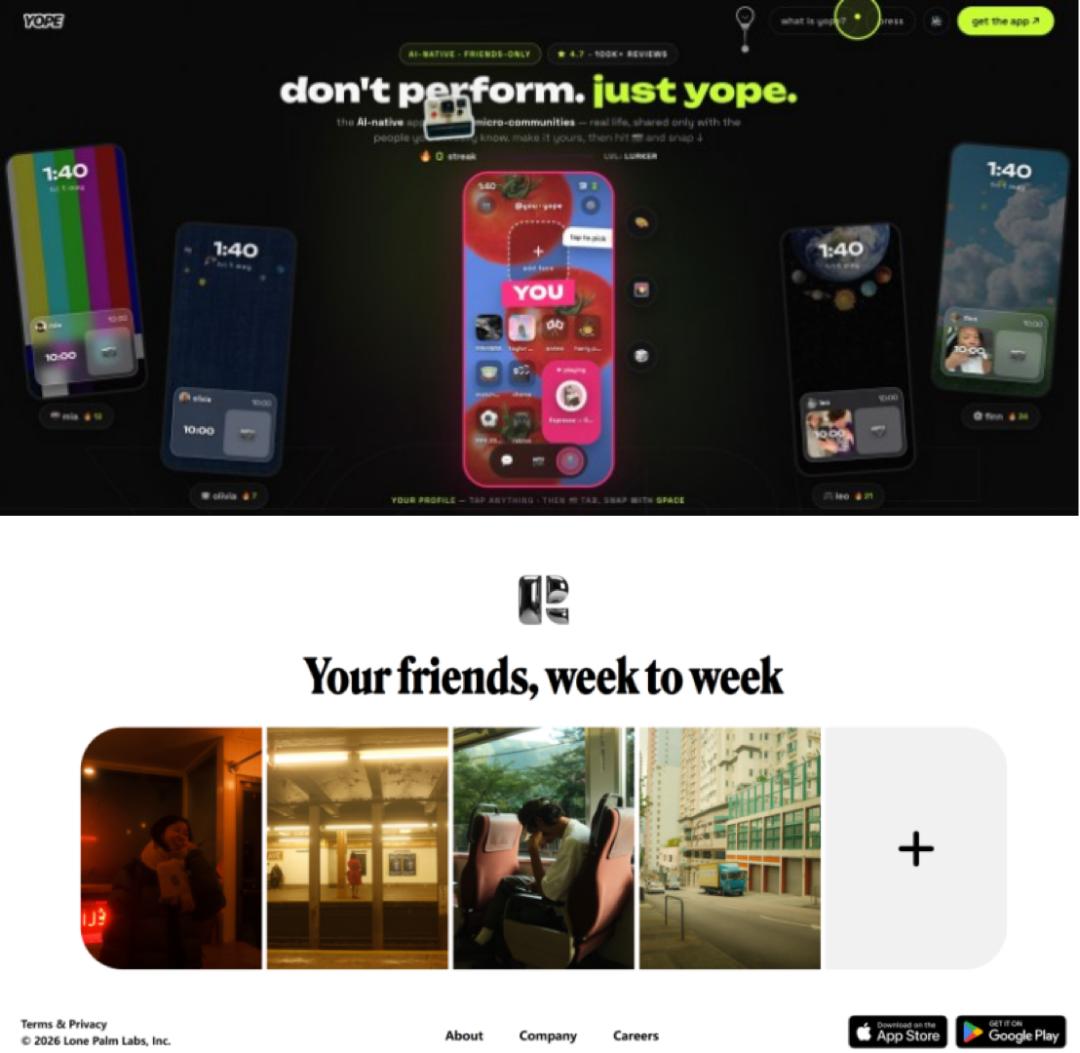
Source: Official websites of Yope and Retro
I. "Space" First, Then Socializing
Positioned as a private social product, Yope first clarifies the product boundary, that is, who can enter and who can see the content.
The team previously found through more than 100,000 user surveys that about 30% of young users have the "photo dump" behavior, that is, posting content on alternate accounts or private accounts; it was also found that many users rarely post publicly, and instead move their daily sharing to private chats and group chats.
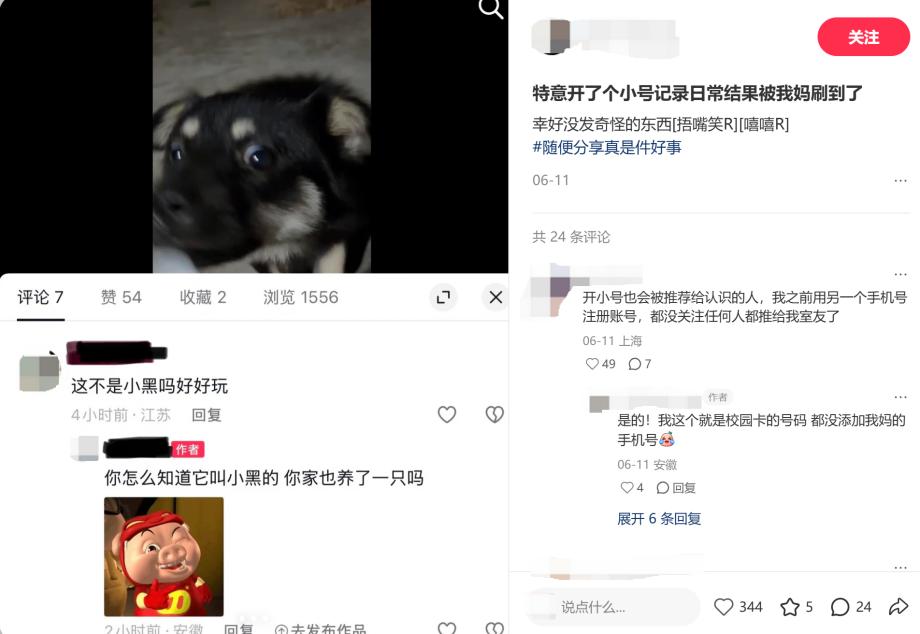
Young people in China have similar demands. Videos posted casually on mainstream social media platforms may be recommended to people they may know, so they turn to alternate accounts; but even with alternate accounts, there is still a chance of being seen by acquaintances. | Source: Xiaohongshu
Therefore, in Yope, accounts are private by default, with no public homepage and no algorithm-recommended information feed. Users can send invitation links to close friends and family members they want to share with, share photos, videos and chat in the group space; the application also provides functions such as lock screen widgets to display photos.
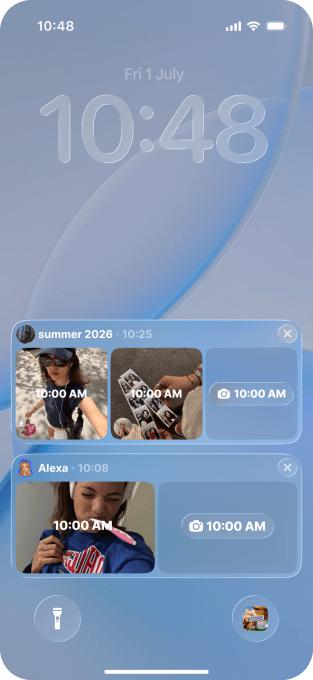
The widget photo display function of Yope | Source: Yope
At this point, Yope shares the same starting point as the previous generation of products such as BeReal and Setlog, all aiming to reduce the expression pressure of young people on public social media platforms. For Bahram Ismailau, co-founder and CEO of Yope, "Young people who are not ready to become 'internet celebrities' actually have no place to express themselves."
But Yope's solution is different. The product's understanding of free expression not only stays at "sharing life truthfully", but also extends further to "how to present these lives".
This is reflected in the fact that users can "decorate" their personal homepage in Yope, which is the Qzone-like function mentioned at the beginning. The application allows users to customize the homepage style, add favorite music, stickers and text, personally set the background color and wallpaper to express their personal aesthetics; the photos and videos uploaded by users will also be displayed on the homepage, and can be presented according to their own preferences.
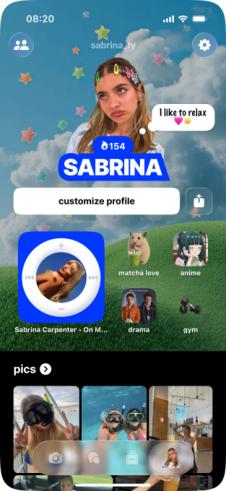
Example of a user's personal homepage | Source: Yope
Settings such as music, layout and stickers turn life recording into a kind of personal creation. Users can decide "what to share" in Yope, and also decide "what these lives will finally look like when preserved". This point is also reflected in Retro.
Retro has a simpler gameplay and is only limited to interactions between friends. In short, it is like an album maintained by friends together, providing functions such as sharing photos with friends, shared albums and photo review, so that users can see what their friends have been up to recently. But different from Setlog, which we observed topped the charts in Japan and South Korea in the first half of the year, Retro chooses to retain the "records".
In the Recap function, users can select the range of photos, generate different forms of collages with one click, and continue to doodle and edit, reorganize a group of life photos into a visual record with personal style, and display it on their own homepage.
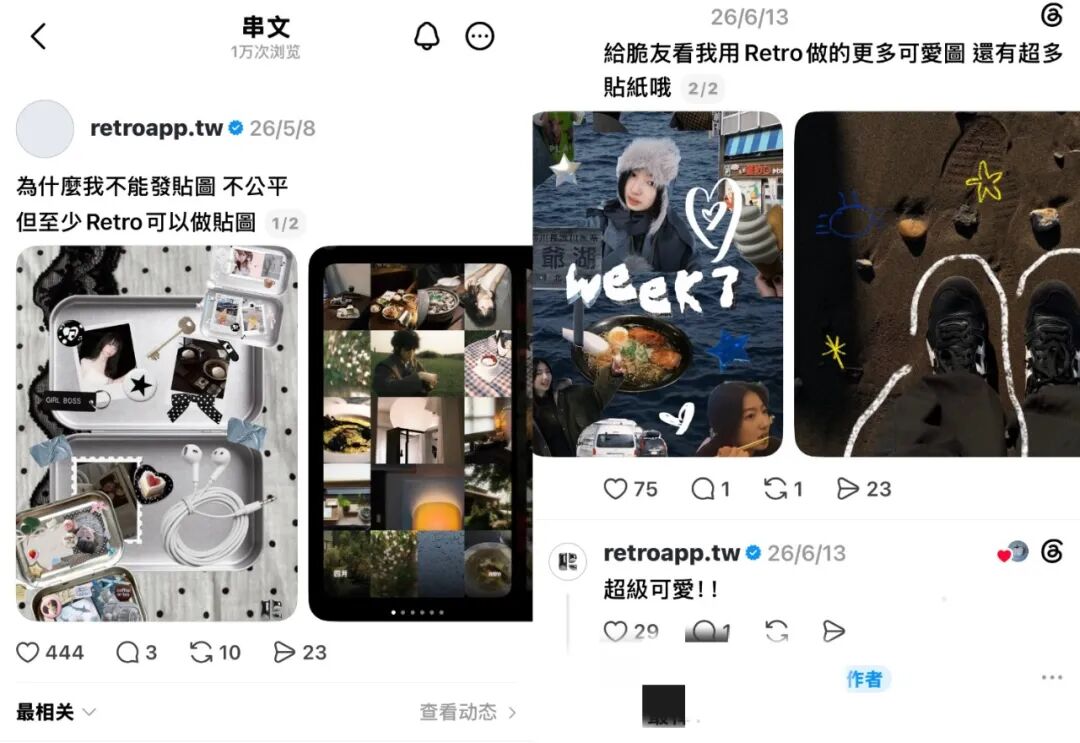
Users use Retro to make collages and organize photos | Source: Threads
If there is any difference between the problem-solving ideas of such products and BeReal and Setlog, the latter hopes to reduce users' social pressure by narrowing the social circle and eliminating traces immediately, but the two products that have recently obtained financing tend to retain users' personalized expression while keeping privacy, giving users a reason to use the product without taking social interaction as the premise. Users open the app not just to see if their friends have updated, but also to simply organize, record and decorate their own lives.
Both Yope and Retro can exist as a personal "private plot" first, and after users allow friends to enter, they further become a shared space. In the past, users' motivation to open the app mainly depended on the content posted by friends.
This change may be related to the problems faced by the previous generation of acquaintance social products.
II. What is left of the App when friends no longer update?
The "anti-Ins" products mainly solve the expression pressure brought by public social interaction.
Therefore, BeReal sends notifications at random times every day, requiring users to take unelaborated real moments in a short time. Although the content is "original ecology", it disappears quickly; setlog requires users to leave several seconds of videos continuously throughout the day, and finally automatically forms a Vlog, which is also not retained. Their common feature is to design a simple and interesting content production rule, and then let friends interact around the new content.
But problems arise accordingly. Even if the content production threshold is extremely low and AI takes over the automatic editing function, users still need to continuously produce content, which is another high requirement for users. A South Korean setlog user said, "Most of daily life is repetitive, so the upload volume will inevitably decrease gradually", but the product still keeps urging users to publish through notifications.
When users lose interest, the platform needs to find new sources of interaction for data growth. After its daily active users dropped sharply, BeReal began to test the celebrity content feed "RealPeople" in 2023, and officially introduced celebrity and brand official accounts in February 2024. At that time, media comments said that BeReal "has become the same as all other social apps".
As for setlog, a distorted gameplay has derived: some users look for strangers on public platforms such as Threads and Reddit to exchange invitation codes and join their own groups, so as to solve the problem of inconsistent content output in family and friend groups. Some people even use setlog as a blind date tool: before two people meet offline, they watch each other's daily video clips for several days, and then decide whether to meet.
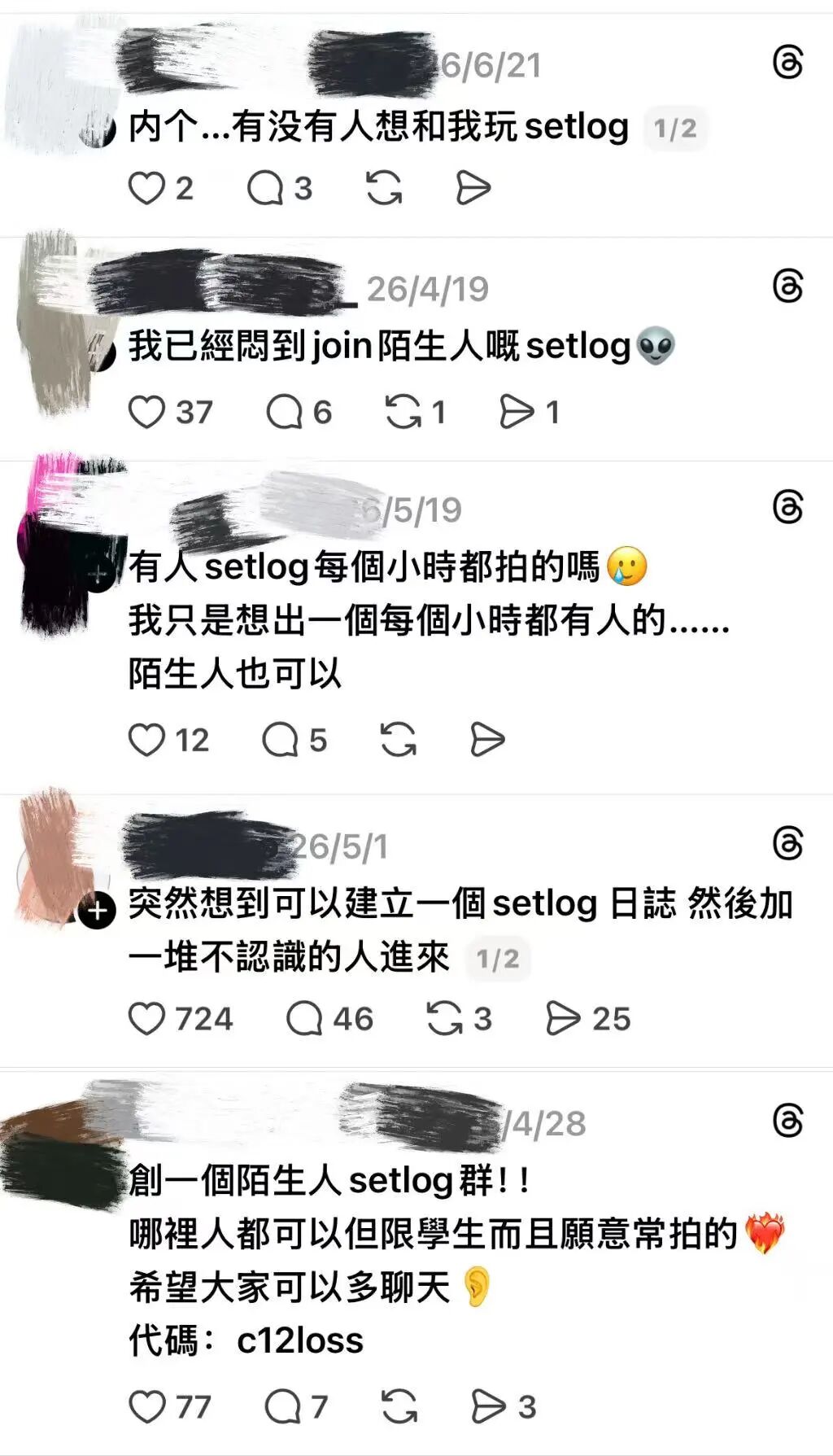
Many users actively look for strangers on the platform to join their setlog groups | Source: Threads
There are even third-party applications SetMate developed specifically around this demand in the app store, where users can find strangers according to their interests, regions, ages and languages, and exchange setlog invitation codes after matching.
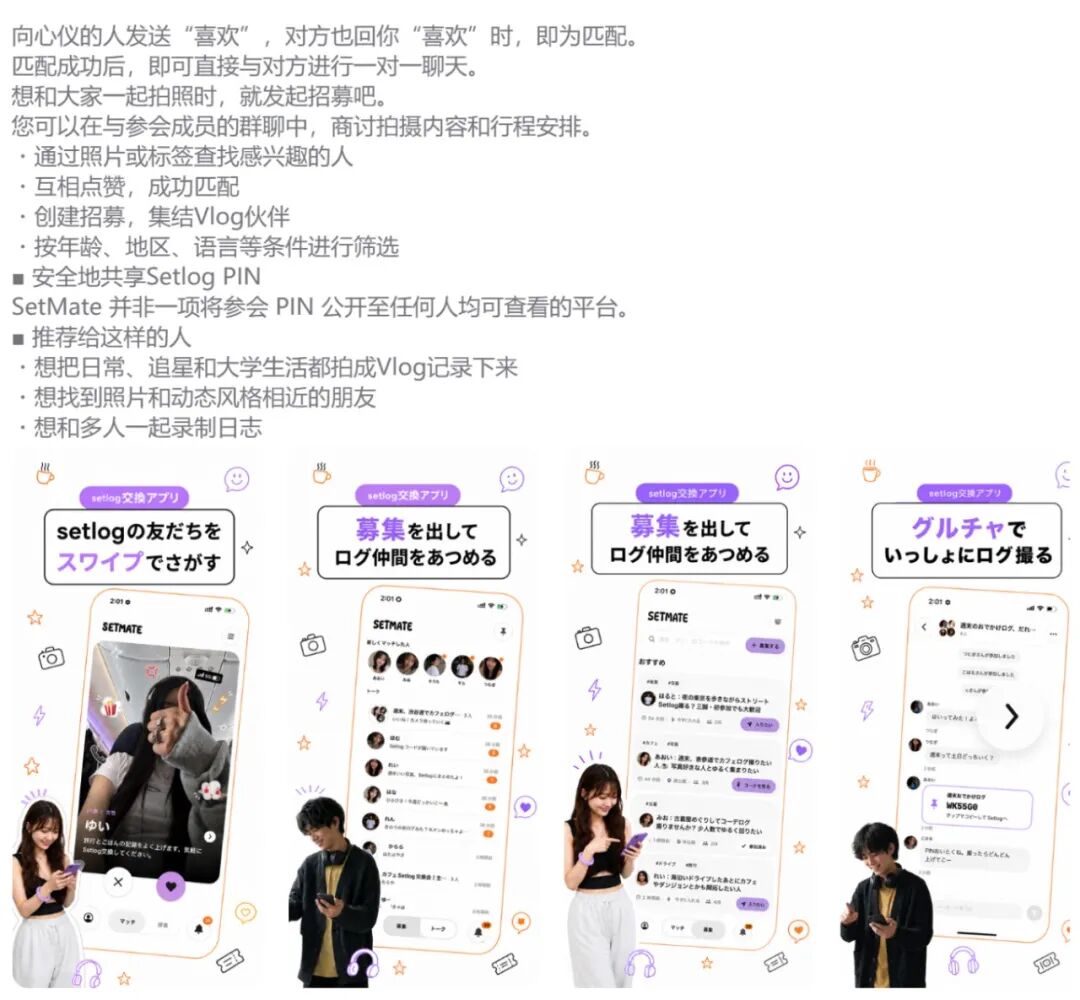
SetMate product introduction | Source: Diandian Data
This actually reveals the long-standing problem of these "new products" that aim to build acquaintance social networks: The appeal of the products mainly comes from "what new content my friends have posted today", but small-scale acquaintance relationships can hardly continuously provide enough fresh content. At this time, the platform or users will actively expand the boundary and break the original acquaintance social positioning.
Final Notes
Yope and Retro have chosen two different paths, but their underlying logic is the same. The retention reason of the products is shifting from whether friends have updated to how much content users have left here. The former depends on the behavior of others and is inherently uncontrollable; the latter depends on the user's own accumulation, and the longer they use it, the higher the exit cost will be.
This is what the two products want to solve: when the source of interaction cannot be sustained, why do users stay, pushing the exploration of acquaintance social interaction from real-time and semi-real-time mode back to asynchronous social interaction.
However, it is still uncertain whether Yope and Retro can completely change the form of acquaintance social products just as WeChat replaced QQ and MSN. The "space" concept only responds to the retention problem that the previous generation of products did not solve, but back to the product positioning, Yope and Retro do not have any innovative design in acquaintance socializing and relationship maintenance. The "space" feature does not serve the maintenance of acquaintance relationships; by analyzing the comment area, we can even find that a large part of users do not use the product for social interaction for a long time.
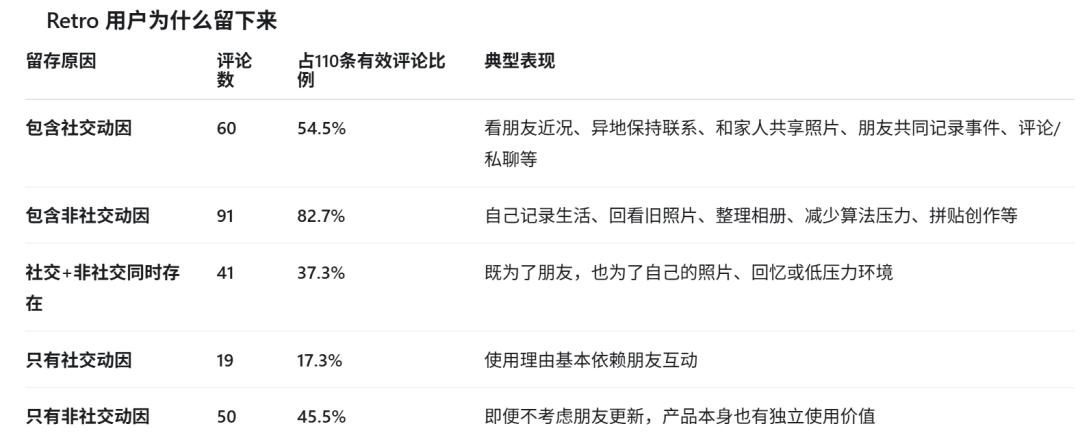
There are few comments on Yope, so we analyze the comments of Retro in the top 5 download markets in the past 90 days. 45.5% of users use the product for non-social motivations (such as recording life and organizing photo albums), twice as many as users who only have social motivations. When classifying, we take whether there are explicit expressions of social values such as relationship maintenance and acquaintance interaction in the comments as the basis for judging social motivations. If there is no relevant expression and the core demands of the comments focus on personal values such as recording, recalling, organizing and low-pressure use, they are classified as non-social motivations. | Comments sorted out by BAIJINGCHUHAI, AI for chart drawing
Therefore, the revival of the "space" concept can only be regarded as a new attempt of products. The question of what kind of new social products young people need still has no answer for the time being.
References:
https://techcrunch.com/2026/07/22/yope-raises-12-3m-to-build-a-private-social-network-without-algorithms-or-ads/
https://techcrunch.com/2026/08/28/friend-focused-photo-sharing-app-retro-snags-21m/?utm_source=chatgpt.com
This article is from the WeChat official account "BAIJINGCHUHAI" (ID: baijingapp), written by Pei Zhengkai, edited by Yin Guanxiao, and published with authorization from 36Kr.