Huawei "lets go", Seres takes over: a full account of the handover of controlling rights over AITO
On September 15, a piece of news made both the automotive industry and the capital market highly alert.
According to reports from CLS, the smart selection vehicle cooperation model between Huawei and Seres will be adjusted this week: Huawei will shift to an asset-light strategy, and the four major links of product, marketing, sales and service will be adjusted from the previous "Huawei-led" to "Seres-led, Huawei-enabled". At the same time, Harmony Intelligent Mobility will focus its resources to accelerate the success of the four brands of Zhijie, Xiangjie, Zunjie and Shangjie.
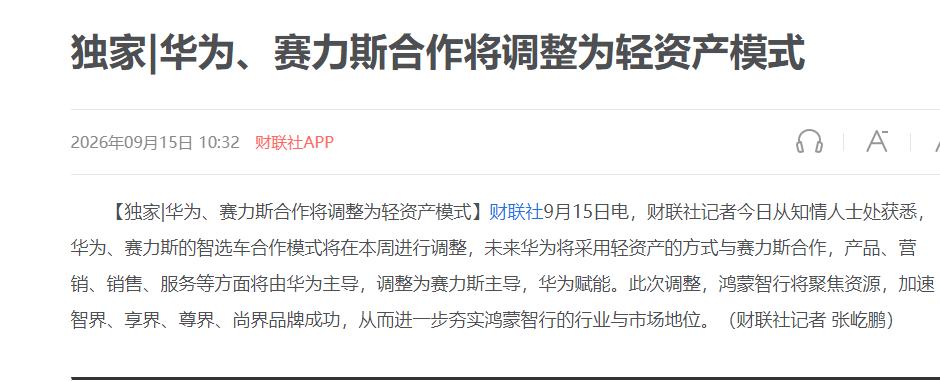
Yicai Global later cited people familiar with the matter to reveal more details: Seres will adopt a new "exclusive franchising" model, with the AITO sales channels operating independently. Some of the original Harmony Intelligent Mobility stores will be transferred to Seres, which will only display and sell AITO models, and its high-end luxury positioning will remain unchanged. The insiders also emphasized that Huawei will not withdraw, and AITO is still part of the Harmony Intelligent Mobility system, still one of the "Five Jie" brands.
That afternoon, Harmony Intelligent Mobility released an official statement: AITO remains a member of the Harmony Intelligent Mobility family, and users' existing rights and subsequent services will not be affected.
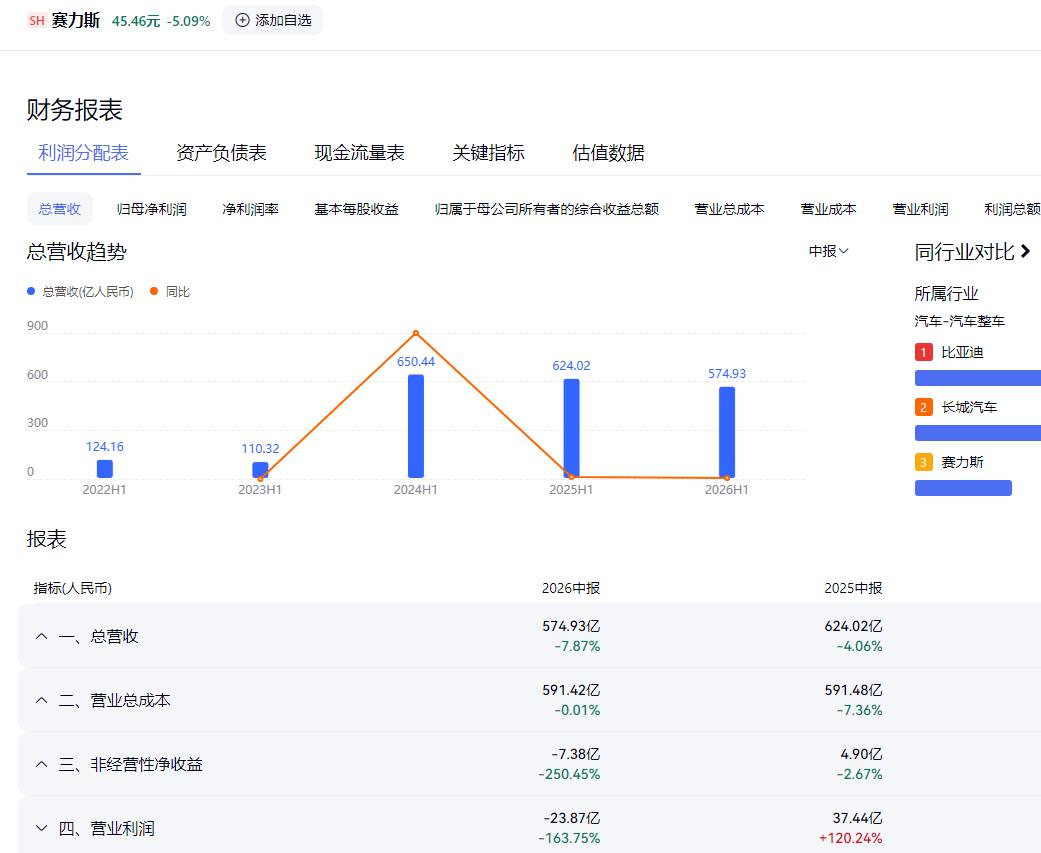
Both sides are downplaying the "breakup" narrative, but the market has voted with its feet. On September 15, Seres' A-shares closed down 5.09% at 45.46 yuan. In the past year, its market value has evaporated by nearly three quarters.
This is the most in-depth reconstruction of rights and responsibilities since the launch of the smart selection vehicle cooperation in 2021. Over the past five years, Huawei has led product development, marketing, channels and services, while Seres was nearly a contract manufacturer; now the order has been reversed. Why now? What do both parties seek? What are the challenges after the handover?
An unbalanced account: Why Seres is determined to take back the leading right
The most direct motivation is cost saving.
According to the 2026 interim report disclosed on August 20, Seres turned from profit to loss. Its revenue in the first half of the year reached 57.493 billion yuan, down 7.87% year on year; the net profit attributable to shareholders was 17.17 billion yuan in loss, compared with a profit of 29.41 billion yuan in the same period last year. Among them, the loss in the second quarter alone was 24.71 billion yuan, and 18.62 billion yuan of impairment was accrued, mainly for phasing out old non-patented technologies and terminating some development projects, with about 17.7 billion yuan concentrated in the second quarter.
There are objective reasons on the cost side. Chairman Zhang Xinghai once publicly calculated accounts in June: the unit price of memory chips rose from 20 yuan to nearly 100 yuan, lithium carbonate rose from 80,000 yuan per ton to 180,000 yuan, and the cost of one AITO vehicle increased by 15,000 to 20,000 yuan.
But what is more striking is the expense side. In 2025, Seres' sales expenses reached as high as 241.9 billion yuan, up 26.1% year on year, of which advertising, image store construction and service fees accounted for 229.5 billion yuan, accounting for 94.9%. The sales expense ratio was 14.65%, with the absolute amount exceeding that of SAIC Motor and approaching that of BYD, while Seres' revenue is only 1/4 to 1/5 of the two. Where did the money go? AITO vehicles are mainly sold in Huawei stores, and a considerable part of this sales service fee flows to Huawei's channels, which some media call the "toll" paid for access to the channels.
Let's look at another set of more controversial figures. According to Seres' Hong Kong stock prospectus, from 2022 to the first half of 2025, the company's procurement amount from its largest supplier (widely recognized by the market as the Huawei system) was 58 billion yuan, 72 billion yuan, 420 billion yuan and 200 billion yuan respectively, totaling about 750 billion yuan. The proportion in total procurement rose all the way from 14.5% to 30.2%, and further rose to 33% in the first half of 2025. This is a disclosed fact. However, Observer.com reminds that this 750 billion yuan is calculated based on the transaction of goods and services, including the supplier's own cost, which is not equal to the profit earned by Huawei.
The pressure on the expense side is also obvious. In the first half of 2026, Seres' sales expenses reached 84.7 billion yuan, eating up more than 60% of the total gross profit of 134 billion yuan in the current period.
As for the widely circulated sharing ratio of "8% marketing channel fee plus 2% technology licensing fee" and the estimation that "about 136,000 to 141,000 yuan flows to Huawei for each AITO vehicle sold", they are all estimated by media and institutions according to conventions, and have never been disclosed in official documents. Seres clearly stated in its prospectus that there is "no profit-sharing arrangement with Huawei". The two calibers should be viewed side by side, and no unilateral statement is a final conclusion.
Putting aside the dispute over calibers, the direction is clear: channels and marketing are one of the biggest cost drain points, and the most direct motivation to regain leading right is to save costs and improve profitability.
Apart from cost, there is also the right to operate independently.
Seres is no longer holding empty cards. In 2024, the company spent 2.5 billion yuan to acquire 919 AITO series trademarks and 44 design patents from Huawei; it also invested 115 billion yuan in cash to take a 10% stake in Huawei's automotive BU spin-off Changan New Energy Technology, and completed all payments in September 2025. In November 2025, Seres was listed on the Hong Kong Stock Exchange, raising a net proceeds of 14.016 billion Hong Kong dollars, about 20% of which was invested in diversified marketing channels and overseas markets. The intention to build self-operated channels is clearly written in the use of raised funds. The AITO brand belongs to Seres at the legal level, and is deeply bound to Huawei at the capital level: the foundation for independent operation was laid two years ago.
Next is the overall industry trend.
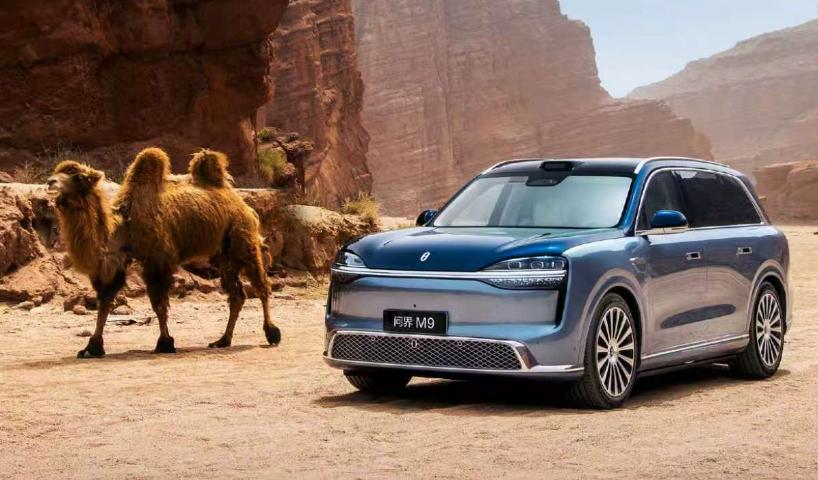
Huawei's technology is being "democratized". Qiankun Intelligent Driving and HarmonyOS Cockpit are no longer exclusive to AITO. In April 2026, the all-new AITO M9 was launched together with Qijing GT7 and Yijing X9, all equipped with Huawei's latest technology. More than 60 models are equipped with Huawei's intelligent driving system, covering price ranges from 150,000 yuan to millions of yuan. The exclusivity that AITO once enjoyed has become the industry standard.
The diversion of the "Five Jie" brands is also intensifying. The proportion of AITO in the total sales of Harmony Intelligent Mobility dropped from nearly 90% in 2024 to about 67% in the first half of 2026, and only about 45.5% in July. Shangjie, Zhijie and Xiangjie are all competing for booth space and traffic in Huawei's stores. Continuing to let Huawei lead the operation is rapidly losing cost-effectiveness.
Finally, there are signals that have been put on the table.
Insiders revealed that the negotiations between the two sides have been going on for one or two months, and the facelifted models have been delayed from launch. The sales figures can confirm this: the year-on-year growth of Seres' wholesale vehicle sales dropped from 10.29% in April, all the way to a 50.86% year-on-year decline in July and a 49.68% year-on-year decline in August, almost halved. In March this year, owners of the 2026 AITO M7 launched a rights protection campaign against the brand after the new model was equipped with an 896-line lidar, exposing the dispute over the leading right of product definition and launch rhythm. Rather than being diluted and delayed, it is better to operate independently.
Each takes what they need: Why Huawei is willing to let go
Many people interpret this adjustment as "Huawei abandoning Seres", which is a misreading.
Huawei has emphasized from the very beginning that it does not manufacture vehicles, and its positioning is an incremental component supplier and ecological platform. The spin-off of its automotive BU into Changan New Energy Technology with open equity is the implementation of this strategy. Letting Seres lead the heavy operation of AITO is exactly in line with its original positioning of asset-light and platform building.
More realistically, Huawei's business map has long gone beyond AITO. Seven brands under the "Five Jie" and "Two Jing" systems are queuing up for resources, and Huawei can no longer put all its energy on AITO. According to the report of CLS, the statement from Harmony Intelligent Mobility is very straightforward: focus resources to accelerate the success of the other four Jie brands.
There is also an efficiency account to calculate. The channels, marketing and services of AITO are labor-intensive and operation-heavy, which previously occupied a large amount of resources of Huawei's terminal system. By returning these to Seres, Huawei can replicate its manpower and traffic to more partners, and serve five "Jie" brands at the same time.
And the interests of both sides have long been deeply bound. Seres is already a shareholder of Changan New Energy Technology, whose equity structure is 80% held by Huawei, 10% by Avatr and 10% by Seres, and Zhang Xinghai has a seat on the board of Changan New Energy Technology. Changan New Energy Technology also has strong performance: Huawei's automotive BU achieved a revenue of 263.53 billion yuan in 2024, up 474.4% year on year, and made a profit for the first time in the whole year. With interests bound to such a depth, Huawei is assured to hand over the operating right.
So it is inaccurate to call it a breakup, which is more like a redistribution of rights, responsibilities and interests. AITO is still within the Harmony Intelligent Mobility system, and user rights and technical support are backed by official statements; but in the past, it was "Huawei acting as the full agent" and Seres was nearly a contract manufacturer, now Seres is upgraded to the brand manager, and starts to take the operating risks of the whole vehicle. Power and profits are transferred together, and risks are also transferred together. The equity structure of "you have me in you" determines that the two sides will not really fall out: when Huawei develops the other four Jie and two Jing brands well, the valuation and profit of Changan New Energy Technology will rise, and Seres' 10% stake will benefit from it.
The real variable to watch is how the per-vehicle profit sharing rule will change. Insiders revealed that the per-vehicle profit sharing will also change, which directly determines two things: whether Seres can turn losses into profits, and the intensity of Huawei's subsequent investment. This is a double-edged sword: Seres pays less, and its short-term profit statement will look better; but if Huawei's technical, traffic and channel support decline synchronously, AITO may lose more than it saves. The sharing terms are the most noteworthy part of the new agreement.
After taking over the leading right: Three major challenges
First, can it take over the channels properly?
Channels, marketing and services are asset-heavy and operation-heavy businesses. Over the past five years, Seres has almost completely relied on more than 700 Huawei stores and the complete marketing system, while it has only built 380 exclusive AITO user centers. The "exclusive franchising" model means building or taking over a complete set of channels, which requires large investment, long cycle and cannot see returns in the short term. Although the company's cash reserve is 731.48 billion yuan, accounting for 57% of the total assets, which is a solid foundation, its monetary funds in the first half of the year have decreased by 353.6 billion yuan, from 872.87 billion yuan at the beginning of the year to 519.30 billion yuan. The cost of channel reconstruction will directly put pressure on this thinning cash account.
Then, can consumers still recognize the AITO brand?
The high-end premium of AITO is highly dependent on Huawei's endorsement. When consumers walk into the stores, they recognize the "Huawei Smart Selection" label, Yu Chengdong's endorsement, and the first-mover advantage of Qiankun Intelligent Driving. After Huawei steps back to the supporting role, can "AITO led by Seres" still support the pricing of 400,000 or 500,000 yuan? This is a more difficult proposition than channel reconstruction, because it tests the trust of consumers.
The most realistic question: Can it make profits?
When the interim report just turned into loss and sales volume almost halved, superimposed with channel reconstruction and renegotiation of sharing terms, whether it will clear all the pressure at one time or make the situation worse depends on two things: the ramp-up speed of new facelifted models including the all-new M9, M6 and upgraded M7, and the implementation rhythm of the new model. CICC judges that the second quarter is the low point of the annual performance, and the performance will improve quarter by quarter afterwards; BOCOM International has lowered its 2026 net profit attributable to shareholders forecast to 880 million yuan. Whether these judgments can be realized will be seen in the next two quarters.
Huawei does not intend to abandon Seres, and Seres is far from being strong enough to operate completely independently.
This is a belated redistribution of rights, responsibilities and interests after the smart selection vehicle model has developed to the large-scale stage. AITO has changed from "Huawei's show room" to "Seres' own business and future". The leading right is handed over by Huawei, and it is also actively claimed by Seres itself.
The real exam has only just begun on September 15: Seres, which has taken over the leading right, needs to prove that it is no more than a contract manufacturer.
This article is from WeChat official account "Qidian Pai", written by Li Yan, and authorized by 36Kr for release.