China Resources still cannot shake Sinopharm's throne as the top player in the blood products industry.
The leading player in the blood products sector has obtained approval for new plasma collection stations.
Tiantan Biological recently announced in a public notice that four single plasma collection stations under Sinopharm Lanzhou, its holding subsidiary, have officially obtained the *Single Plasma Collection License* issued by the Health Commission of Gansu Province, and are approved to carry out single plasma collection business.
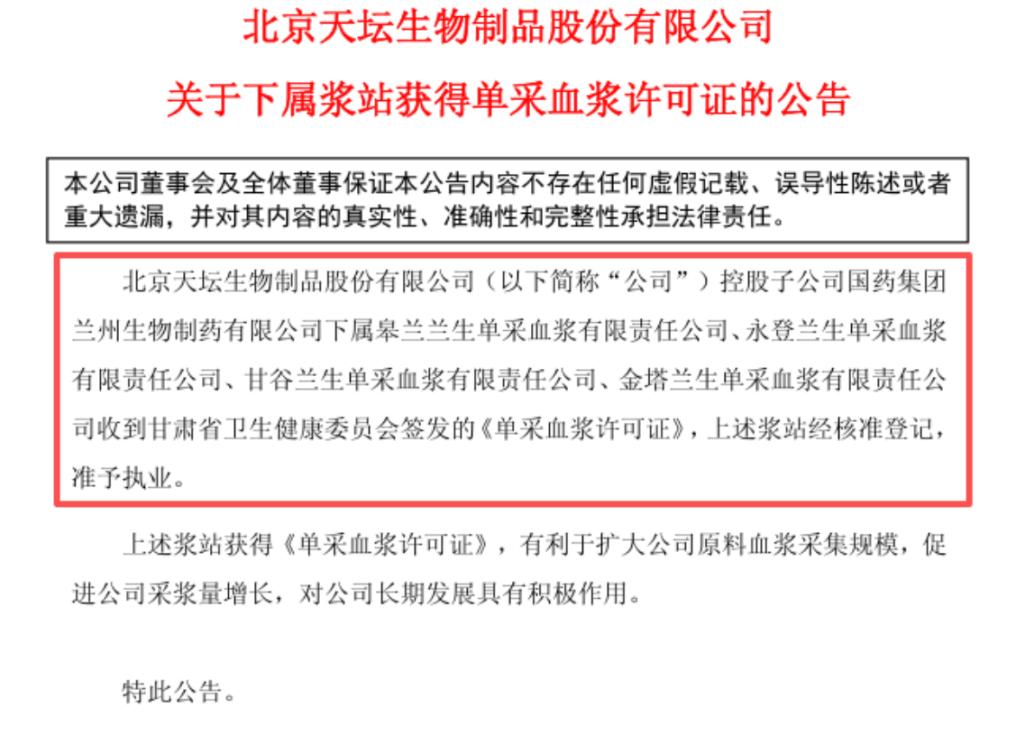
Screenshot from the company's public announcement
In addition to the Sinopharm system continuously expanding its raw plasma supply, the China Resources system, which has access to central SOE resources, is also ramping up its layout of blood product raw materials. As the core blood product platform of China Resources, Boya Bio obtained the practice license for the single plasma collection station in Dalat Banner, Inner Mongolia in July this year, launching a new plasma source in western Inner Mongolia.
By comparing the large-scale expansion of Tiantan Biological's raw material base in Northwest China, we can see that: Sinopharm is concentrating on obtaining the eligible county-level quotas that meet the planning in its long-established home market; China Resources Boya is looking for counties with remaining development space in peripheral regions.
China Resources entered the blood products track through mergers and acquisitions in its early years, and filled the gaps in industrial licenses and production capacity relying on central SOE capital. However, capital cannot quickly break through the core barrier of plasma raw materials. The industry implements the hard rule of "one county, one station", and the county-level plasma station quota is a non-renewable scarce resource.
Capital can acquire listed companies and expand production lines, but it is difficult to quickly replicate the plasma station network that has been accumulated for decades. In the medium and long term, China Resources can hardly shake Sinopharm's leading position.
01. Further expansion of the layout network
Seeing that Tiantan Biological has been approved for four licenses in Gaolan, Yongdeng, Gangu and Jinta at one time in Gansu, many people's first reaction is that "Sinopharm is seizing territory in Northwest China". In fact, the Northwest is not a new battlefield for Tiantan Biological, but an old base that it has operated for many years.
The 30 Lansen system plasma stations publicly displayed on Tiantan Biological's official website have already spread all over Gansu, with stations in Zhangjiachuan, Jingtai, Gulang, Linxia, Yongjing and other places forming a connected grid layout, covering most counties and districts in the province suitable for plasma collection.
The four newly approved stations this time also belong to Lanzhou Biological's integrated platform, which is a further supplementary point and expansion of its original layout.
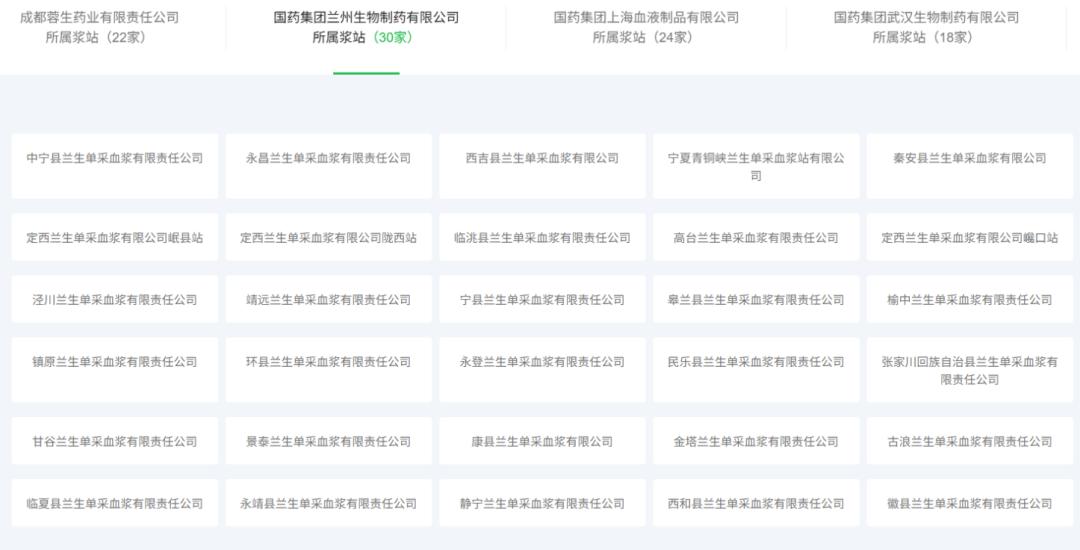
Screenshot from the company's official website
In the Ningxia market, Tiantan's system has also achieved in-depth layout, and Lansen plasma stations in Zhongning, Qingtongxia and other locations have been operating stably for many years. Relying on the dense plasma station network in Gansu and Ningxia provinces, Lanzhou Biological has built a complete closed-loop industrial chain of county-level plasma collection, centralized production and regional supply.
Shaanxi, on the other hand, is a market segmented by multiple players, with Sinopharm Tiantan having mature operating stations in Baishui, Fuping and other places; Xinjiang is exclusively dominated by local enterprises, forming a relatively closed regional pattern.
In contrast, Boya Bio of the China Resources system has no legally operating plasma stations in the entire Northwest region for a long time, with no foundation of localized operation or accumulation of plasma donation resources. If it wants to enter the market, it can only start from scratch.
The most core hard rule in the blood products industry is "one county, one station, total volume control". The county-level plasma station quota is a non-renewable scarce policy resource, and only one single plasma collection station is allowed to be established in one county.
With the four stations in Gansu obtaining licenses this time, Sinopharm Tiantan has taken in the remaining high-quality county quotas in the province that meet the planning and have plasma collection potential, raising the entry threshold for external players.
The approval of new stations is only the starting point, and there is generally a 1-3 year production capacity ramp-up period in the industry. Sinopharm has been deeply rooted in the Northwest for decades, and this regional industrial ecology formed over time is the core barrier that cannot be quickly achieved through capital mergers and acquisitions, nor easily replicated by short-term capital investment.
In comparison, China Resources Boya obtained the practice license for the plasma station in Dalat Banner, Inner Mongolia in July this year. This is also the first plasma station launched by the China Resources system in Inner Mongolia. The project obtained the approval for preparation in early 2025, and completed the acceptance and license acquisition after a year and a half. It is a single-point pioneering project starting from scratch in western Inner Mongolia, and will go through a long ramp-up period in the follow-up stage.
The moat in the Northwest is only a part of Sinopharm's advantages. What truly widens the gap between the two central SOEs is the absolute plasma collection volume brought by its nationwide large-scale plasma station layout.
02. Steadily occupying the leading position in the industry
In the blood products industry, raw plasma is the ceiling of production capacity. All products, production capacity and profits are ultimately restricted by the total plasma collection volume.
Although latecomers can quickly enter the market through capital mergers and acquisitions, there are obvious shortcomings in the endogenous plasma collection expansion speed, and it is unlikely to close the gap with leading enterprises in the short term.
Relying on the years of accumulation of Sinopharm China Biotech, Tiantan Biological operated 85 plasma stations in 2025, collecting 2801 tons of plasma across 16 provinces and regions, accounting for about 20% of the domestic market share. In the same year, there were more than 300 operating single plasma stations in the whole industry, with a total plasma collection of about 14,000 tons, and the growth rate has dropped from 10.9% in 2024 to around 5.6%.
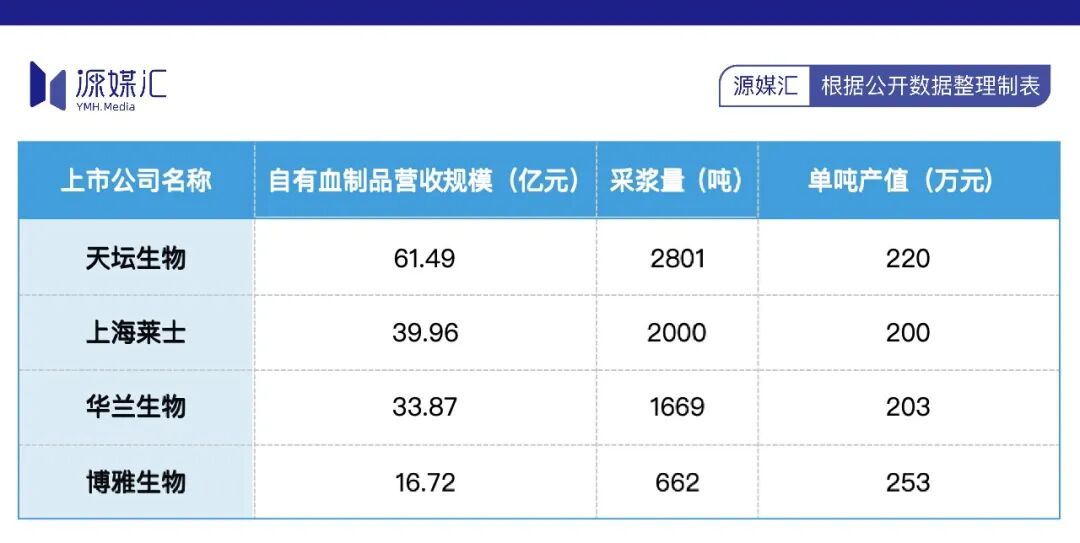
That is to say, the whole industry is gradually entering a stage of "tight balance and low growth".
In addition, Tiantan Biological not only has a large number of plasma stations, but also continues to build new ones - there are still 22 stations under construction at the end of 2025, which will form a compound increment of "stable output of old stations + year-by-year ramp-up of new stations" after they are put into operation in the future.
In comparison, China Resources Boya's consolidated plasma collection reached 662 tons in 2025, including 542 tons from China Resources Boya itself and 120 tons from Green Cross; calculated based on 20 operating plasma stations at the end of 2025, the plasma collection volume per station is about 33 tons.
However, Green Cross was included in the consolidated scope through previous mergers and acquisitions. In other words, the important starting point for China Resources to expand its scale is "buying nonstop". But mergers and acquisitions can only solve the starting point, not the time cost.
Industry experience shows that from obtaining the license to reaching stable production capacity, plasma stations need to complete the filing of plasma donors, carry out health education, and cultivate the habit of continuous repeated donation. The production capacity ramp-up is usually calculated on an annual basis.
Even if China Resources acquires regional blood product enterprises in the follow-up to push the plasma collection scale to the 1,000-ton level in the short term, it still needs to continuously find suitable acquisition targets, stabilize the plasma collection volume of original stations in the stage of asset integration, and ensure the smooth implementation of new stations if it wants to catch up with Tiantan Biological's volume. The whole set of operations is far more difficult than just paying for acquisitions.
However, the competition in the blood products industry does not only depend on the tonnage of plasma collected. The value that can be released from the same ton of plasma after being processed through different processes and product pipelines is also different.
03. China Resources' attempt to achieve curve overtaking
The year-on-year growth rate of national plasma collection volume exceeded 5% in 2025, and the overall raw material supply is steadily expanding, but the core rigid-demand varieties still rely heavily on imports. Among them, the domestic proportion of human serum albumin is only 35%, and nearly 60% of the market is still occupied by imported products.
Under the general tone of continuous policy emphasis on medical autonomy and controllability, a series of measures such as tariff adjustment and R&D progress of recombinant albumin are defining independent plasma resources as national-level strategic assets, and domestic substitution has become the long-term main line of the industry.
Tiantan Biological's goal of reaching 3,000 tons of plasma collection in 2026 is to undertake the task of "autonomy of basic large varieties" with its scale; the volume sales of albumin and intravenous immunoglobulin can not only ensure supply, but also act as a buffer when imports fluctuate.
But the problem is that when the volume goes up, the price may not follow.
In recent years, the combination of medical insurance cost control, DRG/DIP payment reform and the expansion of local volume-based procurement has made hospitals more cautious in prescribing basic large varieties such as albumin and intravenous immunoglobulin. Under the demand of hospitals to control costs, both the purchase price and usage volume of basic blood products are under pressure.
Misfortunes never come singly. Since January 2026, the 3% simplified levy preference for biological products has been fully withdrawn. Except for rare disease varieties such as human coagulation factor VIII, mainstream blood products are uniformly subject to 13% general tax calculation. The direct rise in tax burden has also had a significant impact on corporate profits.
Tiantan Biological's plasma collection volume still maintained positive growth in the first half of 2026, but it fell into the situation of "volume growth without profit growth". Data from Tianyancha shows that under the dual squeeze of falling product prices and the tax reform policy, the enterprise's profit side is under significant pressure, with a year-on-year decline of more than 50%.
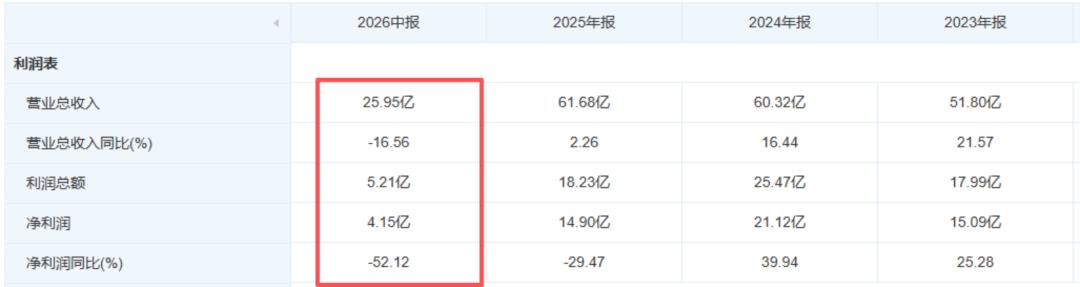
Screenshot from Tianyancha
In contrast, China Resources Boya did not choose to compete head-on in the basic variety track, but made precise dislocation and focused on high value-added pipelines. Its product matrix covers 10 varieties in three categories, focusing on high-value tracks such as fibrinogen, factor VIII, prothrombin complex and 10% chromatographic intravenous immunoglobulin, avoiding the red-hot internal competition in the albumin market.
Relying on the layout of high-end varieties, China Resources Boya has been able to keep the output value per ton of plasma and gross profit margin steadily at the forefront of the industry.
The two central SOEs have formed two completely different survival logics: Sinopharm Tiantan bets on the foundation of plasma sources to hold the basic market of national plasma supply; China Resources Boya deeply cultivates plasma deep processing, and taps the profit potential of each ton of plasma through high value-added products.
The competition in the blood products track is not a zero-sum game where one side wins and the other loses. Ranked by the tonnage of plasma collected, Tiantan firmly occupies the industry throne; if judged by the deep processing value of plasma, China Resources has blazed its own path in the high-end track.