What are the private enterprises in China that invest the most heavily in R&D doing?
To see how a company makes money today, you can look at its revenue.
But if you want to know what it plans to rely on to make profits in three to five years, R&D investment may be a more worthy indicator to observe.
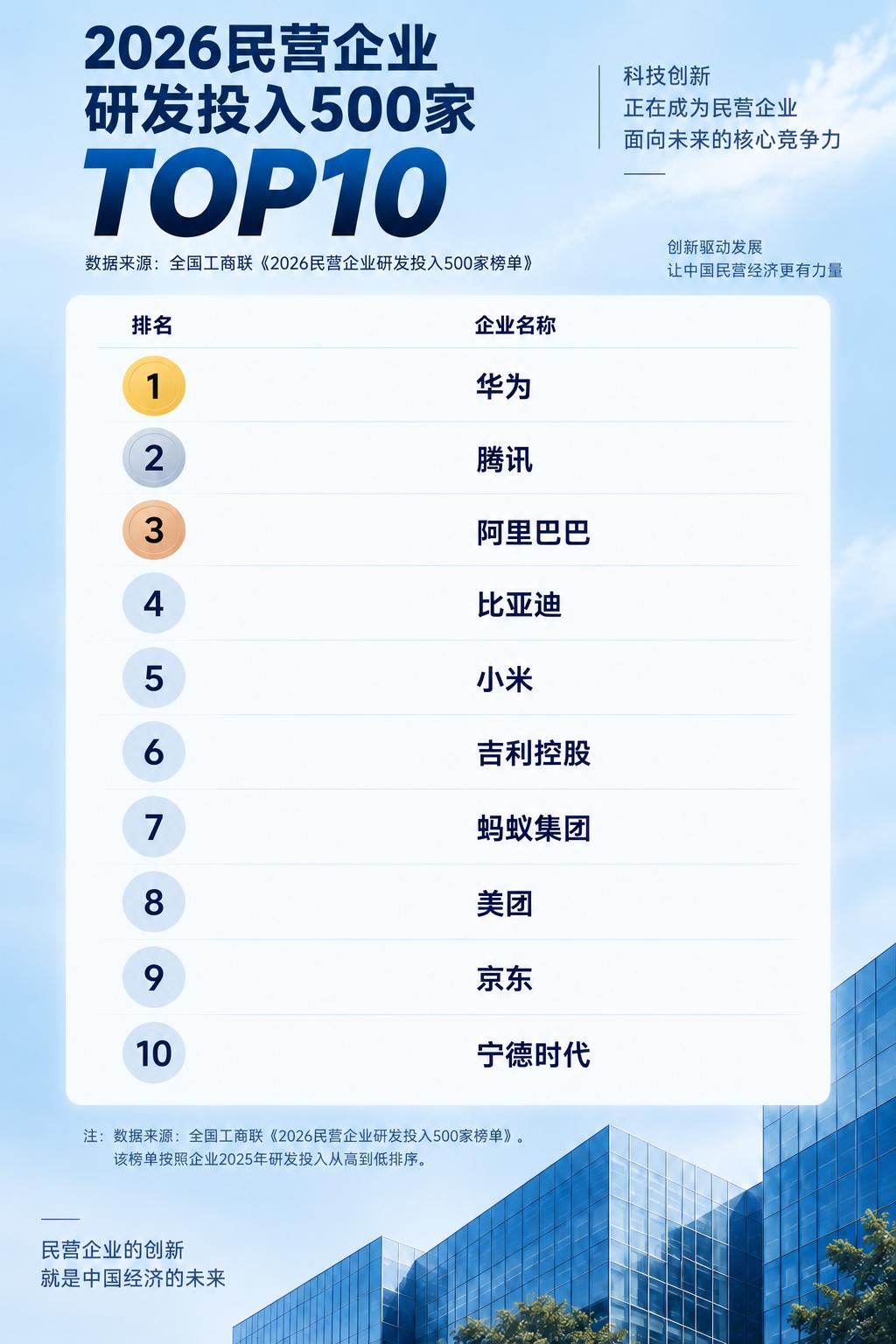
On September 9, the All-China Federation of Industry and Commerce released the 2026 list of top 500 private enterprises by R&D investment. Huawei, Tencent and Alibaba ranked the top three, and high-end manufacturing enterprises including BYD, Xiaomi, Geely and CATL also entered the top 10.
In 2025, the top 1000 private enterprises in terms of R&D investment spent a total of 1.59 trillion yuan, a year-on-year increase of 10.72%.
Where is this growing sum of money being spent?
R&D is spreading to more industries
On the evening of September 6, Wang Chuanfu, Chairman of BYD, took out a thumb-sized battery at an event at the University of Science and Technology of China and said, "This is the battery product from BYD's early entrepreneurial days, and it is also the starting point of BYD's technological innovation journey."
Starting from a small battery, BYD now has more than 120,000 R&D personnel, with cumulative R&D investment exceeding 270 billion yuan. Its R&D investment in 2025 alone reached 63.4 billion yuan, accounting for 7.89% of the annual revenue.
At the same time, BYD has filed more than 71,000 patent applications in total and obtained over 42,000 authorized patents, forming the "technology fish pond" worth trillions of yuan as described by Wang Chuanfu.
Three days later, on the 2026 list of top 500 private enterprises by R&D investment, BYD ranked fourth, following Huawei, Tencent and Alibaba.
From a thumb-sized battery to spending more than 60 billion yuan a year on R&D, BYD is a microcosm of the changes in China's corporate R&D landscape.
In the past, when people talked about R&D, the first things that came to mind were chips, aircraft and aircraft carriers. Nowadays, the automotive industry has become one of the industries with the heaviest R&D investment, and more and more manufacturing enterprises are beginning to become major R&D players.
Among the top 1000 private enterprises in terms of R&D investment in 2025, 785 are manufacturing enterprises, with a total R&D expenditure of 1.12 trillion yuan.
Take Midea for example. Many people still associate it with air conditioners, refrigerators and washing machines, but this company is far more than a home appliance enterprise. In 2025, Midea's R&D expenditure was close to 17.8 billion yuan, with more than 23,000 R&D personnel. Its business has expanded from smart home to industrial technology, building technology, robotics and automation, new energy and other fields.
The construction machinery industry is the same. In the past, an excavator competed more on horsepower, reliability and durability. Now enterprises such as Sany have extended their R&D to intelligent control, unmanned operation and digital construction. On the reconstruction and expansion project of the Beijing-Harbin Expressway, Sany's unmanned paving and rolling fleet worked continuously for more than 480 hours, with 2 pavers and 10 rollers operating fully unmanned.
Even the sewing machine has changed. Ruan Jixiang, Chairman of Jack Technology, once gave an example: In the past, a new employee might need several months of training to operate a sewing machine; after the company launched the world's first AI sewing machine in September 2025, employees can get started in just 3 hours.
This company has developed from traditional sewing equipment to industrial software, AI and robots. This year, Jack Technology has conquered automation technologies such as piece separation, grasping and placement, and is promoting humanoid robots to enter garment factories.
Ruan Jixiang put it frankly, "Although we are in a traditional industry, we must embrace new technologies."
When air conditioners are connected to AI, excavators are required to realize unmanned operation, and sewing machines also rely on software and algorithms to improve efficiency, the technical content behind many traditional products is increasing rapidly.
In the past, enterprises competed more on scale, channels and costs. Now they also have to compete on who can integrate technology into products and deploy it in factories faster. R&D is evolving from the core competence of a small number of technology companies to the daily practice of more and more leading enterprises.
Where is the money flowing?
R&D is entering more and more industries, but the higher you look up the ranking list, the more concentrated the direction of capital investment becomes.
Several terms appear particularly frequently: AI, chips, computing power, software, new materials.
Huawei is a typical example. Last September, at the Huawei Connect event held in Shanghai, Xu Zhijun, Rotating Chairman of Huawei, spent a lot of time talking about one thing: computing power.
He said, "Computing power has been, and will continue to be, the key to artificial intelligence." Subsequently, Huawei announced its Ascend AI chip roadmap for the next three years and new super-node products.
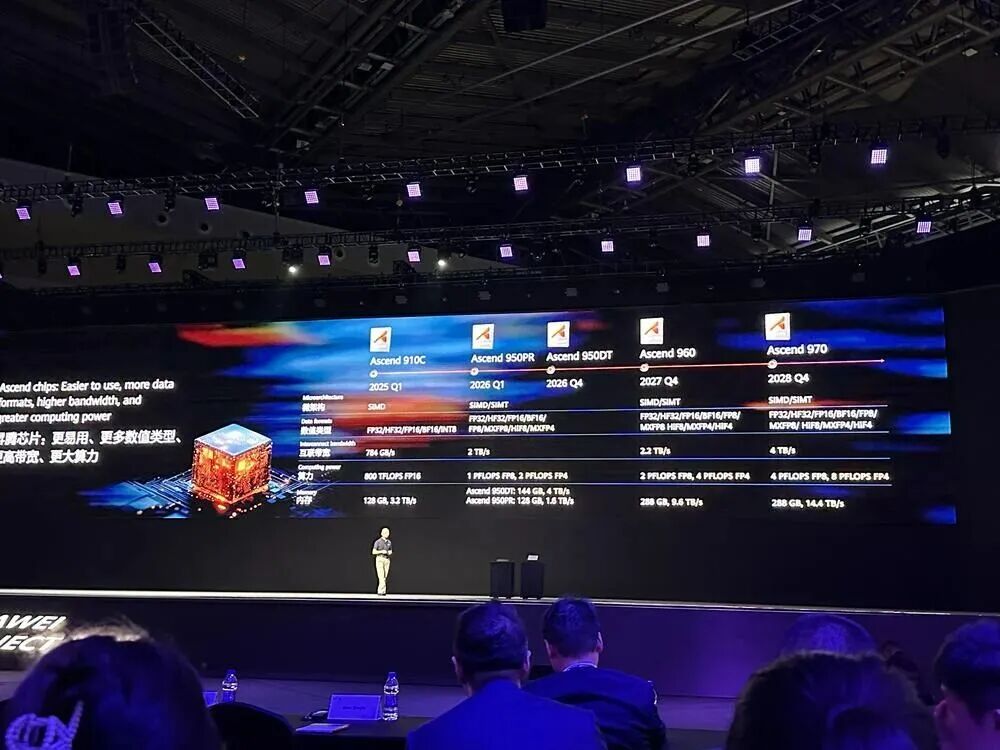
Today's Huawei is far more than researching mobile phones and communication equipment. Its Ascend and Kunpeng series go deep into chips and computing, it has Hongmeng as its operating system, and its business also extends to cloud, AI and intelligent driving. In 2025, Huawei's R&D investment reached 192.3 billion yuan, and its cumulative R&D expenditure in the past ten years exceeded 1.38 trillion yuan.
Alibaba is also moving deeper in this direction.
At the earnings call in February 2025, Wu Yongming, CEO of Alibaba Group, used a vivid metaphor: If AI is like "electricity" in the future, then the cloud computing network is like the "power grid".
A few days later, Alibaba announced that it would invest more than 380 billion yuan in the next three years to build cloud and AI hardware infrastructure, with the total amount exceeding the sum of the past ten years.
In the past, Internet companies were best at developing applications such as e-commerce, payment and search, which were very close to consumers. But the further AI develops, the more inseparable it is from chips and computing power, and behind computing power are servers, storage, networks and data centers.
As a result, Internet companies that used to be relatively "light" have begun to engage in more and more "heavy" businesses.
On the other hand, new materials have also become a direction for heavy investment.
When CATL released its first generation of sodium-ion batteries in 2021, Zeng Yuqun, Chairman of CATL, compared electrochemistry to an "energy magic cube", saying that in this field, "the unknown far outweighs the known".
After several years of development, CATL has continued to explore new materials and technical routes such as sodium electricity based on the mature lithium battery system. In April this year, Zeng Yuqun said another sentence: "For CATL, R&D investment is not a cost, but the ability to go through cycles."
It is not only committed to optimizing existing batteries, but also exploring what materials and technical routes will be adopted for the next generation of batteries.
Some companies whose scale is far smaller than these giants are also betting on similar technical directions.
Axera, which entered the 2026 list of top 500 private enterprises by R&D investment this year, focuses on AI inference chips. According to the company's disclosure, in the first half of 2026, its revenue was 402 million yuan, while its R&D investment reached as high as 516 million yuan, far exceeding the revenue of the same period.
Wynca has long been engaged in agrochemicals and silicone, and is now moving towards higher-end new materials. It is extending silicon-based materials to new scenarios such as semiconductors, robots and new energy vehicles. Some of its products have been commercialized, but many businesses are still in the verification and cultivation stage.
Putting these enterprises together, you will see an increasingly clear chain. AI requires computing power, computing power is supported by chips, and the further upgrading of chips is inseparable from materials and manufacturing processes. When automobiles and batteries move towards intelligence, they will also encounter software, algorithms and new materials.
Therefore, enterprises that used to seem far apart are now converging more and more. Their products can be completely different, but the key technologies that determine the next round of competition are becoming more and more similar.
This is also the area where leading enterprises are most willing to spend money.
How important is R&D?
In May 2025, at Xiaomi's 15th anniversary launch event, Lei Jun, Chairman of Xiaomi, specifically talked about how difficult it is to develop chips when introducing the Ring O1.
Xiaomi started developing mobile phone chips in 2014. After the first round of exploration, it restarted large-scale chip R&D in 2021 and set a long-term plan of investing at least 50 billion yuan over 10 years. By the end of April 2025, the cumulative R&D investment of the Ring project alone had exceeded 13.5 billion yuan.
Lei Jun said at that time, "No matter how many difficulties lie ahead, Xiaomi will never give up."
It is easy to understand when looking at Xiaomi today. Its most important label used to be mobile phones, but now automobiles have become its new business, and it continues to invest in fields such as chips, operating systems, AI and intelligent driving. The mobile phone market has long entered a mature competition stage, and new businesses such as automobiles and chips are becoming the growth space that Xiaomi is seeking for the next decade.
Thus, R&D is increasingly like a ticket to new businesses.
But the reasons why enterprises heavily invest in R&D are not exactly the same. Some are to seek new growth, some are to transform old businesses, and some industries have to prepare in advance for many years later.
Meituan is seeking new growth. Taking food delivery and local life services as its core business, it extends R&D to AI, unmanned distribution, drones and robots, and these technologies are also exploring possibilities for new businesses in the future.
JD is more like using technology to redevelop its old businesses. As of the second quarter of this year, the Zhilang goods-to-person system has been applied in more than 60 warehouses around the world.
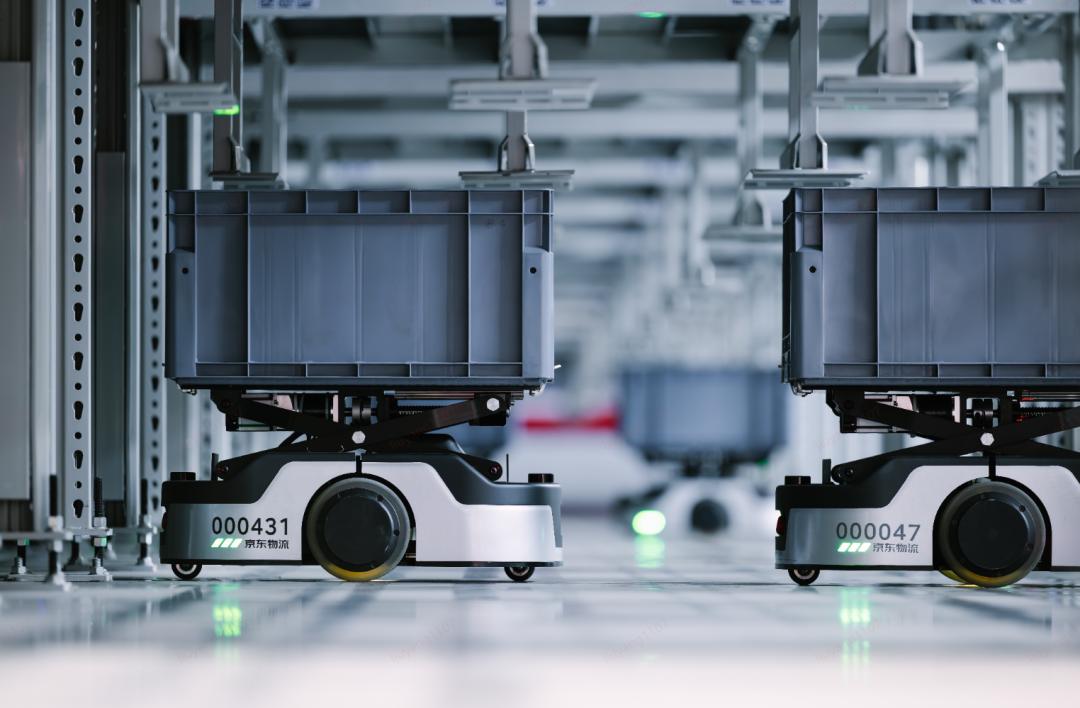
In the first overseas Zhilang warehouse in the UK, nearly 200 robots are responsible for picking and transporting goods, and then delivering the goods to the operators. In the past, people looked for goods in the warehouse, but now the goods are actively delivered to people.
For the retail and logistics industry, technology sometimes does not create new categories, but only reduces the handling times of a package and speeds up inventory turnover. But when the order scale is large enough, every bit of efficiency improvement will eventually turn into real money.
The pharmaceutical industry follows another logic. Hengrui Medicine, which ranks 27th on the list, invested 8.724 billion yuan in R&D throughout 2025, accounting for nearly 30% of its revenue. From early research to clinical trials and final approval, innovative drugs often take many years and face a high risk of failure.
Therefore, for such enterprises, R&D can hardly stop. The drug pipelines that are continuously advanced today may determine whether there will be new products in a few years.
Going a step further, enterprises even begin to actively engage in basic research.
On September 9, 17 private enterprises including Tencent, Geely, Xiaomi, CATL, Yili and Chint jointly launched the "Wenzhou Initiative on Strengthening Basic Research by Private Enterprises" in Wenzhou, proposing to increase the proportion of basic research funds year by year.
Nan Cunhui, Chairman of Chint Group, said on the spot, "Without breakthroughs in basic theories, industrial innovation is like water without a source."
Chips, basic models, robots, new materials and innovative drugs all share the common features of large investment, long cycle and uncertain results. But precisely because of this, only enterprises that can maintain continuous investment have the opportunity to gradually build up their technical barriers.
Of course, more R&D investment does not necessarily mean better results. Whether the money can be converted into technology, whether the technology can be converted into products, and whether the products can finally generate new revenue, determines whether the money is well spent.
Therefore, looking back, what is really worth paying attention to in this 2026 list of top 500 private enterprises by R&D investment is not just the ranking, but where these enterprises are placing their bets.
There is no doubt that in a few years, some of the bets on this list will become the new ranking of the industry.
This article is from the WeChat Official Account "Huashang Taolue" (ID: hstl8888), the author is Huashang Taolue, and it is released with authorization from 36Kr.