It only takes 24 hours to develop an AI mini-game, and who will distribute it has become the biggest challenge.
Over the past two weeks, college student Xi Yang has been using AI to create mini-games at a pace of nearly one per day.
Prior to that, Xi Yang had no experience at all in making games with AI. But with the help of AI programming tools, Xi Yang has now developed dozens of AI mini-games such as "English Handheld Console", "Mini-game Version of Fire and Water in the Forest", and "Detective Reasoning".
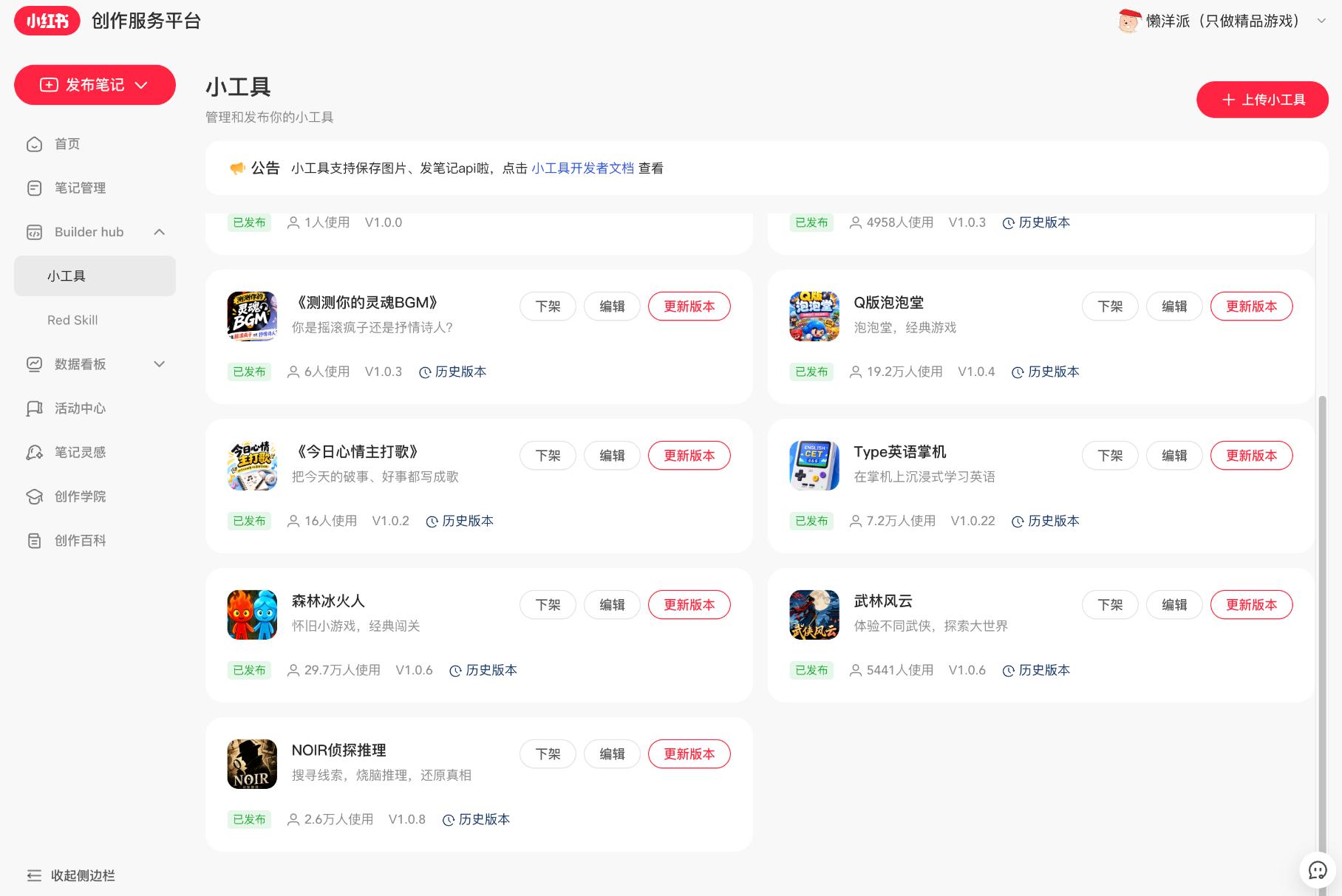
Games published by Xi Yang on the "Mini Tools" section of Xiaohongshu. Source: Provided by the interviewee
The iteration speed after game development is also accelerating. Li Xinlei, the author of the AI mini-game "Azhu's Live Stream of Opening Oysters", told Jiemian News that some of the changes she made based on players' suggestions after the game went live "sometimes only take 3 hours to complete and launch".
Today, it is no longer a novelty for ordinary people to make their own mini-games with AI Vibe Coding. A number of platforms are also trying to integrate game generation, iteration and release into a single product suite, allowing users to describe their ideas in natural language and get a playable game prototype directly.
On January 30, 2026, TapTap launched "TapTap Create", an AI game creation agent that allows users to describe game ideas in natural language, with AI completing code, art, music and other content. Domestic startups have also begun to enter this field. Positioned as an AI interactive content co-creation platform, Funloom AI allows users to generate AI text games by entering text settings. According to 36kr, Funloom has gained about 50,000 users since its launch in March.
AI is further shortening the time it takes for a lightweight game to go from an idea to a playable product, and bringing more people who had no prior game development experience into the creation process. But when AI drastically lowers the barrier to game production and speeds up production, who will accommodate this growing category of new content?
Once the game is made, how can it be seen by others?
For any game, being produced is only the first step.
Especially for this batch of mini-games produced with AI assistance, when the efficiency of the production side is rapidly increased, finding a low-threshold publishing entry, acquiring the first batch of users, and making the works visible have become new issues beyond development.
"At the beginning, I had no idea where to publish my finished game at all," Luo Wenxin, the author of the AI mini-game "Page 1996", told Jiemian News, "It feels like the traffic is scattered no matter where I post it."
AI mini-games lack natural traffic entrances. Without a mature platform that can host games, it is often difficult for creators and players to reach each other.
"Miyepage Collection", a website that collects web puzzle game works, is a product born out of this problem.
Launched at the end of May this year, Miyepage Collection is a website that mainly collects AI mini-games such as web puzzle games and interactive narrative works. Up to now, the website has collected nearly 600 games and has more than 20,000 registered users.
The two developers of Miyepage Collection were originally players of web puzzle games. While playing, they found that the entrances to many games were scattered on different content platforms such as Xiaohongshu and Bilibili, and these platforms have restrictions on the display and jump of external links.
"Since everyone has such a hard time finding games, we will build a collection for them," the developer of Miyepage Collection told Jiemian News. At first, the team took the initiative to find developers on platforms such as Xiaohongshu and contacted them one by one to obtain authorization. But after the number of settled authors increased to around 30 to 40, some authors who had not been contacted by the team before began to submit their works on their own. Luo Wenxin, the game author who "didn't know where to publish his games" before, also published his own games on Miyepage Collection and got about 15,000 plays.
Users do stay on Miyepage Collection. At the end of August, Miyepage Collection conducted a statistics on about 19,000 registered users at that time, of which about 91% of the users continued to play the second work after playing the first one, and about 74% continued to play the third one.
As the number of works increases, Miyepage Collection has also begun to take a more active role in content curation. Based on comments and player feedback after the works go live, the platform produces a "Weekly Recommendation" list, trying to increase exposure for some works with low initial traffic but good feedback.
At present, Miyepage Collection is still operated by only two founders in their spare time, and they hope to have the opportunity to cooperate with other platforms to generate revenue in the future. For AI mini-games that are still in the early stage, many business models have not yet been verified. But it is not difficult to see that this new form of content is spawning new demands.
Platforms are competing for AI mini-games
At the same time, larger platforms are also entering this market.
Since this summer, Xiaohongshu, Bilibili and Douyin have successively opened or tested lightweight interactive content platforms.
Xiaohongshu's product is called "Mini Tools". It allows creators to upload their own web applications and mount the mini tools directly under Xiaohongshu notes, so that users can use them without leaving the App. Bilibili has launched "Toy" to host content such as tests, mini-games, tools, and interactive stories. Douyin began the internal test of "Interactive Space" in mid-July, and NetEase is also conducting internal tests of the AI game platform called "Star Box".
The product forms of these platforms are not exactly the same, but they are all trying to lower the threshold for lightweight interactive content to enter the platform, and trying to keep the games produced by creators in their respective content ecosystems.
Different platforms also show different advantages.
At present, NetEase Star Box is still in the testing stage, but it has been operating creators through creator communities, competitions and small bonuses. Li Xinlei, the author of the game "Oyster Opening Simulator", once had adaptation issues between her work and the platform, and NetEase's product staff would work with her to maintain the Git code repository to adjust the game and platform functions.
Xiaohongshu's recommendation mechanism is also relatively friendly to new creators who have no fan base. Xi Yang hardly used Xiaohongshu before. After registering a new account, his first work "English Handheld Console" got about 50,000 uses in two days; as of press time, the number of users of his "Fire and Water in the Forest" has reached 500,000 at the time of the interview.
Compared with platforms that only provide game hosting capabilities, Xiaohongshu's social attributes also make it easier for developers to directly reach and organize their own players. Li Xinlei described "Oyster Opening Simulator" as a product "created with the participation of players". After the first version of the game was released, a large number of players put forward suggestions for the game through the comment section and group chats, participated in game iteration, and finally formed multiple player communities, with more than ten players spontaneously taking on the work of group management.
It is still difficult to judge which platforms are more suitable for AI lightweight games, but the competition for this new batch of content and creators has already begun.
Many authors, including Luo Wenxin and Li Xinlei, have received private messages from operation staff of different AI game platforms, inviting them to settle on the platforms with their own games.
The AI mini-game "Azhu's Live Stream of Opening Oysters" was originally published on Xiaohongshu. The game got about 23,000 uses on the first day of launch, and rose to about 280,000 on the second day. However, the "Mini Tools" on Xiaohongshu currently cannot support cloud save. If players exit the game after playing for a long time, they can only start all over again.
Later, she published a note explaining this problem of "Mini Tools". After the note was released, the operation staff of NetEase Star Box took the initiative to contact her, introduced the save function of NetEase Star Box platform, and invited Li Xinlei to settle on the platform with her game. Later, the operation staff of TapTap also found her, and introduced the differentiated monetization capability through advertising of TapTap compared with other mini-game platforms.
But from the current product form, there are still obvious boundaries in the attempts of various platforms.
In addition to the save limitation of Xiaohongshu's "Mini Tools" mentioned by Li Xinlei earlier, many developers interviewed also mentioned issues such as save, online multiplayer, and device adaptation. Luo Wenxin told Jiemian News that some of the full-version games hosted on his personal server need to have some features deleted after being ported to Xiaohongshu.
Commercialization is also a problem that these lightweight platforms have not yet fully solved. At this stage, many platforms are more responsible for the functions of work hosting, distribution and user feedback. Creators can get traffic, but they may not be able to directly obtain revenue. If developers want to make profits through advertising, they often need to turn to platforms with more mature commercial systems such as WeChat Mini Games.
This round of competition for AI mini-games does not entirely take place between traditional game distribution platforms. Xiaohongshu, Bilibili and Douyin are first and foremost content platforms. For them, the value of AI mini-games is not just a batch of new game products.
"My understanding is that this is the era of Short Video 2.0," the founder of Miyepage Collection told Jiemian News. He believes that in the "Short Video 1.0" era, users are more recipients of content. But now, several platforms are trying to enrich the scenarios for user retention and interaction. After users come to the platform, they can directly participate in it, experience and play. The relationship between users and the platform has thus changed from simple content reception to deeper participation.
AI has lowered the production threshold of interactive content, allowing interactive content that used to be more costly and less supplied to be continuously produced by ordinary creators. After these contents enter the platform, they also provide user interaction methods different from graphics, texts and short videos. While competing for AI mini-game creators, various platforms are also trying to find the next content form beyond graphics, texts and videos.
When AI rapidly increases the supply, who can accommodate creators, curate works and continuously distribute content to appropriate users is becoming the next question that needs to be answered.
(The names Xi Yang and Luo Wenxin in the article are pseudonyms)
This article is from "Jiemian News", written by Li Shuyao, edited by Wen Shuqi, and republished by 36kr with authorization.