With the number of market players dropping from 71 to 15, why is "building high-quality large vehicles" an unavoidable path for automakers that want to remain in the game?
On September 14, a short post by Li Xiang, CEO of Li Auto, on Weibo sparked widespread heated discussion.
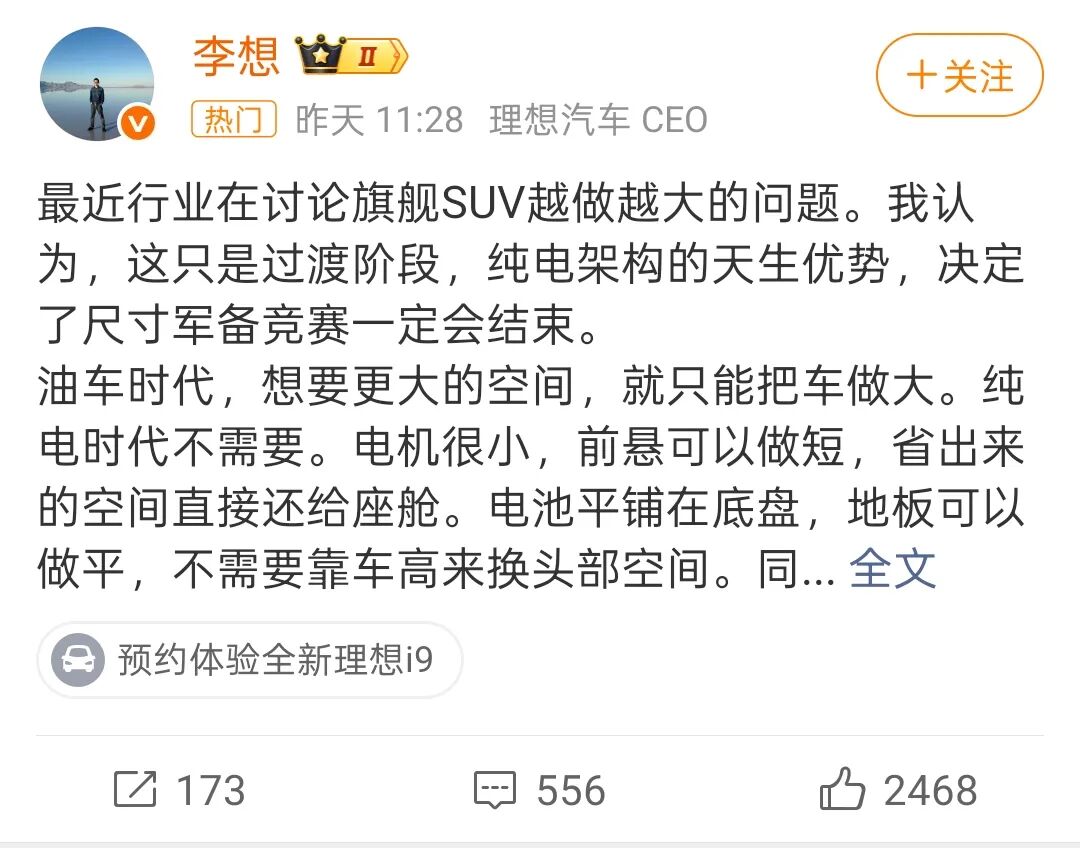
Photo / Screenshot of Li Xiang's Weibo post, Source / New Energy Review on the Internet
From Li Xiang's perspective, the trend of flagship SUVs getting increasingly larger is only a transitional phase, and the size arms race will definitely come to an end. Two days after he made the remarks, on September 16, Li Auto's new family flagship SUV, the all-new Li Auto i9, is set to be released. In terms of dimensions, the Li Auto i9 is noticeably larger than the Li Auto i8, the brand's family 6-seat all-electric SUV.
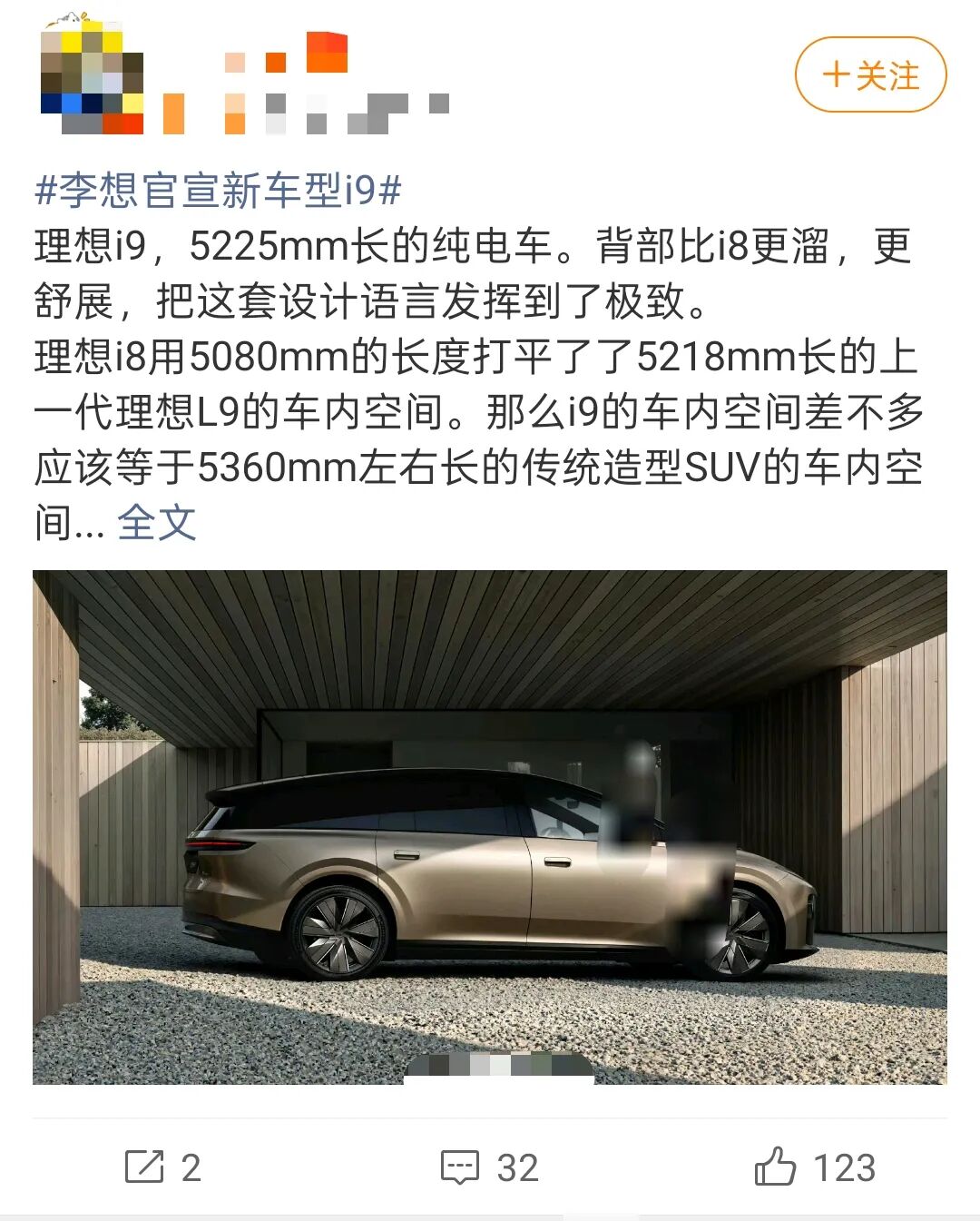
Photo / Li Auto i9, Source / New Energy Review on the Internet
Claiming that "there is little point in focusing excessively on vehicle dimensions" while launching its largest SUV to the market is not a contradiction, but a true reflection of the current survival status of automobile manufacturers.
Back in the fourth quarter of 2025, the "NIO, Xpeng, Li Auto" new car-making forces all turned profitable in the same quarter, but the market landscape changed only half a year later.
In the first half of 2026, Li Auto recorded a net loss of 3.981 billion yuan, swinging from profit to loss; Xpeng posted a net loss of 3.12 billion yuan, a year-on-year increase of about 174%; while NIO recorded positive operating profit under the Non-GAAP (Non-Generally Accepted Accounting Principles) standard, which means NIO has achieved operating profitability for three consecutive quarters.
In addition to cost control, NIO's performance is driven by strong sales of its large SUV, the all-new ES8. On September 14, a relevant NIO official posted that the brand will deliver the 150,000th all-new ES8 this week.
At present, there are about 71 major complete vehicle enterprises in China. The industry generally predicts that the market pattern will be basically finalized in the next three to five years, and only about 15 car manufacturers will be able to sustain their operations in the end. How to stay in the game? The ability to generate sustainable cash flow is definitely more important than sales volume. NIO's profitability has proved that "large vehicles" are the only way for high-end brands to survive.
1. Opposing involution in words, entering the track in action
We can simply set a reference boundary for new energy "large vehicles": vehicle length ≥ 5000mm, vehicle width close to or exceeding 2000mm, wheelbase ≥ 3000mm, which is commonly known in the market as the "5-2-3" specification, and this is also the entry threshold for current domestic flagship SUVs.
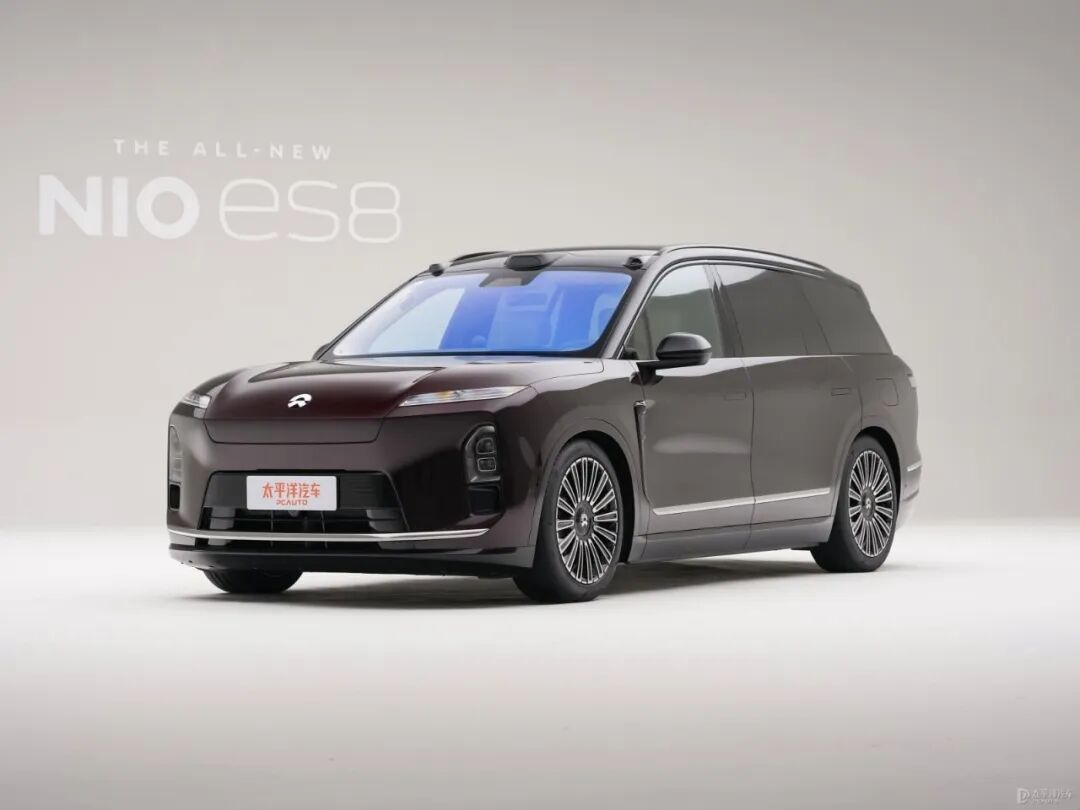
Photo / NIO ES8, Source / New Energy Review on the Internet
Take the all-new NIO ES8 as an example. It measures 5280×2010×1800mm in length, width and height, with a wheelbase of 3130mm, which is a standard large SUV specification. It offers 6-seat, 7-seat and large 5-seat versions, with the whole vehicle priced from 382,800 to 446,800 yuan, and the battery-as-a-service plan starts at 274,800 yuan.
The Li Auto i8 measures 5085×1960×1740mm in length, width and height, with a wheelbase of 3050mm, and its official guide price starts at 309,800 yuan.
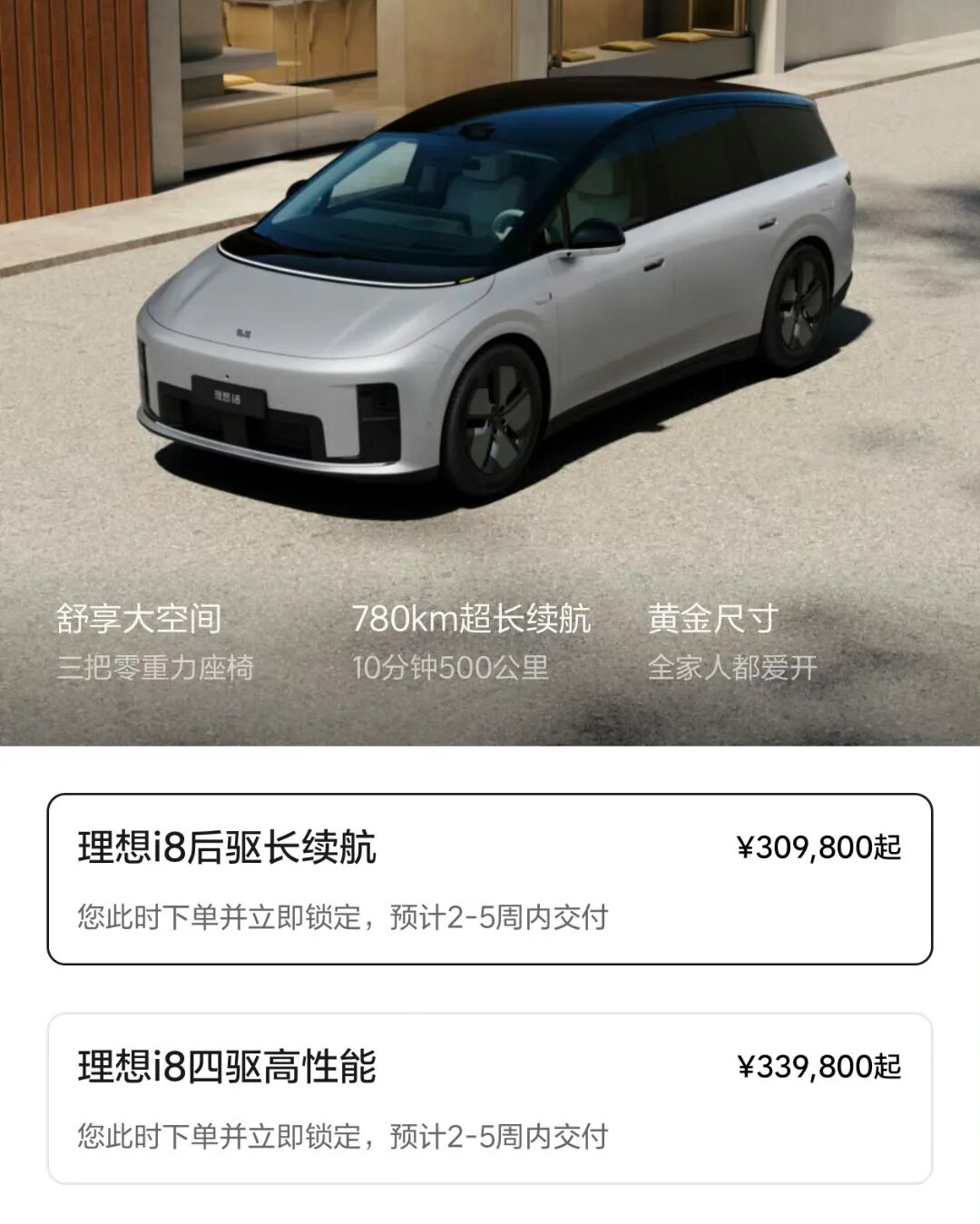
Photo / Li Auto i8 body and its official guide price starting from 309,800 yuan, Source / New Energy Review on the Internet
The upcoming Li Auto i9 is further upgraded to 5225×1970×1752mm, with a wheelbase of 3168mm, which is also a proper "large vehicle".
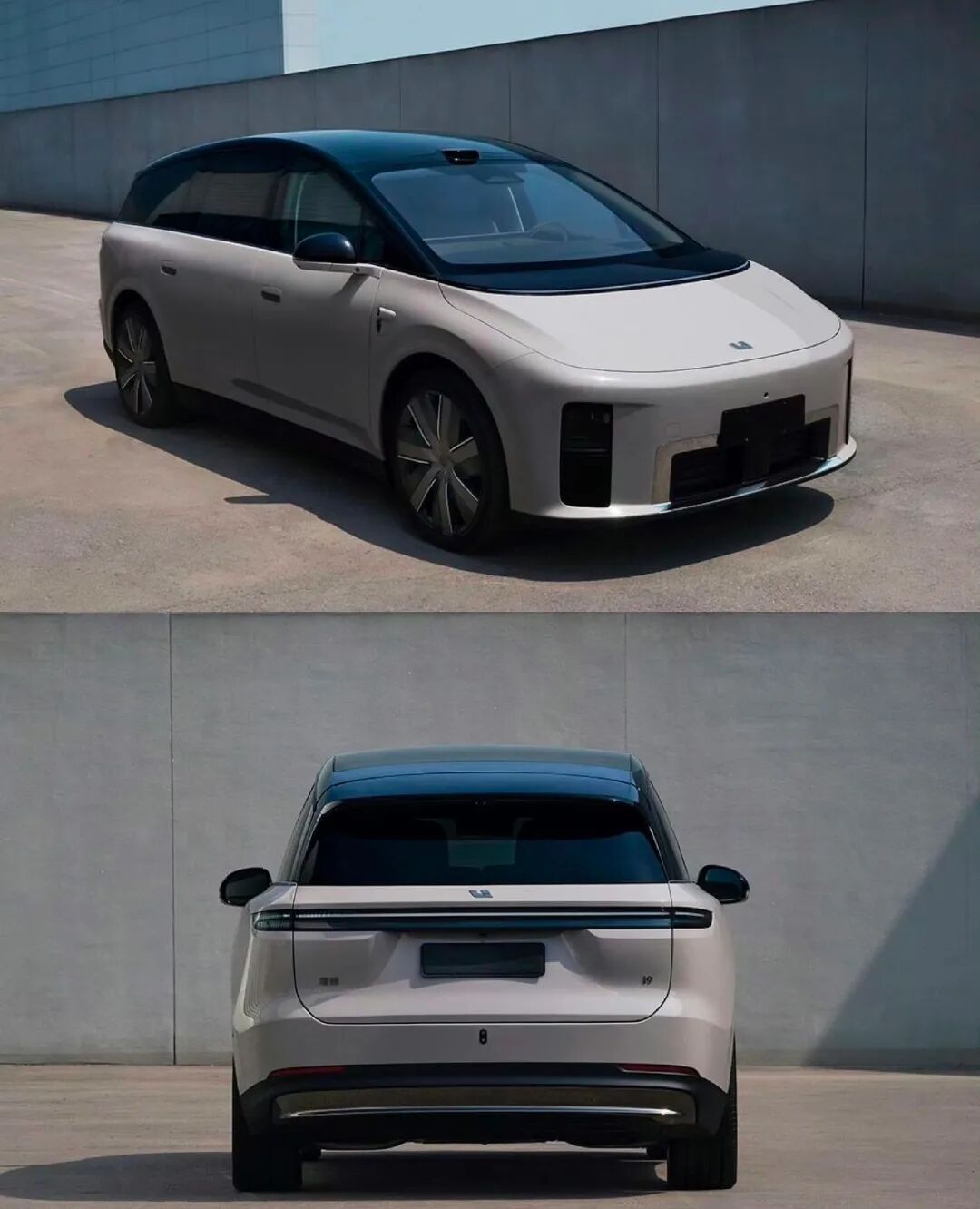
Photo / Li Auto i9, Source / New Energy Review on the Internet
In addition, popular market models such as AITO M9, Zeekr 9X, Leapmotor D19, and Xiaomi Pengcheng N90 all fall within this size range, and the large SUV track has become a must-win battlefield for domestic high-end brands.
In fact, "large vehicles" have already become the core chip for car manufacturers to stay at the high-end table.
The most typical example is still NIO. Launched in September 2025, the all-new ES8 achieved 140,000 deliveries in 335 days, and is about to reach the 150,000 delivery milestone in September 2026. Financial data also clearly shows that the gross profit margin of the two large SUVs ES8 and ES9 has exceeded 20%, and the profit per vehicle is significantly higher than the brand's small and medium-sized models, pushing the brand's average transaction price above 400,000 yuan.
In short, the profit of one high-margin "large vehicle" is often equivalent to that of two mid-range models.
Not only NIO, looking at the domestic auto market from 2025 to 2026, top large-size SUVs such as AITO M9, Li Auto L9, and Zeekr 9X are all the profit pillars of their respective brands.
In addition, the advantages of "large vehicles" are also reflected in supporting brand upgrading, serving as a display window for brand technologies, and seizing the wave of replacement and additional purchases.
Here we have to mention the point that Li Xiang did not mention or deliberately avoided in his "short post": All-electric architecture can indeed achieve "small body with large cockpit", but in the real consumer market, users' perception can hardly be completely separated from the vehicle's body size. Aura, visual perception, and business decency, these subjective feelings are still bound to the external dimensions of the vehicle.
Even if the cockpit can be made spacious technically, most brands still find it difficult to completely abandon large bodies if they want to secure their flagship positioning in the 400,000-600,000 yuan price range.
Thus a unique industry phenomenon has emerged: executives publicly reflect on the size arms race, while new large vehicle products from various manufacturers come one after another.
2. Experience dividends and practical dilemmas of "large vehicles"
Data from the China Passenger Car Association shows that in 2026, large SUVs have become one of the fastest-growing market segments in China's auto market.
In the first half of the year, the cumulative sales of domestic large SUVs were about 369,000 units, and the total sales of the top 5 models were about 206,000 units, accounting for 55.9% of the market share; the cumulative sales of the top 10 models reached 274,000 units, with a market share of up to 74.3%.
According to the latest data, the large SUV market continued to be dominated by new energy models in August, among which the all-new NIO ES8 won the first place in the sales of this segment with retail sales of 10,991 units.
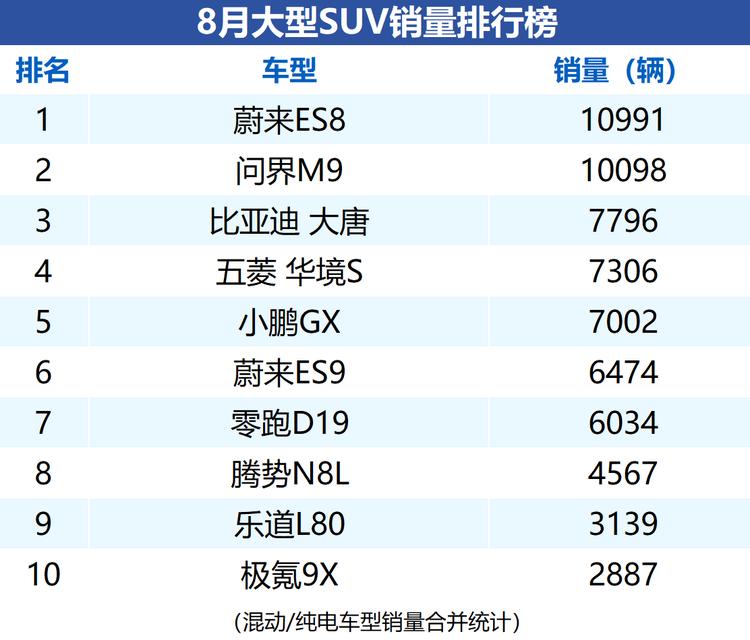
Photo / The all-new NIO ES8 ranks first in sales of this segment with retail sales of 10,991 units, Source / New Energy Review on the Internet
We have also communicated with many ES8 owners, and real and perceptible experience is exactly the charm of this kind of "large vehicle".
Take the all-new NIO ES8 large 5-seat version as an example. Its maximum legroom in the second row is 1376mm, the main and co-pilot seats are equipped with 20-way adjusted zero-gravity seats and 400mm wide leg rests, so both the elderly and children can ride comfortably during long-distance trips. Configurations such as refrigerators, large screens, and multi-zone air conditioners can only be fully arranged on a large vehicle body.
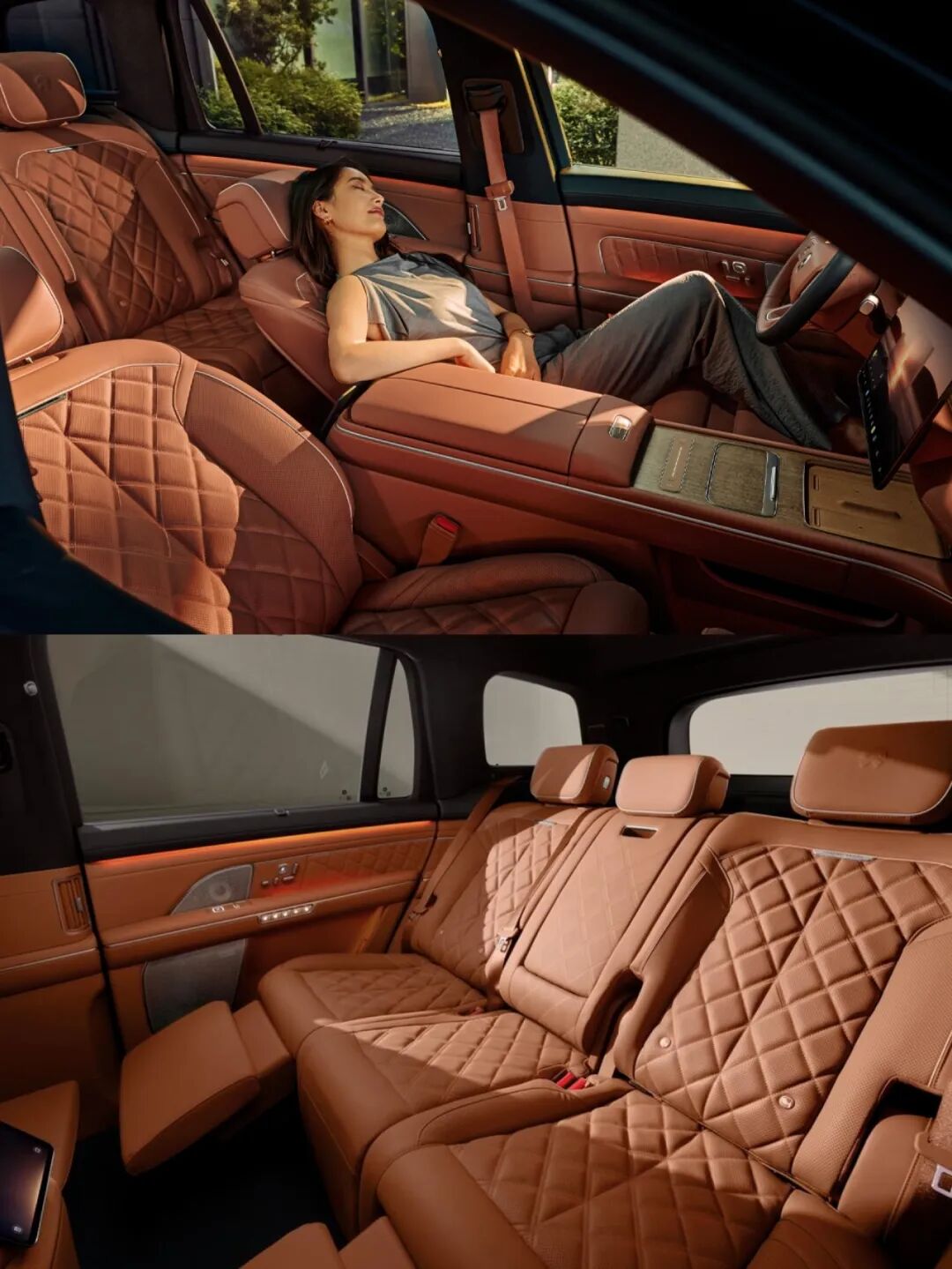
Photo / NIO ES8 large 5-seat space, Source / New Energy Review on the Internet
Business scenarios are also the home ground of large vehicles. The 5.2-meter-class body with independent second-row seats meets the needs of both family travel and reception.
But behind the dividends, the pain points of "large vehicles" are also equally prominent. This is exactly the parking anxiety that Li Xiang emphasized in his Weibo post.
We know that a large number of parking spaces in residential areas and shopping malls follow the 2015 version of the "Code for Design of Garage Buildings", where the net width of small parking spaces is 2.4 meters, and many developers have further reduced it to 2.2 to 2.3 meters. Just imagine, when a "large vehicle" with a width of 2 meters is parked in a standard parking space, the remaining space on both sides after excluding the rearview mirror is extremely limited, can passengers open the door and get on and off the car easily?
The same is true for urban driving. A 5.2-meter body is more prone to scratches in narrow old urban areas, and it is significantly more difficult for novice drivers to control the distance between vehicles and the edges of the car.
Therefore, user evaluations of "large vehicles" are polarized. Families with spacious private parking spaces who mainly drive on highways praise them highly; users living in old residential areas with tight parking spaces suffer from troubles of parking and U-turns.
But it is clear that the market will not eliminate large vehicles just because of their pain points, and the contradictions have forced the industry to find solutions. That is, car manufacturers use intelligent and chassis hardware to make up for the usage shortcomings of large vehicles; the social side promotes the iteration of infrastructure standards.
At the hardware level, rear-wheel steering is becoming a standard feature for 400,000-yuan-class large vehicles, which can greatly reduce the turning radius of large vehicles. The turning radius of 5.2-meter-class SUVs is reduced to 5.8 meters or even lower, significantly improving the flexibility of U-turns on narrow roads and turning in underground garages.
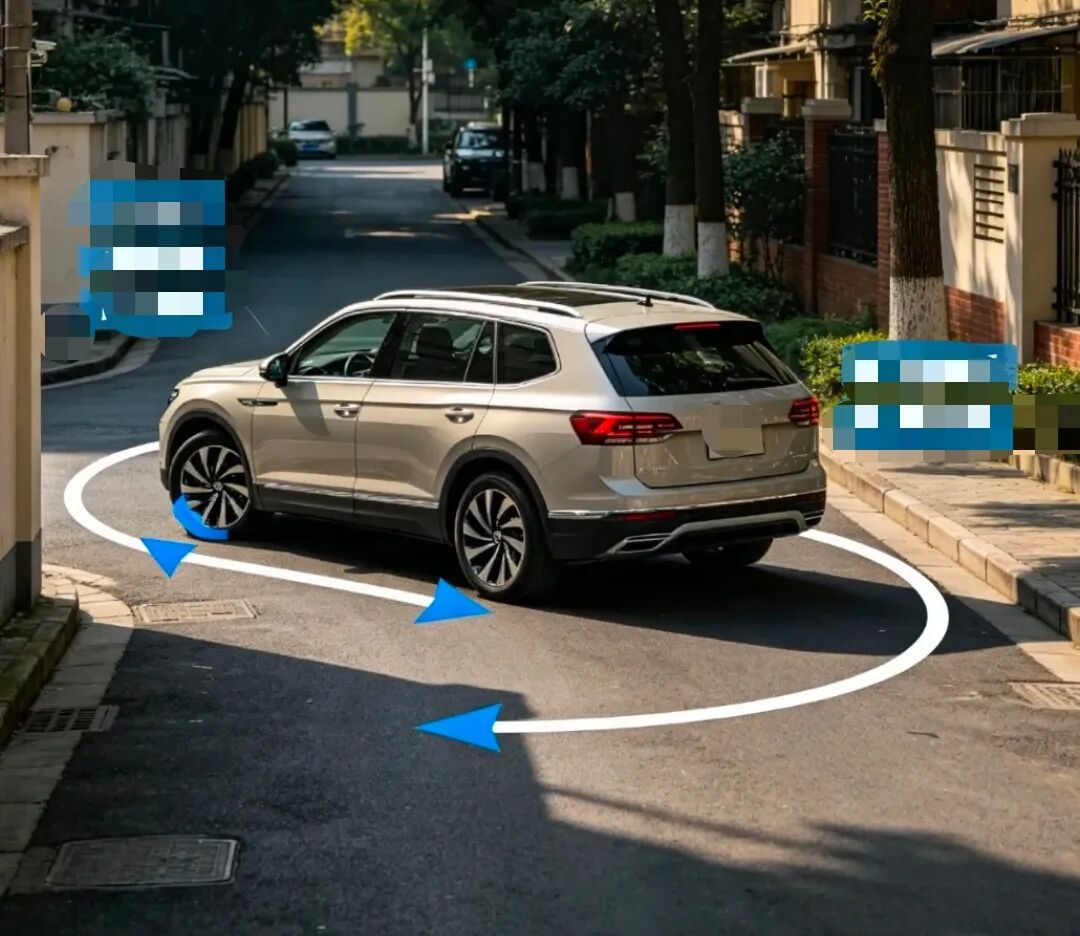
Photo / Vehicle turning, Source / New Energy Review on the Internet
Perception hardware is also continuously upgraded. 360° panoramic image, transparent chassis, multiple ultrasonic radars and lidar visualize the blind areas around the vehicle to assist drivers in judging the edge distance.
At the software level, high-level automatic parking, memory parking, and one-click escape function for narrow parking spaces are popularized. Vehicles can independently complete parking in and out, relieving the pressure of manual parking and leaving the parking work to the machine.
On the other side that can not be touched by automotive product technology optimization, the Ministry of Housing and Urban-Rural Development has launched the revision of parking space related specifications, and some cities in China have piloted new widened parking spaces. However, the transformation cycle of existing garages is very long and can not be completed overnight. The usage dilemma of large vehicles is not only a product issue for car manufacturers, but also a social proposition for urban infrastructure upgrading, which requires the joint efforts of car manufacturers, policy makers and real estate developers.
3. Final notes
The industry contrast that Li Xiang complains about size involution but continues to launch flagship large vehicles is essentially a characteristic of the iterative transition period of the new energy track.
Perhaps the size arms race will eventually end, but the track value of high-end "large vehicles" will never disappear. The core competitiveness of car manufacturers never lies in making the vehicle body larger and larger, but in making space efficiency, usage experience and intelligent shortcomings better and better.
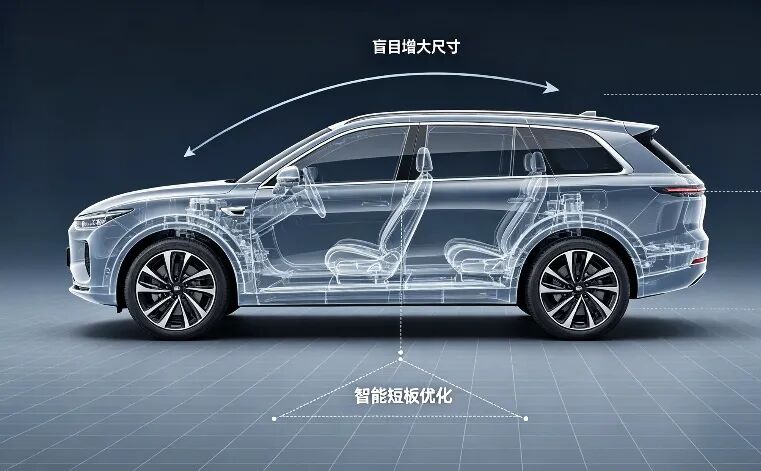
Photo / Blindly increasing dimensions, Source / Generated by AI
With the continuous maturity of all-electric architecture technology, the popularization of intelligent chassis and autonomous driving technology, and the gradual improvement of urban parking infrastructure, the contradiction of large vehicles "full of experience but limited in scenarios" will be continuously alleviated. The industry will eventually