Roundtable: New Energy: Deep-water Gold Panning in the Post-Era | 36Kr 2026 Industry Future Conference
In 2026, industrial investment has entered a deep-water zone, with capital, technology and industry integrating at an accelerated pace. The old investment logic no longer applies, and a new consensus is taking shape. The 2026 Industrial Future Conference focuses on opportunities in the new cycle, and jointly explores the future of the industry and the birth of the "Light of China". From September 9 to 10, the 2026 Industrial Future Conference hosted by 36Kr, with the theme of "Resonance and New Birth Above Deep Waters", was held in Yizhuang, Beijing. Representatives from state-owned asset platforms, industrial investment funds, corporate CVCs, innovative enterprises, and experts and scholars gathered to focus on the industrialization of future industries such as quantum technology. The conference deeply discussed the current cutting-edge technology and industrial perspectives, intensively demonstrated breakthroughs in technical routes such as superconductivity, optical quantum, and ion trap, and shared a large number of specific industrial scenarios, industrial system construction, and the prospect of heterogeneous computing, to jointly explore the future of technology industry investment.
The following conversation is edited and organized by 36Kr:
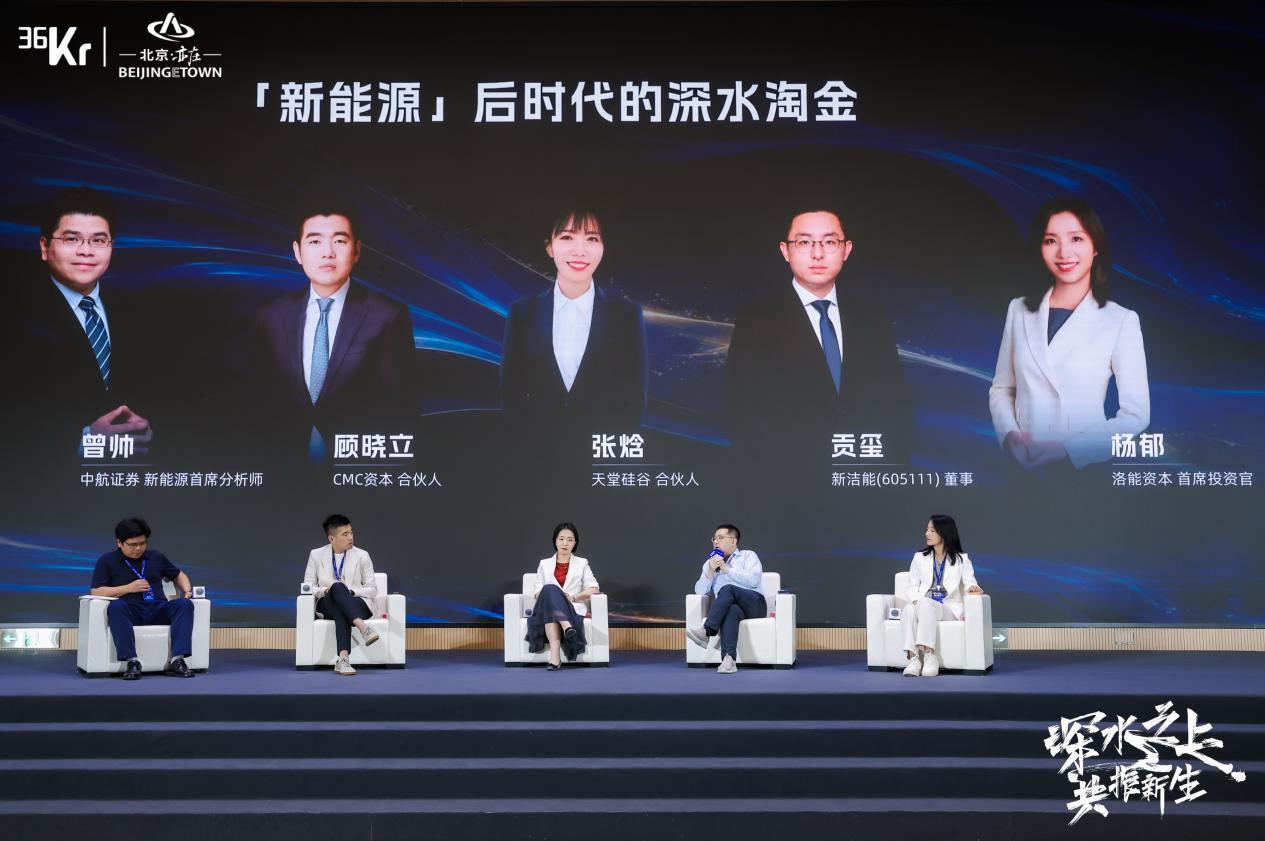
ZENG Shuai | Chief New Energy Analyst, AVIC Securities (Host)
GU Xiaoli | Partner, CMC Capital
ZHANG Han | Partner, Paradise Silicon Valley
GONG Xi | Director, NCEP (605111)
YANG Yu | Chief Investment Officer, Loenergy Capital
ZENG Shuai: Hello everyone! First of all, please let each guest briefly introduce yourself and your company.
GU Xiaoli: Thanks for the invitation from 36Kr. I am from CMC Capital, which was founded in 2010 and has offices in Shanghai, Beijing and Hong Kong. It manages a scale of more than 30 billion RMB, and is a dual-currency fund covering both foreign currency and RMB. For 16 years up to now, we have invested in no more than 90 projects, covering early-stage, mid-stage and late-stage enterprises. The current investment areas include AI applications, new energy, high-end manufacturing, new materials, etc. That's the general layout of our business.
ZHANG Han: Thanks for the invitation from 36Kr. We are Paradise Silicon Valley, founded in Hangzhou in 2000. This year is our 26th year, and we have been focusing on investing in the manufacturing industry all the time. Among our investment directions, new energy is one of the sectors we have heavily invested in. In addition to new energy, we also invest in hard technology manufacturing enterprises such as semiconductors and medical devices. Up to now, we have invested in more than 200 projects in total, 55 of which have completed IPOs on A-share, Hong Kong Stock Exchange or US stock markets, including quite a number of new energy companies. Our investment in new energy started as early as 10 years ago. At the beginning, we invested more in upstream materials and components of the new energy vehicle industrial chain. From 2022 to now, we have invested more in the energy direction, for example, in the energy storage sector, we invested in SIG New Energy, which was just listed on the Hong Kong Stock Exchange this year. We also continue to invest in the photovoltaic sector that is relatively cold at present.
GONG Xi: NCEP is a listed company focusing on process devices and supplemented by analog chips. I have been engaged in small equity investment for almost 10 years. I used to be responsible for the fundraising, investment, management and exit of all funds of a vehicle manufacturer. Today I will talk about our understanding of new energy from the perspectives of automobiles and chips.
YANG Yu: Hello everyone! I am from Loenergy Capital. I represent investors on the one hand and entrepreneurs on the other. Our team is operating two enterprises at the same time. PCG Power is a leading investment management and operation service provider of new power systems in the industry, and also one of the world's leading investment operators of industrial and commercial distributed clean energy power stations. Loenergy Capital focuses on new energy asset investment with long-term value, and has jointly created a unique new energy asset management model of "front store and back factory, combination of light and heavy assets" with PCG Power. Now we have ranked first in national incremental scale and top 3 in stock scale in the segmented track of distributed industrial and commercial clean energy. Our own capital, development fund, M&A fund and inter-institutional REITs have formed a complete asset management closed loop. In addition, we entered the energy storage track this year, and cooperated with SIG New Energy to set up an energy storage fund to further expand the new energy asset management category.
We are one of the relatively mature institutions in the market that have formed a commercial closed loop of new energy power station asset securitization. At the end of last year, we issued the first inter-institutional REITs for distributed clean energy, and completed the first additional issuance this year. We should be a relatively rare entity in the market that has completed the full commercial closed loop of new energy power station assets from development to M&A, operation and maintenance, then to securitization and reinvestment. We are also very glad to communicate with you all.
ZENG Shuai: Next, I would like to introduce the company I work for. AVIC Securities is a securities company under AVIC Industry Group. Its investment business in recent years focuses on military industry and civil aviation, and has made many achievements in IPO tutoring and M&A of investment banking.
For the new energy power station and energy storage station projects just mentioned by Mr. Yang, there is a new direction of capitalization, that is, public offering and private placement REITs. We have advantages in this track and have issued three new energy public REITs.
Back to the theme of the conference, we discussed with the conference organizing committee and set several directions. Please also ask several guests to briefly introduce their views.
First, the current overcapacity of the industry and the investment cycle.
Second, AI + Energy.
Third, the future investment direction.
Fourth, investment methodology.
Fifth, summary.
Starting from the first direction, starting from Mr. Yang. Now everyone is talking about the problem of overcapacity. What is your observation? And in the future of the investment cycle, even the currently unfavorable links may rebound in which segmented track in the next two or three years.
YANG Yu: Compared with other several PE/VC experts, our perspective is more about investing in production assets, and I will share from our perspective. When we first decided to do assets, it was related to the trend judgment of overcapacity. In the previous extremely hot stage of new energy, we foresaw that there would be a cycle of upstream overcapacity in the future.
When overcapacity occurs in the upstream, it is beneficial to the downstream asset investment. We started incubation in 2021, and around 2022 we formally established the entity to deploy assets on a large scale, and began to invest in distributed industrial and commercial photovoltaic on a large scale. In this cycle, we also enjoyed a lot of asset dividends brought by the price reduction of upstream equipment.
From today's point of view, we also saw that the host shared some questions with us in advance, which I think is very interesting. From the perspective of asset investment, the space of newly developable photovoltaic assets is shrinking rapidly now. Especially after the issuance of Document No. 36 in the industry, the assets after May 31 of last year have lost some policy-related support and protection.
Therefore, the downstream asset investment of photovoltaic in the future is in a shrinking state. The only possible opportunity is the distributed industrial and commercial photovoltaic we invested in, which has relatively certain downstream production capacity and good load end in the downstream, so we are still continuing to invest. However, the demand for photovoltaic construction in centralized bases has shrunk rapidly. From this perspective, the upstream overcapacity will not have large-scale rebound or capacity adjustment within a certain period of time.
ZENG Shuai: How long is the time window you observed? One year, two years, three years, or ten years?
YANG Yu: In fact, the service life of these photovoltaic modules is very long. We can see that some photovoltaic power station panels have been used for 30 years, and the power generation effect is still very good. For example, we will invest in some power stations (built seven or eight years ago) whose overall design and equipment construction have some problems, and we will carry out corresponding transformation, which will generate corresponding procurement demand. But compared with the large-scale development and construction in previous years, there is still a big gap.
Therefore, we think there are not many opportunities for large-scale growth in photovoltaic demand, including our investment in energy storage. In the current structure of the power market, the next two or three years will be a very good window for new investment in energy storage. We think that in the stage of energy storage, some high-end energy storage equipment applied to large-scale grid-side energy storage will have good opportunities for capacity consumption.
ZENG Shuai: Grid-side energy storage, please pay attention to this key word mentioned by Mr. Yang.
GONG Xi: I think there may be a larger and more macro framework. This question sounds like it was raised by a secondary market expert. After I have been engaged in primary equity investment for such a long time, I found that most of the primary market investment is to invest in growth stocks, and the logic of growth is far greater than the logic of cycle. Everything has growth and cycle, but which one is the main melody at a certain stage. Generally, permeability is taken as a very important dividing point.
After I started to do M&A, especially after contacting the secondary market, I found that the cycle is very important, because there are far more cyclical stocks than growth stocks in the secondary market. A very special point of the cycle is that when the PE is very low, the EPS is very high. It looks very cheap, but in fact, you are investing at the highest point of risk.
But if this logic is applied to growth stocks, it is often the place where you can pick up leaks at the beginning. I think a more grand framework is to see whether the main melody of this track is growth logic or cycle logic. If it is within the main melody of cycle, from the two perspectives I observed, the new energy related to automobiles is lithium electricity and batteries. I think most of this track has been the cyclical logic of growth.
Of course, on the whole it is cyclical logic, but there are still structural growth logic in some points. For example, some emerging small devices, including some emerging battery structures in the future, will superimpose part of the growth logic on the original cycle logic, which is what we will pay more attention to.
I often say that if you can invest in cyclical stocks in the primary market and also in the secondary market, which stage would you choose to invest in? I prefer to invest in cyclical stocks in the secondary market. If the resonance is in the same frequency, the secondary market obviously has an extra liquidity. So this is from the perspective of batteries.
From the perspective of chips, we see that the terminal AI optical modules, including the import substitution in the automobile industry, are still in the growth logic. From such perspectives, low PE often means that it is just the beginning, and that's how I look at this matter.
ZHANG Han: The question raised by Mr. Zeng is relatively macro, and I quite agree with what Mr. Gong said just now. We may be more micro. I think on the whole, for new energy, including the large energy form superimposed with traditional energy, the main melody is positive. When we communicated with you just now, everyone has a consensus that as long as the sun is still shining and the earth is still continuing, human demand for energy will always go up, and even with the emergence of AI, this upward trend may be accelerated.
So this is the main melody. On this point, we are less concerned about actively defining which link will rebound now or in two years, and we will not bet in advance which link will be completely hopeless. We may try to find investment opportunities from a more micro perspective. For example, we will pay attention to what variables appear in each link such as photovoltaic, energy storage, and vehicles. These variables may exist in three aspects:
1. Changes on the supply side. Especially after the emergence of AI, manufacturing, power generation equipment, energy storage equipment, etc. can be superimposed with AI to make them more efficient than the original traditional route, reducing costs and increasing efficiency for customers, or bringing benefits improvement to partners, so that they can make more money. SIG opened up the situation in this way at the beginning.
2. Changes on the demand side. AI itself is a demand.
3. Whether there are some new first-line teams starting a business, especially the formally organized teams that have worked in the new energy segmented field for at least 10 or 20 years from large factories, where we may find some opportunities in the primary market.
GU Xiaoli: As mentioned earlier, "everything has a cycle". Especially in the Chinese market, even the very stable consumer industry overseas, such as Baijiu, can be regarded as a cyclical industry in China, and new energy is even more so. We have been deploying new energy since 2012. Photovoltaic has experienced three cycles and is now entering the fourth cycle. To invest in new energy, we must embrace the cycle. Take photovoltaic as an example, you can also make money in the cycle. For example, in 2016 and 2017, companies such as JA Solar were delisted from the US stock market after being listed there. The investors and institutions that participated in the privatization at that time made a lot of money. So there are still many opportunities to make good use of the cycle in the primary market.
In March last year, we invested in Ganfeng Lithium Battery, a holding subsidiary of Ganfeng Lithium, whose main business is large-scale energy storage and solid-state batteries. When we invested, it was still loss-making. More than half a year after the delivery, the company achieved a net profit of 400 million RMB in the first half of the year and 800 million RMB for the whole year. At that time, everyone was still talking about overcapacity, the valuation was very cheap, we entered almost at the net asset value, and we got 550 million RMB of dividends in half a year. This may be our own requirement.
More importantly, new energy is not just a cycle. For example, Beihang University has invested a lot in the military industry. Let me give some examples: the orders for gas turbines have been scheduled to 2030; in terms of power grid equipment, a large number of overseas power grids need to be renovated, and the orders are too many to be scheduled. This is not a cycle. Maybe it will become a cycle one day in the future, but it will definitely develop vigorously in the next 3 to 5 years, and the production capacity cannot be expanded. Another point is that in the past year, the whole world including China has restarted nuclear energy, not just nuclear fusion, but also nuclear fission. Many supply chain enterprises in these two fields are cross-border from the military industry. These companies have the second and third growth curves, which is not a cycle either. So I think the whole new energy industry still has a lot of investment opportunities, both cyclical and non-cyclical.
ZENG Shuai: Mr. Gu spoke very well. The so-called "everything has a cycle" is actually a time rhythm problem of secondary market trading, the mismatch between the rhythm of supply and demand. If you shorten the time, everyone thinks there is a cycle, but if you look at the whole industry from the dimension of 5 or 10 years, it is still in a growth state. So many people in the world have not worn bright clothes, used various household appliances, driven smart cars, met their own household energy supply, and used their own AI agents. From this perspective, there are indeed many growth tracks worthy of our continued investment.
All guests have just shared part of their investment directions. Next, please share with us the investment methodology and the directions that your investment institutions are optimistic about. By the way, please share whether you tend to choose enterprises that already have advantageous positions, or invest in growing enterprises with subversive possibilities when investing in a specific track?
GU Xiaoli: I think both have opportunities. First, let's talk about where the opportunities for traditional leading enterprises lie. For example, among the companies with the largest increase in A-shares in the past two years, Yangtze Optical Fibre and Cable, Hengtong Optic-Electric, and Zhongtian Technology Group are all enterprises that have been established for 20 or 30 years and are already industry leaders. In the past one or two years, no matter the stock price or performance growth, they may exceed the total of the past 5 or 10 years. Why? Driven by the fourth industrial revolution of AI, energy is not just new energy now. Traditional energy is booming in an all-round way, nuclear power is restarted, and rockets are the same, all of which have growth opportunities. This will make many listed companies thrive, and unlisted companies reach the listing standards. This