Roundtable: Pathfinding · New Map of Industrial Division of Labor, Embracing the New Future — How National Strength Transforms into Industrial Value | 36Kr 2026 Industrial Future Conference
In 2026, industrial investment has entered a deep-water zone, where capital, technology and industry are accelerating their integration. The old investment logic no longer applies, and new consensus is taking shape. The 2026 Industrial Future Conference focuses on opportunities in the new cycle, and jointly explores the future of the industry and the birth of the "Light of China". From September 9 to 10, the 2026 Industrial Future Conference hosted by 36Kr, with the theme of "Resonance and New Birth Above the Deep Water", was held in Yizhuang, Beijing. Representatives from state-owned capital platforms, industrial investment funds, corporate CVCs, innovative enterprises, experts and scholars gathered to focus on the industrialization of future industries such as quantum technology. The conference deeply discussed the current cutting-edge technology and industrial perspectives, intensively demonstrated the breakthroughs in technical routes such as superconductivity, photonic quantum and ion trap, shared a large number of specific industrial scenarios, industrial system construction and the prospects of heterogeneous computing, and jointly explored the future of sci-tech industrial investment.
The following dialogue is organized and edited by 36Kr:
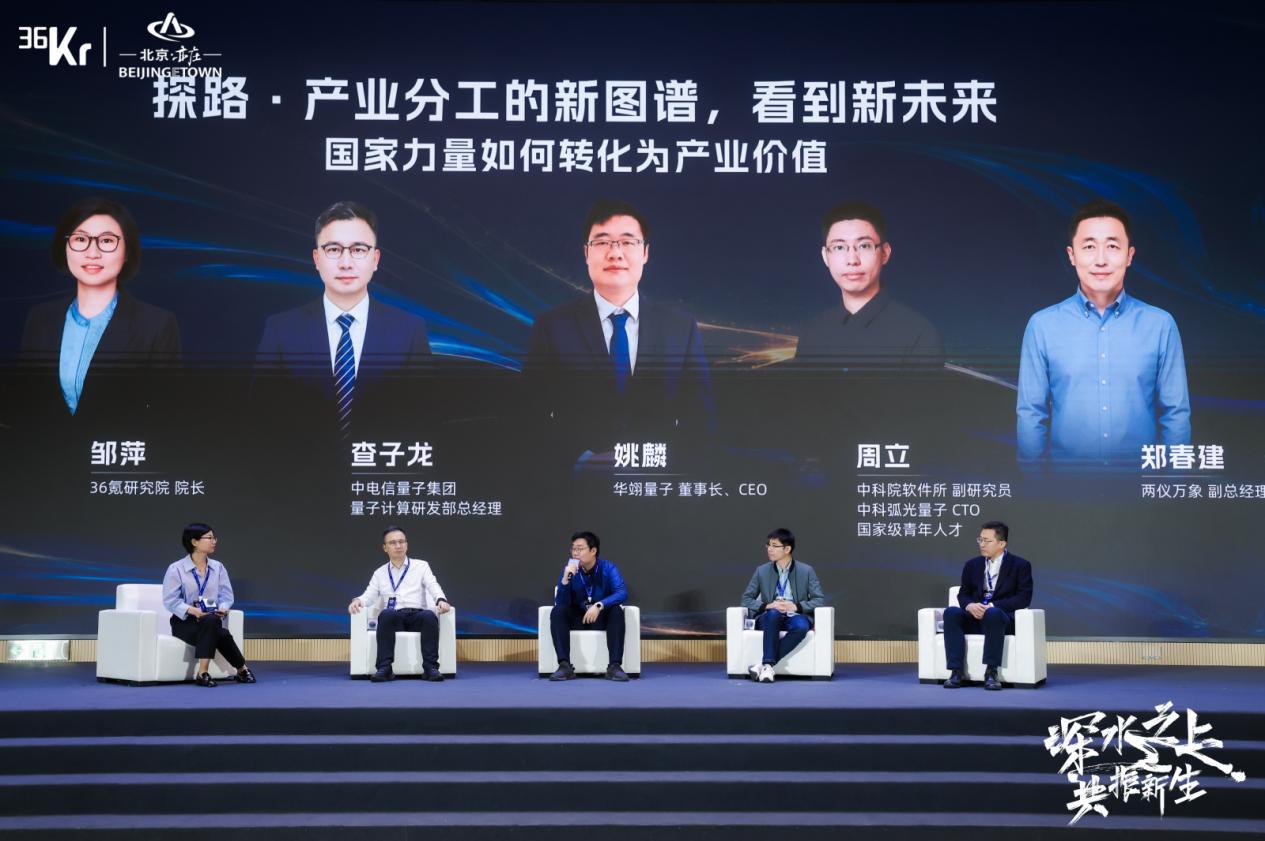
Zou Ping | Dean of 36Kr Research Institute (Host)
Zha Zilong | General Manager of Quantum Computing R&D Department, China Telecom Quantum Group
Yao Lin | Chairman and CEO of HuaYi Quantum
Zhou Li | Associate Researcher of Institute of Software, Chinese Academy of Sciences, CTO of Zhongke Huguang Quantum, National Youth Talent
Zheng Chunjian | Deputy General Manager of Liangyi Wanxiang
Zou Ping: Just now, we talked with Mr. Zhang Fan from Yizhuang State Investment from the perspective of state-owned capital, and saw how capital makes layout strategies in the quantum technology field. Next, we will turn our attention to front-line industrial enterprises. In the past, when we talked about quantum technology, we mostly focused on its technical breakthroughs in the laboratory. Today, the industry proposition has shifted to how technologies land, how the industrial chain collaborates, and how commercialization can be realized smoothly, which is also the core starting point of our roundtable theme "New Map of Industrial Division of Labor, Seeing New Future".
It is a great honor to invite four guests who are deeply engaged in the quantum technology field, and they are exactly at different links of the industrial chain. We will jointly analyze the current division of labor pain points, breakthrough paths of the quantum industry and what new development opportunities will emerge in the future from the perspectives of hardware tackling, software ecology and scenario traction. Welcome all guests!
First of all, please introduce the core business of your company and your position in the industrial chain. Mr. Zha, you can start first.
Zha Zilong: As China Telecom Quantum Group, we focus more on application expansion and scenario pilot, and we have relevant practices in the fields of communication, computing and measurement.
Those who know our company know that we have acquired QuantumCTek, which is our subsidiary. Combined with the endowment characteristics of China Telecom, we have taken deep roots in the quantum communication field. In previous years, together with QuantumCTek and relevant laboratories, we have also been working in the quantum computing field, making corresponding explorations from the delivery of complete machines to cloud platforms and application scenarios.
If we include the subsidiaries of QuantumCTek, we will cover the entire industrial chain. For the group itself, we hope to explore more application scenarios together with ecological partners including customers, and apply various scientific research achievements of quantum technology to the real industrial side.
Yao Lin: Our HuaYi Quantum is an enterprise transformed from the technology of Tsinghua University. Our main product is the R&D of the complete ion trap quantum computer. In this respect, we are relatively in the middle reaches of the industrial chain, and many suppliers provide us with core key components required for the research of quantum computers. In addition, we will also cooperate with downstream parties including many application parties, software algorithm development enterprises and universities and institutes to explore the application direction of computing itself.
The quantum industry is currently in a stage with obvious international progress, and it does have some supply chain restrictions and related factors. Therefore, we will also carry out domestic substitution of core components, and use such equipment to support the development of other domestic quantum computing related R&D enterprises. Relatively speaking, we are in a position between the middle reaches and the upper reaches of the industrial chain.
Zhou Li: Relying on the scientific research accumulation of the Institute of Software of the Chinese Academy of Sciences, Zhongke Huguang Quantum focuses on quantum computing software. Our positioning is the full-stack layout of quantum software, that is, to connect the basic software that helps hardware machines run, the tool platform that helps developers make applications, and the industry-oriented application software.
Quantum computers are manufactured by hardware teams and companies, and we hope that through quantum software, users can use quantum computing more conveniently and give full play to the potential of hardware.
Zheng Chunjian: Liangyi Wanxiang is a quantum technology company focusing on the full-stack development of atomic quantum computing complete machines and the upstream and downstream ecology. We are incubated from the atomic quantum computing team of Tsinghua University. The core product of the company is the complete atomic quantum computer. In addition to the complete machine, we will also develop some upstream component products to provide them to scientific research institutions and enterprises in need.
At the downstream end, we also connect application scenarios through cloud platforms, including our own self-developed cloud platforms, and also access heterogeneous computing platforms provided by enterprises such as China Telecom.
Zou Ping: Some of your products have been put into use on the China Telecom platform, right?
Zheng Chunjian: We are currently in the process of communication and docking.
Zou Ping: The four of us here today happen to represent different links in the industrial chain. You can start from your respective positions to talk about your views on the current maturity of the quantum technology industry, make a judgment, and introduce what your core development priorities are.
First, I would like to ask Mr. Zha: China Telecom Quantum not only operates the Tianyan Quantum Computing Cloud Platform, but also promotes quantum security applications. From the perspective of the actual accessed computing power scale, user call frequency and payment willingness of your platform, what development stage do you think the current commercialization of quantum computing and cloud services is in? In your opinion, what is the most needed breakthrough first in the industrial chain: hardware performance, software tools, or scenario verification that can be realized first?
Zha Zilong: You just asked several questions. The Tianyan Quantum Computing Cloud Platform mainly focuses on quantum computing. At the same time, China Telecom Quantum is also doing work related to quantum security services, which actually focuses on key services for quantum communication. At present, these two businesses are not interconnected, and they are two different businesses.
Relatively speaking, quantum security services have entered a stage where they can be used on a large scale, and we are already exploring applications in large-scale scenarios. But for the quantum computing field, I personally think it is still in the initial verification stage, and there is still a long way to go before large-scale applications.
Judging from the current number of platform users, user payment willingness and cooperation situation, most of the current applications are still in the exploration of quantum computing advantage scenario applications, and the real entry into the practical stage is affected by many factors. I have been observing the situation abroad, and their applications are also more concentrated in some focused points and scenarios. But there is still no precedent for realizing large-scale applications.
For future breakthroughs, I think hardware, software and scenarios are all very important, because all three need to make efforts in the initial stage. But here I think the most core underlying technology lies in whether the hardware can finally support and realize the fault-tolerant general quantum computing.
To get more people involved and make more people think this industry is promising depends on the applicability of software and the practicability of scenarios. These three stages need to make efforts simultaneously. It is very important to achieve phased results along the way in the future, including various explorations in the middle. No matter which enterprise it is, it is the key for everyone to work together to develop this track well.
Zou Ping: So it is not to make efforts at a single point, but to realize certain collaborative upgrading on the three sides of hardware, software and scenarios at the same time.
Thank you, Mr. Zha. The platform side can often perceive the development of the whole industry first. Hardware is the base of quantum computing, and ion trap and neutral atom are the technical routes that China focuses on making breakthroughs. Next, we would like to consult Mr. Yao and Mr. Zheng: HuaYi's ion trap has entered the stage of small-batch delivery. From laboratory to industrialization, what do you think is the most critical challenge among engineering integration, cost control and yield? What core capabilities must be firmly mastered by our own enterprises to realize independent controllability?
Yao Lin: At present, the main challenge we are facing lies in engineering integration. In the case of low output, the requirement of yield will eventually be reflected in the quality of deliverables. Therefore, the accuracy rate and final performance of the products are closely related to the perfection degree of engineering integration. When enterprises carry out scientific and technological R&D and innovation, one of the significant differences from universities and research institutes is that we need to consider the restrictions of many practical application environments, including the specific situation and application situation of customers, to make corresponding improvements in design, and truly transform quantum computers from laboratory instruments into computing tools that can be used at customer sites.
There are many challenges to overcome here. At the current stage, let alone whether we can give full play to the advantages of quantum computing in the use link, first of all, we hope that the quantum computing capability can be really used in the current application environment, which requires very high engineering integration standards.
This also involves relevant requirements for the entire supply chain. For a long time, there have been certain import restrictions on core components involved in quantum technology abroad. In the past few years, I believe that all parties of different technical routes have done a lot of work in this regard.
Independent controllability and localization are very important parts of the quantum information industry. We hope to minimize the equipment that completely depends on imports. In our technical route, including free space electro-optic modulators and special laser amplifiers, we used to rely heavily on foreign products. For the superconducting route, there are also many different enterprises making efforts, such as the domestic substitution of dilution refrigerators and low-temperature amplifiers, and QuantumCTek has done a lot of work in this aspect.
I believe that everyone in the industry will aim at the core products that used to rely on imports to carry out independent R&D. I think this is the common goal of all of us.
Zou Ping: Mr. Zheng, the neutral atom complete machine of Liangyi Wanxiang is still in the stage of R&D and verification. From the selection of technical route to prototype integration, which link do you think is the most needed breakthrough at present? Which links can be solved through joint tackling or the "appointing experts for critical tasks" mechanism? Just like the scenarios released by Yizhuang just now, it can also release a demand list, and we can apply for tackling tasks based on the demand list. Which link do you think is the most needed breakthrough, and which links can accelerate the tackling through external cooperation?
Zheng Chunjian: For our first-generation complete machine, all the functions involved in the physical bit level have completed the R&D and verification work. What we are doing now is mainly engineering integration. Engineering integration is to transform the system that often needs manual adjustment in the laboratory into a stable, compact, continuously operable and automatically feedback complete machine. There are not many stuck points in this process. The main task is to realize engineering, including modularization and miniaturization, and achieve faster delivery by enhancing its product performance.
On the basis of the first-generation complete machine, we are also carrying out key technology R&D and breakthroughs for the second-generation and third-generation complete machines, including larger-scale physical bits, encoded logical bits, continuous loading operation, more accurate reading and measurement, etc. The breakthrough of these technologies requires the breakthrough of some components in our upstream. Our upstream is mainly some optoelectronic devices. The improvement of the performance of the complete machine requires better performance and stability of the components, which requires us to carry out joint R&D to achieve this goal.
For upstream components, some optoelectronic devices have commonalities between different technical routes. We and the ion trap route have many common demands. Now some upstream enterprises have achieved great dividends by serving quantum technology enterprises. For example, Pinzhun Laser was recently listed on the Sci-Tech Innovation Board, which also benefited from the rapid development of quantum technology in recent years and achieved great profits in the process. Therefore, we also hope that these upstream enterprises can pay more attention to and participate in the demands of quantum technology enterprises.
In addition to the upstream, we also hope that downstream scenarios can carry out more cooperation with complete machine enterprises and algorithm enterprises to jointly explore some issues: whether the problems in scenarios can be transformed into quantum problems, and whether the verification of the complete machine can be carried out. We hope that through this kind of cooperation, the complete machine can be used to a greater extent.
Zou Ping: Just now you mentioned that we need to coordinate with the upstream, and also need downstream scenarios to help us do verification. We know that the existing software products of Zhongke Huguang can be used under multiple hardware routes such as superconductivity and ion trap at the same time, and the current technical routes have also been slightly converged. In fact, for software vendors, this is both an opportunity and means the maximum adaptation cost.
Mr. Zhou, from your perspective, what specific challenges will the parallel development of multiple hardware routes bring to our software layer? In the long run, is it possible for the software ecology to reversely promote the standardization of hardware interfaces and indicators through productization or platformization? For example, we now have neutral atom and ion trap routes, which will put forward requirements for you. How do you meet the software requirements under different routes?
Zhou Li: Our software layer faces users upward, including developers and specific application industries; downward, we connect hardware machines, especially considering that the technical path of the current hardware layer has not yet converged. For us, the challenges are different on the upward and downward sides. For upstream users, they do not know or care about the specific parameters of the underlying hardware very much. For them, they hope to have a basic platform that can be precipitated and reused, just like the programming languages in our classic programs, or the integrated environments such as IDE that we often use. They hope to write quantum programs smoothly according to their own needs in such an environment.
Now that the hardware routes have not converged, what we need to do is to precipitate the intermediate interface, so that they can connect smoothly and are easy to update. At the hardware layer, we now hope to cooperate with various hardware manufacturers, companies and enterprises, because the intermediate interface problem requires mutual understanding and joint formulation.
For upstream users, I have seen many new explorations in the academic circle, and they are trying to find ways to lower the threshold for developers. But the academic circle is only one aspect, because the academic circle mostly views issues from a theoretical perspective. However, when users are actually using the technology, they have scenarios with real demands, which are often not covered by the academic circle. Therefore, I think in the software field, we need to shift our attention from the academic circle to the industrial circle to realize real application landing.
Regarding standardization, we need a longer period of docking and practice with a wider range of users. At this point, we are relatively behind for the time being. Internationally, some companies in the United States, such as IBM and its launched Qiskit, started earlier and now monopolize more than 80% of users around the world. This is a huge challenge for us. But we also have our own advantages — our hardware manufacturers. I have always believed that China's environment is more conducive to the maturity, catalysis and landing of new enterprises and new technologies. For us, this is a new opportunity. In this process, we hope our software can have greater user stickiness and more developers to participate. We will gradually extract the common needs of users in this process, and re-condense the standards on the basis of these new needs; after we have new needs and standards, we can further connect with hardware manufacturers to see how these common needs can be specifically realized.
Zou Ping: Just now, the four of you respectively judged the maturity of the entire industrial development from the perspectives of platform application, hardware and software. We also see that every link of the entire quantum technology industry is evolving at an accelerated pace, but everyone's R&D process and R&D rhythm are different.
Next, we will move on to the next stage. We will discuss how the coordination of the entire industrial chain operates, what the current industry stuck points are, including what you said just now that you need to communicate with the upstream and verify software services downstream. Let's start with the most basic hardware-software collaboration first.
Next, I would like to invite Mr. Yao and Mr. Zhou to talk about the part of hardware-software collaboration. We know that HuaYi and Zhongke Huguang have already carried out practical cooperation. I would like to ask Mr. Yao and Mr. Zhou to talk about where the biggest