With refinancing exceeding 4 billion yuan in a single month to take an absolute leading position far ahead of all peers, Samsung has taken a stake in Patsini, and the competitive landscape of the embodied perception track is accelerating its convergence.

Why did two industrial giants with extremely strong independent R&D capabilities both choose Pansini?
In 2026, embodied perception financing has entered a head enterprise screening period. The focus of institutions has begun to shift to mass production, customers and continuous delivery.
According to incomplete statistics from public financing information, as of the end of August, at least 18 domestic enterprises related to embodied perception have completed financing. The financing rounds remain intensive, but the distribution of funds has rapidly diverged, with financing scale, investment frequency and head institutions all concentrating on a small number of enterprises.
Pansini is at the absolute center of this capital concentration. In March 2026, the company completed a Series B financing of over 10 billion yuan; in August, it received another 10 billion yuan strategic round financing. Recently, it disclosed a Series B++ financing of several hundred million yuan. Two rounds in a single month and three rounds in half a year, the total accumulated financing amount exceeds 40 billion yuan. This figure has far surpassed the sum of the public financing amount of other global tactile sensor enterprises in the same period of 2026.
The investors of this round include Guangxin Fund (Fortune Global 500), Sichuan Science and Technology Innovation Investment Group, Shandong Guohui Fund, CITIC Capital, Senma Fangdao Fund, VisionChina Media, Taizhonghe Fund, Suqian Industrial Development Venture Capital, etc. Old shareholders such as Jingming Capital and Hexin Fangce continued to increase their holdings. Samsung has made heavy strategic investments, new institutions are entering the market, and old shareholders are following up their investments, which means capital's recognition of Pansini is deepening.
Continuous financing in a short period of time is already extremely rare. What is more noteworthy is Pansini's industrial shareholder lineup: the trillion-dollar giants Samsung and BYD have previously successively selected this embodied perception enterprise founded in 2021. One spans semiconductors, consumer electronics and the global supply chain, while the other owns the world's leading new energy vehicle manufacturing system. Why did the two industrial giants with extremely strong independent R&D capabilities both choose Pansini?
Samsung does not test for the industry, but only bets on head enterprises at key positions
It is reported that Samsung conducted systematic research on multiple global embodied perception enterprises before investing, and finally chose Pansini.
Looking at Samsung's investments in embodied intelligence in recent years, a clear main line can be seen: it invested in Figure AI to occupy the humanoid robot ontology, bet on Physical Intelligence to seize the general robot brain, and chose Pansini to hold the entry point of embodied perception and physical interaction. The tracks are different, but the standards are consistent: The technology must enter the global first echelon and have the ability to define the next stage. Entering Samsung's global layout together with Figure and PI further confirms Pansini's leading position in the global embodied perception field.

For Samsung, the first thing Pansini needs to serve is Samsung's own expanding robot product matrix.
Samsung has announced that it will upgrade its global manufacturing bases to "AI-driven factories" by 2030, and gradually deploy humanoid robots and special-purpose robots to cover equipment operation, facility management, material handling and precision assembly. Its robot products are also extending to commercial services, public spaces and consumer end scenarios.
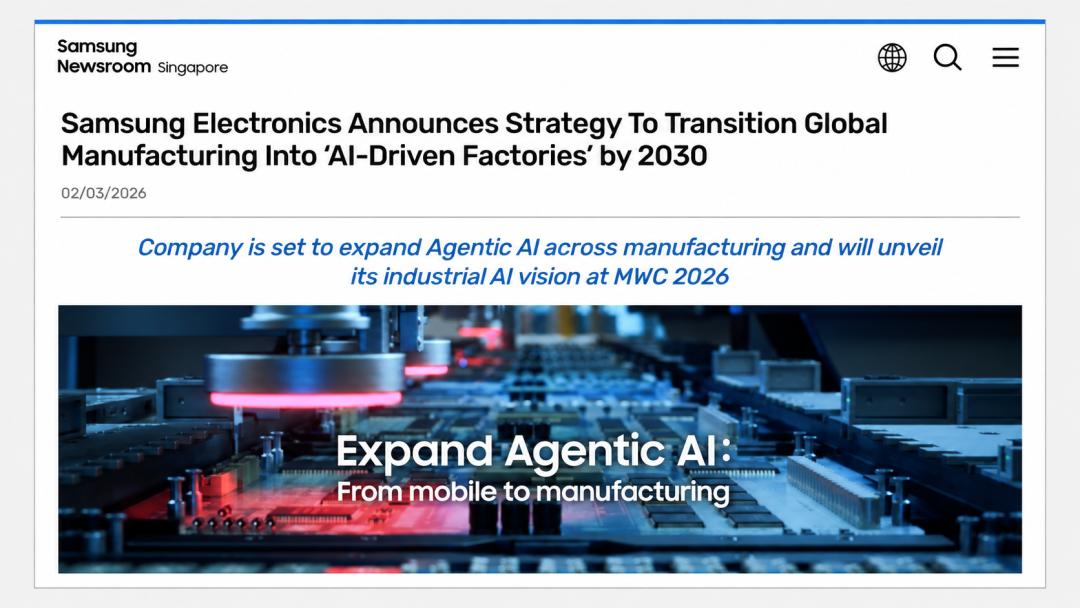
Different robots correspond to different tactile requirements: assembly robots need to judge the insertion force, offset load and whether the parts are in place; logistics robots need to identify the grasping force and slippage; humanoid robots require coordinated force perception of the palm, joints, soles and even the whole body, and service robots also need to solve the safety boundary when contacting humans.
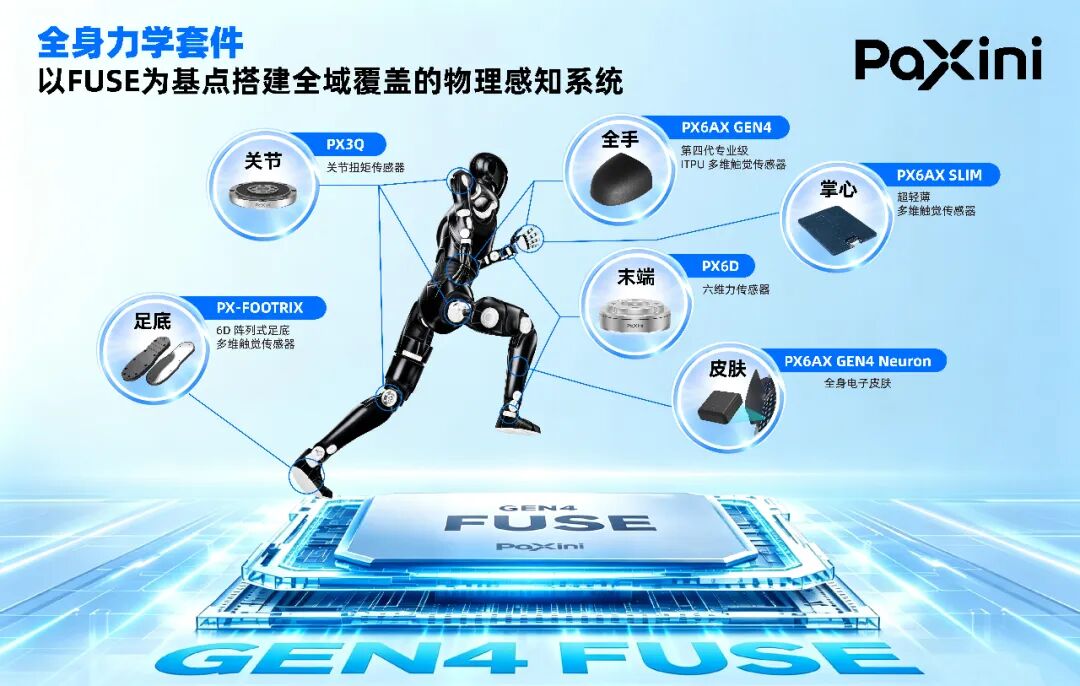
The wider the coverage of robot products, the higher the value of a unified tactile base. Pansini's technical system runs through tactile perception chips, multi-dimensional tactile sensors, full-body haptic products, embodied data and models. Perception nodes can be deployed at fingertips, palms, joints, soles and the whole body, and adjust the size, shape and structure according to different robot products; the collected physical interaction data can also be continuously imported into models and control systems.
Samsung chose Pansini, aiming at the FUSE chip technology that can cover the tactile base of the entire robot product matrix.
From capital to production lines, BYD continues to increase its investment in Pansini
If Samsung focuses on technical depth, BYD tests the results of production lines.
In 2025, BYD made a strategic investment in Pansini, setting the highest amount of its disclosed investment in the embodied intelligence field. On August 25, 2026, the two sides signed a strategic cooperation agreement, and the cooperation expanded from equity investment to business collaboration in data collection, robotics and industrial manufacturing.
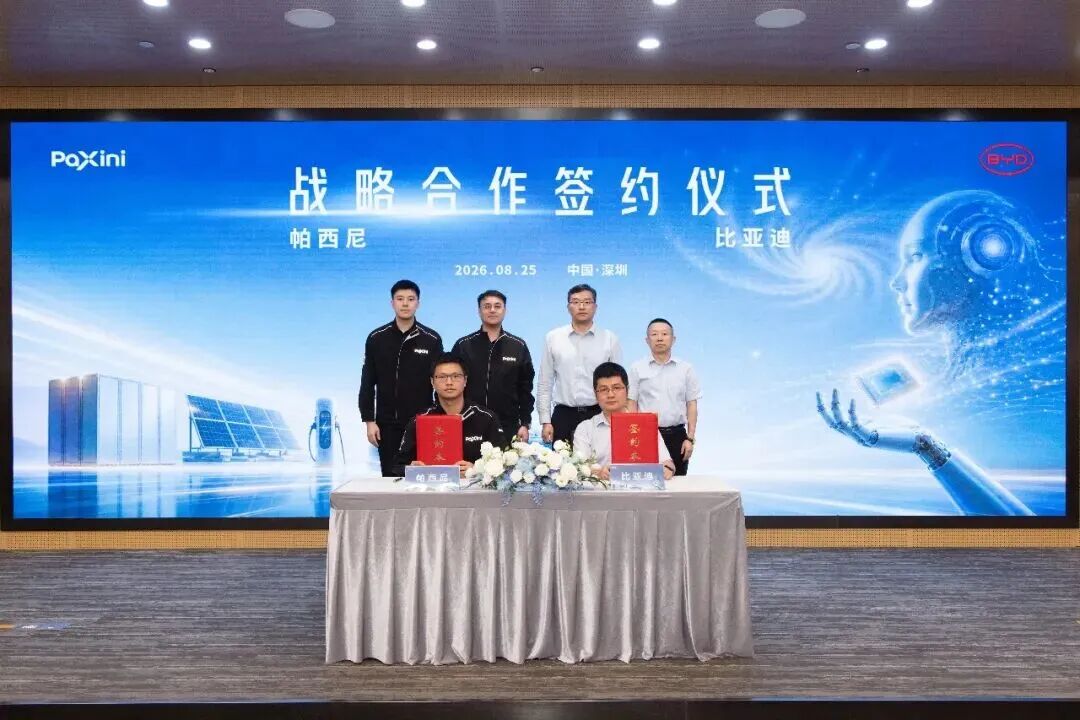
According to the public information of the two sides, BYD will provide the whole vehicle and parts manufacturing process, factory scenarios and supply chain resources, while Pansini will provide tactile sensing, multi-dimensional perception and full-modal data collection capabilities. Real working condition data will also be used for model training to improve the generalization and decision-making capabilities of robots.
The problems in automobile manufacturing often occur in the last few millimeters: whether the buckle is pressed to the bottom, whether the connector is inserted correctly, whether the wiring harness is squeezed, and whether the flexible material starts to slip. Veteran workers correct their movements by resistance, friction and vibration. These indescribable "hand feelings" have long supported the last flexible defense line of the manufacturing industry.
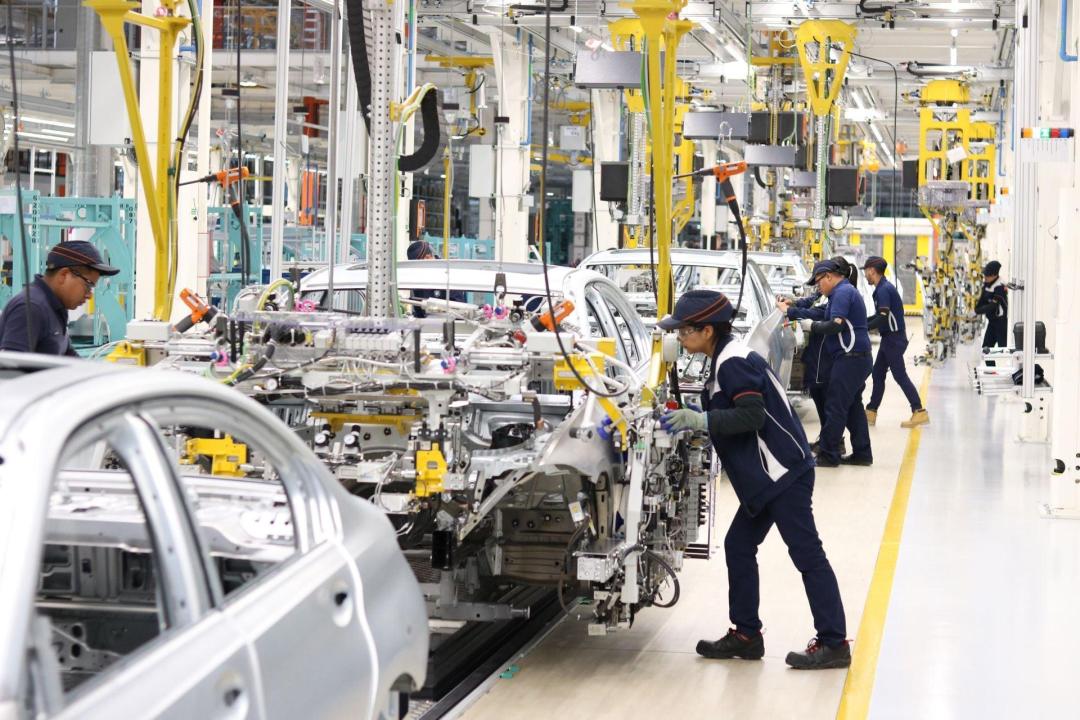
What Pansini wants to do is to turn hand feelings into physical data that machines can collect, understand and reuse.
The manufacturing industry does not pay for concepts, and production lines only recognize results.
Equipment vibration, material deviation, vehicle model switching, electromagnetic noise and long-tail failures will all be exposed in continuous production. For BYD, the truly scarce resources are production lines, processes, quality responsibility and industrial data. Opening these resources to Pansini means that the two sides have entered the stage of jointly solving industrial problems.
Samsung bets on the future, while BYD delivers production line results. Pansini has obtained both technical imagination and industrial certainty at the same time, which is the fundamental reason why capital continues to concentrate on it.
Perception routes are accelerating convergence, and generation gaps are created by iteration speed
Embodied perception still has different technical branches, but the industrial evaluation standards have converged one step ahead: whether tactile perception can cover the whole robot body, whether it can enter the data and control closed loop, whether it can achieve stable mass production, and whether it can continue to iterate in real tasks. Without crossing these four thresholds, no matter how impressive the parameters are, the product can only stay at the prototype stage.
"Full stack" has become a high-frequency word in the industry. It is not difficult to put sensors, data, models and robots on one page of PPT, but a real closed loop relies on long-term engineering verification.
A single grasping or assembly failure may result from sensor drift, mechanical structure, calibration error, data timing, control response or model judgment. A system spliced by multiple suppliers requires cross-company troubleshooting, and any modification at any layer may cause new adaptation problems.
Pansini has mastered tactile perception chips, multi-dimensional tactile sensors, data collection, embodied models and tactile integrated terminals. Failure samples generated on site can be traced layer by layer along actions, data and signals, and then enter the next round of design of device structure and chip architecture.
The full-stack capability finally brings three results: faster problem positioning, faster product iteration, and faster large-scale cost reduction.
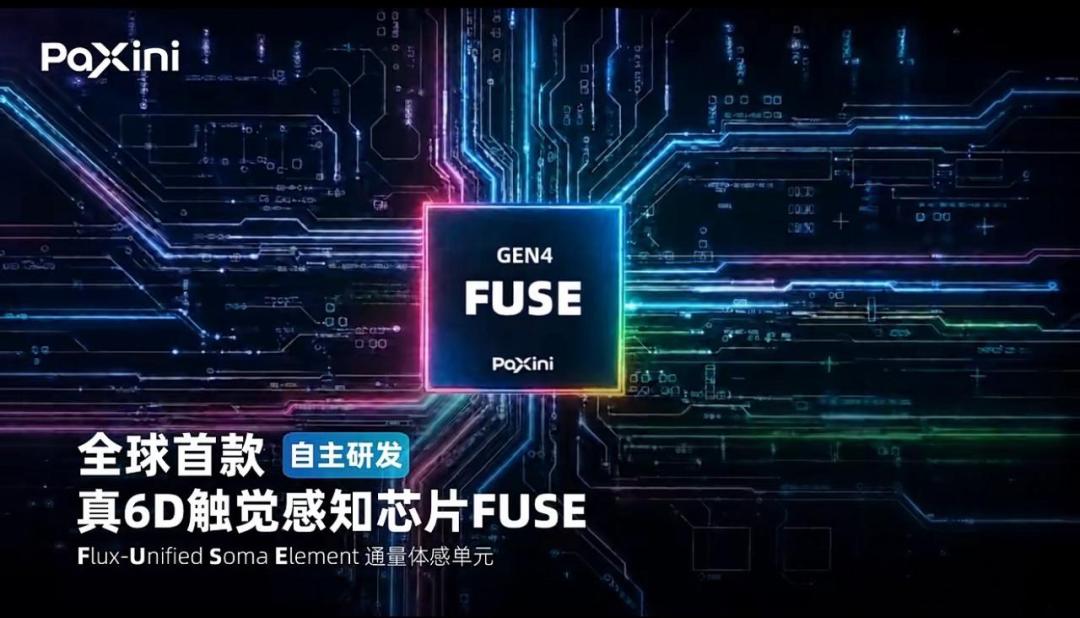
Pansini's 4th generation GEN4 FUSE is exactly the product of this mechanism. Built on the evolution of four generations of chip architectures and a large number of robot tasks, it has native true 6D tactile perception capability, and supports tactile sensors to extend to different shapes, sizes and robot parts, covering fingertips, joints, soles and whole-body perception nodes. From the first-generation prototype to the fourth-generation chip, it means Pansini has completed multiple rounds of technical trade-offs. Industrial products must balance accuracy, latency, power consumption, service life, volume, yield and cost at the same time.
The generation gap of hard technology is rarely hidden in an isolated parameter. It lies in how many more cycles a company has gone through to discover problems, revise designs and re-achieve mass production. The "4" in GEN4 is more informative than any word of "pioneering" and more convincing than any description of "leading".
1 million chips are an engineering database that cannot be purchased
In the past year, the cumulative shipment of Pansini's self-developed tactile perception chips has exceeded 1 million. The significance of the one million chips is not only about the quantity: after the chips are integrated into different tactile products and put into different working conditions, the deviations in design, calibration and testing will be continuously exposed and corrected. These results are finally precipitated into Pansini's engineering database.
Large-scale manufacturing is the cruelest stress test for hardware technology.
Pansini makes trade-offs for mass production from the design end: it adopts DFM design to reduce structures that rely on precise adjustment; it chooses a magnetoelectric solution with separated circuits and elastomers to improve stability and sealing; the materials find the engineering optimal solution among sensitivity, wear resistance and service life. Calibration is completed automatically by robotic arms and force control systems, and the algorithm optimizes sampling points and loading paths synchronously. After that, the products have to undergo more than 10 million presses, friction, EMC and high & low temperature tests, and verify their reliability in complex working conditions such as high temperature, underwater and strong magnetic fields.
Each mass production process leaves new process windows, calibration curves and failure boundaries. Prototypes compete on parameters, while mass production competes on distribution; one chip with accurate measurement represents technology, but the 1 millionth chip that still measures accurately is the real manufacturing barrier. Competitors can buy similar devices and make prototypes with similar parameters. However, the engineering experience accumulated from four generations of iteration and one million chips of mass production cannot be supplemented through financing.
Pansini's 1,000,001th chip is built on the problems solved by the previous 1 million chips.
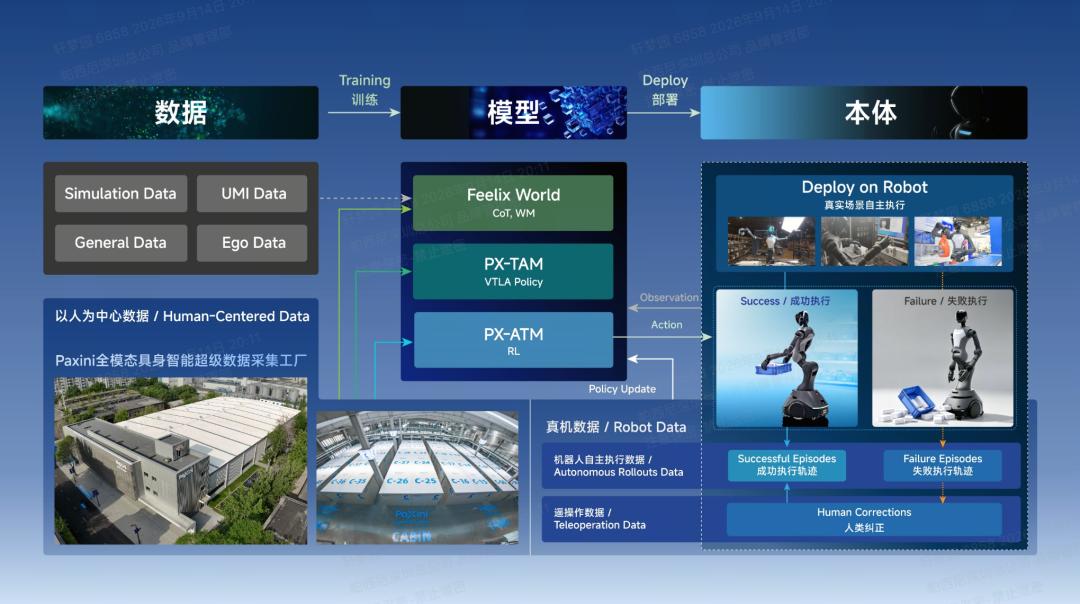
There is another data curve growing synchronously. Tactile nodes deployed in data collection and cooperation scenarios will continuously generate physical interaction data such as vision, tactile sensation, joint state and motion trajectory, and import them into models and control systems such as OmniVTLA 2.0. Manufacturing data improves the next chip, and interaction data improves the next movement.
The one million chips are not only a shipment curve, but also a continuously rising learning curve.
Pansini's valuation boundary goes far beyond sensors
The growth of the embodied industry will be directly transmitted to the perception layer. As robots move from prototypes to large-scale deployment and from single actions to complex tasks, tactile configurations will also expand from fingertips to palms, joints, soles and even the whole body. The number of robots and the number of tactile nodes per unit rise at the same time, and each new node corresponds to new hardware demand and physical data entry.
Pansini has thus formed three core business pillars: large-scale supply of tactile chips and sensors, continuous massive production of physical interaction data, and deep collaborative technology of tactile perception with models and control systems.
The value of the three business pillars is finally realized in customers' real scenarios: providing full-body haptic hardware for robots, continuously supplying full-modal embodied data required for model training, and helping customers shorten the integration cycle and improve task success rate with the system capability that connects perception, decision-making and execution.
Every time the embodied industry lands in a new scenario, Pansini gains a new growth entry, and the value of this perception infrastructure becomes higher.
Industrial shareholders are translating capital advantages into growth advantages
The investors of this round cover local state-owned assets, long-term funds, market-oriented institutions and industrial capital; industrial forces in the manufacturing and electronics sectors such as BYD and Samsung have already made their investments in advance. Funds of different attributes coming together do not mean that they are chasing the same narrative, but that they have reached a consistent judgment on the same physical hard problem: once robots enter real operations, tactile feedback is a rigid demand for the control closed loop.
Local state-owned assets connect regional industries and application scenarios, market-oriented institutions provide governance and continuous financing capabilities, and industrial shareholders bring supply chain, customer verification and global channels. The continuous increase of investment by old shareholders is based on their long-term observation of the company's previous R&D and delivery progress. For Pansini, the value of these funds is far higher than the amount on the books.
