Roundtable: The Light of China Has Become a New Consensus | 36Kr 2026 Industry Future Conference
In 2026, industrial investment has entered a deep-water zone, where capital, technology and industry are accelerating their integration. The old investment logic no longer applies, and a new consensus is emerging. The 2026 Industrial Future Conference focuses on new cycle opportunities, and jointly explores the future of the industry and the birth of "Light of China". From September 9 to 10, the 2026 Industrial Future Conference hosted by 36Kr, with the theme of "Above the Deep Water, Resonate for New Birth", was held in Yizhuang, Beijing. Representatives from state-owned capital platforms, industrial investment funds, corporate CVCs, innovative enterprises, experts and scholars gathered together, focusing on the industrialization of future industries such as quantum technology. The conference conducted in-depth discussions on cutting-edge technologies and industrial perspectives at the current stage, intensively demonstrated breakthroughs in technical routes such as superconductivity, optical quantum, and ion trap, and shared a large number of specific industrial scenarios, industrial system construction, and the prospects of heterogeneous computing, to jointly explore the future of technology industrial investment.
The following dialogue is edited and organized by 36Kr:
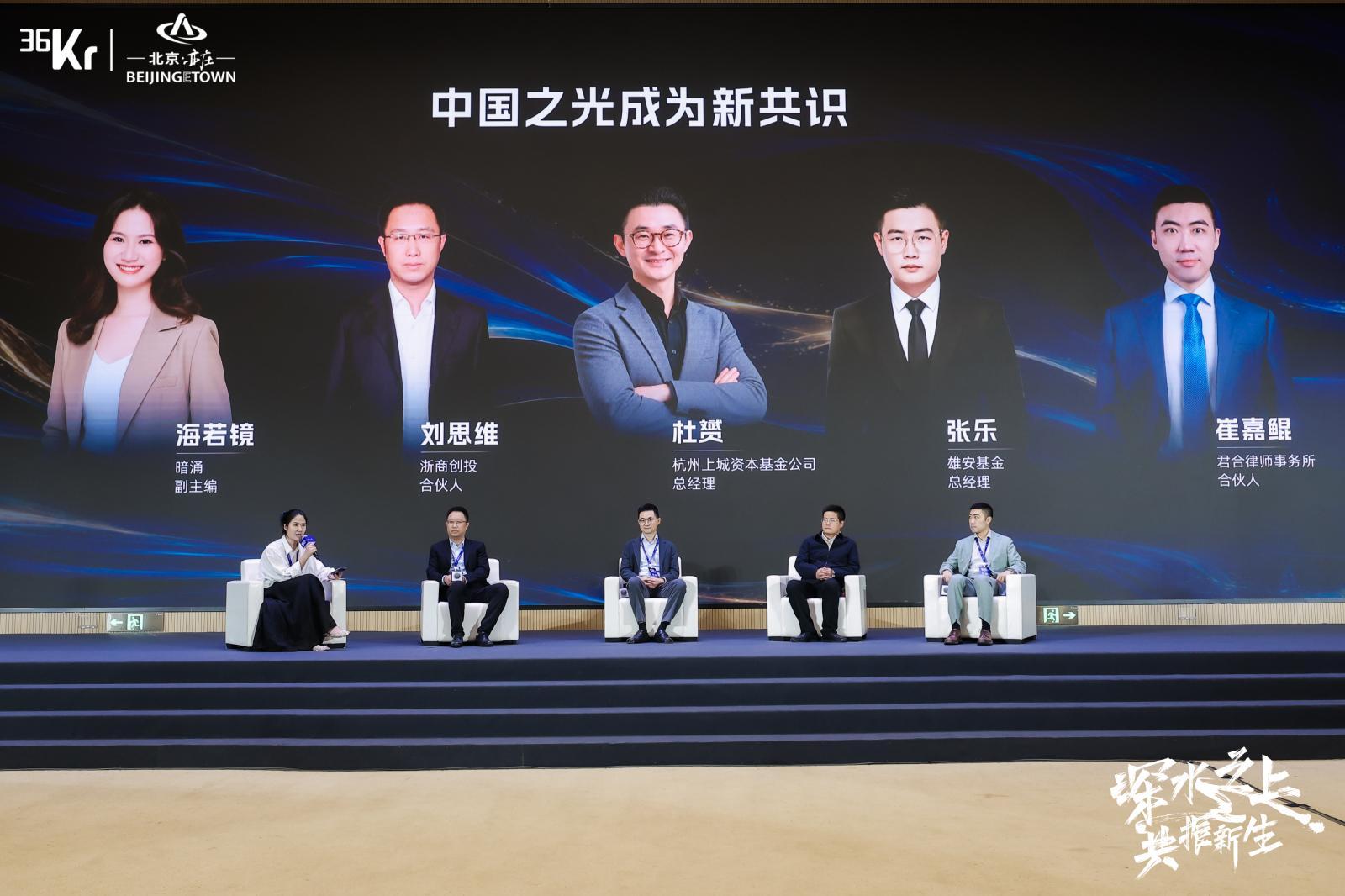
Host:
Hai Ruojing, Deputy Editor-in-Chief of Anyong
Guests:
Liu Siwei, Partner of Zheshang Venture Capital
Du Yun, General Manager of Hangzhou Shangcheng Capital Fund Co., Ltd.
Zhang Le, General Manager of Xiong'an Fund
Cui Jiakun, Partner of JunHe Law Offices
Hai Ruojing: Good morning, everyone! It is a great honor for me to host this important roundtable today. I am Hai Ruojing, Deputy Editor-in-Chief of Anyong. I would like to briefly review several important moments I observed in the first eight months of 2026, and I believe everyone present will have similar feelings.
In January, Zhipu AI was listed on the Hong Kong Stock Exchange; in April, DeepSeek V4 was open-sourced; shortly after, it announced the completion of 500 billion yuan in external financing, and there was new news yesterday that it may be preparing to list on the STAR Market; at the end of July, Changxin Technology was listed on the STAR Market, rising 4.6 times on the first day and becoming the new market value leader; less than a month later, Unitree Robotics went public again. These four companies are in the tracks of large model, memory chip and embodied intelligence respectively. Their growth cycles and capital paths are not the same, but they share a common change: the growth of a world-class technology enterprise cannot be separated from the multi-stage relay of large capital.
Changxin is one of the most typical cases. Starting in 2016, it has accumulated losses of about 30 billion yuan in ten years, behind which is the long-term and firm support of Hefei state-owned capital, which accompanied it to persist for ten years in the loss. In the end, the market also rewarded the long-term adherents: on the first day of listing, Hefei state-owned capital had a floating book profit of more than 1 trillion yuan.
Today, when capital begins to concentrate and increase investment in "Light of China" enterprises, it also brings several issues worthy of in-depth discussion: Where will the second and third batches of "Light of China" come from? Who will ignite them? How should state-owned capital, market-oriented funds and industrial forces collaborate in this system?
It is a great honor for us to invite four guests today. First, please briefly introduce yourselves. If convenient, you can also combine your institutions to talk about which gap in the market has been filled by the round of increased technology investment from state-owned GP and LP.
Liu Siwei: Thanks to Yizhuang, thanks to 36Kr, and thanks to the host for the invitation. I am very glad to participate in this roundtable.
I am Liu Siwei from Zheshang Venture Capital. Founded in 2007 in Hangzhou, Zhejiang Province, Zheshang Venture Capital is a private enterprise. In 2015, the company carried out reverse mixed ownership reform and became a "mixed ownership" enterprise. At present, its equity structure includes provincial state-owned capital, central enterprise capital and private capital, with assets under management of about 650 billion yuan, driving about 200,000 jobs, and the total accumulated market value under management exceeds 8 trillion yuan. At present, it has invested in more than 400 enterprises, of which about 60 to 70 are listed in the capital market. This is the basic situation of our company.
Regarding the general division of labor between state-owned capital and private capital, I would like to share my personal views. State-owned GP and state-owned capital providers are mainly suitable for participating in long-cycle, large-scale and low-volatility investments; private GP is more suitable for project screening and pricing. In addition, post-investment empowerment is also one of the strengths of private GP. The relationship between the two is a relay relationship, not a substitution relationship.
That's all for my sharing. Thank you!
Du Yun: Thanks to 36Kr for the invitation, and thanks to the host. I am Du Yun, from Hangzhou Shangcheng Capital. Hangzhou Shangcheng Capital is a state-owned capital investment platform belonging to Shangcheng District of Hangzhou. We also have our own private equity fund license, and adopt the strategy of FOF plus direct investment: on the one hand, we participate in the funds of market-oriented institutions as LP; on the other hand, we carry out direct investment through filed self-managed funds.
At present, our fund management scale is 10 billion yuan, with about 25 sub-funds under investment, with a total scale of about 20 billion yuan; the scale of direct investment is close to 2 billion yuan. Combined with Mr. Liu's sharing just now, I think state-owned capital mainly plays two roles in the current market.
On the one hand, it participates in the fundraising of GP funds as long-term capital. You may also notice that most of the LPs of many funds are state-owned capital, including provincial, municipal and district-level state-owned capital, and joint investment of multiple local state-owned capitals.
On the other hand, in the field of direct investment, some projects have a long cycle and are difficult to exit in the short term; some projects are in line with the orientation of national policies, but their short-term valuation is too high to be digested by market-oriented capital. In this case, state-owned capital can play a certain complementary role.
Zhang Le: Hello everyone, I am Zhang Le from Xiong'an Fund. The full name of Xiong'an Fund is China Xiong'an Group Fund Management Co., Ltd., which is the manager of the government investment fund of Xiong'an New Area. At present, the fund management scale is more than 20 billion yuan. Xiong'an Fund actively serves the national strategy, is committed to widely attracting and gathering domestic and foreign forces and capital to participate in the construction and development of Xiong'an New Area, and helps Xiong'an New Area become an innovation highland and entrepreneurial hot land in the new era.
We have just released the recruitment announcement for four sub-fund managers not long ago. Everyone is welcome to actively participate in the application, and all kinds of venture capital institutions and entrepreneurial enterprises are welcome to develop in Xiong'an.
Cui Jiakun: Hello everyone, I am a partner in the Beijing office of JunHe Law Offices, mainly engaged in RMB and USD funds, investment and financing transactions, mergers and acquisitions and other related businesses. I have a close relationship with 36Kr. Nine years ago, I participated in the establishment of 36Kr's own fund project and served as the external lawyer of 36Kr at that time. Many years have passed in a blink of an eye.
I am mainly engaged in non-litigation business. When I was chatting with Mr. Du off the stage just now, he asked me what emerging businesses have appeared recently from a legal perspective. In recent years, we have actually handled a considerable number of dispute resolution cases. After many investment projects go through a long cycle, they may be accompanied by the decline of investors' patience for exit and return, or new changes in the invested enterprises or the external market environment, leading to various complex disputes.
From the perspective of external lawyers, we also have a relatively unique perspective, and have the opportunity to see the ups and downs of some projects. Today, we see that everyone is pouring into certain industry fields, and three to five years later, we may also see the risks contained in them gradually exposed, which will bring some enlightenment to us and our peers. So in this roundtable, I will also try to share some of our market observations with you from different perspectives.
Hai Ruojing: Just now, the guests briefly talked about how state-owned capital and market-oriented funds, two different types of capital, can give full play to their respective strengths.
The funds where the guests present are located have management scales ranging from 100 billion yuan level to 200 billion yuan level. I would like to ask that as large-scale capital becomes more and more concentrated, in the past, VC may have adopted a decentralized investment strategy, but now it turns to concentrate on "building light". What are the reasons behind this? For example, in the era of AI and embodied intelligence, the probability of the birth of super-large enterprises may be higher than ever, and this process requires saturated investment, which is one of the reasons I thought of.
I would like to ask you which links are more suitable for centralized collaboration to "build light"? Which links are more suitable for decentralized trial and error to retain innovation?
Liu Siwei: To concentrate our efforts on "building light", the key lies in how to understand this "light". The first type refers to optical chips, optical devices, etc.; the second type refers to stocks with the word "light" in the stock market; the third type refers to the "light" of China's future hope, such as strategic emerging industries like quantum technology and commercial aerospace.
At present, what we need to concentrate our efforts on breaking through are the fields that face "neck sticking" problems in China, such as high-end optical chips, high-end optical devices and core materials, and precision optical manufacturing.
Why does the phenomenon of concentrating on "building light" appear? Personally, I think after the arrival of the AI era, the entire industrial logic has changed. Computing power, data and top talents all require saturated investment, and single-point innovation cannot support the industrial ecosystem. To truly build this "light", the participation of multiple forces is required.
Personally, I think the construction of the infrastructure layer requires more participation from state-owned capital, such as the underlying computing power and infrastructure layer; private capital is more suitable for participating in the application layer. In the direction of algorithms and other fields, we need to maintain decentralized exploration, not to concentrate on a single route, but to promote multiple technical routes to move forward in parallel.
The above is my personal view. Thank you.
Hai Ruojing: That is to say, the AI Infra layer may require more participation from state-owned capital?
Liu Siwei: Yes.
Du Yun: I understand that "Light of China" refers to leading enterprises in the field of hard technology that can occupy a certain position in the global industrial chain. On the one hand, there are objective reasons for the centralized investment in these enterprises, because these industries require large capital investment; at the same time, the more capital is invested, the deeper the barrier will be, and the leading effect and "winner takes all" effect will become more obvious in the later stage. Therefore, everyone will concentrate on chasing such enterprises.
Second, from the policy perspective, no matter the capital investment policy, state-owned capital policy or capital market policy, they are more encouraging and supporting the hard technology related industries, thus forming the current pattern.
Which links need to concentrate on "building light" and which stages need early decentralized investment? I think for some industries that have achieved industrialization or have been successfully verified globally, for example, the semiconductor memory industry has development experience in Japan and South Korea, we can learn from the existing path and create "Light of China" through high investment. Such industries are more in need of centralized investment.
On the other hand, for some fields where the early technical routes have not yet converged, such as embodied intelligence and embodied brain models, various technical routes are not yet clear, and decentralized investment is required to lay out different directions in the early stage. This is my point of view.
Hai Ruojing: I see. When the certainty of technology and industrial paths is relatively strong, it is more suitable for state-owned capital to carry out centralized investment. Mr. Zhang, what's your opinion?
Zhang Le: Personally, I think that for strategic emerging industries with relatively strong certainty, which are gradually moving from the early exploration stage to the pillar industry stage, moderate centralized investment should be carried out. For future industries, decentralized investment is more suitable before centralized investment. For future industries, we should encourage innovation and trial and error, support scientists and entrepreneurs to explore new directions and new fields. Appropriate decentralization can not only have more investment opportunities, but also diversify investment risks.
Hai Ruojing: For strategic emerging industries with strong certainty, many directions may have been verified, and it is suitable for centralized investment at this time. As we just discussed, future industries still need to complete technical verification through decentralized investment, but now we also see that many future industry companies have attracted a lot of capital, and have become the direction of state-owned capital to increase investment intensively.
Please talk about why the phenomenon of centralized investment has also appeared in many very emerging future industry directions?
Du Yun: The first reason is the track reason. At present, the main capital in the capital market is concentrated in a few tracks, such as AI, embodied intelligence, etc. The AI field covers directions such as semiconductors and computing power; embodied intelligence extends from embodied models and ontologies to downstream applications. The overall investable tracks are focused on these fields, and state-owned capital hopes to focus on cultivating these tracks. Many market-oriented institutions have also accepted the capital contribution from state-owned capital, so all parties have formed a strong consensus on track selection.
Second, taking the embodied brain track as an example, there are many enterprises, such as the leading Zhiyuan, Galaxy General, Xinghaitu, etc., all of which have obtained large-scale financing, but there is also obvious differentiation inside. The overall financing scale is very large, but the capital absorbed by the top enterprises may be more than the total financing of all enterprises after the fifth place, which is also an important feature of the current market.
Hai Ruojing: The guests present represent different regions and different cities. If everyone is chasing similar tracks, will there be homogeneous investment or even redundant construction?
Liu Siwei: The phenomenon mentioned by the host does exist in reality. In the process of our investment, or when we contact with FOF and LP, we often receive similar feedback: every place hopes to introduce industries related to "light", some places hope to lay out lithography machines, and some hope to lay out semiconductors or chips. How to explain this phenomenon? Personally, I think the convergence of consensus is one aspect, but more importantly, we should adjust measures to local conditions. We should start from the local advantageous industries and find the direction with mainstream advantages and industrial agglomeration foundation. For example, Zhejiang has developed private enterprises, and some industries with relatively small investment, close to consumption scenarios and suitable for early verification may be more suitable.
For example, northern China has a heavy industry foundation, and directions such as heavy manufacturing and deep-water robots may be more suitable, because the local area has industrial foundation and skilled technical workers. The robot industry itself can also be divided into "light" and "heavy": the north is more suitable for heavy robots, and the south is more suitable for light robots and manipulators, because the relevant industrial chain is more concentrated. Industries such as commercial aerospace and military industry may also be more suitable for taking root and developing in some cities in the north. This is my personal view.
Hai Ruojing: We still need to adjust measures to local conditions and combine local advantages. The next question is also the long investment cycle issue that several guests just mentioned. "Patient capital" has been discussed for many years. As Lawyer Cui just mentioned, the businesses with high returns in the past are mainly dispute resolution businesses, and some institutions may no longer have the patience to wait.
On this issue, we also see that the national venture capital guidance fund has indeed extended the cycle to 20 years, and the assessment system has also undergone some changes. I would like to ask Lawyer Cui: From your perspective, when we define "patient capital", where is its boundary? From the legal and auditing perspective, is there a set of reviewable and interpretable standards to distinguish between "patient persistence" and "invalid persistence"?
Cui Jiakun: The host's question is quite challenging, and the definition itself is very difficult. Let me talk about my personal understanding. The policy orientation of the Chinese market is relatively obvious. Generally speaking, when we start to advocate a new term or concept, it often means that it is lacking in reality. It is precisely because of the lack that we need to advocate it.
For example, adding the attributive "patient" before "capital" is itself worthy of discussion. Capital is naturally free-flowing, and under the order of market economy, capital will be