Roundtable: Growth · The New Investment Equation for Capital Investors — Patience and Value That Transcend Cycles | 36Kr 2026 Industry Future Conference
In 2026, industrial investment has entered a deep-water zone, where capital, technology and industry are accelerating their integration. The old investment logic no longer applies, and a new consensus is taking shape. The 2026 Industrial Future Conference focuses on opportunities in the new cycle, and jointly explores the future of the industry and the birth of the "Light of China". From September 9 to 10, the 2026 Industrial Future Conference hosted by 36Kr was held in Yizhuang, Beijing, under the theme of "Above the Deep Water, Resonate for New Birth". Participants from state-owned capital platforms, industrial investment funds, corporate CVCs, innovative enterprises, and experts and scholars gathered to focus on the industrialization of future industries such as quantum technology. The conference conducted in-depth discussions on current cutting-edge technologies and industrial perspectives, showcased breakthroughs in technical routes including superconductivity, photonic quantum, and ion trap, and shared a large number of specific industrial scenarios, industrial system construction, and the prospects of heterogeneous computing. All participants jointly discussed the future of technology industrial investment.
The following dialogue is edited and organized by 36Kr:
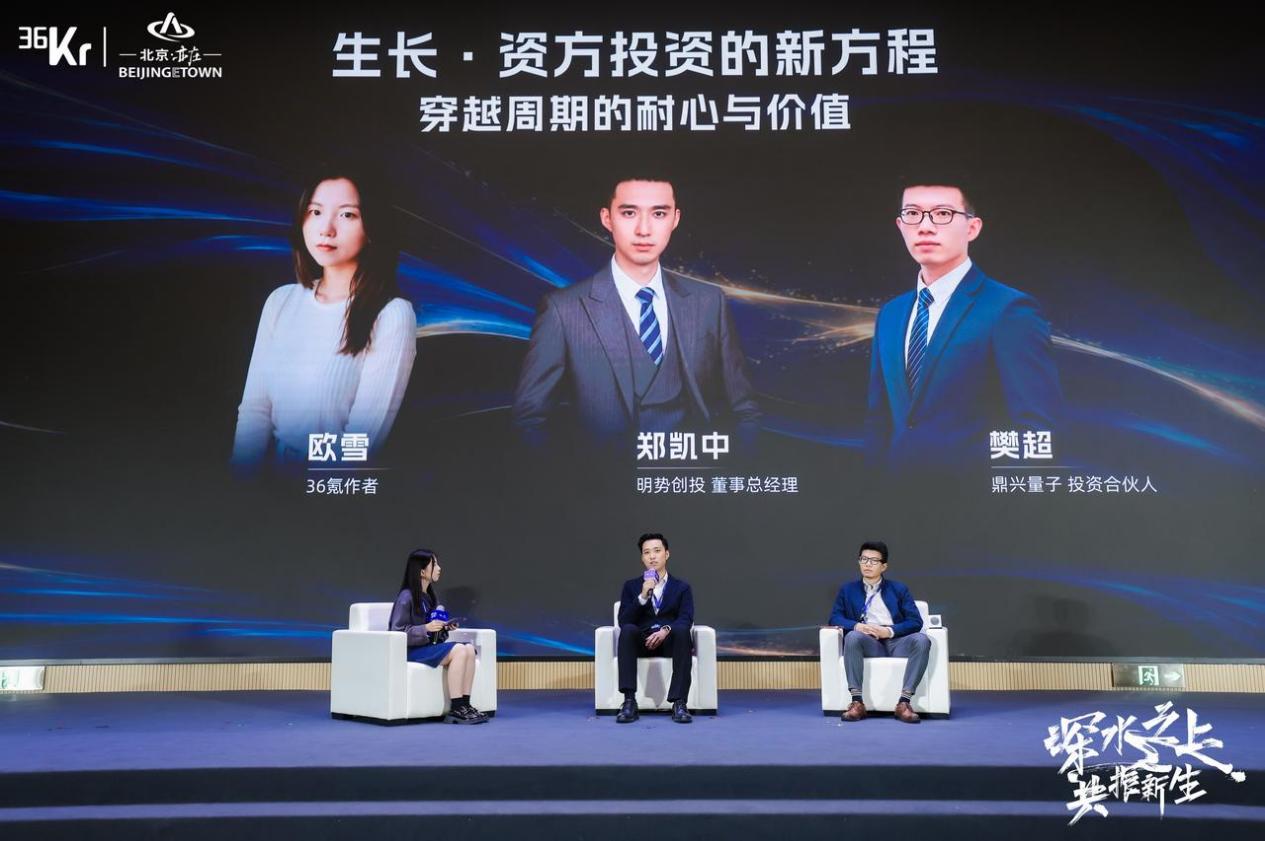
Ou Xue | Author of 36Kr (Host)
Zheng Kaizhong | Managing Director, Mingshi Venture Capital
Fan Chao | Investment Partner, Dingxing Quantum
Ou Xue: We have heard a lot about quantum computing earlier. In 2026, if I have to pick the most talked-about track in the primary market that still has certain divergences, I think quantum computing will definitely rank at the top.
Most people may have a common perception that there are two different perspectives in the industry now. One side believes it has the long-term potential as an "atomic bomb of computing power", while the other pays more attention to the pre-investment valuation of quantum computing and the gap between theoretical expectation and actual implementation. It is obvious that the technology side is making progress, but the commercial side is still climbing uphill, which is a very objective status of the industry at present.
This year, some domestic quantum computing enterprises have taken IPO actions, and some people say "this year can be regarded as the first year of IPO for China's quantum technology". We can see that many leading enterprises have started listing tutoring, and the financing track is also very active. Especially from last year to this year, the financing scale in the first half of this year has increased significantly. There is also an objective reality that many routes in quantum computing have not converged, the overall revenue scale of the industry is still very limited, and real commercial scenarios are still being explored.
The core topic we want to discuss today is, at this current node, what exactly are we paying attention to as capital parties? Is it the improvement of the number of qubits, the progress of error correction capabilities, or the feasibility of a closed business loop?
Today we have invited two investors from different perspectives, welcome to both guests! Before we start the formal discussion, please give a brief self-introduction, and share the current layout of your respective institutions in the quantum computing track.
Zheng Kaizhong: Thank you very much for the invitation from 36Kr! I am Zheng Kaizhong from Mingshi Venture Capital, and I have been continuously focusing on opportunities in the fields of cutting-edge technology, AI infrastructure, and AI for Science. Founded in 2014, Mingshi Venture Capital is one of the earliest domestic institutions focusing on technology investment. At the beginning of our establishment, we were the earliest institutional investor of Li Auto. Centering on the electrification and intelligence of automobiles, we have invested in a large number of ecological enterprises, and later expanded to advanced manufacturing and cutting-edge technology.
From the second half of 2021 to the first half of 2022, as an angel investor, Mingshi invested in MiniMax, and since then entered the full-link layout of the AI Ecosystem. We focus on AI infrastructure at the upstream, including computing, storage and communication, and on AI hardware and applications at the downstream.
Generally speaking, as an early-stage technology institution, Mingshi Venture Capital is willing to believe in entrepreneurs with long-term vision and willingness to do difficult things in the first round, and firmly accompany them to move forward. As I mentioned earlier, MiniMax and Li Auto were both invested by us from the angel round, the earliest round, and we continued to invest for 6-7 rounds. In this process, we will continue to build connections and cooperation for our Portfolio based on the resources of the upstream and downstream of the ecological chain and strategic binding. This is the basic situation of our fund.
As for the attention to quantum, I think it largely stems from our focus on the base of computing power. As we all know, when studying micro problems, especially atomic-level problems, accurate calculation becomes a very critical bottleneck limiting its capability.
Quantum computing has the opportunity to play a relatively large role here and solve some objective problems we have indeed seen. Mingshi has been paying attention to quantum computing since 2018 and has made continuous investments. In 2018, as the earliest institutional investor, we invested in SpinQ Technology, a domestic quantum computing company. Over the past 8 years, we have continued to pay attention to the evolution of the quantum computing ecosystem, technological changes and application implementation. Since then, we have completed investments covering the key supply chain of the whole machine, including the application layer.
Overall, I think Mingshi Venture Capital holds a very open and embracing attitude towards cutting-edge technology, and is willing to accompany these idealistic entrepreneurs to move forward continuously. Thank you all!
Fan Chao: Hello everyone, I am Fan Chao from Dingxing Quantum Fund. Our name may be the only one among all investment institutions that contains the word "quantum". When we named the fund in the early years, we thought quantum entanglement itself is a byword for technology, so there is a certain origin behind it.
We have observed the quantum sector for several years, and officially started investing in 2021. There were about three or four years of observation time before that. Up to today, among the key projects we have laid out, Guoyi was just listed last month. Whether we added positions in Guoyi for two rounds ourselves, or led core institutional LPs to jointly increase their holdings, we have invested more than 500 million yuan in total in one project. Once we select a good project, we will attach great importance to it. Second, we have laid out Boson in the photonic quantum field, with an investment of nearly 100 million yuan. These two are the projects that we have made relatively late efforts in the past year, and are close to the IPO market.
In addition, we have just recently established a quantum industry fund to comprehensively lay out the entire track. Our methodology may be somewhat different. This fund is mainly co-incubating new assets with several industries we are familiar with. We will not invest too many projects whose valuation or stage does not match our positioning, and we will incubate projects by ourselves.
Ou Xue: Thank you for your brief introduction. From what you just shared, we can hear that the betting logic of the two institutions is indeed different. First, I want to break down the investment logic in detail. The first question is for Mr. Zheng, since Mingshi has always emphasized the four-stage investment model: scientific discovery, technology implementation, large-scale engineering, and productization. Which stage do you think quantum computing is in now?
Zheng Kaizhong: From the perspective of Mingshi, we propose the four-stage model. To a large extent, we believe that as early-stage technology investment, or VC-stage investment, we should focus on fields where scientific problems have been solved and have entered the engineering implementation stage, no matter for new technologies or new products. Quantum computing is indeed very special, or for many cutting-edge technologies, we have observed a very obvious change now: engineering and technology, or science and engineering are mutually coupled. Quantum computing is a very typical example. As the number of qubits increases, new key technical problems will inevitably be introduced, such as noise problems, control problems, and subsequent error correction problems, which actually involve scientific issues. With the improvement of scientific control methods, it may further reconstruct the implementation of our entire engineering. Essentially, we think the industry has now entered a stage where science and engineering jointly promote development.
I think for quantum computing, the same is true for many cutting-edge technologies. We see that the iteration of engineering is now further feeding back the development of science. For China, we are very fortunate to see that this may be a differentiated opportunity, which can further promote the development of the entire industry by rapidly accelerating the speed of engineering.
Specific to the changes in the quantum computing stage, we are pleased to see progress in key technical fields, whether it is the number of qubits, fidelity and error correction, which can be better integrated into the system organically. This is a very good change. Secondly, since the end of 2024 and the beginning of 2025, we have found that AI is also actively feeding back the changes of quantum computing. In addition to the application of "quantum-AI integration", more is the improvement of AI to the efficiency of error correction algorithms, which indeed plays a great role in accelerating the development of the entire quantum industry.
Therefore, we generally believe that quantum is now in a period of accelerated development of science and technology, and the advantages of engineering will further expand and amplify the development speed of quantum computing.
Ou Xue: I think the concept of mutual coupling between science and engineering is quite interesting.
Zheng Kaizhong: Yes, we think that in the field of hard technology, more and more cases show that the two are not completely separated, but a process of mutual coupling and mutual promotion.
Ou Xue: Next, I would like to ask Mr. Fan. You just introduced the general layout of Dingxing Quantum. I would like to ask, what is your core decision-making logic when judging whether a quantum computing company is worth investing in? Compared with the perspectives of other institutions, do you have any differentiated points?
Fan Chao: I may answer from another angle, and give several reference dimensions from the perspective of scientific research and engineering:
First, we particularly prefer well-established teams, and do not like individual technical experts to start businesses independently. We have been investing in technology and high-end manufacturing for so many years, and a situation we have always worried about is that a technical expert or a professor starts a business independently, and the result is that it is difficult to form a commercial company in most cases. They may have major obstacles in commercial company management, team management, and expectation management. Therefore, we very much prefer well-established teams, at least a mature team of 5-10 people, plus a group of doctoral students would be better.
Second, the team must have cross-border capabilities. In fact, there are still many technical blind spots in the breakthrough of quantum computing that have not been touched. When we reach that stage, new problems will emerge, so cross-border capabilities are necessary. How to understand cross-border? Most people are used to staying in schools, and when doing experiments and scientific research, they pursue the extreme of some parameters, or discover a certain principle or phenomenon, but in actual business, they have to solve customers' problems. You need to provide stable and effective functions. The gap in between lies in how you treat the stability, and how to connect with customer demands. Everyone needs to settle down to work, which is a bit difficult for many professors. Therefore, we hope to invest in teams with cross-border capabilities, and a team with more diverse backgrounds in terms of inclusiveness will be much better.
The second point is that we have relatively high requirements for diverse teams and cross-border capabilities. Of course, this is now reflected in some AI for Science and Quantum for Science enterprises, that they can make a good fit or match between the upstream, downstream and end-user demands. I think this group of people has high requirements. In addition to scientific principles, they need to know how to implement in engineering, how to achieve integration and miniaturization. I think this can be accelerated with the help of colleagues in the semiconductor industry or the AI industry, and the requirement is indeed very high.
Third, in the past, most of the people in this field were a group of very smart elites, but we hope that when running a commercial company later, they can lower their stance. Because as everyone says, quantum computing has not yet reached the premise of large-scale fault tolerance. To run a commercial company well and achieve the balance of multiple goals, you actually need to better position yourself to serve customers. Including the integration of quantum and supercomputing, in fact, our current ecological volume is completely different from that of AI. The total volume of AI is at least trillions, but quantum computing has just exceeded 10 billion in terms of industry output value. So I think everyone should actively embrace any partners that can accelerate industrialization.
Ou Xue: To sum up, it feels that Dingxing Quantum has a very comprehensive consideration of the entire team, which is very similar to the feedback I got from many other investors. They all value cross-border capabilities very much. It seems that everyone's logic is roughly the same.
Next, we will explore the technical routes of quantum computing. We also know that the routes of quantum computing have not yet fully converged, such as superconductivity, photonic quantum, ion trap and so on. First, this question is for Mr. Zheng. It seems that you are focusing on cutting-edge optoelectronic science and some core components, so the photonic quantum route naturally has some intersections with the optoelectronic industry. Among these routes, will you naturally prefer photonic quantum more, or are you very open to all routes?
Zheng Kaizhong: First of all, we are definitely very open. I want to emphasize that Mingshi does pay a lot of attention to optoelectronics. We have been paying attention to the evolution of the entire optoelectronics industry since 2021. At that time, we noticed the general trend of "optoelectronics replacing copper", and around the entire AI evolution ecosystem, we invested in many opportunities of optoelectronics that assist or form the AI Supporting layer.
In this process, what we focus on is to understand how different optoelectronic devices or modules embedded in a system play their roles, rather than treating them as discrete devices. The same applies to quantum. We know that in addition to photonic quantum, many routes in the quantum field will also use optical technologies. For example, for neutral atoms, how to control and manipulate atoms, how to use optoelectronics to control them, all require optical technologies. The laser itself can also generate atoms and ions.
In fact, optoelectronics will be a very key technical pillar in the entire quantum industry, but this does not mean that we are limited to examining the changes of quantum from the perspective of optoelectronics. How Mingshi views the path of quantum computing, I think we consider this issue from several levels:
First, the changes at the scientific level, which are problems that must be solved. We know that for the key indicators of quantum computing, the number of qubits, fidelity, and advanced indicators such as the progress of error correction are all key scientific indicators. I remember that Google published an article on error correction in the first half of 2023, and many people in the industry questioned that the article might be caused by experimental errors, because the difference in code distance was not that large. Until 2024, Google's Willow quantum chip was officially released, and everyone officially verified that the error correction Surface code or Break even has been crossed. So I think these scientific progress and breakthroughs are definitely our key focus.
Including the increase in the number of scalable atomic arrays in the neutral atom field, this is also a very important scientific indicator. The first point is that major breakthroughs and changes at the scientific level are of great value and significance for a certain technical route.
Secondly, the changes at the engineering level. The improvement and breakthrough of a single point of indicator does not mean that it can be used as an engineering system. We pay special attention to whether the quantity and quality in a subsystem can operate compatibly, which plays a great role in the productization or engineering implementation of the entire quantum computing.
Finally, back to the choice of technical path. We generally believe that in addition to the comparison of science and engineering, what problems the technical characteristics of a certain route are suitable for solving also needs to be included in the consideration. For example, for superconductivity, its gate circuit operation speed is very fast, so it may have additional value for some scenarios with high-frequency operations; photonic quantum is naturally suitable for solving graph-related problems; neutral atoms have a large number of qubits, long coherence time, and are easy to manipulate, so they are naturally suitable for some scientific computing problems. For example, using some neutral atoms to do many-body simulation is very suitable as the base of next-generation scientific computing.
Generally speaking, ion trap has high fidelity and easy operation, so it has natural advantages for applications and scenarios with high-frequency interaction with quantum. Overall, the choice of technical path should be defined by the demands of scenarios, which is similar to that demands select technology to define products. Generally speaking, science determines its upper limit, engineering capability determines its feasibility, and finally we go back to what problems the scenario solves, and whether it has higher ROI and value than traditional solutions, which determines whether a certain route can be truly implemented.
Therefore, we have very high expectations for different technical routes, and we do see that in different fields and scenarios, quantum computing can really bring greater advantages and values different from traditional computing.
Ou Xue: Thank