A Full Insight into Two Decades of Venture Capital in Northeast China: The Three Northeastern Provinces Are Determined to Stand on Their Own and Hold Their Ground
When it comes to the three provinces in Northeast China, namely Heilongjiang, Jilin and Liaoning, you will see two completely different versions of this region. One is the familiar side: rich Northeast Chinese grilled skewers delicacies, a strong sense of everyday life, low housing prices and consumer prices. The other side is marked by population outflow, ebbing capital, a cold venture investment atmosphere, and the unwritten rule in the venture circle that "no investment crosses the Shanhaiguan Pass".
However, beyond the grand structural narrative, small cracks have emerged: this year, Chang Guang Satellite secured 5 billion yuan in strategic investment, becoming the most prominent commercial aerospace project in Northeast China; the number of annual events in the Northeast China's primary market in 2025 hit its highest range in history, with the activity of local state-owned capital funds rising significantly in particular.
We believe that only complete data can bring more factual fragments to the surface.
Therefore, this is not an article telling capital stories, but an attempt to sort out the full 20-year history of venture investment in Northeast China with data, as well as a result verification report for the previous article about the efforts of local state-owned GPs in Northeast China to boost venture investment. We strive to ensure that every judgment we make has a corresponding basis in the statistics.
I. Total Volume Curve: Sustained Macroeconomic Growth With Two Peaks and Two Troughs
Counted by natural years, the 25-year development of venture investment in Northeast China has exactly gone through 5 Five-Year Plans. During the 14th Five-Year Plan period (2021-2025), there were 525 financing events in the Northeast China's primary market, 8.5 times the number in 2006-2010, which is an impressive achievement. The overall linear growth curve is as follows:
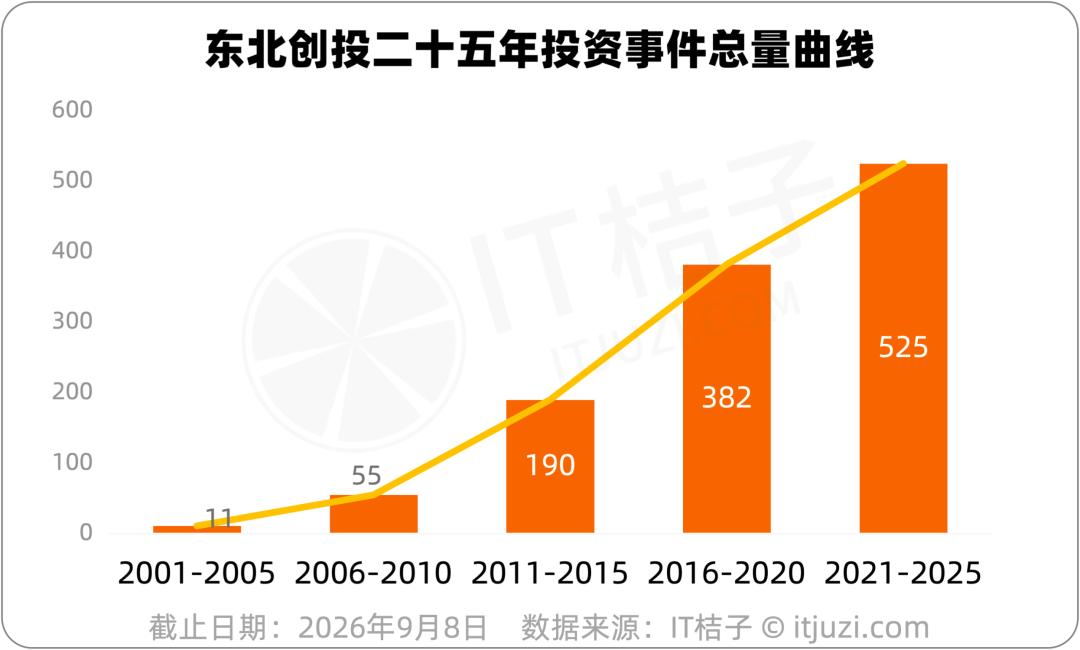
Note: Only primary market events (equity financing, mergers and acquisitions, strategic investment, etc.) are counted, and secondary events such as IPO and NEEQ listing are not included. The 2026 data is as of early September.
However, from the perspective of market cycles, this 25-year-long development is not linear, but fluctuates repeatedly. It can be divided into five different stages with different durations and performances.
The first stage is the 10-year "Wilderness Era" from 2001 to 2010: there were only 66 accumulated events in 10 years, less than 7 events per year on average. It can be said that the concept of "venture investment" barely existed in Northeast China at that time, and most financing events were led by local industrial groups.
Nevertheless, some established national leading institutions have begun to consciously lay out their presence in Northeast China. For example, Shenzhen Venture Capital, Cowin Capital, IDG Capital, and HSG began to tentatively enter startups in cities like Shenyang and Dalian around 2008.
The second stage is the "Pioneering Era" from 2011 to 2013: the number of events increased from a handful of scattered cases per year to dozens, realizing quantitative growth.
The third stage is the "Mass Entrepreneurship and Innovation Boom" from 2014 to 2018: the number of events rose from 43 per year to 75 in 2016, doubling in only two years, and reached a peak of 91 in 2018. This was mainly driven by the national mass entrepreneurship and innovation trend in the first three years of this period, followed by the peak of the O2O and consumer internet tracks. Capital flowed along the trend, and Northeast China also got a small share, even if it was only a leftover piece of the pie.
The next stage is the "Ebb Tide Era" from 2019 to 2023, the number of events gradually declined from 91 to 73 in 2022, and the number of active institutions dropped sharply in 2023. The number of events can better represent the overall industry temperature, indicating that the "vital signs" of Northeast China's venture investment sector are declining, and the industry has gone through a new round of adjustment.
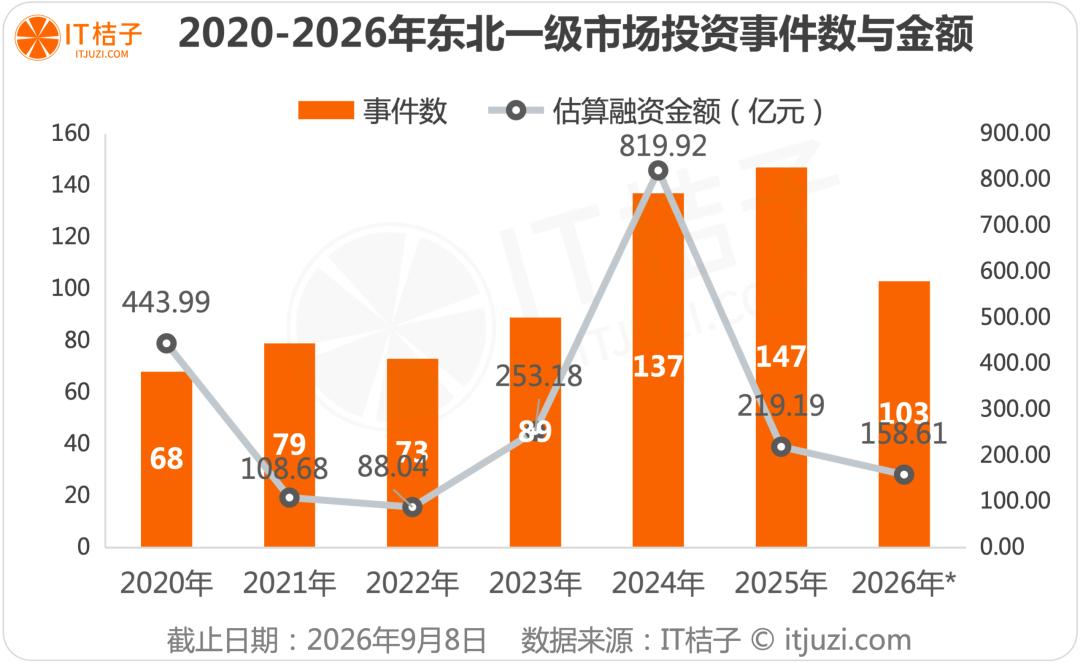
Note: The amount of some events is not disclosed, and the amount is based on estimated statistical caliber. The high financing amount in 2024 is mainly contributed by a single 60 billion-yuan transaction of "Dalian New Alliance".
Somewhat abnormal is that the total financing amount in the ebb tide era was rising instead, reaching 444 billion yuan in 2020: this was supported by large-scale mergers and acquisitions such as the restructuring of Dalian Hengli Group and the mixed ownership reform of state-owned enterprises. The amount represents the overall scale, which is mainly driven by major head events.
However, Northeast China has entered the "State-owned Capital-Driven Era" since 2024: there were 137 events in 2024, 147 in 2025, and 103 in the first 8 months of 2026, which has reached 70% of the total number of events in 2025. At the current pace, the full-year 2026 will most likely refresh the annual record of Northeast China's venture investment over the past 25 years.
Converted to annual average, the density of events in Northeast China's primary market since 2024 has reached about 141 per year, 20 times that of the Wilderness Era and 2 times that of the Mass Entrepreneurship and Innovation Boom, hitting the highest range in history. But the driving force this time is completely different from the previous stages.
II. Institutional Ecosystem: Institutions Come and Go, Most Try But Few Stay Persistently
By sorting out the investors of each event in the past 20 years and counting the number of institutions that made investments in Northeast China each year, we get a curve that climbs slowly and rises spirally:
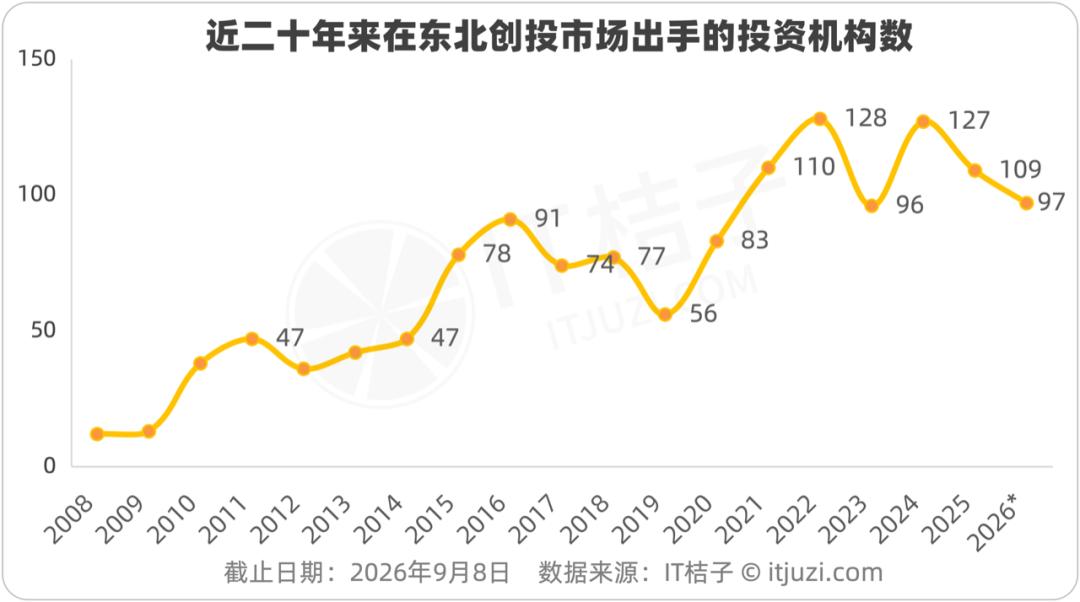
There was an obvious upward trend in the periods of 2014-2016, 2019-2022 and 2023-2024, followed by a round of decline. After such cycles, the number of investment institutions active in Northeast China has grown from single digits 20 years ago to double digits 10 years ago, and now to more than 100 on average, which has achieved a qualitative leap on the whole.
However, when we break down the number of investments made by these institutions, we find that most of them are "one-off" investments, just testing the waters.
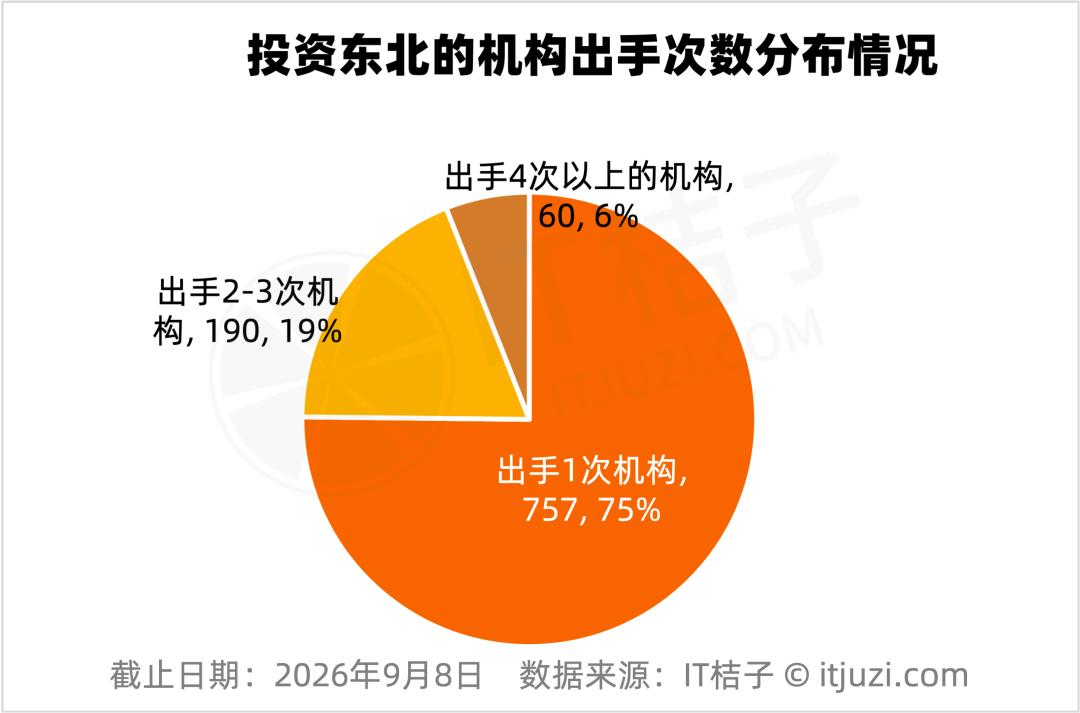
According to data from IT Juzi, more than 75% of institutions have only made one investment, and only 60 institutions have made more than 4 consecutive investments, accounting for only 6%.
Next, we classify the institutions that have made investments in Northeast China in the past six years by their camps, to see the proportion and activity differences among market-oriented VCs, state-owned capital, industrial CVCs, and foreign-funded institutions.
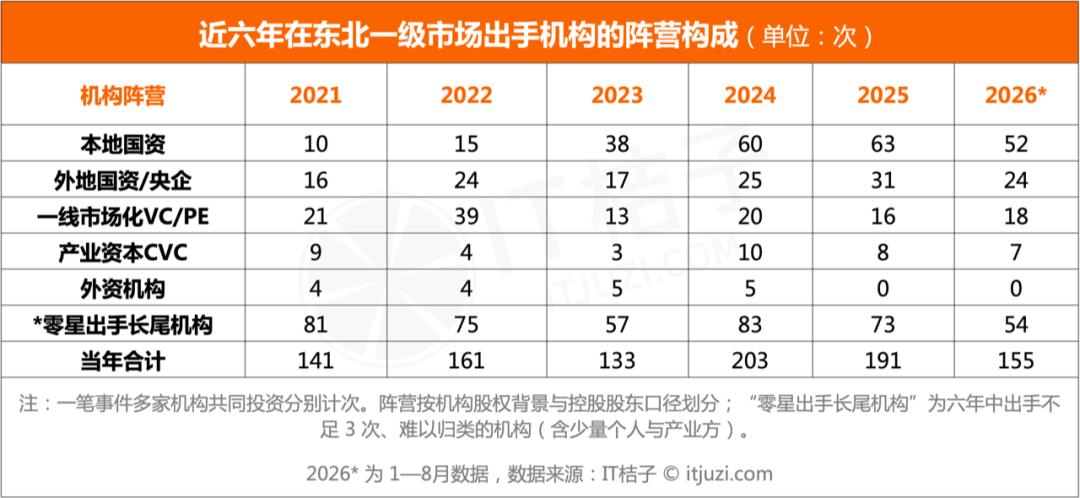
The number of investments made by first-tier market-oriented VC/PE institutions was 39 in 2022, when GL Ventures, Matrix Partners China, Yunfeng Capital and other institutions were still investing in October Rice in Shenyang, and Cowin Capital also invested in "Aiant", an auto parts manufacturer in Harbin; the number dropped sharply to 13 in 2023, two thirds of which vanished within one year, and it has not recovered to more than 20 in the following three years.
The performance of foreign-funded institutions is even more decisive. From 2021 to 2024, foreign institutions such as True Ventures, Mubadala, and Och-Ziff made 4 to 5 investments per year. Among them, Mubadala made investments for three consecutive years from 2022 to 2024, participating in the investment of October Rice, Dalian New Alliance, etc.; in 2025 and 2026, the number of investments made by foreign-funded institutions in Northeast China is zero.
What happened simultaneously with the withdrawal of other institutions is the large-scale entry of local state-owned capital.
The number of investments made by local state-owned capital increased from 10 in 2021 to 63 in 2025, with the proportion rising from 7.1% to 33.5%, nearly quintupling in four years; non-local state-owned capital and central enterprise-related institutions (Shenzhen Venture Capital, SDIC Group, Chengtong Fund, National Integrated Circuit Industry Investment Fund, etc.) have stably maintained 16 to 31 investments per year, forming another force of "state-owned buyers" in the Northeast China market.
The most dramatic footnote of the camp transition is: in 2022, market-oriented VC/PE made 39 investments while local state-owned capital only made 15, the number of market-oriented investments was 2.6 times that of state-owned capital; in 2024, the situation was completely reversed, with local state-owned capital making 60 investments and market-oriented institutions making 20, the number of state-owned investments was 3 times that of market-oriented ones. The turning point of the two curves occurred in 2023.
The scattered long-tail institutions are mainly passing-through institutions that have made less than three investments, local industrial parties and individual investors. However, the scale of this group has also shown a trend of shrinking in the past six years, indicating that the "scattered private capital" in the Northeast China market is also retreating.
III. Active Investors: Market VCs Gradually Exit, Local State-owned Capital Takes Over
By listing the top 20 institutions with the most investments in the Northeast China's primary market in the past six years (2021-2026) and the previous decade (2010-2020), we can see that the active institutions have also undergone a large-scale reshuffle.
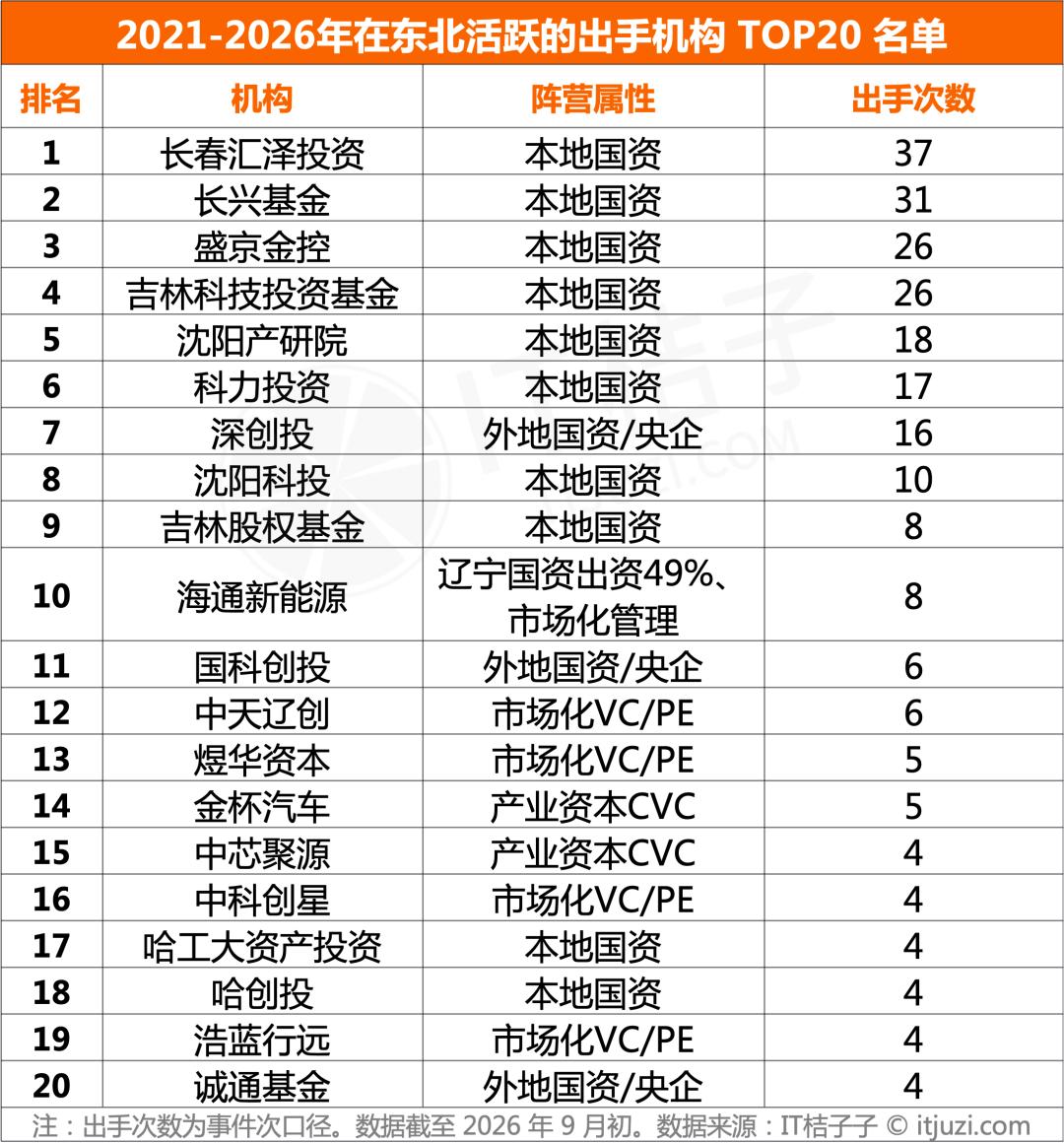
The top 6 institutions in the list — Changchun Huize Investment (37 investments), Changxing Fund (31 investments), Shengjing Financial Holding (26 investments), Jilin Science and Technology Investment Fund (26 investments), Shenyang Industrial Technology Research Institute (18 investments), Keli Investment (17 investments) — are all local state-owned institutions in the three Northeast provinces.
The 7th place goes to Shenzhen Venture Capital (16 investments), which itself has a state-owned capital background from Shenzhen. Local state-owned institutions take 10 seats in the TOP20, plus 4 seats for non-local state-owned/central enterprise institutions, the state-owned capital camp takes 14 seats in total, accounting for 70%; there are only 5 truly market-oriented VC/PE institutions, most of which rank behind in the list.
Comparing this list with the Northeast China market situation of the previous decade, it can be called a complete "reshuffling".
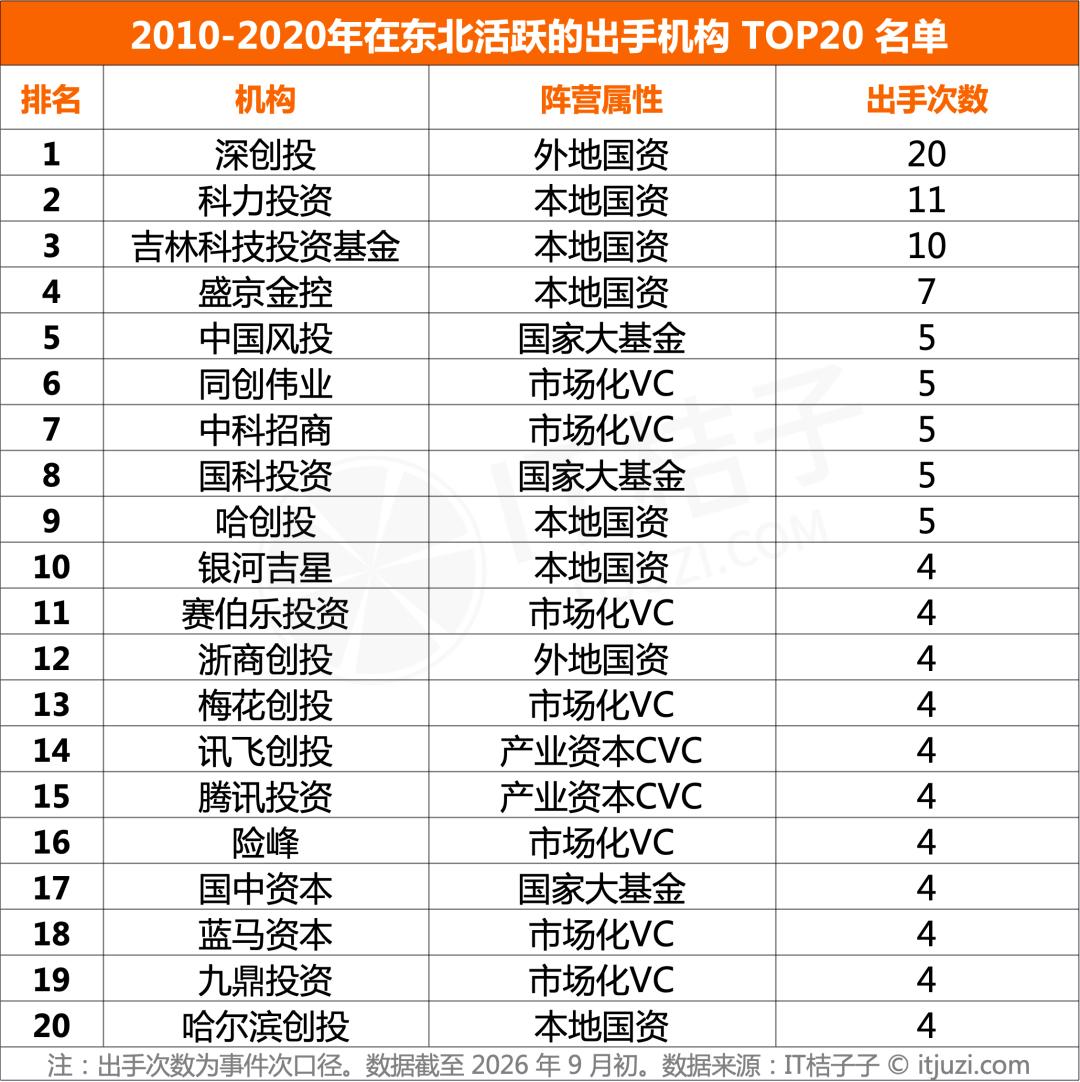
The most active institution in 2010-2020 was Shenzhen Venture Capital, which made 20 intensive investments across industries including pharmaceutical health, automotive, commercial aerospace, new materials, and environmental protection, with major investment cases including Chang Guang Satellite. Shenzhen Venture Capital is probably the most long-term non-local institution investing in Northeast China, which entered the Northeast market with its first project in 2007 and has been investing in Northeast China for 20 years by 2026.
It can be seen that in the TOP20 institution list of that period, local state-owned institutions only took 6 seats, far less than the current 10, and local state-owned institutions took 3 seats in the top 6, the National Integrated Circuit Industry Investment Fund and China Venture Capital took 1 seat, and market-oriented VC institutions such as Cowin Capital and Zhongke Zhaoshang were also very active.
During 2010-2020, first-tier early-stage market-oriented VC institutions such as Cybernaut Investment, Plum Ventures, Shunwei Capital, Lema Capital, and Jiuding Investment made more than 4 investments in Northeast China before 2020, but they are rarely seen in this region in recent years. The last investment made by national institutions such as HSG and GL Ventures in Northeast China was basically in 2022. Tencent's last public investment in Northeast China was in 2018, and iFlytek Venture Capital still made investments in Northeast China in 2023.
Looking at today's list, the active players are a group of local state-owned GPs with names containing "Changxing", "Shengjing", "Keli". Their common characteristics are: the parent fund or direct shareholder is the provincial and municipal finance or state-owned assets supervision and administration commission, all of them are registered in Northeast China, their investment radius is mainly within their own province, and they mainly invest in early-stage projects of angel round and Series A round.
According to statistics from IT Juzi, among the 97 institutions that made investments in Northeast China in 2026, 43 are new investors making their first investment this year, accounting for nearly half; the other half are old players that have made layouts in the past and returned to the market, totaling 54 institutions.
In other words, among the nearly 1,000 institutions that have ever invested in Northeast China, only about 54 are still making investments in 2026, including 16 local state-owned institutions, 20 non-local state-owned/central enterprise institutions, 12 market-oriented VC/PE institutions, and 6 CVCs. After the "passing-by investments" faded out, there are too few