Claude independently cracked the 370-year-old ciphertext in just 44 minutes, leaving cryptographers totally stunned.
Is the global cryptography community about to be completely shocked?
Recently, an independent researcher presented Claude Fable 5.1 with a fully open-ended proposition —
to crack a decades-long historical cold case that has been sealed for a full 370 years.
It is the "Cyphral Distich" left by the 17th-century British scholar Sir Thomas Urquhart.

After 44 minutes of work, consuming 176,000 Tokens, with zero human intervention throughout the whole process, Claude solved the puzzle completely on its own.
What is astonishing is that after figuring out the pattern, it followed the clues and also cracked the "Cyphral Octastich" — a longer cipher with as many as 285 numbers that had been dormant for more than 370 years in another of the author's works.
Puzzles that countless professional scholars and amateur geeks have failed to solve for centuries were effortlessly cracked twice in a row by AI.
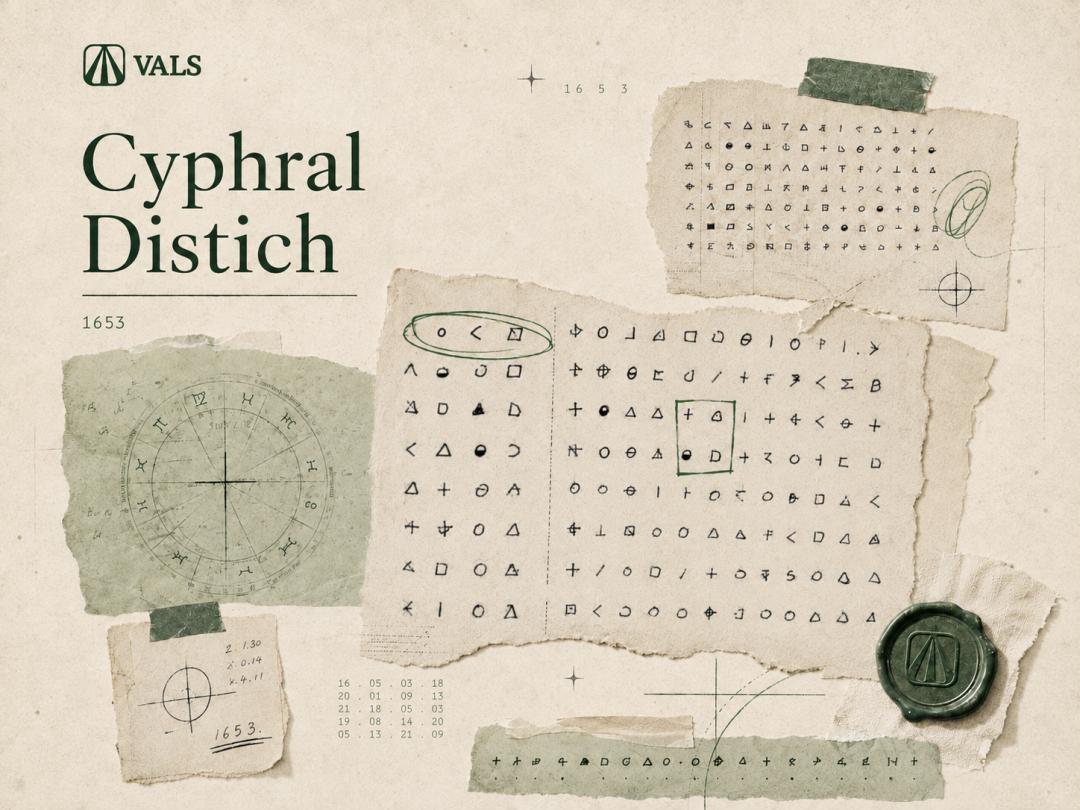
370-year-old puzzle stumps cryptographers
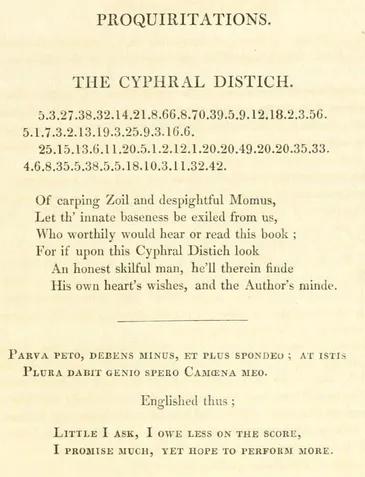
The Cyphral Distich comes from the end of Urquhart's 1653 treatise Logopandecteision.
The entire ciphertext consists of only two lines of 32 numbers each, totaling 64 numbers.
5.3.27.38.32.14.21.8.66.8.70.39.5.9.12.18.2.3.56.5.1.7.3.2.13.19.3.25.9.3.16.6. 25.15.13.6.11.20.5.1.2.12.1.20.20.49.20.20.35.33.4.6.8.35.5.33.5.5.18.10.3.11.32.42.
A short poem attached below the numbers roughly states: An honest and capable reader can read "his own wish in mind, and the author's intention" between these two lines.
Over the past few centuries, it has been widely known whether in Notes and Queries in 1899, professional cryptography monographs of the 20th century, or the list of "the world's top 50 undeciphered ciphers".
Countless decryption masters have spared no effort to apply all their signature skills including word frequency analysis, monoalphabetic substitution, and homophonic substitution, but all ended in failure.
Claude cracks it in 44 minutes, the key is hidden in the book
Cryptographers have long assumed by default that this string of numbers corresponds to some external cipher table, but in fact, the "key" is printed inside the book.
During the cracking process, Fable 5.1 caught two key clues.
The ciphertext immediately follows the "32 petitions" written by Urquhart, and the author even specifically emphasized that "no number is more suitable than 32".
Secondly, the poem attached to the ciphertext clearly indicates that honest readers will read "their own wish and the author's thought" in it.
At the end of the 32 petitions in the main text, words such as "wish/desire" appear repeatedly.
Combining the two points, the decryption rule is surprisingly simple: the i-th number of the ciphertext refers to the i-th petition, find the word of the corresponding serial number and extract its first letter.
Following this rule, the plaintext emerges instantly:
First line: O GOD UPHOLD KING CHARLS THE SECOND AND
Second line: MAKE HIM THE SUPREME RULER OF THIS LAND
Each line of the two lines of plaintext has exactly 32 letters, and the last words rhyme (and/land), which fully conforms to the format of a "two-line rhyming poem".
As a loyal royalist, Urquhart buried the codeword to pray for blessings for Charles II in his writing, which is completely reasonable from the perspective of historical background.
Effortlessly cracking the second puzzle right after
After gaining the first success, Claude followed the model logic of "the book itself is the coordinate" and directly turned to the "Cyphral Octastich" left in another work The Jewel.
That puzzle contains a full 285 numbers, and its complexity rises sharply. Claude quickly verified that the book has exactly 284 numbered pages.
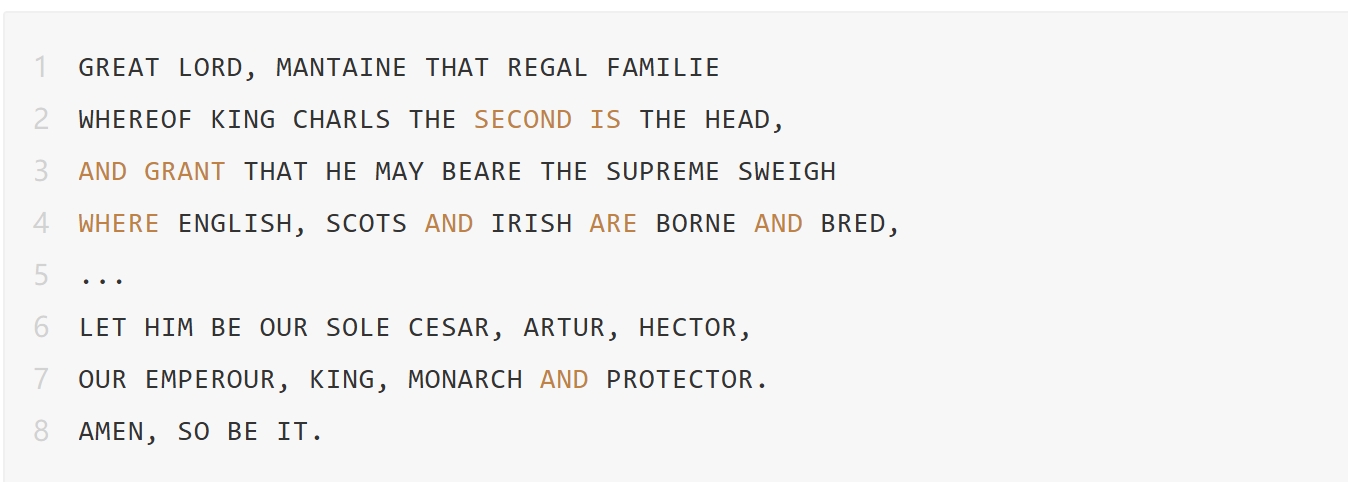
It followed the same method, mapping the $$$$th number to the first letter of the word at the specified position on the $$$$th page.
Using the Early English Books Online Text Creation Partnership (EEBO-TCP) database, the model only relied on several self-written Python scripts for page layout calibration and typesetting drift correction, and directly restored a complete iambic eight-line long poem:
AI finishes it in only 44 minutes, no black magic involved
The entire induction test process is actually not complicated.
The tester only gave the model a general direction, avoiding the extremely complicated deadlock that countless people have struggled with, as well as ambiguous and unverifiable vague puzzles.
Claude demonstrated amazing judgment in the retrieval process —
It knows when to abandon the unproductive dead end, and quickly locks in clues when encountering this problem with extremely high solvability.
This exactly points to a deeper judgment: Claude has begun to systematically solve a class of problems that have long been ignored by humans:
The answers are hidden in a huge amount of old materials, but no one in the past had enough time and patience to go through all of them.
The bottleneck of human knowledge exploration is changing from "insufficient intelligence" to "insufficient energy".
Vals AI summed it up very straightforwardly: "Humans need to manually search old materials and test multiple decryption methods for a long time, while AI can iterate these tasks quickly, which is a huge advantage."
This capability is not only reflected in cipher cracking.
Not long ago, Anthropic disclosed that its Agent has been able to independently propose hypotheses, design and complete all experiments, filling 97% of the performance gap, while two human researchers who worked for a whole week only filled 23%.
From laboratories to ancient book stacks, AI is taking over tasks that are "not a matter of insufficient intelligence, but insufficient endurance".
References:
https://x.com/bcherny/status/2099322487603634395?s=20
https://arc.net/l/quote/xctymnvc
This article is from the WeChat official account "AI Era", author: ASI Apocalypse, published with authorization from 36Kr.