Baidu has developed a large number of AI products, but none of them can represent Baidu?
Recently, after observing the AI office products developed by several major domestic tech giants, I've noticed a quite interesting phenomenon.
If you are asked about Tencent's AI office product, many people will immediately think of WorkBuddy.
When it comes to Alibaba, the answer is getting increasingly clear: Qianwen Office.
As for ByteDance, Doubao Work has also officially stepped onto the public stage.

But if you raise the same question to Baidu:
Who on earth is Baidu's designated AI office product?
This question suddenly becomes very hard to answer.
It is not because Baidu has no relevant products.
On the contrary, Baidu's AI products may be far more numerous than most people imagine.
ERNIE, Kuku AI, Baidu Dazi, Miaoda, Comate (ERNIE Quick Code), Qianfan...
Baidu has already covered almost all scenarios including chat, search, code writing, application development, office work, and Agent.
But this is exactly where the interesting part lies:
It has a large number of products, yet none of them has formed a strong public perception that "this is Baidu's exclusive AI office offering".
This problem has become increasingly prominent especially after Tencent, Alibaba and ByteDance all started to push AI to the "practical work" scenario.
If we only look at the products that currently have relatively high competitiveness for Baidu to participate in this track, I think at least three of them are worth discussing separately:
DuMate, Kuku AI, Miaoda.
But what's more interesting is that these three products are actually taking three completely different development paths.
DuMate: The one that most resembles WorkBuddy, yet is also the least "Baidu-like" product
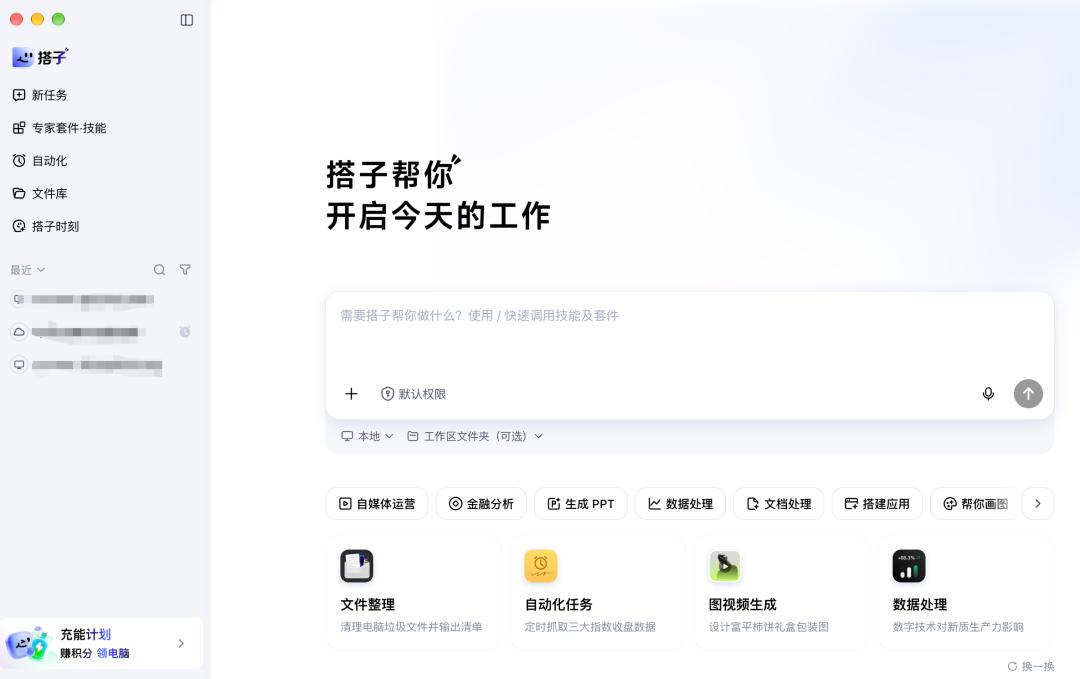
Judging only from the product definition, DuMate is actually the most standard "AI office Agent" of Baidu at the current stage.
Baidu's official positioning for it is very straightforward:
It is a desktop-level AI office agent for individuals and teams, which can view the screen, operate software, process files, and connect business systems, allowing users to directly assign tasks to AI for execution through natural language.
Does this description sound very familiar?
Because it is almost completely aligned with the direction that WorkBuddy and various Computer Agent products are competing for today:
In the past, you asked questions in the AI dialog box.
Now AI is starting to actually take over your computer and complete work for you.
From the perspective of product form, DuMate is very "orthodox".
It has a dedicated client, can process local files, call custom skills, execute scheduled tasks, and also emphasizes closed-loop task execution.
So if someone says:
"Baidu actually had its own WorkBuddy long ago."
This statement is not wrong at all.
But DuMate's biggest problem may also be very obvious:
Too few people know about it, and its functions are the most imperfect among the four tech giants.
At least from the perspective of ordinary users, you can hardly get the feeling that "Baidu is going all out to promote DuMate".
Its current product temperament is more focused on desktop Agent and enterprise employee efficiency tools, rather than a super office entry that has covered all knowledge workers.
Even compared with WorkBuddy, Doubao Work and Qianwen Office, its functions are the most incomplete.
This does not mean that the product direction is not feasible.
On the contrary, I think DuMate's direction is very clear.
It is more like:
An AI employee that helps you operate your computer.
The question is, can an "AI employee" directly undertake the entire brand of "Baidu AI Office"?
At least for now, it still takes time to prove this.
More critically, although DuMate's capabilities are very similar to next-generation office products, its "Baidu-exclusive assets" are not that obvious for the time being.
When Tencent develops a desktop Agent, it has the backing of WeChat, WeCom, Tencent Docs and Tencent Meeting.
If Baidu only develops an "Agent that can operate computers", the final competition will still focus on the execution capability of the Agent itself.
There is still much room for imagination to turn this card into Baidu's unique competitive advantage.
Kuku AI: Boasting the richest resources, yet needs to break through the old perception of "Wenku and Netdisk"
Another completely different route is taken by Kuku AI.
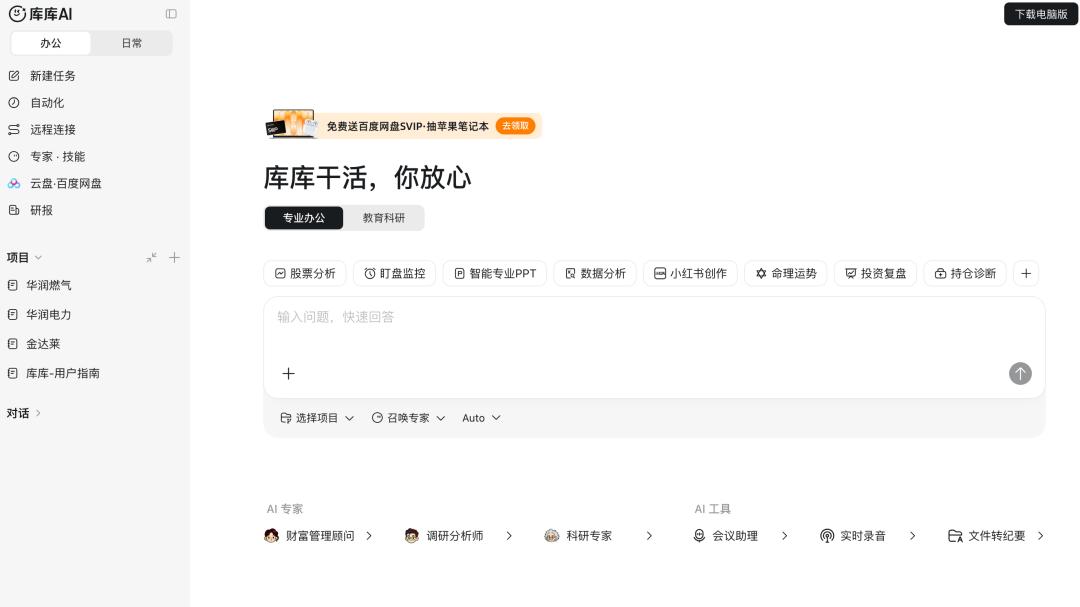
Its predecessor GenFlow came from Baidu Wenku and Baidu Netdisk. Now the official defines it as a "universal cross-end agent", which is naturally connected to Baidu Wenku, Baidu Netdisk, as well as a large amount of content and file scenarios accumulated by Baidu over the years.
The biggest difference between this route and DuMate lies in:
DuMate develops towards office scenarios starting from "operating computers".
Kuku AI develops towards office scenarios starting from "files, knowledge and content".
And this is exactly Baidu's very distinctive advantage.
Essentially, a large part of people's work is processing information:
Searching for materials, reading PDFs, organizing files, writing reports, making PPTs, processing spreadsheets, summarizing meeting content, and conducting industry research.
This is exactly what Baidu Wenku and Baidu Netdisk have accumulated the most over the past decade.
Therefore, from the perspective of resource endowment, Kuku AI is very suitable for developing AI office functions.
Even compared with building a new AI office software from scratch, its biggest advantage is that:
Users' files are already stored here.
This point is extremely important.
The final competition of AI office is not only about "whether the model can write PPT well", but about who better understands your work context.
What solutions you have written in the past, what materials you have stored, what industries you have researched, what PDFs, contracts and spreadsheets you own.
These are the key factors that truly turn AI from a "public model" into "your exclusive work assistant".
So theoretically, Kuku AI has a very high upper limit.
But it also has a prominent problem:
The past product perception is too deeply rooted.
When many users see Baidu Wenku, their first reaction is still "search for reference materials".
When they see Baidu Netdisk, their first reaction is still "store files".
Now we suddenly tell users:
A universal AI Agent has actually grown out of these platforms.
This perception migration is not that easy to achieve.
Kuku AI must prove that it can not only "process documents", but also truly cover the complete work link.
Otherwise, it will easily give people the impression that it is still:
A very powerful AI document tool.
Rather than:
The AI that you open first every workday.
There is still a long distance between the two positioning.
Miaoda: It may have the greatest imagination space, but is it really a standard "office product"?
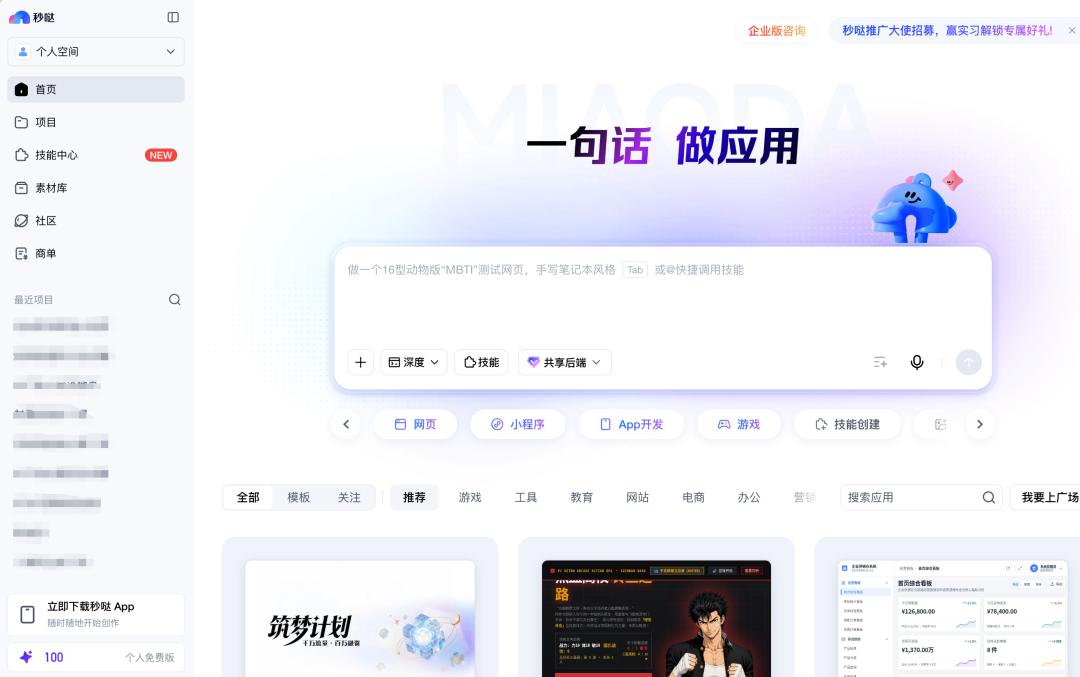
The third interesting product is Miaoda, which I personally think is the best AI product developed by Baidu. Unfortunately, it is too vertical and has a relatively high usage threshold.
Miaoda's initial positioning was very clear:
You can generate applications through natural language even if you cannot write a single line of code.
Baidu's official currently still defines it as a no-code application development platform, allowing users to quickly create websites, H5 pages, mini-games, lightweight applications and other products through conversations.
If it stays at this positioning, Miaoda should not be included in the AI office competition.
It is more in the same track as Lovable, Base44, Replit, Vibe Coding and low-code platforms.
But a change this year makes me think it is worth continuous observation.
Miaoda 3.0 has begun to clearly expand towards the "universal Agent" direction.
Baidu has added general task capabilities including data analysis, in-depth research, image generation, PPT generation, video generation, web page parsing and other functions in its update log, hoping to put "market research - application generation - operation" into the same work closed loop.
This change is very interesting.
Because the so-called "office work" in the future may not only refer to Word, Excel and PPT.
For example, an operation staff member says:
"Help me make an event registration system."
In the past, this was a dedicated development requirement.
In the future, it may just be an ordinary daily office requirement.
A product manager says:
"Turn this survey result into a data dashboard that my boss can view directly."
In the past, you might need to ask R&D staff for help.
In the future, AI will complete it directly.
If understood in this way, Miaoda has stepped on a very interesting direction:
The end point of AI office may not be to operate software for you, but to create software directly for you.
This is also the most special feature of Miaoda compared with traditional Office Agent products.
But problems also exist.
When a product can not only generate applications, but also make PPTs, conduct research, analyze data, generate images and videos...
What on earth is its exact positioning?
This is a problem that all super Agents will encounter.
More and more capabilities do not mean clearer brand perception.
If the first reaction of users when they think of Miaoda is still "generate an application with one sentence", it is still quite far from being "the entry of Baidu AI Office".
Therefore, Baidu's current problem may not be the lack of products at all
After putting these three products together, things become even more interesting.
DuMate solves the problem of:
Can AI operate the computer for me.
Kuku AI solves the problem of:
Can AI understand and process my knowledge and files.
Miaoda solves the problem of:
Can AI directly create tools according to my personalized needs.
You will find that all three directions are feasible.
Even putting them together exactly forms the capabilities that the next-generation AI office product should have:
It knows all your materials,
It can help you make PPTs, spreadsheets and conduct research,
It can also operate the browser and computer,
And finally it can even directly create an application for you.
So now I am unwilling to simply draw a hasty conclusion:
"Baidu should bet all its resources on DuMate."
Or:
"Baidu should bet all its resources on Kuku AI."
Or:
"Miaoda is the absolute future."
Because the real problem may not be choosing one out of three.
But that ordinary users today have no idea at all:
What is the relationship between these three products.
Standing inside Baidu, each team may have fully sufficient product logic.
But from the user's side, they only have one most simple question:
Tencent tells me to use WorkBuddy.
Alibaba tells me to use Qianwen Office.
ByteDance tells me to use Doubao Work.
Then who does Baidu exactly want me to open?
This may be the real question that Baidu's AI products need to answer at the current stage.
Because a very cruel change in the AI era is happening:
Users will not remember ten AI products from one company.
In the end, they may only remember one single entry.
Baidu certainly has no shortage of AI technologies, nor is it short of assets such as search, Netdisk, Wenku, Maps, Cloud, and knowledge base.
DuMate, Kuku AI and Miaoda all have their own valid reasons for existence.
But what really tests Baidu in the next stage may not be whether it can develop another new AI product.
It is whether it can turn these scattered capabilities into a clear answer that users can easily understand.
Now this answer has not fully emerged yet, and it feels that Baidu does not have enough confidence to make an official public announcement.
This article is from the WeChat Official Account "Everyone is a Product Manager" (ID: woshipm), written by Guai Ge, published with authorization from 36Kr.