The second battlefield for Chinese gaming giants is by no means AI games.
At a time when the global gameplay dividend is on the verge of depletion, where exactly is the next opportunity for game developers?
In general, developers with different product genes and varying scales have chosen different breakout directions. Tencent Games has placed its bets on 3A paid single-player titles and hardcore competitive games; NetEase continues its high-quality product strategy to continuously deepen its competitive moat; miHoYo attempts cross-category expansion to break out of the ACG comfort zone; as for a large number of small and medium-sized developers, they have flocked to mini-games somewhat passively, a track featuring fast validation and quick revenue return.
These directions are all logically sound, but they all imply a common premise: it is necessary to find a gameplay entry point that is closer to the user base of new users & general users. Gradually, developers seem to realize that the further they move in this direction, the more unavoidable it is to adopt subtractive lightweight processing and casual games.
Developers who seize this opportunity early have reaped huge profits, such as Century Games and Lemonjoy.
*Whiteout Survival*, developed by Fuzhou White Bear Studio under Century Games, has verified the market potential of casualized SLG. This SLG product with an ice and snow survival theme and simulation operation shell has ushered in another peak three years after its launch — its total revenue in the first half of 2026 is about 723 million US dollars (over 4.8 billion RMB), with monthly average revenue stably in the range of 110 million US dollars. According to Sensor Tower data, the game's global revenue in June increased by 11% month-on-month, surpassing *Honor of Kings* to top the global mobile game revenue chart.
Lemonjoy has taken the lead in proving the commercialization logic of Merge-2 with *Gossip Harbor*, replacing the traditional match-3 level logic with a lighter merging operation, which has driven a global Merge-2 trend. This generational gap in gameplay has also allowed Chinese developers to take the initiative in the gameplay evolution of casual sub-categories for the first time.
Now, looking at the global revenue list of Chinese mobile game publishers, we will find an interesting change: Tencent, NetEase and miHoYo still firmly occupy the top positions, but the rankings of casual game developers such as Lemonjoy and Century Games are continuously rising, and they are beginning to enter the top tier that was previously monopolized by mid-to-hardcore products. They may not have shaken the position of the giants, but they have proven one thing in another way, that casual games are becoming a highly certain growth pole in the global market.
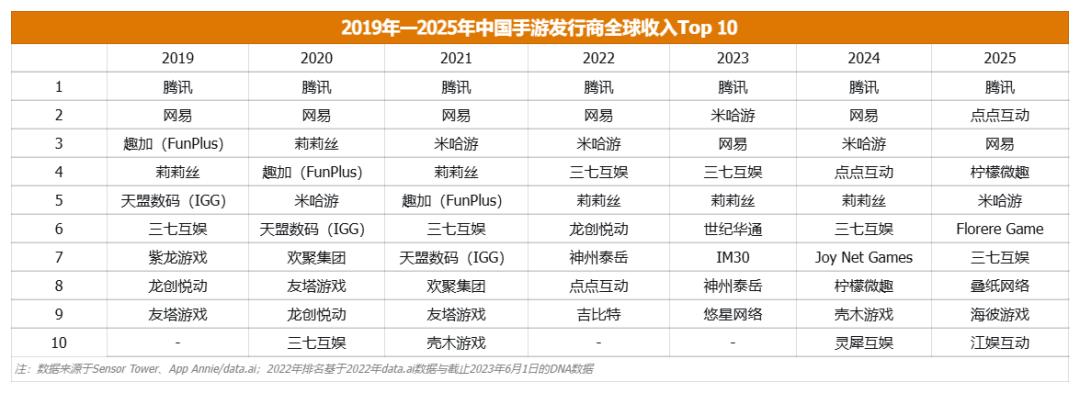
For large developers, casual games are already one of the few under-exploited certain opportunities in the current stock competition. As for developers who have proven themselves on this track, the correctness of the direction has been verified, so the next step is of course to move forward.
An arms race around the casual game track is accelerating and fermenting under the surface.
Major reshuffle of overseas expansion forces
First of all, what we can see from the global revenue list is that the current product structure of mobile games has quietly changed: traditional competitive and content-driven products still support the user base of top developers, and more and more new products are beginning to find new combination methods from mature categories such as SLG, match-3, and simulation operation.
On the one hand, gameplay such as match-3, merging, and idle play have low entry barriers and a wide user base, with strong adaptability between different markets; on the other hand, hyper-casual products continue to explore new user demands with extremely simple gameplay. Among them, "SLG+X" is a solution that has been repeatedly verified by the market in the past two years. It not only retains the advantages of SLG's long-term operation and commercialization, but also lowers the user threshold by superimposing gameplay such as survival, match-3, and tower defense, which has become an important attempt for many developers to impact the large DAU market.
This attempt is gradually reflected in the specific actions of game companies.
Through the author's long-term tracking of the casual game track, we found that for large developers that already have mature hardcore game businesses, casual games are becoming a path to expand user circles, enrich product matrices, and find new increments in the global market. Self-development, investment, mergers and acquisitions, and global publishing, different companies are entering this track in different ways.
At the same time, we also clearly feel that the category of "casual games" is becoming more and more "difficult to define".
In terms of gameplay, classic gameplay such as match-3, merging, and idle play are still continuously iterating, products that emphasize a single core mechanism such as bead puzzles, stress relief games, and arrow games continue to appear, while traditional hardcore categories such as SLG and simulation operation are also expanding user coverage by lowering operation thresholds, simplifying strategy links, and adding more casual gameplay.
The boundaries between different categories are becoming blurred, and "casualization" itself is becoming a noteworthy product trend. Therefore, the "casual games" we want to discuss today are not limited to a single category in the traditional sense, but mainly focus on three types of products: mainstream casual games with core gameplay of match-3, merging, and idle play; hyper-casual games represented by gameplay such as bead puzzles, stress relief games, and arrow games; and SLG products that are actively undergoing lightweight transformation.
In the past, the author analyzed various products within the casual game track, from large developer R&D to small team production, from female-oriented casual games to lightweight casual SLG games, we have always maintained a high degree of attention to casual games. Now, as casual games become more and more important, we try to shift our perspective from specific products to the companies themselves, to see how Tencent, NetEase and more domestic developers lay out the casual game track and continue to increase their investment.
Looking for the second growth curve
For Tencent, finding a new growth engine is actually more important than "whether to make casual games".
Tencent Games is the well-deserved leader in China. According to Qimai Data, in the TOP 10 mobile game bestseller list in the Chinese market in 2025, Tencent's titles account for nearly 70%, most of which are long-established hits. This overwhelming advantage has been taken for granted by the outside world today. At the same time, it also means that Tencent's new games face great challenges in the domestic market.
Therefore, for Tencent, the overseas market is not only an extension of revenue sources, but also an important space to find the next growth curve, and casual games just provide another possibility. To a certain extent, the importance of this matter to Tencent may be no less than its investment in hardcore tracks such as 3A and open world in recent years.
Looking back at Tencent's early overseas game layout, casual games have actually been an important focus.
In 2015, Tencent acquired a majority stake in Miniclip, a European casual game developer. A year later, it took control of Finnish game company Supercell with a transaction size of about 8.6 billion US dollars.
Before being incorporated into Tencent's business map, both companies had formed a mature global product system. When Tencent acquired a majority stake in Miniclip in 2015, the latter already had users in 195 countries and six continents, with cumulative mobile game downloads exceeding 500 million, and published 45 mobile games, among which *8 Ball Pool* had more than 100 million downloads. A year later, when Tencent took control of Supercell, the latter had already opened up the global market with titles such as *Hay Day*, *Clash of Clans*, and *Boom Beach*, and *Clash of Clans* even topped the US App Store revenue chart only three months after its global launch.
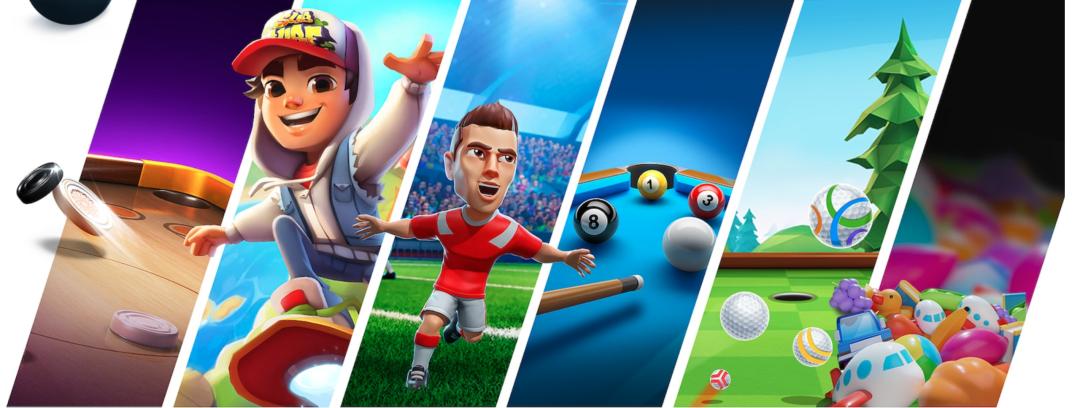
The significance of these two transactions is not only to increase Tencent's overseas product reserve, but also to allow Tencent to directly enter the R&D and operation systems that have been verified by the global market by holding mature overseas companies, so as to obtain the global experience accumulated by local teams for many years.
Looking back at these two transactions ten years later, we can find that they are undoubtedly representative investments in Tencent's overseas game layout.
According to Tencent's second quarter 2026 financial report, the revenue of its international game business in the quarter was 18.6 billion RMB, a year-on-year increase of 4% at constant exchange rates. Although the revenue of some Supercell games has declined, Supercell is still an important part of Tencent's international game business. More notably, Miniclip ushered in new breakthroughs in this quarter: *Arrows: Puzzle Escape*, a casual game developed by its studio Lessmore, became the most downloaded mobile game in Q2 2026 globally, and brought strong in-app advertising revenue. Tencent also specifically pointed out in its financial report that if the revenue of games monetized through in-app advertising such as *Arrows* is included in the international game business for adjustment, the year-on-year growth rate of its international game business will be 4 percentage points higher than the disclosed data.

If Miniclip in 2015 allowed Tencent to acquire a casual game company that had already succeeded in the global market, then *Arrows* ten years later shows that the value generated by this investment is no longer limited to a mature product.
After Tencent took a stake, Miniclip continued to expand its product and R&D network through mergers and acquisitions. It acquired SYBO, the developer of *Subway Surfers*, in 2022, brought FuturLab, the developer of *PowerWash Simulator*, under its umbrella in 2024, and acquired casual game company Easybrain for 1.2 billion US dollars. From sports casual represented by *8 Ball Pool*, to parkour represented by *Subway Surfers*, to puzzle products from Easybrain and simulation experience from FuturLab, the casual categories covered by Miniclip are continuously expanding, and its business territory has expanded from a single product and team to multiple sub-categories.
This path of "Tencent holding overseas companies, and then the invested companies continuing to integrate overseas studios" is not an isolated case in Tencent's overseas game layout.
A similar path also appeared on Supercell. After Tencent took control, Supercell established an independent investment system and continued to invest in overseas game teams. In 2017, Supercell acquired 62% of the shares of Space Ape. In 2026, Supercell further announced the acquisition of the remaining shares of Metacore, bringing *Merge Mansion* into its long-term operation product portfolio.
We can get a glimpse of Tencent's idea of laying out the overseas casual game track: let the original strong manufacturers maintain a relatively independent R&D and operation system, and use their hands to invest, acquire and incubate new products in the global market.
At the same time, Tencent has not stopped the pace of self-development and self-publishing. If we pull the timeline further back, Tencent's exploration of mass casual games has actually been accumulated for a long time. *QQ Farm*, launched in 2009, combined planting and operation with friend interaction relying on the social relationship chain of QQ Zone, and became a representative product of Tencent's early social casual games. This year, this classic casual game under the Magic Cube Studio has also been officially launched on mini-programs.
After the rise of mobile games, TiMi Studio launched casual products such as *Tiantian Match* and *Tiantian Run*, accumulating R&D and operation experience in categories such as match-3 and parkour.
In 2024, *Age of Empires Mobile*, developed by TiMi and published by Level Infinite, was launched overseas. Only 20 days after its release, its cumulative revenue exceeded 100 million RMB. In 2025, Level Infinite also briefly launched a product called *Age of Empires: Survival* overseas. Without major changes in gameplay content compared with *Age of Empires Mobile*, it tried to use more lightweight means to divert traffic for the product and attract more lightweight general users through popular sub-gameplay materials for user acquisition at that time.
This product did not maintain long-term operation, but from it we can see that TiMi and Level Infinite had already begun to explore more lightweight publishing methods and potential user groups at that time.
Now, TiMi Happy Game Studio is once again laying out the match-3 track. In the previous report "Tencent Made Another Big Move on the Large DAU Track", Jinghe Core mentioned that Tencent's TiMi Happy Game Studio is developing a match-3 + simulation operation game *Happy Match Time*, which is a new case of Tencent's continuous investment in the large DAU casual game track in recent years. At the same time, the author learned from IEG internal sources that IEG has formed a team earlier this year to try to develop lightweight match-3 games and enter the overseas market.
In this way, Tencent's casual game layout presents two parallel paths: on the one hand, it continuously expands the global product and team network through overseas assets such as Miniclip and Supercell, and on the other hand, it relies on self-developed studios such as TiMi, Photon and Magic Cube to continue to explore new casual products. The former helps Tencent continuously absorb products and teams that have been verified in overseas markets, while the latter provides it with the ability to continuously develop new products independently.
Apart from products, we have to mention Level Infinite, Tencent's overseas publishing brand launched in 2021. After several years of business development, it is more appropriate to call Level Infinite Tencent's international game business brand now. In addition to overseas publishing, Level Infinite has now covered multiple links such as game operation, localization, marketing and player communities, becoming an important window for Tencent to connect to the global market.
This global-oriented publishing and operation system connects Tencent and cooperative development teams at one end, and brings different types of games to overseas markets at the other end. This also completes the last piece of the puzzle for Tencent's casual game layout.
From the product expansion of global teams such as Miniclip, to the continuous self-development of internal studios, coupled with Level Infinite's ability to complete global publishing, operation and localization, Tencent's continuously expanding global casual game network is gradually emerging.
NetEase begins to re-examine casual games
Compared with Tencent, which is still expanding its territory in the casual game field through acquisitions, NetEase's game business has changed a lot in recent years. From new mobile game products to overseas studios, NetEase is reallocating resources, and casual games are a track with relatively obvious changes.
Especially in lightweight tracks such as hyper-casual games, although NetEase has made many attempts before, it has never formed a sufficiently clear and stable product layout. Now, with the withdrawal of some overseas businesses, this change has become more obvious.
In February this year, Mattel announced that it will acquire the remaining 50% stake in Mattel163 held by NetEase. After the transaction is completed, the game company jointly established by NetEase and Mattel officially becomes a wholly-owned subsidiary of Mattel. Mattel paid 159 million US dollars for this 50% stake, and the overall valuation of Mattel163 is about 318 million US dollars.
The scale of this transaction itself is not particularly huge, but combined with NetEase's game layout in the past few years, it is quite meaningful.
When Mattel163 was established at the end of 2017, NetEase obviously did not treat it as an ordinary IP cooperation. The two sides each hold