$12.9 billion, the largest acquisition in NVIDIA's history is about to be finalized.
An acquisition deal worth nearly 100 billion yuan has been finalized.
Recently, Jensen Huang, founder and CEO of NVIDIA, published a post on NVIDIA's official blog, "I am pleased to announce that NVIDIA has agreed to acquire Hugging Face for 12.9303 billion US dollars (approximately 87 billion yuan)."
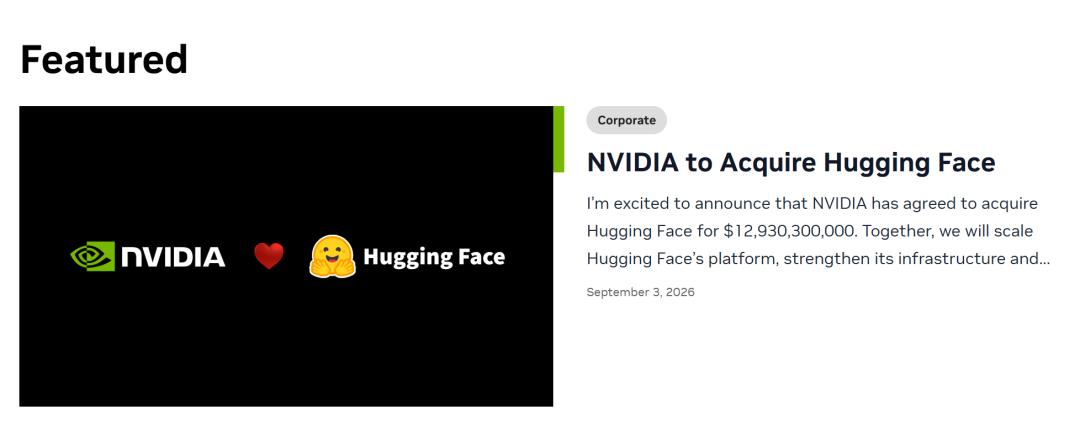
After the transaction is completed, Hugging Face will continue to operate as an open platform for the entire AI ecosystem, rather than becoming an exclusive tool of NVIDIA. Interestingly, only three years have passed since Hugging Face's publicly disclosed post-money valuation of 4.5 billion US dollars in August 2023, but its valuation has nearly tripled.
It is worth mentioning that this is also the largest acquisition in NVIDIA's history in terms of transaction value. From a broader perspective, this investment is only the latest move by NVIDIA in its transformation from a chip supplier to an AI ecosystem architect over the past period of time.
Jensen Huang spends a huge sum of 12.9 billion US dollars
The consideration of this transaction is accurate to the single digit - 12.9303 billion US dollars.
Subsequent supplementary documents submitted by NVIDIA show that approximately 11.9 billion US dollars of the total amount will be paid to existing Hugging Face shareholders, and another 1 billion US dollars will be reserved in the form of equity to retain the core team that joins NVIDIA. This transaction is still subject to regulatory approval, which means the specific completion time is yet to be determined.
In this official announcement, Jensen Huang devoted a lot of space to reviewing the origin of the cooperation between the two parties: "NVIDIA has been Hugging Face's largest contributor of open-source models and data for many years", "We have released more than 500 open-source models and 250 open-source data sets in total"...
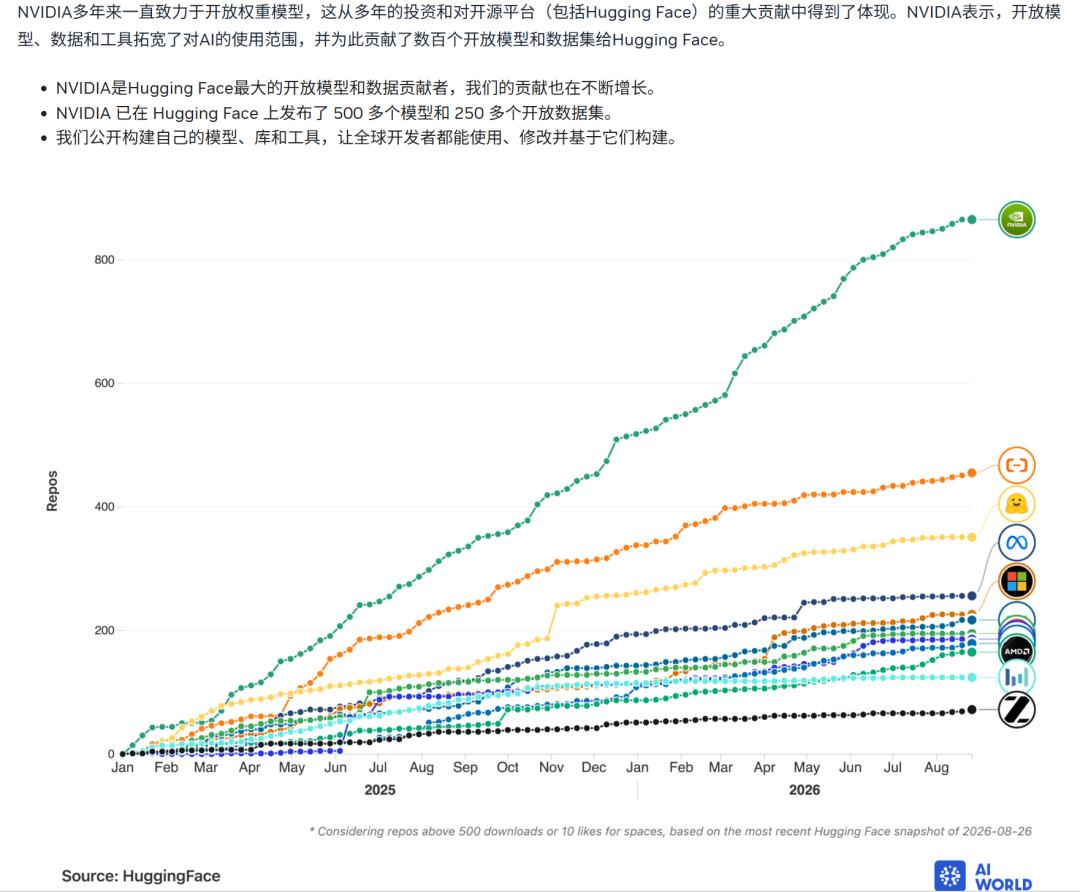
As of the date of the announcement, more than 3 million models, 1 million applications and 500,000 datasets have been hosted on the Hugging Face platform, which is used by more than 18 million developers, researchers and creators around the world, and more than 200,000 enterprises rely on it to discover, evaluate, customize and deploy AI models. Jensen Huang even promised in the announcement, "Hugging Face will remain an open platform for the entire AI ecosystem."
When we compare this nearly 100 billion yuan transaction with NVIDIA's acquisition history, the significance of "the largest in history" becomes even more prominent.
In 2019, NVIDIA acquired network chip company Mellanox for 6.9 billion US dollars, which was then publicized as the largest acquisition in NVIDIA's history. The price of this acquisition of Hugging Face is nearly twice that of the previous one, officially refreshing the record. At the same time, for Hugging Face itself, it completed a Series D financing of 235 million US dollars in August 2023 with a post-money valuation of 4.5 billion US dollars, and the consideration of this transaction is about 2.9 times the valuation at that time.
According to foreign media reports, the net worth of Hugging Face's three co-founders, Clément Delangue, Julien Chaumond and Thomas Wolf, has each risen to about 1.8 billion US dollars as a result of this transaction.
In fact, the completion of this acquisition is the result of multiple efforts by NVIDIA.
In terms of capital background, NVIDIA actually participated in Hugging Face's Series D financing as early as 2023 and became one of its investors. Other tech giants that participated in the investment in the same period include Google, Amazon, Intel, Salesforce and so on. According to previous reports from the British Financial Times, at the end of 2025, NVIDIA once proposed an offer of about 500 million US dollars to Hugging Face, with a post-money valuation of 7 billion US dollars. However, this detail has never been positively confirmed by Hugging Face's official side. At the same time, some foreign media reported that the offer was politely rejected by Hugging Face, on the grounds that it did not want to introduce a single dominant investor, fearing that it would affect the independence of the company's decision-making.
Even Clément Delangue, the CEO of the company, admitted in an interview with Forbes as early as 2022, "We want to be the first company to ring the listing bell with an emoji instead of a three-letter stock ticker."
After many twists and turns, Hugging Face was eventually acquired by NVIDIA, and the transaction was completed at a price almost twice the valuation of the previously rejected offer when the two sides returned to the negotiation table.
From a robot chat application to the "GitHub of the AI world"
How on earth did this company, for which NVIDIA spent a huge sum of 12.9 billion US dollars, grow into what it is today?
The answer dates back to New York in 2016.
Hugging Face was co-founded in New York in 2016 by Clément Delangue, Julien Chaumond and Thomas Wolf. The company's name comes from the "hugging face" emoji, which is the root of the CEO's idea of "wanting to be the first company to ring the listing bell with an emoji".
At the beginning of the business, the team developed a chatbot application for teenagers, focusing on companion-style conversations, but this product did not become popular in actual development. The real turning point came a few years later, when the team gradually realized that rather than developing a consumer-grade chat application, open-sourcing the technical capabilities they had accumulated in natural language processing could attract a broader group of developers.
As a result, the company transformed from a chatbot application to an open machine learning model hosting and collaboration platform, but the original "hugging face" logo of the company is still in use today.
As a cutting-edge enterprise, the experience of Hugging Face founder Clément Delangue himself is also quite legendary. Clément Delangue, who grew up in La Bassée, a small town in northern France, became a well-known seller on eBay France at the age of 17, engaged in cross-border trade of off-road vehicle accessories and bicycles. In addition to having a business acumen, Clément Delangue also taught himself computer science through open courses at Stanford University.
Before starting his own business, he founded the note-taking app VideoNot.es and the media monitoring platform Mention, and also worked at Moodstocks, an image recognition company acquired by Google. It can be said that this background as a "non-typical technical founder" has to some extent shaped Hugging Face's early product philosophy of "making the product likable first, and then considering technical barriers".
After deciding to transform into an open-source platform, Hugging Face's financing pace also entered a fast track. It completed a 100 million US dollars Series C financing in May 2022 with a valuation of 2 billion US dollars; it completed a 235 million US dollars Series D financing in August 2023, and its valuation rose to 4.5 billion US dollars. Now, its valuation has risen to 12.9 billion US dollars.
As of the day the transaction was officially announced, the company's platform has hosted more than 3 million models, 1 million applications and 500,000 datasets, serving more than 18 million developers worldwide and more than 200,000 enterprise customers, covering the full tool chain from model hosting and dataset sharing to enterprise-level AI deployment.
This business model of "attracting developers with free open-source services and realizing revenue through enterprise services" has also made the industry accustomed to calling Hugging Face the "GitHub of the AI world".
Behind this is a booming track. According to the *Open Source AI Model Market Report 2026* released by the research institution Research and Markets, the global open source AI model market size will grow from 19.05 billion US dollars in 2025 to 23.08 billion US dollars in 2026, with a compound annual growth rate of about 21.1%, and is expected to reach 50.03 billion US dollars in 2030. Hugging Face is one of the representative platforms explicitly mentioned in this report.
NVIDIA's this move of placing a big bet is also to seize the entry point of the AI ecosystem.
NVIDIA's investment landscape
If the growth history of Hugging Face tells the story of how an open-source platform went from niche to mainstream, then zooming out the camera, the key question becomes why NVIDIA is willing to pay the price of its largest acquisition ever for an open-source platform.
The answer starts with NVIDIA's overall investment landscape over the past year and more.
According to NVIDIA's financial reports and public information disclosure, as of July 26, 2026, the total value of the company's current equity investment portfolio has reached about 99 billion US dollars, which is a huge increase from 7 billion US dollars in the same period of 2025 and 2.2 billion US dollars in 2024.
And several of the largest investments are all invested in large model companies, which are widely known in the industry. Among them, the maximum investment commitment to OpenAI is up to 300 billion US dollars, the maximum investment to Anthropic, the parent company of Cursor, is up to 100 billion US dollars, and NVIDIA invested 50 billion US dollars in Safe Superintelligence founded by Ilya Sutskever. In addition, NVIDIA invested more than 100 billion US dollars in xAI in January 2026. This equity was later converted into shares of SpaceX following the merger of xAI into Elon Musk's SpaceX, with a book value of about 210 billion US dollars. This is another intersection between Elon Musk's business territory and NVIDIA's capital territory in addition to the acquisition of Anysphere by SpaceX.
Colette Kress, CFO of NVIDIA, even said bluntly at the company's fiscal 2026 Q2 earnings call, "The company has invested nearly 500 billion US dollars in cutting-edge AI labs."
In addition to directly betting on large model companies, NVIDIA's other main investment line is cloud infrastructure and upstream supply chain. Specifically, in January 2026, it invested 2 billion US dollars in CoreWeave to help it expand its AI computing power infrastructure; in March of the same year, it invested 2 billion US dollars in AI cloud company Nebius; also in March this year, NVIDIA respectively invested 2 billion US dollars in three optical communication and chip design enterprises, Marvell, Lumentum and Coherent, to jointly develop silicon photonics technology; in May this year, NVIDIA further invested up to 3.2 billion US dollars in Corning, a special glass and optical communication enterprise, and signed an agreement to invest up to 2.1 billion US dollars in data center operator Iren.
In the view of industry insiders, the logic of NVIDIA's this investment layout is not complicated. As part of strategic investment, these companies that receive NVIDIA's investment use the funds to purchase NVIDIA's chips and computing power in return, thus forming a self-reinforcing closed loop of capital and demand.
For this "wide net casting" style of investment, Jensen Huang gave a relatively complete explanation on the "Dwarkesh" podcast program in April this year: "There are so many excellent foundation model companies, we try to invest in all of them. We don't pick winners, we need to support everyone."
In this regard, Jensen Huang also gave two reasons. First, "picking winners" is not what NVIDIA should do in the first place; second, it is a historical lesson of the company itself. "At the beginning of NVIDIA's founding, there were 60 3D graphics companies on the market. If you were asked to guess which one of the 60 would survive, NVIDIA would definitely not be on the list, and everyone would rule us out. But we have come to today, so I am humble enough not to pick winners."
In terms of specific implementation, NVIDIA's investment is handled by two business lines respectively. One is the corporate development department, which leads tens of billions of dollars level strategic large-scale investments in OpenAI, Anthropic, Synopsys, CoreWeave, Nebius, xAI and other projects. The other is NVentures, which is headed by NVIDIA's vice president. According to statistics from private equity data firm Tracxn, as of May 2026, NVentures has invested in more than 80 companies in total, 20 of which have grown into unicorns.
According to the introduction on the official website of NVentures, this is "NVIDIA's venture capital arm, focused on investing in technology visionaries who are committed to solving complex problems, integrating NVIDIA's professional capabilities and resources to build long-term cooperation with the new generation of teams and help them accelerate growth". Its key investment directions cover AI infrastructure, robotics, digital biology, applied AI, cutting-edge computing power and other key technology fields. The official website also specially mentions that what NVentures brings to invested enterprises is not only capital, but also the support of NVIDIA's technical team, platform integration capabilities, and assistance in market expansion, helping enterprises embed NVIDIA's self-developed technologies such as Nemotron and BioNeMo into their own product systems to leverage the entire NVIDIA ecosystem.
The acquisition of Hugging Face is the latest move that NVIDIA has made in this grand game.
This article is from WeChat official account "Rongzhong Finance" (ID: thecapital), written by Feng Xiaoting, edited by Wu Ren, and authorized for release by 36Kr.