Why are both Zhong Shanshan and Zong Qinghou wary of platforms?
Not long ago, Zhong Shanshan, founder of Nongfu Spring, publicly lashed out at e-commerce platforms, which sparked strong repercussions in public opinion and the market. However, after sorting out relevant information, we found that Zong Qinghou, founder of Wahaha, who is also a long-time rival in the beverage industry, has long held grievances against e-commerce platforms (he once stated that e-commerce "disrupts the price system"). This makes us very curious: why are these two beverage giants so dissatisfied with e-commerce platforms?
And why are the two companies so sensitive to the "price system", while international beverage giants like Coca-Cola and Pepsi rarely mention such problems?
With the above questions in mind, we consulted a large number of materials and wrote this article, whose core viewpoints are as follows:
First, the past success of both Wahaha and Nongfu Spring is inseparable from their control over terminal channels.
Second, the control over terminal channels enables Nongfu Spring to achieve the same gross profit margin as Coca-Cola, but loopholes have emerged in the above system in the e-commerce era.
Third, Wahaha and Nongfu Spring would be better off learning from Coca-Cola, shifting from channel premium to brand premium.
The Secret to Nongfu Spring's Success: Channel Control
First of all, we sorted out the gross profit margins of representative beverages in China, as shown in the figure below:
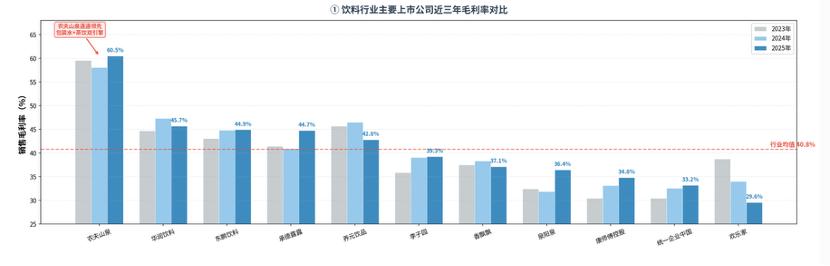
In the figure above, Nongfu Spring's bottled water ranks first with a gross profit margin of 60%, which is quite surprising. By conversion, a bottle of red-pack Nongfu Spring bottled water has a retail price of 2 yuan, an ex-factory price of only 0.67 yuan, and a production cost of only 0.23 yuan. The retail price is about 3 times the ex-factory price, and the channel link takes away about 1.33 yuan.
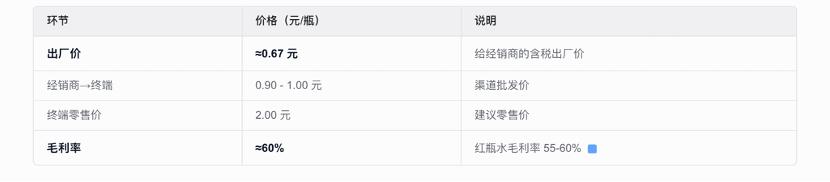
Judging only from the profit margin, Nongfu Spring indeed belongs to the category of "excess profit". The gross profit margin of China Resources Beverage in the above figure is only around 45%.
Why does a bottle of water generate such a high premium from canning to the consumer end? After multi-party research, we finally found the reason: channel control.
In the construction of its distribution system, Nongfu Spring successively learned the "joint sales body" model and the "in-depth distribution" model, but failed to stick to them for various reasons. It finally established the "large distributor system" in 2016 to realize manufacturer-distributor collaboration.
This is a middle path that takes into account the vitality of distributors and brand control. The reform has two core points:
Regional integration: Only one distributor is retained in each prefecture-level city, county-level distributors are cancelled, and all markets are assigned to this "large prefecture-level distributor".
Personnel integration: The front-line sales staff of the enterprise are assigned to the distributor's team and managed uniformly by the distributor.
The adjustment of the distribution system finally gave Nongfu Spring the leverage to dominate the market: By the end of 2023, Nongfu Spring had about 5,000 distributors, covering more than 3 million terminal retail outlets across China. (The current terminal coverage should be more than 4 million), which allows Nongfu Spring to penetrate into every capillary of urban and rural streets across the country, making it a veritable national-level brand.
After explaining the theory, let's look at the specific methods. How did Nongfu Spring distribute its products to more than 3 to 4 million terminal retail stores across the country? In addition to the normal distribution of supermarkets and convenience stores, both Nongfu Spring and Wahaha have found the same secret weapon: freezers in small stores.
In simple terms, Nongfu Spring (or Wahaha) gives freezers to family-run small stores (including convenience stores and restaurants) for free, on the condition that the freezers only store the company's own products (or give priority to the company's products). The latter can get the freezer for free, saving a large sum of money, and of course they are willing to cooperate.
But we need to note that essentially, Nongfu Spring and Wahaha have controlled millions of terminal channels by giving away freezers, making it very difficult for other products to enter these small stores. If you pay attention, you can often see a convenience store with Wahaha's freezer on the left and Nongfu Spring's on the right, and the two companies have essentially completed the control of channels.
At this time, consumers do not have much choice, and can only pay for the bottled water that has been marked up layer by layer.
After controlling the channels, on the one hand, the products can obtain channel premium capability, and on the other hand, a series of subsequent products can enter the freezers, which improves the success rate of product R&D. Taking Nongfu Spring as an example, its tea beverage business has been thriving in recent years, and the freezer channel is the top contributor, such as the success of Oriental Leaf.
Then why are these two companies so wary of e-commerce? Is it just because of the low prices on e-commerce platforms?
Let's focus on the "disrupts the price system" mentioned by Zong Qinghou. What he cares most about is not the low price itself, but the "decision-maker" status of beverage companies in the entire distribution system, that is, their absolute pricing power in the terminal market. A bottle of water, from ex-factory to being sold to consumers, has gone through many turnovers, but both Wahaha and Nongfu Spring are the absolute center of the entire chain, and distributors have relatively weak pricing power (if the price is chaotic, the manufacturer will take back the freezer, which is not worth the loss for retailers).
The situation is different after the emergence of e-commerce, especially the instant retail. If the cost of a bottle of water for terminal retailers is 0.9-1 yuan, in the past it could only be sold offline through freezers, now terminal distributors can completely set the price of the product between 1.5-2 yuan, sell a large number of products at low prices online, and still obtain sufficient profits.
At this time, the absolute central position of Nongfu Spring and Wahaha is diluted. The official no longer has absolute pricing power over the products, and they begin to vent their grievances on the platforms. But the fundamental contradiction at this time is the competition for pricing power between the group and its distributors.
Nongfu Spring has always emphasized the red line that the proportion of e-commerce sales must not exceed 5%, but in reality, distributors have sufficient motivation to challenge this red line.
It is Better to Turn to Learn from Coca-Cola
After briefly sorting out the sales model, how should we view this phenomenon?
Wahaha and Nongfu Spring have actually enjoyed the high gross profit margin (close to excess profit) brought by the traditional model, but throughout the commercial history, there is almost no business model that can work for all scenarios. The development trend of e-commerce is irreversible, and enterprises certainly need to adjust their business models.
In other words, the fact that Nongfu Spring can sell a bottle of water for 2 yuan is not supported by the so-called brand premium, but the result of "channel control". Once the channel control is diluted, not only will the price of bottled water fall below 2 yuan, but also other series of products will decline accordingly. Channel control is one of the core pillars of Nongfu Spring's high gross profit margin and terminal advantages. This is also the main reason why the business model still works even though the channel cost is too high.
In contrast, Coca-Cola does not have such concerns, and it even actively embraces platforms. It previously invested in Indian food delivery platform Zomato and food delivery startup Thrive, and its bottler Swire Coca-Cola has also built a private domain membership system with more than 50 million members.
Coca-Cola also relies on bottlers, freezers and terminal execution, and will face channel conflicts, but its brand power and systematic capabilities make it more resilient to channel fluctuations, and its price system is relatively more stable.
The most fundamental difference between the two sides is that the 60% high gross profit margin of the former comes from channel control, while that of the latter comes from brand premium. Coca-Cola's strong brand power endows its products with value that is valid both online and offline. In contrast, the pricing of Wahaha and Nongfu Spring relies on channel control. Once the channel is loosened, the price system may loosen. Enterprises need to think about whether this 60% gross profit margin conforms to the value of the products.
Of course, Coca-Cola will also launch online-exclusive products or special packaging to maintain the uniqueness of channels, but its attitude is to actively embrace the trend.
After the analysis, on the one hand, we can indeed understand Zhong Shanshan's resentment towards platforms, but on the other hand, we hope Nongfu Spring can re-examine the relationship between value, price and channels. Since the trend is irreversible, it is better to take the initiative to innovate.
This article is from the WeChat official account "Critical Thinking Investment Research", written by Tong Zhibin, published with authorization from 36Kr.