Changxin Technology has a profit margin as high as 82%, ranking first.
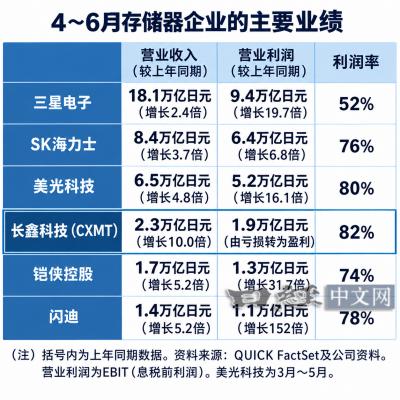
Nikkei compared the financial reports of Samsung Electronics, SK Hynix, Micron Technology (March-May), Kioxia Holdings, SanDisk and Changxin Technology (April-June), finding that Changxin's profit margin has exceeded the semiconductor business of SK and Samsung...
In the storage chip segment where demand for artificial intelligence (AI) is surging, Chinese enterprises are rapidly catching up with their rivals. Changxin Technology Group (CXMT), which went public in July, posted an operating profit margin as high as 82% from April to June, the highest among all major players. It is reshaping the landscape of the storage chip market that was previously dominated by South Korean, American and Japanese enterprises for most of the global market share.
Nikkei compared the financial reports of South Korea's Samsung Electronics, SK Hynix, US-based Micron Technology (March-May), Kioxia Holdings, US-based SanDisk and Changxin Technology (April-June). Based on data from QUICK FactSet and corporate disclosures, the analysis was conducted using EBIT (Earnings Before Interest and Taxes), which is equivalent to operating profit.
Changxin Technology is engaged in DRAM for short-term storage, with clients including Chinese tech giants such as Alibaba Group, ByteDance and Tencent Holdings. Its operating profit surged to approximately 1.9 trillion yen when converted to Japanese yen, compared with a loss of about 29 billion yen in the same period last year.
Although its profit level lags behind South Korean enterprises and Micron, it has surpassed Kioxia and SanDisk, which focus on NAND flash memory for long-term storage. Its operating revenue reached 10 times that of the previous corresponding period at about 2.3 trillion yen, the fastest growth rate among the six companies.
What is notable is its extremely high profit margin, which has exceeded SK (76%) and Samsung's semiconductor business (70%).
SK, Samsung and Micron are focusing on developing High Bandwidth Memory (HBM) manufactured by stacking DRAM. High-performance HBM is critical for AI servers.
Changxin Technology's main products include general-purpose DRAM "DDR5" which is widely used in consumer products such as personal computers and game consoles in addition to data centers.
As SK and Samsung prioritize supplying products to AI servers, the supply for general products such as computers has decreased, leading to a sharp rise in DDR5 prices. Changxin Technology is the biggest beneficiary from this trend.
There are also differences in contract forms between HBM and DDR5. HBM usually adopts annual supply agreements with large-scale cloud service providers, so it is not easily affected by short-term market fluctuations. In contrast, DDR5 is more vulnerable to market sentiment fluctuations, with its transaction price rising sharply.
Taiwan-based research firm Trend Force pointed out that "since the January-March period, the profitability of HBM has begun to fall below that of DDR5".
With the improvement of profitability, Changxin Technology's investment capacity is also growing. From January to June, its free cash flow (FCF, net cash income and expenditure), which is the sum of operating cash flow (CF) and investment activity cash flow (CF), reached about 2.2 trillion yen, an improvement of about 2.8 trillion yen compared with the same period last year.
Changxin Technology will actively expand its production capacity as it raises funds through initial public offering (IPO) and obtains government support.
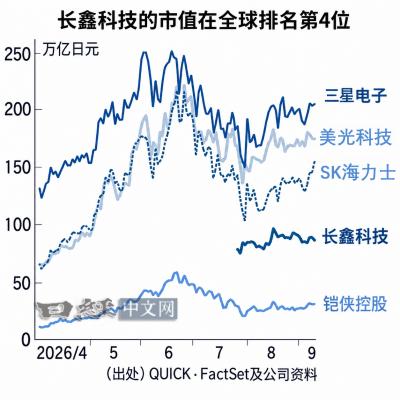
According to data from QUICK FactSet, Changxin Technology's total market capitalization excluding its own shares has reached 87 trillion yen, surpassing Tencent to become the company with the highest market value in the Chinese market. Its market value is nearly three times that of Kioxia (31 trillion yen).
As the performance of storage chip enterprises is affected by market conditions and profits are difficult to stabilize, the expected price-to-earnings ratio (PER) of the industry usually hardly rises. The P/E ratios of SK, Samsung and Kioxia all remain at single-digit levels, while Changxin Technology's P/E ratio is close to 20 times, reflecting investors' high expectations for its growth.
Previously, China's manufacturing industry expanded its market share through general-purpose products with relatively low prices and continuously improved its competitiveness. In the automotive battery field where Japanese and South Korean enterprises held advantages, Contemporary Amperex Technology (CATL) has jumped to the top of global market share. In addition, enterprises with global influence have also emerged in the home appliance and smartphone sectors.
Among Chinese storage chip enterprises, YMTC's parent company Changjiang Storage Holdings (CCSH) has also submitted an IPO application, and will become a competitor of Kioxia which focuses on NAND.
Once Chinese manufacturers increase production capacity and launch low-price offensives, they may become a factor disrupting the market and rewrite the existing market power landscape.
This article is from the WeChat Official Account "Nikkei Chinese" (ID: rijingzhongwenwang), authored by Nikkei Chinese, and authorized for release by 36Kr.