Starting from 9.9 yuan, with more than 200 rotating dishes and monthly revenue reaching millions, has a new fast food model emerged?
How does the all-day all-you-can-eat model work?
A 200-plus-square-meter fast food restaurant in the southern part of Beijing often sees long queues forming half an hour before meal times.
At 6 a.m., the 9.9-yuan breakfast buffet starts serving; at 11 a.m., the store switches to a 19.9-yuan stir-fry buffet; after 5 p.m., the 49.9-yuan barbecue buffet takes over. The same store, with three sets of products and three price points, covers all three daily meals, and can generate a monthly turnover of over one million yuan!
In the current fiercely competitive rice fast food track, is this all-day all-you-can-eat model for breakfast, lunch and dinner a new solution?
Fast food restaurant adopts all-day all-you-can-eat model, generating monthly revenue exceeding 1 million yuan
According to Red-C Restaurant Network, this fast food brand called "Fan Xiaoman" currently has 4 outlets in Beijing and Tianjin in total. The Beijing outlet opened in 2025, let's take a close look at its single-store model:
1. All-day all-you-can-eat, mainly located around communities and commercial districts
The most prominent feature of Fan Xiaoman is "all-day buffet", splitting the store's business hours into three business units, setting relatively high-frequency products for each time period, focusing on different needs, to meet consumers' consumption demands in different time slots, catering to both rigid daily meal needs and small casual gatherings.
To this end, the store has designed three completely different sets of products and prices. It starts serving breakfast at 6 a.m., switches to lunch market at 11 a.m., and enters the dinner market after 5 p.m. The three time periods adopt different buffet prices and operation modes: the breakfast buffet offers common breakfast items at 9.9 yuan; the lunch buffet provides stir-fried dishes at 19.9 yuan to solve consumers' lunch dilemma; the dinner buffet focuses on the demand for small social gatherings, offering barbecue at 49.9 yuan.
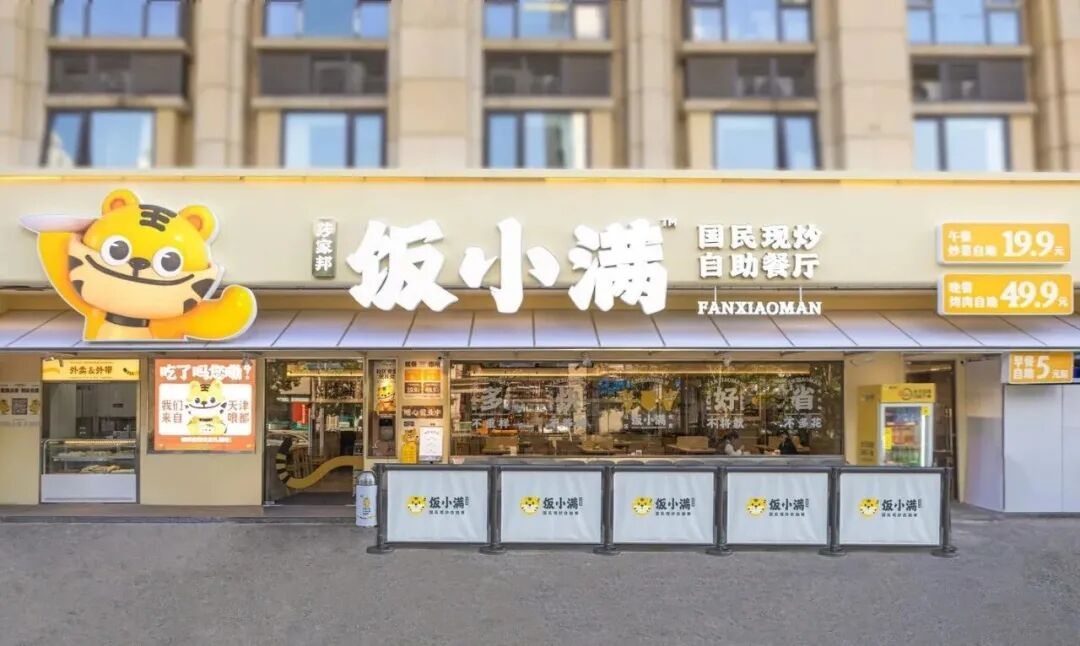
△ Image source: Official account of Fan Xiaoman
At present, Fan Xiaoman's outlets are mainly located in communities, such as areas near Guoyuan of Dahongmen Sub-district and Anhuibeili of Asian Games Village in Beijing, as well as communities on Jinbin Avenue and Lanzhou Road of Heping District in Tianjin.
The rent in such areas is relatively lower than that in core commercial districts, but there is a large permanent population and high repurchase rate. This site selection idea also matches Fan Xiaoman's all-day operation model well.
2. Over 200 dishes in rotation, updated regularly every week/every half month to maintain freshness
The store builds a product pool around different consumption demands. At present, there are more than 200 products in total, all dishes are arranged by number to facilitate consumers to pick up their meals quickly.
Breakfast has more than 30 dishes such as wonton, sugar fried dough sticks, leek boxes, pan-fried dumplings and spicy soup, which mainly meet the daily breakfast needs of nearby residents.
During the lunch period, in addition to common Chinese fast food such as stir-fries, cold dishes and spicy hot pot, there are also large meat dishes such as Peking duck, sea bass, big bone in soup and braised pork. For 19.9 yuan, you can choose from 40 to 50 dishes at will, which can make you full and eat well, with a strong sense of value.
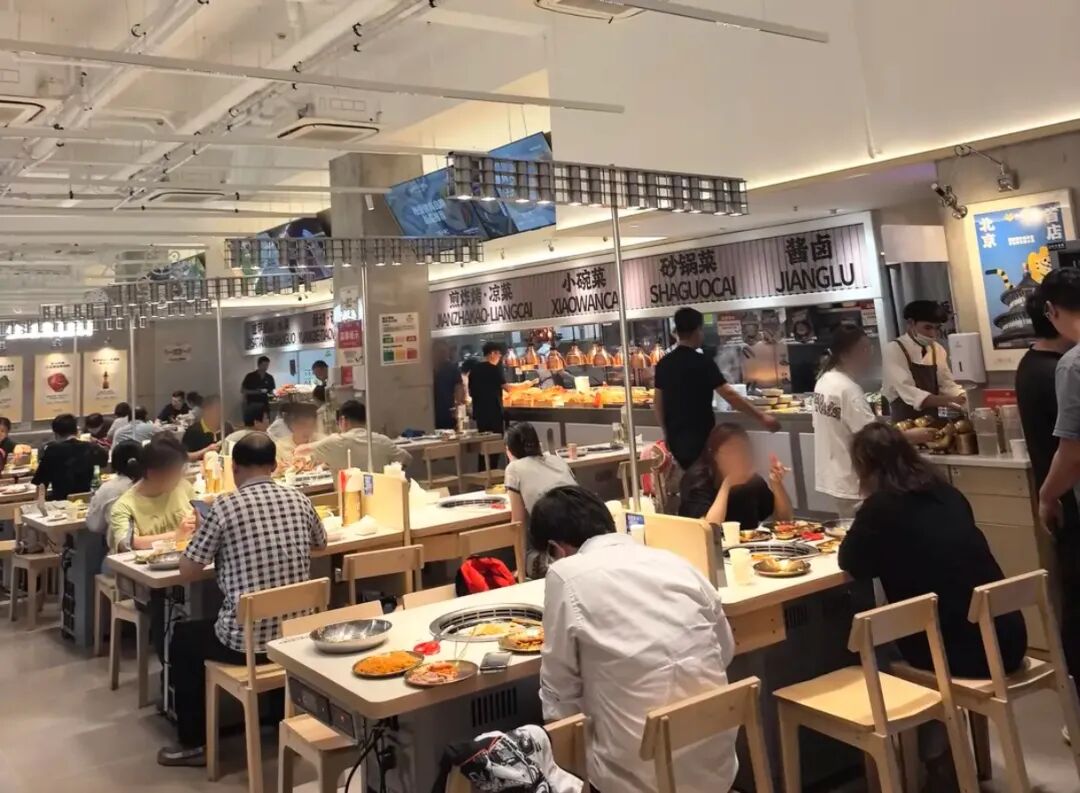
△ Image source: Fan Xiaoman's Dianping store page
The main dishes for dinner are barbecue, marinated snacks, barbecued pork, roast duck, casserole and so on. At the same time, fried chicken, pizza, ice cream and unlimited drinks are added, and the consumption scenario also shifts from rigid meal demand on workdays to small gatherings with friends.
According to public information, the store adjusts individual dishes slightly every week, and adjusts product categories every half month. Consumers can choose freely within the fixed price, and the store maintains freshness in different consumption periods by constantly adjusting dishes.
3. Open kitchen, with clear labels for "freshly cooked on site" and "pre-made"
The store divides the dishes into three categories: freshly made on site, semi-prepared, and pre-made, and publicizes them with signs of different colors. Consumers can not only see "what dishes are available", but also clearly know "how this dish is made".
For freshly cooked products, the store is equipped with an open kitchen, where consumers can see the production process of some dishes through the open display window.
For a fast food restaurant focusing on the all-you-can-eat model, this practice not only strengthens the perception of freshly made food, but also increases the transparency of product information.
Turn "the business of one meal" into "the business of the whole day"
For the industry, what is really worth paying attention to about Fan Xiaoman's all-day all-you-can-eat model is that it turns rice fast food from "the business of one meal" into "the whole-day business of one store".
For a long time, the core passenger flow of rice fast food is concentrated in the lunch market, the dinner market has serious diversion, and the periods such as breakfast and afternoon are obviously idle. In the past two years, more and more brands such as Laoxiangji, Mr. Rice, Nanchengxiang and Xiaonv Dangjia have begun to adjust their operation modes: adding freshly cooked dishes, trying weighing-based self-selection, expanding breakfast and dinner services, and even covering more consumption scenarios through different store models.
The common logic behind this is: the competition in the lunch market is too fierce, it is getting harder and harder to make profits, and everyone has to find incremental business beyond a single meal.
The all-day all-you-can-eat model similar to Fan Xiaoman also emerged under such a background. On the basis of extending business hours, it combines the currently popular buffet model, reintegrating "cost-effectiveness" and "store efficiency".
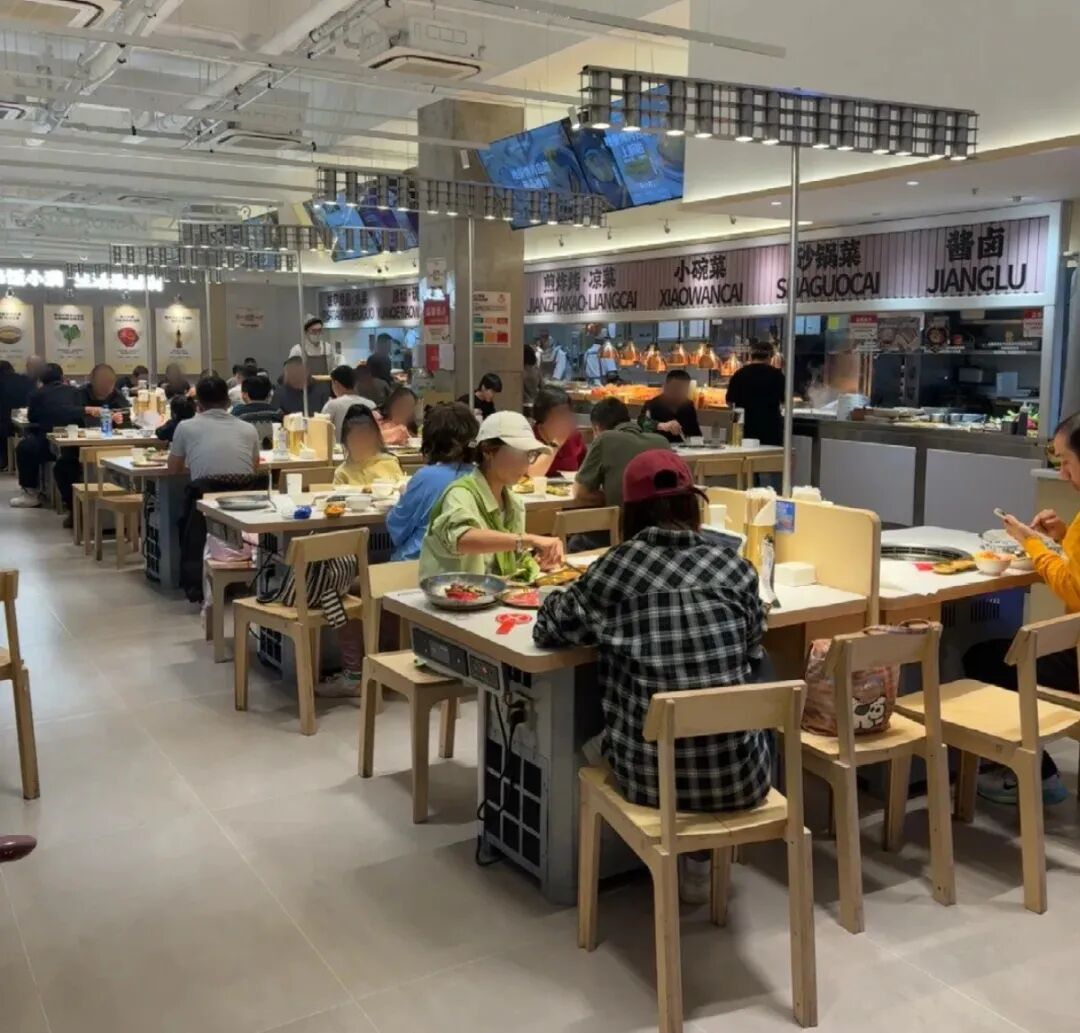
△ Image source: Fan Xiaoman's Dianping store page
For consumers, this model takes into account both "cost-effectiveness" and "richness", offering more choices than fixed set meals, and compared with weighing-based self-selection, it eliminates the calculation of "how much to take and how much to pay", making decision-making easier.
For stores, by changing operation strategies according to high-frequency demands in different time periods, using "low price + rich choices" to improve consumption appeal, it can break the "dependence on lunch market", expand customer groups and consumption scenarios, and improve the store's time utilization rate and the upper limit of per-square-meter revenue.
From this perspective, this seems to be a win-win model for both consumers and stores, but the reality may not be so ideal.
Low price + buffet, the hardest part is to break even
The all-day all-you-can-eat model can expand business scope, but at the same time it also amplifies the complexity of store operation.
The buffet model is regarded by the industry as the "PLUS version of self-selection", with product richness and cost-effectiveness multiplied on the basis of the self-selection model. Correspondingly, the challenges also multiply: waste leads to increased loss, and low customer unit price combined with high cost makes the profit threshold extremely high.
Under the model of Fan Xiaoman, the same store has to constantly switch operation systems, and breakfast, lunch and dinner correspond to different ingredients, different personnel and different equipment demands. The requirements for supply chain, cost control, on-site scheduling, service and other capabilities are significantly higher than those of ordinary fast food. Taking daily stock preparation as an example, if you prepare too little, consumers will feel "not enough to eat"; if you prepare too much, unsold food will become loss.
More critically, this model has higher requirements for passenger flow density. Its basic profit formula can be summarized as: low customer unit price × high passenger flow × high store utilization rate. All three conditions are indispensable.
Yin Lu, the founder of Fan Xiaoman, once revealed that the overall gross profit margin of Fan Xiaoman's stores is about 40%-42%, and it is a small profit but quick turnover business, so the requirements for site selection are very high, especially for community-based stores. Only when there is a sufficiently stable population around, and passenger flow can be continuously generated at breakfast, lunch and dinner, can the pressure brought by low customer unit price be diluted.
If the passenger flow is sufficient, the low customer unit price can dilute the fixed cost by scale; if the passenger flow is insufficient in a certain period, the products, personnel and equipment added for all-day operation will become a burden.
This is also the thought-provoking part of this model — how to continuously turn "doing business all day long" into "making profits all day long", and turn "high utilization rate" into stable profits.
This article is from WeChat official account "Red-C Restaurant Network", author: Red-C Editorial Department, published with authorization from 36Kr.