Wall Street is fully convinced: the Federal Reserve will raise interest rates this week.
Investors are on high alert to brace for this week's Federal Reserve interest rate meeting. The market widely expects the Fed to raise interest rates again, a move that is likely to pose new threats to the global financial markets that have already shown vulnerability to rising bond yields.
For years, the U.S. inflation rate has remained stubbornly above the Fed's 2% target, and interest rate hikes have long been the core regulatory tool used by the central bank in history to stabilize prices.
After newly appointed Fed Chair Kevin Warsh delivered a speech widely interpreted as hawkish last month, market bets that the Fed will announce a rate hike this month have continued to rise. Even so, given that the Fed has kept interest rates unchanged throughout 2026, some investors were still skeptical earlier about whether the Fed would really take this step.
All the suspense over the rate hike was finally completely resolved after the release of the red-hot inflation report last week. Data released by the U.S. Department of Labor last Friday showed that the U.S. core Consumer Price Index (CPI), which excludes volatile food and energy components, rose 0.3% month-on-month in August, exceeding expectations. Interest rate futures prices reflect that the market currently believes the probability of the Fed raising the overnight rate target range by 25 basis points this week is as high as 90%. Before the release of the CPI report, this probability was about 70%.
What is even more dramatic than the change in interest rate pricing is undoubtedly the speed at which Wall Street investment banks revised their reports.
According to Nick Timiraos, the renowned journalist known as the "new Fed wire service", almost all Fed watchers who did not previously expect a September rate hike changed their forecasts after the August CPI data came in slightly higher than expected.
Among the 20 major investment bank institutions counted by Timiraos, as many as 17 currently expect the Fed to raise interest rates this month. In addition, for the magnitude of interest rate changes in the remaining three meetings of the year, most industry institutions also expect the Fed to raise interest rates two to three times...
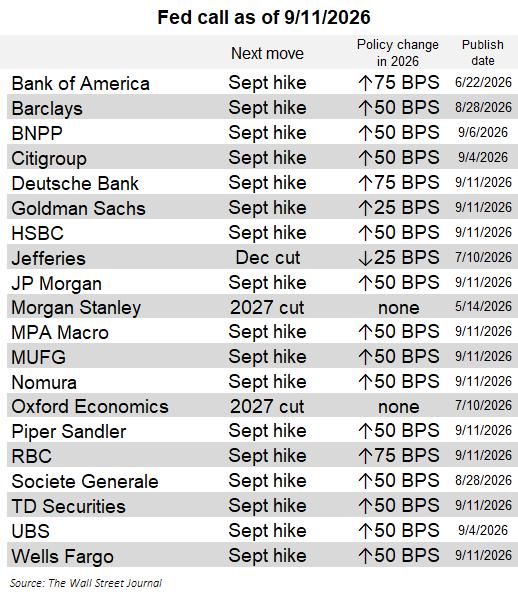
(New version of forecast)
It should be noted that just last Thursday, in the above table counted by Timiraos, investment banks that expected the Fed to keep interest rates unchanged for the whole year once occupied about half of the total.
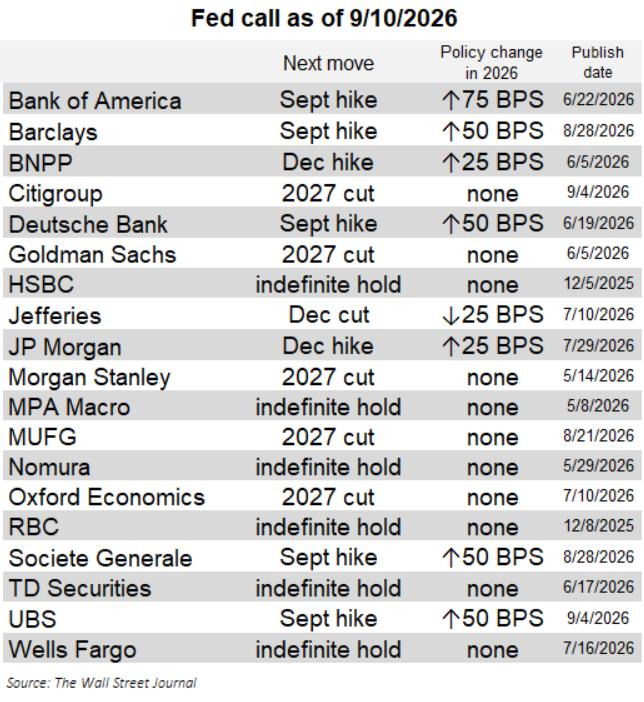
(Old version of forecast from last Thursday)
Among them, Goldman Sachs gave up its original expectation of "no rate hike" in September last Friday. Goldman Sachs pointed out, "We now expect a 25-basis-point rate hike at the September FOMC meeting next week (previously expected to keep interest rates unchanged). Further rate hikes may follow at subsequent meetings — this is not our base case... We believe that with the market having priced in a nearly 90% probability of a rate hike, the FOMC will want to avoid the market reaction that may be triggered by keeping interest rates on hold."
Alicia Levine, Chief Investment Officer of BNY Wealth, also said, "The market is now widely expecting a rate hike in September."
Another highly notable institution is Citigroup — the firm previously expected the Fed to cut interest rates three times this year. But Citi Research's latest forecast last Friday is that the Fed will raise interest rates by 25 basis points to the 3.75%-4% range at this week's FOMC meeting, and the bank characterizes this action as a "dovish rate hike". Given that there has been one rate hike in September, Citi expects the median of this year's interest rate dot plot will show one additional rate hike for the rest of the year — that is, two in total, but many officials may no longer expect further rate hikes after September.
New Suspense: Will the Fed Open the Door to Consecutive Rate Hikes?
In fact, as the financial market is convinced that the Fed will raise interest rates this week, two new questions naturally arise: How high will the Fed's interest rate rise? Will more tightening monetary policy cause any volatility in the financial market?
Nick Timiraos, the "new Fed wire service", said investors have almost assumed that the Fed will raise interest rates for the first time in three years this week. But the more difficult question to answer is: What happens next? The Fed rarely acts blindly before officials are convinced that "a single rate hike is not enough".
Timiraos cited former Fed Vice Chairman Richard Clarida, who now works at Pimco, as saying, "If the Fed raises interest rates in September, there will inevitably be more rate hikes afterwards."
According to statistics, since the Fed established the federal funds rate as the core tool for regulating borrowing costs in the 1990s, the Fed has only carried out one "one-and-done" rate hike in 1997. Clarida predicted that the possible rate hike action by the Fed in September "will by no means stop after just one move".
Josh Hirt, senior U.S. economist at Vanguard Group, even said that forecasting three rate hikes is a "pretty reasonable starting point" for thinking about the Fed's future moves. He said in an interview that the possible magnitude of rate hikes ranges from one to six times.
Ian Lyngen, head of U.S. interest rate strategy at BMO Capital Markets, pointed out that he expects after a 25-basis-point rate hike this month, the Fed will carry out rate hikes of the same magnitude at the October and December meetings respectively — which will effectively overturn the 2025 rate cut plan promoted by former Fed Chair Jerome Powell, and push the Fed's benchmark interest rate to the range of 4.25% to 4.5%.
As for the consequences of this more tightening monetary policy, Derek Tang, policy economist at Monetary Policy Analytics, said two aspects of the potential vulnerability of financial markets are obvious: first, the optimism driving the artificial intelligence spending cycle, and second, the private credit held by the insurance industry.
"I think people should pay more attention to these aspects," Tang said.
Some investors said that rate hikes and rising U.S. Treasury yields may create ripple effects under the surface of the market. Interest rate-sensitive sectors may face greater pressure, such as small-cap stocks that tend to rely more on debt financing.
Of course, as mentioned above, there is also a historical exception to the view that "one rate hike by the Fed will trigger multiple rate hikes": in 1997, after the Fed raised interest rates once, it kept interest rates unchanged until it cut interest rates 18 months later.
In any case, the Fed has a tool that may help guide expectations this week. Fed officials submit forecasts for economic growth, unemployment, inflation and interest rate trends four times a year. The most famous interest rate dot plot forecast — which Warsh refused to participate in when he attended the meeting for the first time in June — can reveal how many rate hikes the Federal Open Market Committee expects.
Dean Maki, chief economist of hedge fund Point72 Asset Management, said that the signals released by these Fed officials' forecasts "will be stronger than usual at ordinary times".
This article is from the WeChat official account "CLS", author: Xiao Xiang, published with authorization from 36Kr.