Mecka AI, which hires people to film the scene of itself making coffee, has been given a valuation of 500 million US dollars by HSG.
Place your iPhone on the kitchen counter, put on haptic gloves, attach several sensors to your arm, then start making coffee. After shooting and uploading the video, Mecka AI will pay you.
The company's collection points are not located in laboratories, but scattered in kitchens, workshops and chemical laboratories around the world. All workers are ordinary people, and there is not a single robotics engineer on site.
Headquartered in New York, Mecka AI was registered and established in 2024, and did not emerge from stealth mode until August 2025. On September 11, 2026, TechCrunch reported that it is close to completing a new round of financing led by HSG, with a valuation of about 500 million US dollars. The amount has not been disclosed, the terms have not been finally finalized, and neither the company nor HSG has responded.
They do not make robots, nor do they train models. They record the process of people working in real environments and process it into data that robots can learn from.
01 Four People With No Robotics Background
Among the founding team, Josh Gao and Mogen Cheng are Canadian, and they sold the food and beverage payment company they co-founded in 2023. Jason Chong's cryptocurrency exchange was acquired by Coinbase, and he joined Coinbase afterwards. Duy Nguyen is the only non-Canadian in the four, who made millions of US dollars by reselling limited-edition sneakers in the early years and now manages operations.
None of the four people have ever worked on robots.

Founders of Mecka AI
Chong's previous company was called Utopia Labs, which specialized in building on-chain payment infrastructure and was acquired by Coinbase at the end of 2024. Kindred Ventures led its seed round, and three years later Kindred invested in Mecka again.
Gao said that the four had discussed starting another fintech company, but finally decided to see where the computing power would flow next, and landed on the data infrastructure for robots.
In the following months, they read papers, visited robotics laboratories, and sent private messages to robotics researchers on social media.
The mainstream approach at that time was teleoperation, where people used controllers to remotely control robots to complete tasks, repeating thousands of times to let the policy model learn from these trajectories.
The four came to the opposite conclusion: directly use the records of people working for training.
"Almost no one believed this could work at that time." Gao said.
In August 2025, it secured an $8 million seed round led by Neo; in November 2025, a $25 million Series A; in early 2026, a $35 million top-up, both of which were not announced at the time. On June 1, 2026, Fortune first reported that Mecka disclosed the latter two rounds together as approximately $60 million, led by Framework Ventures, with participation from Menlo Ventures, SV Angel, Kindred Ventures and angel investor Ted Xiao... Vance Spencer, co-founder of Framework, told Fortune: "This is the fastest growing company we have ever invested in."
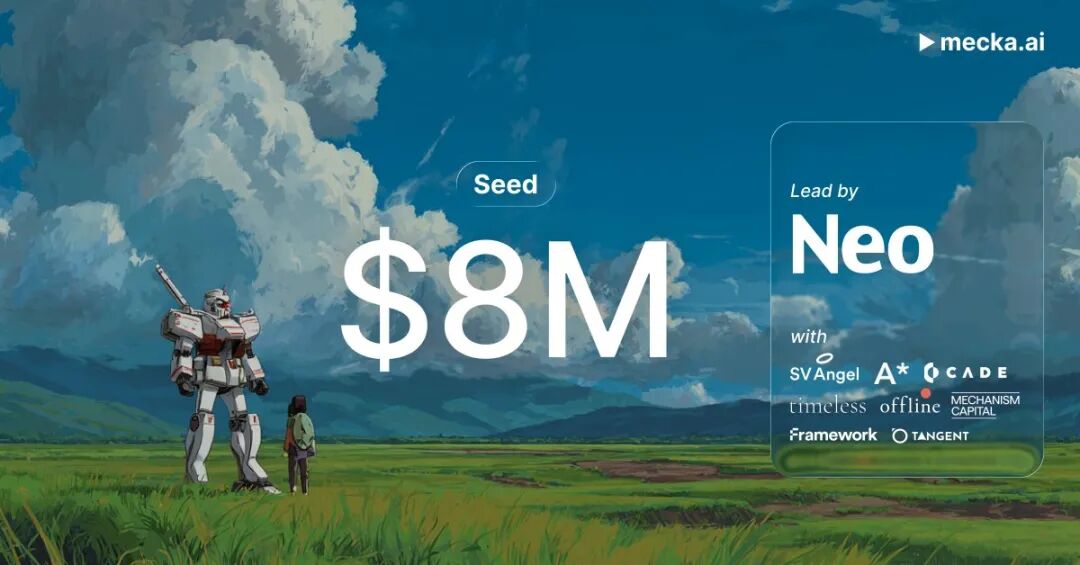
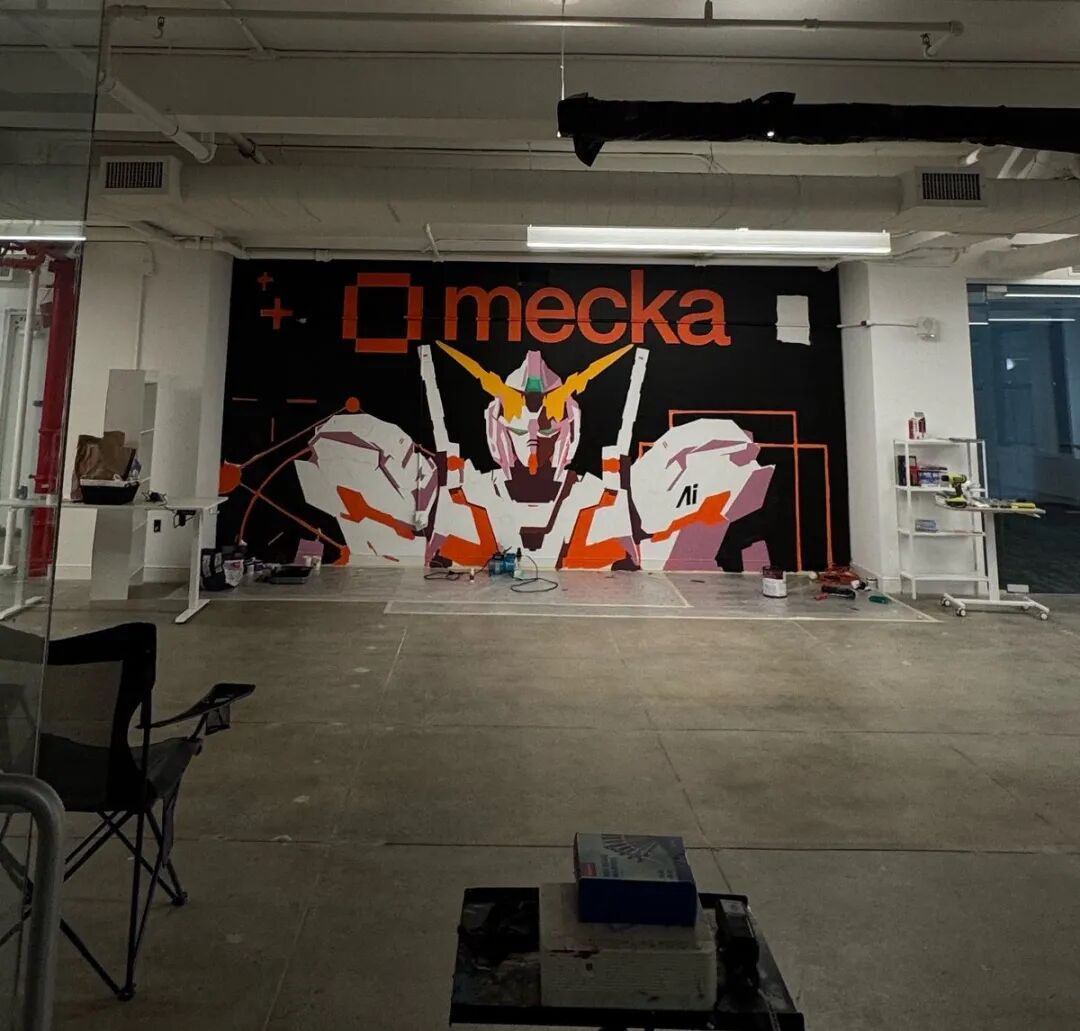
The company name Mecka is derived from "mecha", which refers to the giant human-piloted robots in science fiction works.
02 Pay People to Film Themselves Working
Mecka pays ordinary people to wear self-developed body sensors and haptic gloves, and film themselves working with their mobile phones. The mobile phones are mainly iPhones, and Mecka uses their built-in depth and inertial sensors as a set of distributed recording devices.
The footage captured by the camera is only one of the signals. A complete set of data also includes wrist pose, finger joint movements, contact events and grip strength, gaze points, and IMU data that records full-body dynamics. These channels must be aligned to the millisecond level. Once the vision and haptics drift in time, the policy model that is learning force-controlled contact will learn wrong information.
All the collected materials are finally aggregated into a library called Egoverse. Mecka claims that its scale exceeds 30,000 hours, the largest number among similar datasets.
The company has an in-house video understanding laboratory, which is responsible for supplementing hand keypoints, 3D reconstruction and action annotation.
The most difficult step in this technology is retargeting.
The kinematics of human hands are different from those of robot end effectors, so actions need to be mapped to joint limits, workspace and gripper morphology. Once this step is completed, Mecka can inherit the long-tail data that is unaffordable for teleoperation. The clutter of workshops, real lighting, and recovery actions after errors are all included.
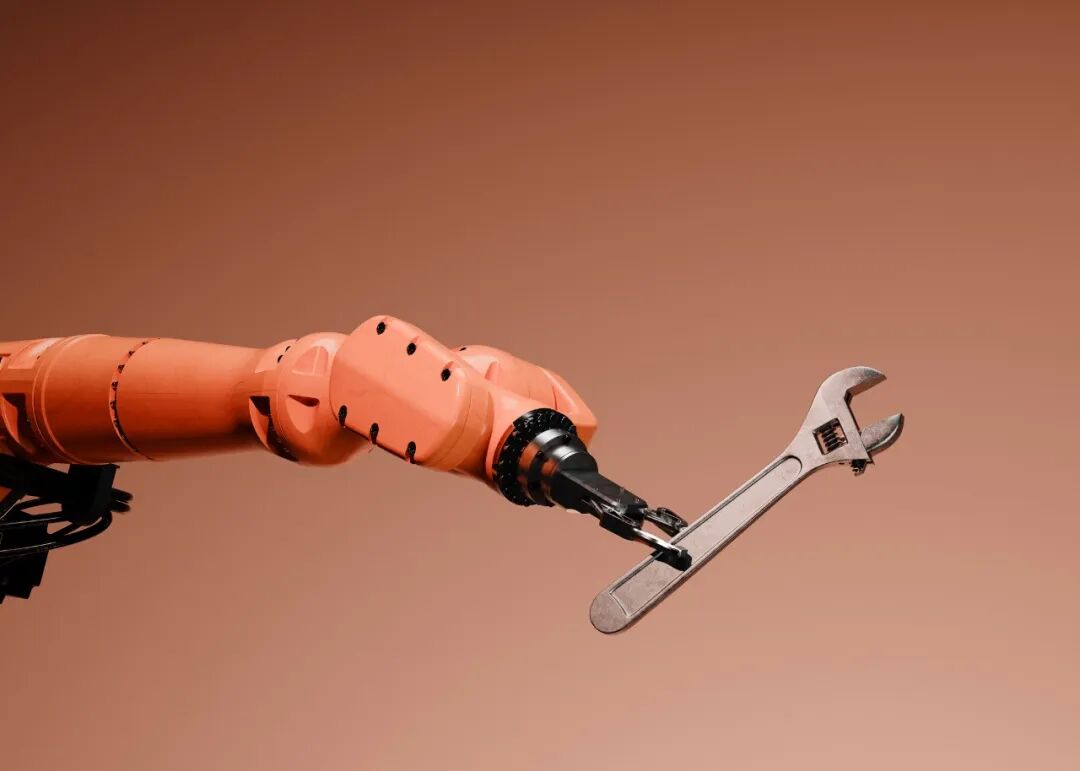
Humans have no force feedback on their bodies, nor can they read joint torque. A video of screwing a screw can tell the robot what the action looks like, but cannot tell it how many Newton meters of force are used.
But retargeting itself is lossy, because human joints and tendons do not match those of robots. Those who dismiss this approach believe that the robot force sensing data collected by teleoperation is more directly usable, and Mecka's solution cannot cross the threshold of physical contact.
Mecka is also one of the participants in the academic project EgoVerse, alongside Stanford University, ETH Zurich, and Meta Reality Labs. The academic EgoVerse is different from the company's proprietary Egoverse, and the latter is the product sold externally. The publicly announced duration of the academic project is inconsistent, the paper says 1362 hours, the official website says 4003 hours, and the number of collected segments ranges from 80,000 to 440,000.
03 Data Collected With Customer Funds Can Be Reused
Steve Jang from Kindred broke down Mecka's business in the investment announcement.
Customer projects include license terms that allow Mecka to use the collected data for its own products. Customers pay to support the recorder network, and help Mecka accumulate real-world annotation capabilities at the same time.
In Jang's words, Mecka is "building its own moat while getting paid".
The other part of the business starts only after the robots are put into factories, including installation, calibration, monitoring and on-site maintenance. This set of facilities is naturally independent of robot bodies and models.
Gao wants to put Mecka on the front line to help enterprises integrate and train models. He says that usable robots can be deployed today, right now.
Jang explained why the two businesses are placed in one company: a pure data company would need to build channels from scratch in the future, while a pure deployment company has no action data available for fine-tuning. Each part reduces the cost of the other.
On the revenue side, when it was disclosed in June 2026, Mecka said that based on signed contracts, the annual recurring revenue run rate is about 100 million US dollars, and the company had about 40 employees at that time.
It has not disclosed the names of most of its customers. The only verifiable paying customer so far is the humanoid robot company 1X Technologies.
The names listed alongside Stanford and ETH Zurich on the official website belong to academic partners of the open source research consortium, and do not constitute enterprise orders.
The $100 million figure is unaudited, and the company has not disclosed how much of it is stable subscription revenue and how much comes from one-off data projects.
Also in the same track, XDOF was founded by Philipp Wu and Fred Shentu from the University of California, Berkeley. The two previously developed the low-cost teleoperation system GELLO. The company is negotiating a Series B round led by 8VC, with a valuation of about 1.2 billion US dollars, annualized revenue of about 50 million US dollars, and around 20 customers.
Skild AI completed a large financing earlier, raising 1.4 billion US dollars in 2025 with a valuation of over 14 billion US dollars.
A more practical threat comes from customers themselves. Tesla, Figure, and 1X are all building internal data collection teams. Once vertical integration is completed, the room for independent data suppliers will be compressed.
04 The Difference in "Money" for Data Collection Between China and Abroad
For data collection itself, "how to collect" has become the key for various players to tell their stories.
In the article "Figure Launches a Global 'Data Collection Economy' With One App, Which Chinese Embodied Enterprise Will Be the First to Follow?", TideAI introduced the US robotics giant's approach to embodied data.
Figure officially renamed the data collection APP it tested for four months to Index and launched it globally. Users record first-person perspective videos of themselves folding clothes, washing dishes, and mopping the floor, and get paid after the upload is approved. In four months, Index covered 108 countries and regions, accumulated 16 million videos, Figure paid 15 million US dollars to creators, and promised to invest more than 1 billion US dollars in data and computing power in the next 12 months.
It can be seen that whether it is the US startup Mecka or the leading company Figure, both are adopting a paid crowdsourcing model to expand their embodied databases. Figure paying 15 million US dollars to creators is a clear transaction; Mecka pays recorders and venues, and includes the cost in the project budget.
But in China, the attitudes and strategies of players of different identities are completely different when it comes to the "paid" model.
In the article "JD Cloud Goes All in on Physical AI: Collecting Embodied Data With Domestic Helpers?", TideAI analyzed the approach of internet player JD Cloud. It plans to collect more than 10 million hours of real-scene video data within two years, mobilizing 100,000 internal employees and up to 500,000 external personnel from various industries to participate.
At the World Robot Conference in August, JD Cloud demonstrated what its collection solution looks like: domestic workers wear the self-developed JoyEgoCam head-mounted device, which weighs about 220 grams, has a built-in inference unit and vehicle-grade IMU, and records upper limb trajectories, force distribution and human-robot interaction parameters while doing housework.
In March 2026, JD announced the construction of the world's largest embodied intelligence data collection center in Suqian, Jiangsu. On May 20, the first national embodied intelligence data collection community officially went into operation, covering an area of about 4,000 square meters.
From the current perspective, is JD's data collection cost covered by the user's domestic service fee? Users pay for domestic helpers to work at home, while the data generated by the helpers' work is taken away by JD. Under the background of stricter enforcement of the Personal Information Protection Law and the Data Security Law, this kind of collection embedded in services has greater compliance uncertainty.
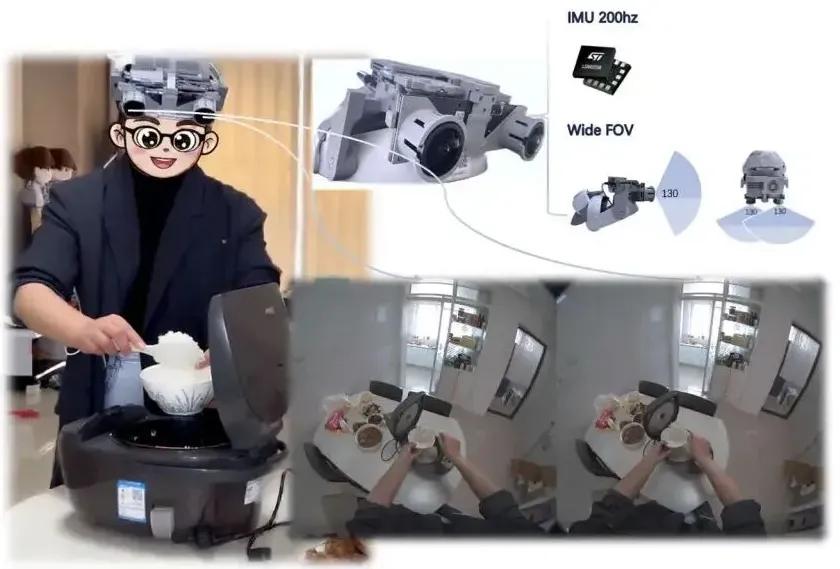
JD JoyEgoCam Data Collection
Then look at another path taken by leading domestic embodied players.
Realbotix built a data collection factory of about 2000 square meters; Unitree open sourced the UnifoLM-WBT dataset, which contains 1.89 million operation records in 340 hours; UBTECH's RoboMIND covers 279 tasks... Most of these data are collected by collectors wearing motion capture devices in self-built venues, and are open sourced to the public after collection, with no payment to ordinary people.
The domestic self-built route amortizes the cost in venue rent and equipment depreciation.
They are all collecting data from people, and the difference between these companies lies in the cost side.
05 TideAI's Viewpoint
Putting Figure, Mecka AI and JD Cloud together, the crowdsourcing data collection business has three different faces.
Figure pays for data with clear transactions; Mecka turns collection into outsourcing and sells data customized according to customer specifications; JD embeds data collection into domestic services, so the data generated by domestic helpers' work becomes training assets at the same time.
The difference comes down to two questions: who pays, and who benefits.
The current wave of entering the embodied data track in China adopts the approach of building factories, buying robots, and recruiting collectors first. The advantage is that data quality is controllable, but the cost is that every bit of growth requires corresponding investment in venues and manpower. Mecka has no factories, it splits data collection into a crowdsourcing network plus self-developed sensors, the scale grows with the number of people, hiring ordinary people and using their own mobile phones.
Mecka can reuse the data collected with customer funds in its own products, and every project revenue continuously enriches the same asset. Most domestic data collection companies sell project deliverables, and the same capability is quoted repeatedly to different customers, which is difficult to turn into reusable assets.
The uncertainties are equally obvious.
The $100 million annualized run rate is calculated based on signed contracts and is unaudited; the $500 million valuation comes from media reports, the terms have not been finalized, and Mecka is not yet on HSG's public portfolio list. Its real bet is on a technical link: whether human actions can be stably transferred to robot bodies. If this step cannot be achieved, what it sells is just a batch of videos labeled with hand keypoints.
The biggest problem is that data from different companies are not compatible with each other, and Mecka adds a new variable to this problem: its recorder network is distributed across countries, and the data collected is naturally cross-lingual and cross-living-scenario.
If the crowdsourcing route really takes off in China, the first thing to discuss is the data specification, and the number of hours of data to be collected comes second.
* References
1. TechCrunch Mecka AI nears $500M valuation in Sequoia-led deal amid rush for robot training data
2. Fortune